PUBLISHER: Mordor Intelligence | PRODUCT CODE: 2125599

PUBLISHER: Mordor Intelligence | PRODUCT CODE: 2125599
India Software Services Export - Market Share Analysis, Industry Trends & Statistics, Growth Forecasts (2026 - 2031)
According to Mordor Intelligence, the India software services export market size is expected to grow from USD 158.19 billion in 2025 to USD 165.32 billion in 2026 and is forecast to reach USD 206.15 billion by 2031 at 4.51% CAGR over 2026-2031.
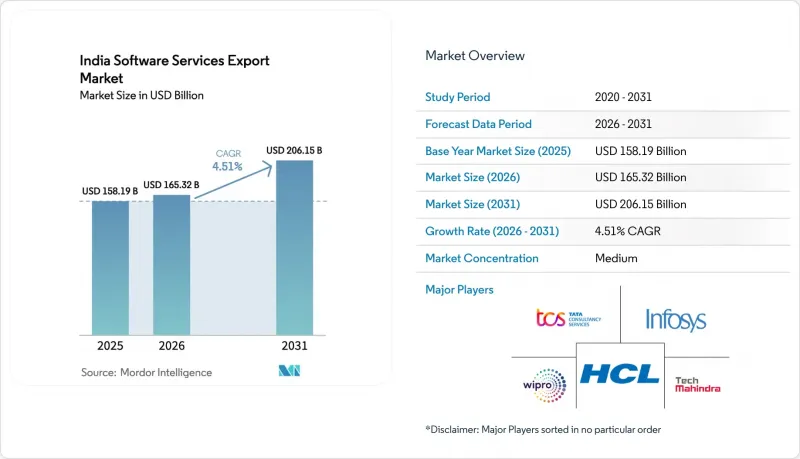
This report is Segmented by Activity (IT Services, Software Product Development, and More), Service Delivery Model (On-Site, Near-Shore, Offshore, and More), Client Industry (Banking and Financial Services, Retail and Consumer, and More), Client Size (Large Enterprises and Small and Medium Enterprises), and by Export Destination. The Market Forecasts are Provided in Terms of Value (USD).
India Software Services Export Market Trends and Insights
Rising Global Demand for Cost-Efficient Digital-Transformation Services
Enterprise technology spending is rising 11.2% to almost USD 160 billion in 2025, and Indian vendors deliver complex transformations at 40-60% lower cost than on-shore teams. Buyers now seek strategic capability building rather than simple cost-cutting, which lets Indian firms price premium specialty work such as cybersecurity and data analytics. Multi-year engagements improve revenue visibility, while measured ROI proofs Tata CLiQ lifted conversions by 11.3% after implementing personalization, encouraging repeat outsourcing. Mid-tier suppliers benefit most because they combine domain depth with leaner overheads that global consultancies cannot easily match. Altogether, this driver adds an estimated 1.2 percentage-points to the forecast CAGR of the India software services export market.
Expansion of Cloud-Migration and Managed-Services Contracts
Strategic alliances with AWS, Azure, and Google Cloud let Indian providers capture migration fees plus 3-to-5-year managed-services annuities. HCLTech's exclusive global services pact for Nuance customers underpins this shift toward cloud-native recurring revenue. Skills in containerization, micro-services, and DevOps accelerate, and certification pipelines scale across tier-II cities, broadening the talent base. The operational-expenditure model resonates with mid-market buyers, expanding the total addressable pool for Indian exporters.
Intensifying Competition from Vietnam, Philippines and CEE
Vietnamese hourly rates of USD 1,000-3,500 undercut India's USD 800-4,200 brackets, while attrition stays near 10-15% versus higher churn in Bengaluru and Hyderabad. Central and Eastern Europe lure EU clients needing cultural proximity, eroding India's hold on commoditized services. To protect share, Indian vendors must double-down on IP creation and high-complexity consulting, or risk margin squeeze.
Other drivers and restraints analyzed in the detailed report include:
- Government Incentives Bolstering IT Exports
- Accelerated AI/ML Adoption by BFSI and Retail Clients
- Talent Attrition and Wage Inflation in Tier-I Indian Cities
For complete list of drivers and restraints, kindly check the Table Of Contents.
Segment Analysis
IT services accounted for 58.72% of the India software services export market in 2025, reflecting historical reliance on application management and infrastructure support. However, software product development is growing fastest at 5.71% CAGR, signaling a turn toward IP-led revenue models. Product studios in Bengaluru and Hyderabad now prototype fintech, health-tech, and ed-tech platforms that compete globally. Product teams now integrate design thinking, domain SMEs, and agile governance, creating sticky client relationships that transcend typical T&M billing.
Offshore centers still deliver 63.78% of the India software services export market size, underscoring India's deep labor pool and resilient digital infrastructure. Yet GCCs are expanding at 6.03% CAGR as multinationals set up captive hubs for R&D, data science, and product engineering. India hosts 1,580 GCCs today and may reach 2,400 by 2030, representing over USD 100 billion in service throughput.
This evolution blurs outsourcing boundaries: service providers now co-innovate with in-house teams or compete head-to-head for AI architects, cloud engineers, and product managers. The India software services export market benefits from ecosystem spillovers start-ups, academia, and government labs collaborate inside smart-city tech parks that accelerate time-to-solution.
Complete Report Scope:
- By Activity
- IT Services
- Software Product Development
- Business Process Services (BPO)
- Others
- By Service Delivery Model
- On-site
- Near-shore
- Offshore
- Captive / Global Capability Centres (GCCs)
- By Client Industry
- Banking and Financial Services
- Retail and Consumer
- Healthcare and Life Sciences
- Manufacturing
- Telecom and Media
- Others
- By Client Size
- Large Enterprises
- Small and Medium Enterprises
- By Export Destination
- North America
- Europe
- Asia-Pacific
- Middle East
- South America
- Africa
List of Companies Covered in this Report:
- Tata Consultancy Services (TCS)
- Infosys
- Wipro
- HCL Technologies
- Tech Mahindra
- Cognizant Technology Solutions
- LTIMindtree
- Mphasis
- Oracle
- Microsoft
- IBM
- Accenture
- Deloitte
- PwC
- Capgemini
- Genpact
- Persistent Systems
- Hexaware Technologies
- Zensar Technologies
- LandT Technology Services
Additional Benefits:
- The market estimate (ME) sheet in Excel format
- 3 months of analyst support
TABLE OF CONTENTS
1 INTRODUCTION
- 1.1 Study Assumptions and Market Definition
- 1.2 Scope of the Study
2 RESEARCH METHODOLOGY
3 EXECUTIVE SUMMARY
4 MARKET LANDSCAPE
- 4.1 Market Overview
- 4.2 Market Drivers
- 4.2.1 Rising global demand for cost-efficient digital transformation services
- 4.2.2 Expansion of cloud migration and managed services contracts
- 4.2.3 Government incentives (SEZ, tax holidays, PLI) bolstering IT exports
- 4.2.4 Accelerated AI/ML adoption by BFSI and retail clients
- 4.2.5 Japan mid-tier firms' near-shore preference for India
- 4.2.6 ESG-linked "green software engineering" outsourcing surge
- 4.3 Market Restraints
- 4.3.1 Intensifying competition from Vietnam, Philippines and CEE
- 4.3.2 Talent attrition and wage inflation in Tier-I Indian cities
- 4.3.3 Cross-border data-residency and localisation mandates
- 4.3.4 INR volatility-driven currency-hedging costs
- 4.4 Supply-Chain Analysis
- 4.5 Regulatory Landscape
- 4.6 Technological Outlook
- 4.7 Porter's Five Force Analysis
- 4.7.1 Threat of New Entrants
- 4.7.2 Bargaining Power of Buyers
- 4.7.3 Bargaining Power of Suppliers
- 4.7.4 Threat of Substitutes
- 4.7.5 Competitive Rivalry
- 4.8 Assesment of Macroeconomic Factors on the Market
5 MARKET SIZE AND GROWTH FORECASTS (VALUE)
- 5.1 By Activity
- 5.1.1 IT Services
- 5.1.2 Software Product Development
- 5.1.3 Business Process Services (BPO)
- 5.1.4 Others
- 5.2 By Service Delivery Model
- 5.2.1 On-site
- 5.2.2 Near-shore
- 5.2.3 Offshore
- 5.2.4 Captive / Global Capability Centres (GCCs)
- 5.3 By Client Industry
- 5.3.1 Banking and Financial Services
- 5.3.2 Retail and Consumer
- 5.3.3 Healthcare and Life Sciences
- 5.3.4 Manufacturing
- 5.3.5 Telecom and Media
- 5.3.6 Others
- 5.4 By Client Size
- 5.4.1 Large Enterprises
- 5.4.2 Small and Medium Enterprises
- 5.5 By Export Destination
- 5.5.1 North America
- 5.5.2 Europe
- 5.5.3 Asia-Pacific
- 5.5.4 Middle East
- 5.5.5 South America
- 5.5.6 Africa
6 COMPETITIVE LANDSCAPE
- 6.1 Market Concentration
- 6.2 Strategic Moves
- 6.3 Market Share Analysis
- 6.4 Company Profiles (includes Global level Overview, Market level overview, Core Segments, Financials as available, Strategic Information, Market Rank/Share for key companies, Products and Services, and Recent Developments)
- 6.4.1 Tata Consultancy Services (TCS)
- 6.4.2 Infosys
- 6.4.3 Wipro
- 6.4.4 HCL Technologies
- 6.4.5 Tech Mahindra
- 6.4.6 Cognizant Technology Solutions
- 6.4.7 LTIMindtree
- 6.4.8 Mphasis
- 6.4.9 Oracle
- 6.4.10 Microsoft
- 6.4.11 IBM
- 6.4.12 Accenture
- 6.4.13 Deloitte
- 6.4.14 PwC
- 6.4.15 Capgemini
- 6.4.16 Genpact
- 6.4.17 Persistent Systems
- 6.4.18 Hexaware Technologies
- 6.4.19 Zensar Technologies
- 6.4.20 LandT Technology Services
7 MARKET OPPORTUNITIES AND FUTURE OUTLOOK
- 7.1 White-space and Unmet-Need Assessment

