PUBLISHER: Mordor Intelligence | PRODUCT CODE: 2100586

PUBLISHER: Mordor Intelligence | PRODUCT CODE: 2100586
Smart Water Management - Market Share Analysis, Industry Trends & Statistics, Growth Forecasts (2026 - 2031)
According to Mordor Intelligence, the smart water management market size stands at USD 20.74 billion in 2026 and is projected to reach USD 37.43 billion in 2031, delivering a 12.54% CAGR through the forecast period.
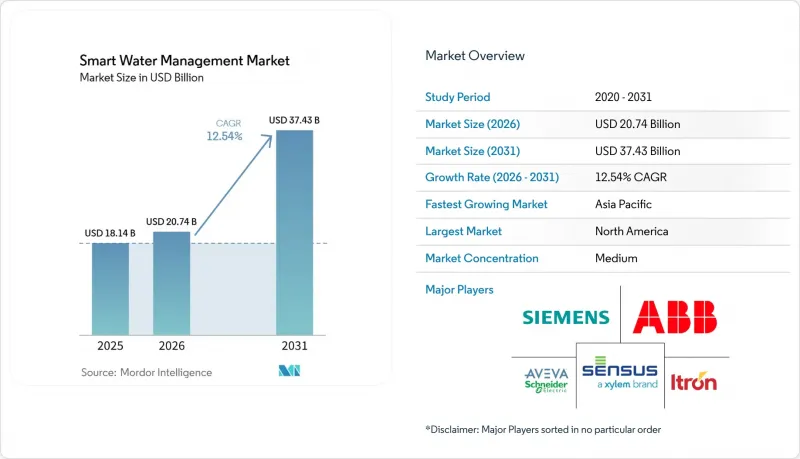
This report is Segmented by Component (Solutions, and Services), End User (Residential, Commercial, and Industrial and Public Utilities), Communication Technology (Cellular, LPWAN, and More), Application (Water Pipeline Monitoring and Leak Detection, Pipeline Monitoring, and More), and Geography (North America, South America, Europe, and More). The Market Forecasts are Provided in Terms of Value (USD).
Global Smart Water Management Market Trends and Insights
Growing Need to Manage Rising Global Water Demand
Urban expansion and industrial development place mounting stress on finite freshwater reserves, prompting utilities to maximize existing infrastructure rather than invest in new supply. India's Jal Jeevan Mission, which aims to provide piped water to 146 million rural households, relies on remote monitoring to maintain service-level targets for its dispersed assets. The United Arab Emirates mandates the use of smart meters to enforce quotas across agricultural and residential accounts as desalination dependence increases. Singapore's NEWater program, which now meets 40% of the nation's demand, integrates real-time quality sensors and analytics to optimize blending ratios, illustrating how scarcity accelerates digital adoption. Drought episodes in the western United States and southern Europe further prompt regulators to become champions of consumption visibility, solidifying a long-term 2.8-percentage-point increase in the smart water management market.
Rising Pressure to Curb Non-Revenue Water Losses
Average non-revenue water rates run 30-50% in many developing regions, draining utility cash flow and wasting energy tied to pumping and treatment. Herning, Denmark trimmed losses from 8.5% to 6% within a year after installing 18,000 NB-IoT meters, highlighting the payoff from continuous acoustic monitoring. SUEZ saved 33 million m3 in 2024 enough for 660,000 people through a global fleet of 7 million connected meters. California's regulator now ties allowed rate hikes to audited leak-reduction results, reinforcing investment urgency. The driver contributes a medium-term 3.1-percentage-point boost to growth.
Capital-Intensive Nature of Metering and Network Upgrades
Advanced metering infrastructure typically costs USD 200-400 per endpoint, stretching payback to 5-10 years. Many municipal utilities must first service debt or expand basic coverage, pushing digital projects into later budget cycles. Rate recovery often trails deployment, forcing up-front financing from retained earnings. Badger Meter noted that U.S. municipal budgets cluster orders late in fiscal years, underscoring episodic funding. While public-private contracts such as Landis+Gyr's 15-year deal with Denmark's TREFOR can shift risk to vendors, the restraint still subtracts 2.3 percentage points from CAGR during the medium term.
Other drivers and restraints analyzed in the detailed report include:
- Government Smart-City and Sustainability Mandates
- Rapid Adoption of LPWAN Connectivity
- Interoperability Gaps Across Legacy OT-IT Systems
For complete list of drivers and restraints, kindly check the Table Of Contents.
Segment Analysis
Services revenue in the smart water management market rose briskly and is projected to maintain a 14.81% CAGR to 2031, eclipsing the slower expansion in perpetual-license solutions. Managed offerings, which combine network monitoring, cybersecurity, and cloud hosting, appeal to midsize utilities that prefer predictable fees to new head-count commitments. Professional services covering integration and regulatory compliance are likewise expanding as project scope widens. Vendors are packaging end-to-end bundles, illustrated by the March 2025 Itron-Schneider Electric collaboration that merges metering hardware with edge-computing software into a turnkey deliverable.
Solution deployments still represented 46.28% of 2025 revenue and retain importance where asset ownership and onsite control remain strategic. Distribution-network monitoring platforms pull in real-time pressure and flow data, while asset-management modules support utilities pursuing ISO 55000 certification. Analytics solutions are the fastest-growing slice within solutions, tying machine-learning insights to capital-planning decisions in systems facing trillion-dollar deferred maintenance backlogs across North America. As margins migrate from hardware to software, suppliers are recalibrating portfolios toward subscription analytics and outcome-based contracts, a trend likely to keep narrowing the share gap between services and solutions through 2031.
Residential deployments are forecast to grow 15.23% annually, overtaking the historically dominant public-sector segment. California's 2024 rules compel individual residential metering, accelerating retrofits of millions of unmetered connections. Tiered tariffs require hourly or daily reads, driving LPWAN adoption. Connected home dashboards and leak-alert mobile apps, once optional, are becoming standard as utilities adopt customer engagement models drawn from power retail.
Public-sector users, which include municipal utilities and government facilities, held 41.83% of smart water management market size in 2025 by virtue of capital access and policy mandates. Nevertheless, constrained municipal budgets can slow refresh cycles. Commercial and industrial customers occupy a middle ground; sub-metering helps property owners allocate costs, while factories seek process-water optimization to mitigate production risk. Itron's 2025 move to buy Locusview underscores the appeal of pairing field-service management with network analytics for utility and industrial operators alike.
Complete Report Scope:
- By Component
- By Solution
- Enterprise Asset Management
- Distribution Network Monitoring
- Supervisory Control and Data Acquisition (SCADA)
- Meter Data Management
- Analytics
- Other Solutions
- By Services
- Professional Services
- Managed Services
- By Solution
- By End User
- Residential
- Commercial
- Industrial and Public Utilities
- By Communication Technology
- Cellular (2G/3G/4G/5G, NB-IoT)
- LPWAN (LoRaWAN, Sigfox)
- RF Mesh / Wi-SUN
- Satellite and Others
- By Application
- Water Pipeline Monitoring and Leak Detection
- Water Consumption and Distribution
- Irrigation Management
- Wastewater Monitoring
- Flood and Stormwater Management
- By Geography
- North America
- United States
- Canada
- Mexico
- South America
- Brazil
- Argentina
- Rest of South America
- Europe
- Germany
- United Kingdom
- France
- Italy
- Spain
- Russia
- Rest of Europe
- Asia Pacific
- China
- Japan
- South Korea
- India
- Australia
- New Zealand
- Rest of Asia Pacific
- Middle East
- United Arab Emirates
- Saudi Arabia
- Turkey
- Rest of Middle East
- Africa
- South Africa
- Nigeria
- Kenya
- Rest of Africa
- North America
Geography Analysis
North America retained 34.71% of the smart water management market share in 2025, sustained by robust U.S. regulatory frameworks that compel leak audits and cyber-hardening. Adoption is poised to continue, yet growth moderates as most tier-one utilities have already installed AMI networks. Federal infrastructure grants supplement local budgets, but incremental deployments increasingly focus on analytics overlays rather than meter rollouts.
Asia Pacific is on track for a 14.61% CAGR to 2031, reflecting large-scale digitization programs in China and India. China's Sponge Cities and 14th Five-Year Plan funnel capital into real-time runoff management and water conservation. India's Jal Jeevan Mission is deploying smart sensors throughout rural networks to maintain service levels across 146 million households. Southeast Asian nations, including Indonesia and Vietnam, are planning similar moves as urbanization accelerates and climate variability worsens.
Europe balances stringent environmental directives with aging infrastructure. Germany and France are upgrading meters to comply with the 2024 revision of the Water Framework Directive, while the United Kingdom's regulator ties allowable returns to demonstrated efficiency gains, spurring analytics adoption. South America and Africa trail in absolute spending but represent long-run upside. Brazilian concessionaires are trimming non-revenue water to unlock tariff hikes, and Gulf Cooperation Council states bundle desalination and distribution projects with utility-wide smart-meter targets under ambitious national visions.
- Xylem Inc. (incl. Sensus)
- Itron Inc.
- ABB Ltd.
- Siemens AG
- Schneider Electric SE (+AVEVA)
- Honeywell International Inc.
- IBM Corporation
- SUEZ Water Technologies and Solutions
- Badger Meter Inc.
- Landis+Gyr AG
- Kamstrup A/S
- Trimble Water
- Huawei Technologies Co. Ltd.
- Esri
- Evoqua Water Technologies
- Sebata Holdings Ltd.
- Hitachi Ltd.
- Arad Group
- TaKaDu Ltd.
- i2O Water Ltd.
- Veolia Environnement S.A.
- Cisco Systems Inc.
Additional Benefits:
- The market estimate (ME) sheet in Excel format
- 3 months of analyst support
TABLE OF CONTENTS
1 INTRODUCTION
- 1.1 Study Assumptions and Market Definition
- 1.2 Scope of the Study
2 RESEARCH METHODOLOGY
3 EXECUTIVE SUMMARY
4 MARKET LANDSCAPE
- 4.1 Market Overview
- 4.2 Market Drivers
- 4.2.1 Growing Need to Manage Rising Global Water Demand
- 4.2.2 Rising Pressure to Curb Non-Revenue Water Losses
- 4.2.3 Government Smart-City and Sustainability Mandates
- 4.2.4 Rapid Adoption of LPWAN Connectivity (LoRaWAN, NB-IoT)
- 4.2.5 Digital-Twin Platforms Enabling Predictive Pipe-Failure Modelling
- 4.2.6 AI-Driven Adaptive Pressure Control Cuts Energy Use (Under-the-Radar)
- 4.3 Market Restraints
- 4.3.1 Capital-Intensive Nature of Metering and Network Upgrades
- 4.3.2 Interoperability Gaps Across Legacy OT/IT Systems
- 4.3.3 Cyber-Security Vulnerabilities in Converged Water OT Networks
- 4.3.4 Tariff-Driven Cost Inflation for IoT Components Post-2025
- 4.4 Industry Value Chain Analysis
- 4.5 Regulatory Landscape
- 4.6 Technological Outlook
- 4.7 Porter's Five Forces Analysis
- 4.7.1 Threat of New Entrants
- 4.7.2 Bargaining Power of Suppliers
- 4.7.3 Bargaining Power of Buyers
- 4.7.4 Threat of Substitutes
- 4.7.5 Intensity of Competitive Rivalry
- 4.8 Impact of Macroeconomic Factors on the Market
5 MARKET SIZE AND GROWTH FORECASTS (VALUE)
- 5.1 By Component
- 5.1.1 By Solution
- 5.1.1.1 Enterprise Asset Management
- 5.1.1.2 Distribution Network Monitoring
- 5.1.1.3 Supervisory Control and Data Acquisition (SCADA)
- 5.1.1.4 Meter Data Management
- 5.1.1.5 Analytics
- 5.1.1.6 Other Solutions
- 5.1.2 By Services
- 5.1.2.1 Professional Services
- 5.1.2.2 Managed Services
- 5.1.1 By Solution
- 5.2 By End User
- 5.2.1 Residential
- 5.2.2 Commercial
- 5.2.3 Industrial and Public Utilities
- 5.3 By Communication Technology
- 5.3.1 Cellular (2G/3G/4G/5G, NB-IoT)
- 5.3.2 LPWAN (LoRaWAN, Sigfox)
- 5.3.3 RF Mesh / Wi-SUN
- 5.3.4 Satellite and Others
- 5.4 By Application
- 5.4.1 Water Pipeline Monitoring and Leak Detection
- 5.4.2 Water Consumption and Distribution
- 5.4.3 Irrigation Management
- 5.4.4 Wastewater Monitoring
- 5.4.5 Flood and Stormwater Management
- 5.5 By Geography
- 5.5.1 North America
- 5.5.1.1 United States
- 5.5.1.2 Canada
- 5.5.1.3 Mexico
- 5.5.2 South America
- 5.5.2.1 Brazil
- 5.5.2.2 Argentina
- 5.5.2.3 Rest of South America
- 5.5.3 Europe
- 5.5.3.1 Germany
- 5.5.3.2 United Kingdom
- 5.5.3.3 France
- 5.5.3.4 Italy
- 5.5.3.5 Spain
- 5.5.3.6 Russia
- 5.5.3.7 Rest of Europe
- 5.5.4 Asia Pacific
- 5.5.4.1 China
- 5.5.4.2 Japan
- 5.5.4.3 South Korea
- 5.5.4.4 India
- 5.5.4.5 Australia
- 5.5.4.6 New Zealand
- 5.5.4.7 Rest of Asia Pacific
- 5.5.5 Middle East
- 5.5.5.1 United Arab Emirates
- 5.5.5.2 Saudi Arabia
- 5.5.5.3 Turkey
- 5.5.5.4 Rest of Middle East
- 5.5.6 Africa
- 5.5.6.1 South Africa
- 5.5.6.2 Nigeria
- 5.5.6.3 Kenya
- 5.5.6.4 Rest of Africa
- 5.5.1 North America
6 COMPETITIVE LANDSCAPE
- 6.1 Market Concentration
- 6.2 Strategic Moves
- 6.3 Market Share Analysis
- 6.4 Company Profiles (includes Global Level Overview, Market Level Overview, Core Segments, Financials as Available, Strategic Information, Market Rank/Share for Key Companies, Products and Services, and Recent Developments)
- 6.4.1 Xylem Inc. (incl. Sensus)
- 6.4.2 Itron Inc.
- 6.4.3 ABB Ltd.
- 6.4.4 Siemens AG
- 6.4.5 Schneider Electric SE (+AVEVA)
- 6.4.6 Honeywell International Inc.
- 6.4.7 IBM Corporation
- 6.4.8 SUEZ Water Technologies and Solutions
- 6.4.9 Badger Meter Inc.
- 6.4.10 Landis+Gyr AG
- 6.4.11 Kamstrup A/S
- 6.4.12 Trimble Water
- 6.4.13 Huawei Technologies Co. Ltd.
- 6.4.14 Esri
- 6.4.15 Evoqua Water Technologies
- 6.4.16 Sebata Holdings Ltd.
- 6.4.17 Hitachi Ltd.
- 6.4.18 Arad Group
- 6.4.19 TaKaDu Ltd.
- 6.4.20 i2O Water Ltd.
- 6.4.21 Veolia Environnement S.A.
- 6.4.22 Cisco Systems Inc.
7 MARKET OPPORTUNITIES AND FUTURE OUTLOOK
- 7.1 White-Space and Unmet-Need Assessment

