PUBLISHER: Mordor Intelligence | PRODUCT CODE: 2100648

PUBLISHER: Mordor Intelligence | PRODUCT CODE: 2100648
Middle East and Africa Biofertilizers - Market Share Analysis, Industry Trends & Statistics, Growth Forecasts (2026 - 2031)
According to Mordor Intelligence, the Middle East and Africa biofertilizers market size was valued at USD 315.10 million in 2025 and estimated to grow from USD 343.90 million in 2026 to reach USD 542.70 million by 2031, at a CAGR of 9.55% during the forecast period (2026-2031).
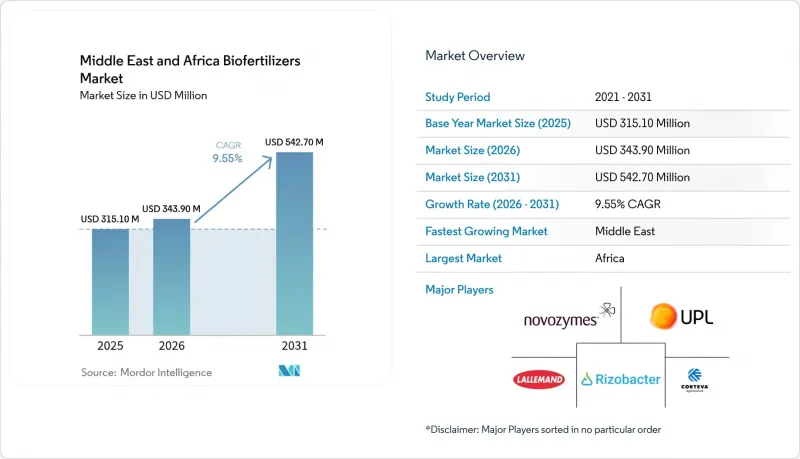
This report is Segmented by Microorganism Type (Rhizobium, Azospirillum, Azotobacter, Mycorrhiza, Phosphate Solubilizing Bacteria, and Other Microorganism Types), by Crop Type (Row Crops, Horticultural Crops and Cash Crops), and by Geography (Africa and the Middle East). The Market Forecasts are Provided in Terms of Value (USD) and Volume (Metric Tons).
Middle East and Africa Biofertilizers Market Trends and Insights
Rapid Expansion of Organically Certified Farmland
The "World of Organic Agriculture 2025" report states that certified organic farmland in Africa has reached 3.4 million hectares in 2023, recording a 24% increase in organic farmland. Certified organic acreage across key Middle East and Africa markets expanded between 2019 and 2024, with Egypt, Kenya, and South Africa leading adoption rates. This growth trajectory accelerates biofertilizer demand as organic certification standards mandate biological inputs over synthetic alternatives. The organic rule set prohibits most synthetic nutrients and has pushed grower cooperatives to adopt Rhizobium and Azospirillum inoculants for nitrogen and phosphorus management. Trade harmonization under the African Continental Free Trade Area is letting Kenyan suppliers reach North and West African buyers without duplicate registrations, further widening the addressable customer base. Morocco's Green Morocco Plan has allocated significant resources to organic transition support, creating regulatory frameworks that favor biological inputs and establish quality certification pathways. The enlarged distribution footprint directly lifts demand for biobased inputs within the Middle East and Africa biofertilizers market.
Government Subsidies and Preferential Import Duty Waivers for Bio Inputs
Government subsidy schemes across the region increasingly favor biological inputs, with Morocco's organic-input subsidy program reducing farmer adoption costs compared to unsubsidized synthetic alternatives. Saudi Arabia's Ministry of Environment, Water, and Agriculture has implemented targeted support for greenhouse operators adopting biological nutrient management systems, aligning with Vision 2030 sustainability objectives. These policy shifts reflect strategic recognition that biological inputs support food security goals while reducing import dependency. The UAE's National Food Security Strategy 2051 explicitly prioritizes local production technologies, including microbial inoculants for controlled environment agriculture. South Africa's regulatory framework under the Fertilizers, Farm Feeds, Agricultural Remedies and Stock Remedies Act provides clear pathways for biofertilizer registration. These fiscal incentives shrink the cost gap with subsidized urea and encourage first-time trials, accelerating penetration across the Middle East and Africa biofertilizers market.
Dominance of Heavily Subsidized Synthetic Fertilizers
National fertilizer subsidy programs in countries such as Nigeria and Egypt provide structural advantages to synthetic inputs, limiting the adoption of biological alternatives in price-sensitive market segments. In Nigeria, the fertilizer subsidy program, while aimed at enhancing food security, unintentionally restricts the use of biofertilizers by sustaining artificial price advantages for imported synthetic fertilizers. Similarly, Egypt enforces a controlled price for urea, which is significantly lower than the free-market price, creating a cost barrier for microbial alternatives. These pricing policies encourage farmers to favor fertilizers with quick nutrient release, despite stewardship programs promoting practices for improved soil health. However, the fiscal burden of maintaining these subsidy programs may present future opportunities for biological inputs, as governments explore cost-effective solutions to enhance agricultural productivity while alleviating budgetary pressures.
Other drivers and restraints analyzed in the detailed report include:
- Volatile Synthetic Fertilizer Prices Driving Input Substitution
- Boom in High Tech Greenhouse Acreage in Arid Economies
- Low Farmer Awareness and Weak Extension Networks
For complete list of drivers and restraints, kindly check the Table Of Contents.
Segment Analysis
Rhizobium inoculants captured 44.5% of the Middle East and Africa biofertilizers market share in 2025 and exhibited the fastest growing CAGR of 9.8% from 2026-2031, reflecting the dominance of chickpea, lentil, and soybean rotations in Kenya, Morocco, and South Africa. Phosphate-solubilizing bacteria are being sought by growers to unlock native phosphorus in soils facing high diammonium phosphate prices. Azospirillum and Azotobacter segments are expanding in cereal systems where nitrogen fixation can trim synthetic urea without yield losses. Mycorrhizal products are penetrating Gulf and North African horticulture because they improve water-use efficiency in saline soils.
Rhizobium seed treatments now dominate mechanized farms because coating lines ensure uniform coverage and rapid nodulation. Soil-applied granular blends remain popular among smallholders who broadcast microbes during land preparation, even though field performance varies with moisture. Bundled consortia that pair nitrogen fixers with phosphate solubilizers are gaining favor because they deliver multiple nutrients in one pass, lowering labor. The diversity of microbial modes of action broadens the customer base and supports steady volume growth for the Middle East and Africa biofertilizers market.
Complete Report Scope:
- By Microorganism Type
- Rhizobium
- Azotobacter
- Azospirillum
- Phosphate-solubilizing Bacteria
- Mycorrhiza
- Other Microorganisms
- By Crop Type
- Row Crops
- Horticultural Crops
- Cash Crops
- By Geography
- Africa
- South Africa
- Nigeria
- Egypt
- Rest of Africa
- Middle East
- Iran
- Saudi Arabia
- Rest of Middle East
- Africa
List of Companies Covered in this Report:
- Novonesis Group
- UPL Limited
- Lallemand Inc.
- Rizobacter Argentina S.A. (Bioceres Crop Solutions Corp.)
- FMC Corporation
- Koppert B.V.
- IPL Biologicals Limited
- Groundwork BioAg Ltd.
- Biobest Group N.V. (Floridienne)
- Biomax Technologies Pte. Ltd.
- Mapleton Agri Biotec Pty Ltd
- BASF SE
- Bayer AG
- Corteva Agriscience
Additional Benefits:
- The market estimate (ME) sheet in Excel format
- 3 months of analyst support
TABLE OF CONTENTS
1 Introduction
- 1.1 Study Assumptions and Market Definition
- 1.2 Scope of the Study
2 Research Methodology
3 Executive Summary
4 Market Landscape
- 4.1 Market Overview
- 4.2 Market Drivers
- 4.2.1 Rapid expansion of organically certified farmland
- 4.2.2 Government subsidies and preferential import-duty waivers for bio-inputs
- 4.2.3 Volatile synthetic fertilizer prices driving input substitution
- 4.2.4 Salinity-mitigation programs in Gulf soils
- 4.2.5 Boom in high-tech greenhouse acreage in arid economies
- 4.2.6 Carbon-credit pilots for soil microbiome projects
- 4.3 Market Restraints
- 4.3.1 Dominance of subsidized synthetic fertilizers
- 4.3.2 Low farmer awareness and weak extension networks
- 4.3.3 Counterfeit / low-quality inoculants from regulatory gaps
- 4.3.4 Cold-chain logistics hurdles for liquid formulations
- 4.4 Regulatory Landscape
- 4.5 Technological Outlook
- 4.6 Porter's Five Forces Analysis
- 4.6.1 Threat of New Entrants
- 4.6.2 Bargaining Power of Buyers
- 4.6.3 Bargaining Power of Suppliers
- 4.6.4 Threat of Substitutes
- 4.6.5 Intensity of Competitive Rivalry
5 Market Size and Growth Forecasts (Value and Volume)
- 5.1 By Microorganism Type
- 5.1.1 Rhizobium
- 5.1.2 Azotobacter
- 5.1.3 Azospirillum
- 5.1.4 Phosphate-solubilizing Bacteria
- 5.1.5 Mycorrhiza
- 5.1.6 Other Microorganisms
- 5.2 By Crop Type
- 5.2.1 Row Crops
- 5.2.2 Horticultural Crops
- 5.2.3 Cash Crops
- 5.3 By Geography
- 5.3.1 Africa
- 5.3.1.1 South Africa
- 5.3.1.2 Nigeria
- 5.3.1.3 Egypt
- 5.3.1.4 Rest of Africa
- 5.3.2 Middle East
- 5.3.2.1 Iran
- 5.3.2.2 Saudi Arabia
- 5.3.2.3 Rest of Middle East
- 5.3.1 Africa
6 Competitive Landscape
- 6.1 Market Concentration
- 6.2 Strategic Moves
- 6.3 Market Share Analysis
- 6.4 Company Profiles (Includes Global Level Overview, Market Level Overview, Core Segments, Financials as Available, Strategic Information, Market Rank/Share, Products and Services, Recent Developments)
- 6.4.1 Novonesis Group
- 6.4.2 UPL Limited
- 6.4.3 Lallemand Inc.
- 6.4.4 Rizobacter Argentina S.A. (Bioceres Crop Solutions Corp.)
- 6.4.5 FMC Corporation
- 6.4.6 Koppert B.V.
- 6.4.7 IPL Biologicals Limited
- 6.4.8 Groundwork BioAg Ltd.
- 6.4.9 Biobest Group N.V. (Floridienne)
- 6.4.10 Biomax Technologies Pte. Ltd.
- 6.4.11 Mapleton Agri Biotec Pty Ltd
- 6.4.12 BASF SE
- 6.4.13 Bayer AG
- 6.4.14 Corteva Agriscience
7 Market Opportunities and Future Outlook

