PUBLISHER: Mordor Intelligence | PRODUCT CODE: 2120415

PUBLISHER: Mordor Intelligence | PRODUCT CODE: 2120415
Biological Organic Fertilizer - Market Share Analysis, Industry Trends & Statistics, Growth Forecasts (2026 - 2031)
According to Mordor Intelligence, the biological organic fertilizer market size is projected to grow from USD 12.62 billion in 2025 to USD 13.79 billion in 2026 and is forecast to reach USD 20.81 billion by 2031 at an 8.58% CAGR over 2026-2031.
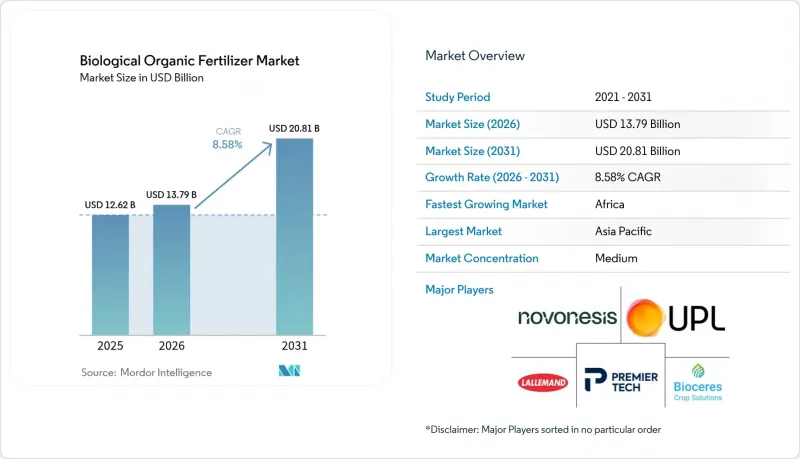
This report is Segmented by Type (Microorganism and Organic Residues), by Application (Grains and Cereals, Pulses and Oilseeds, Fruits and Vegetables, Commercial Crops, and Turf and Ornamentals), and by Geography (North America, Europe, Asia-Pacific, South America, The Middle East, and Africa). The Market Forecasts are Provided in Terms of Value (USD).
Global Biological Organic Fertilizer Market Trends and Insights
Federal Incentives for Regenerative Farming
Across major farming regions, government programs refund a large share of biological input costs, tilting the economic calculus in favor of microbial products. In December 2025, the United States Department of Agriculture (USDA) launched a USD 700 million Regenerative Pilot Program to promote practices that enhance soil health, water quality, and biodiversity. The funding is allocated through the Natural Resources Conservation Service (NRCS), with USD 400 million provided via the Environmental Quality Incentives Program (EQIP) and USD 300 million through the Conservation Stewardship Program (CSP). India encourages the use of biological fertilizers through subsidies provided under programs such as the Capital Investment Subsidy Scheme (CISS), which offers up to 100% assistance to government agencies and 25% assistance to private units for production. Farmers also benefit from financial support under the Paramparagat Krishi Vikas Yojana (PKVY) and receive incentives to reduce chemical fertilizer use through the PM-PRANAM initiative. Under the Common Agricultural Policy (CAP) 2023-2027, the European Union requires that at least 25% of the direct payments budget be dedicated to voluntary eco-schemes that support climate and environmentally sustainable practices. Together, these incentives shorten payback periods, making biological products economically attractive even in row-crop systems.
Escalating Restrictions on Synthetic Fertilizers
Regulators worldwide are capping allowable nitrogen and phosphorus loads, creating a durable pull for the biological organic fertilizer market. The European Union is implementing restrictions on synthetic fertilizers to achieve a reduction in nutrient losses of at least 50% by 2030, as part of the "Farm to Fork" strategy. This initiative also aims to reduce overall fertilizer use by 20%. New regulations (EU 2019/1009) aim to enhance environmental standards, encourage the use of organic alternatives, and limit the use of microplastics, including polymer coatings on fertilizers, beginning in 2026. China enforces restrictions on chemical fertilizer use through stringent registration requirements, bans on high-toxicity products, and a national directive aimed at achieving zero growth in usage to address environmental concerns. Even fertilizer majors are repositioning. Yara International ASA increased the share of its research budget dedicated to microbes. While enforcement intensity varies by region, progressive restrictions are visible across developed and emerging markets, anchoring a structural shift toward biological inputs.
Short Shelf Life in High-Temperature Climates
Microbial viability declines significantly when exposed to temperatures above 30 °C, limiting its use in tropical regions. The absence of adequate cold-chain infrastructure further intensifies this issue, as only a small proportion of rural distribution points in Africa are equipped with refrigeration facilities. This limitation results in a considerable percentage of product returns in countries with warmer climates, such as Nigeria and Kenya, during the hotter periods of the year. Although encapsulation provides some protection, it also significantly increases costs, creating financial challenges for smallholder farmers. Efforts to address this issue, such as the introduction of solar-powered village cold rooms in India, remain in the early stages, with the number of operational units still too limited to effectively reduce the risks associated with temperature sensitivity in these regions.
Other drivers and restraints analyzed in the detailed report include:
- Rapid Adoption of Microbial Consortia Blends
- Farmer-Led Data Cooperatives Unlocking Localized Soil Health Insights
- Low Farmer Awareness Outside Specialty Crops
For complete list of drivers and restraints, kindly check the Table Of Contents.
Segment Analysis
Microorganisms are the largest type, capturing 57.3% of the biological organic fertilizer market share in 2025 and are forecast to grow at a 10.5% CAGR through 2031, the highest among all categories. Rhizobium is anticipated to hold a significant share of the biological organic fertilizer market, as legume growers across regions such as North America and Asia increasingly adopt inoculants to reduce their reliance on synthetic nitrogen while maintaining crop productivity. Azospirillum is experiencing rapid growth, driven by its adoption in large-scale maize farming operations aiming to achieve similar reductions in nitrogen use. The use of phosphate-solubilizing bacteria and mycorrhizal fungi is also growing steadily, particularly in areas where phosphorus deficiency is prevalent or where the economic considerations of perennial crops make premium-priced solutions viable. This trend is especially notable in crops such as coffee, almonds, and avocados.
Organic residues accounted for the remaining share in 2025. Green manure leads this sub-segment but faces challenges in mechanized grain belts due to its labor-intensive nature. Fish and bone meals perform well in high-value vegetable systems, as their slow-release phosphorus complements tight irrigation schedules. Although region-specific subsidies support neem and castor oil cakes, scalability in export-oriented markets is limited by concerns over heavy-metal residues and inconsistent nutrient analysis. The adoption of organic residues is influenced by regional agricultural practices, availability of raw materials, and the cost-effectiveness of these inputs compared to synthetic alternatives. Efforts to improve nutrient consistency and address contamination concerns are critical for enhancing their adoption in global markets.
Complete Report Scope:
- By Type
- Microorganism
- Rhizobium
- Azotobacter
- Azospirillum
- Blue-green Algae
- Phosphate-Solubilizing Bacteria
- Mycorrhiza
- Other Microorganisms
- Organic Residues
- Green Manure
- Fish Meal
- Bone Meal
- Oil Cakes
- Others
- Microorganism
- By Application
- Grains and Cereals
- Pulses and Oilseeds
- Fruits and Vegetables
- Commercial Crops
- Turf and Ornamentals
- By Geography
- North America
- United States
- Canada
- Rest of North America
- Europe
- Germany
- United Kingdom
- France
- Spain
- Italy
- Russia
- Rest of Europe
- Asia-Pacific
- China
- India
- Japan
- Australia
- Rest of Asia-Pacific
- South America
- Brazil
- Argentina
- Rest of South America
- Middle East
- Saudi Arabia
- United Arab Emirates
- Rest of Middle East
- Africa
- South Africa
- Nigeria
- Rest of Africa
- North America
Geography Analysis
Asia-Pacific is the largest geography and commanded 42.5% of the biological organic fertilizer market share in 2025. India and China anchor growth via generous subsidy pools and mandatory nutrient-reduction directives. In India, the Indian Farmers Fertiliser Cooperative Limited (IFFCO) and Krishak Bharati Cooperative Limited (KRIBHCO) are prominent fertilizer cooperatives contributing to agricultural sustainability by supporting the domestic biological fertilizer market. They manufacture various eco-friendly products, including biofertilizers and compost, alongside their primary chemical fertilizer operations, securing local supply. China offers tax rebates to distributors that swap synthetic inventory for biologicals, accelerating channel penetration in Shandong and Henan provinces.
Africa records the fastest CAGR of 8.8% through 2031. Nigeria has allocated a significant budget for smallholder vouchers to support microbial products, with initial maize trials showing a notable increase in yields. In South Africa, collaborative funding for biological inputs in the Western Cape fruit-growing region has led to a significant reduction in synthetic nitrogen use. However, challenges such as gaps in cold-chain infrastructure and limitations in product shelf life continue to restrict the full potential of these initiatives. Despite these obstacles, donor-supported programs from organizations such as the United States Agency for International Development (USAID) and the Bill and Melinda Gates Foundation are steadily expanding the scope of pilot projects.
North America and Europe contributed significantly to the 2025 market revenue, with steady annual growth driven by reimbursement programs and strict nitrate regulations. In the United States, payments under the Conservation Stewardship Program led to a substantial annual increase in adoption among row-crop operators in the Midwest. Canada's Agricultural Clean Technology Program provided substantial funding to support the co-financing of on-farm bioreactors, resulting in a significant reduction in production costs. In Europe, countries such as Germany, France, and the Netherlands showed the fastest adoption rates due to stringent nitrogen limits, while Spain and Italy experienced slower adoption but still recorded notable growth in biological sales, supported by exports of citrus and olives.
- Novonesis Group
- Bioceres Crop Solutions Corp
- Lallemand, Inc.
- Premier Tech Ltd. (Gestion Bernard Belanger Ltee)
- Corteva Agriscience
- Indian Farmers Fertiliser Cooperative Limited (IFFCO)
- Krishak Bharati Cooperative Limited (KRIBHCO)
- Madras Fertilizers Limited (MFL)
- T. Stanes and Company Limited (Amalgamations Group)
- String Bio Private Limited
- UPL Limited
- Kiwa Bio-Tech Products Group Corporation
- Protan AG
- Savio Bio Organic and Fertilizers Private Limited (SBOF)
- Yara International ASA
- Coromandel International Limited
- Sustane Natural Fertilizer, Inc.
Additional Benefits:
- The market estimate (ME) sheet in Excel format
- 3 months of analyst support
TABLE OF CONTENTS
1 Introduction
- 1.1 Study Assumptions and Market Definition
- 1.2 Scope of the Study
2 Research Methodology
3 Executive Summary
4 Market Landscape
- 4.1 Market Overview
- 4.2 Market Drivers
- 4.2.1 Federal incentives for regenerative farming
- 4.2.2 Escalating restrictions on synthetic fertilizers
- 4.2.3 Rising demand from organic packaged-food processors
- 4.2.4 Rapid adoption of microbial consortia blends
- 4.2.5 Farmer-led data cooperatives unlocking localized soil health insights
- 4.2.6 On-farm bioreactor platforms lowering production costs
- 4.3 Market Restraints
- 4.3.1 Short shelf-life in high-temperature climates
- 4.3.2 Fragmented, country-specific registration hurdles
- 4.3.3 Low farmer awareness outside specialty crops
- 4.3.4 Biocontamination risks during decentralized production
- 4.4 Regulatory Landscape
- 4.5 Technological Outlook
- 4.6 Porter's Five Forces Analysis
- 4.6.1 Bargaining Power of Suppliers
- 4.6.2 Bargaining Power of Buyers
- 4.6.3 Threat of New Entrants
- 4.6.4 Threat of Substitutes
- 4.6.5 Intensity of Competitive Rivalry
5 Market Size and Growth Forecasts (Value)
- 5.1 By Type
- 5.1.1 Microorganism
- 5.1.1.1 Rhizobium
- 5.1.1.2 Azotobacter
- 5.1.1.3 Azospirillum
- 5.1.1.4 Blue-green Algae
- 5.1.1.5 Phosphate-Solubilizing Bacteria
- 5.1.1.6 Mycorrhiza
- 5.1.1.7 Other Microorganisms
- 5.1.2 Organic Residues
- 5.1.2.1 Green Manure
- 5.1.2.2 Fish Meal
- 5.1.2.3 Bone Meal
- 5.1.2.4 Oil Cakes
- 5.1.2.5 Others
- 5.1.1 Microorganism
- 5.2 By Application
- 5.2.1 Grains and Cereals
- 5.2.2 Pulses and Oilseeds
- 5.2.3 Fruits and Vegetables
- 5.2.4 Commercial Crops
- 5.2.5 Turf and Ornamentals
- 5.3 By Geography
- 5.3.1 North America
- 5.3.1.1 United States
- 5.3.1.2 Canada
- 5.3.1.3 Rest of North America
- 5.3.2 Europe
- 5.3.2.1 Germany
- 5.3.2.2 United Kingdom
- 5.3.2.3 France
- 5.3.2.4 Spain
- 5.3.2.5 Italy
- 5.3.2.6 Russia
- 5.3.2.7 Rest of Europe
- 5.3.3 Asia-Pacific
- 5.3.3.1 China
- 5.3.3.2 India
- 5.3.3.3 Japan
- 5.3.3.4 Australia
- 5.3.3.5 Rest of Asia-Pacific
- 5.3.4 South America
- 5.3.4.1 Brazil
- 5.3.4.2 Argentina
- 5.3.4.3 Rest of South America
- 5.3.5 Middle East
- 5.3.5.1 Saudi Arabia
- 5.3.5.2 United Arab Emirates
- 5.3.5.3 Rest of Middle East
- 5.3.6 Africa
- 5.3.6.1 South Africa
- 5.3.6.2 Nigeria
- 5.3.6.3 Rest of Africa
- 5.3.1 North America
6 Competitive Landscape
- 6.1 Market Concentration
- 6.2 Strategic Moves
- 6.3 Market Share Analysis
- 6.4 Company Profiles (Includes Global Level Overview, Market Level Overview, Core Segments, Financials as Available, Strategic Information, Market Rank/Share for Key Companies, Products and Services, and Recent Developments)
- 6.4.1 Novonesis Group
- 6.4.2 Bioceres Crop Solutions Corp
- 6.4.3 Lallemand, Inc.
- 6.4.4 Premier Tech Ltd. (Gestion Bernard Belanger Ltee)
- 6.4.5 Corteva Agriscience
- 6.4.6 Indian Farmers Fertiliser Cooperative Limited (IFFCO)
- 6.4.7 Krishak Bharati Cooperative Limited (KRIBHCO)
- 6.4.8 Madras Fertilizers Limited (MFL)
- 6.4.9 T. Stanes and Company Limited (Amalgamations Group)
- 6.4.10 String Bio Private Limited
- 6.4.11 UPL Limited
- 6.4.12 Kiwa Bio-Tech Products Group Corporation
- 6.4.13 Protan AG
- 6.4.14 Savio Bio Organic and Fertilizers Private Limited (SBOF)
- 6.4.15 Yara International ASA
- 6.4.16 Coromandel International Limited
- 6.4.17 Sustane Natural Fertilizer, Inc.
7 Market Opportunities and Future Outlook

