PUBLISHER: Mordor Intelligence | PRODUCT CODE: 2114270

PUBLISHER: Mordor Intelligence | PRODUCT CODE: 2114270
Europe Biofertilizers - Market Share Analysis, Industry Trends & Statistics, Growth Forecasts (2026 - 2031)
According to Mordor Intelligence, the Europe biofertilizer market size is expected to grow from USD 1.14 billion in 2025 to USD 1.22 billion in 2026 and is forecast to reach USD 1.67 billion by 2031 at 6.6% CAGR over 2026-2031.
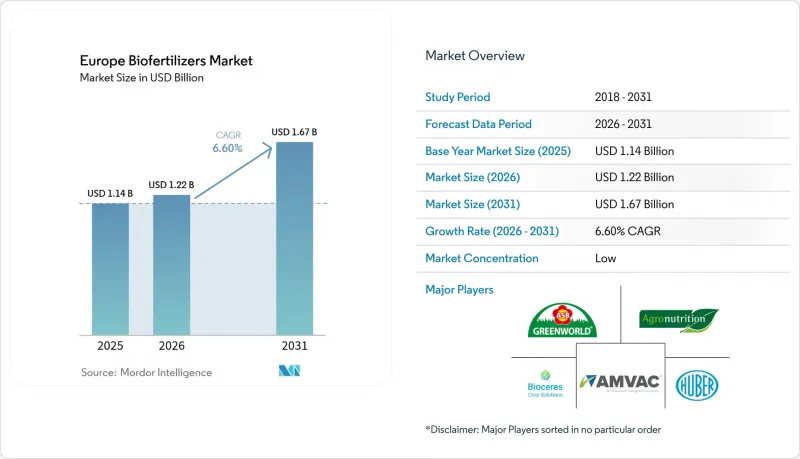
This report is Segmented by Form (Rhizobium, Azospirillum, Azotobacter, Mycorrhiza, Phosphate-Solubilizing Bacteria, and Other Biofertilizer), Crop Type (Row Crops, Horticultural Crops, and Cash Crops), and Geography (Germany, United Kingdom, France, Spain, Russia, Italy, Netherlands, Turkey, and Rest of Europe). The Market Forecasts are Provided in Terms of Value (USD) and Volume (Metric Tons).
Europe Biofertilizers Market Trends and Insights
EU Farm to Fork Organic-Area Mandate
The 25% organic farmland target under Farm to Fork shifts roughly 17 million additional hectares into biological management, an expansion that requires unprecedented volumes of microbial inoculants for nitrogen fixation and phosphorus mobilization. Governments such as Germany and France have embedded the mandate into national strategies, creating clear timelines that shape procurement planning for distributors and cooperatives. Funding streams tied to the mandate cover farmer training, demonstration plots, and outcome verification which together shorten adoption learning curves. Suppliers that bundle agronomy services with input sales gain early loyalty because many growers face steep learning curves after decades of synthetic fertilizer dependence. Market intelligence points to rising pre-season booking of microbial products as growers secure supply in advance of peak spring applications, a pattern that underscores the mandate's pull effect on the Europe biofertilizer market.
Restrictive EU Carbon and Nutrient Regulations
The nitrate cap of 170 kg N per hectare and emergent carbon fees of USD 26.5-31.8 per ton of CO2 equivalent are altering farm budget math in real time. Danish and Dutch growers, operating in some of the strictest nitrate-vulnerable zones, now document fertilizer savings of 40-50% since 2019 by leaning on phosphate-solubilizing bacteria that unlock residual phosphorus. Because regulators index carbon fees to the EU Emissions Trading System, cost escalators on synthetic ammonia are widely expected, prompting cereal and rapeseed growers to diversify nutrient sources before penalties bite deeper. Continuous monitoring requirements that tie nitrogen application records to subsidy eligibility further reinforce the switch to low-impact biologicals. These twin policies push microbial suppliers to validate carbon and nutrient efficiency claims through third-party field trials, a move that sharpens competitive differentiation.
Field-Performance Variability
Multisite trials show yield responses ranging 15-40% because microbial survival hinges on pH, texture, and moisture profiles that differ sharply from Mediterranean loams to Nordic clays. In sandy soils of Poland and Hungary, rapid desiccation during summer lowers microbial persistence, creating inconsistent returns for cereal growers. Early spring cold snaps cut mycorrhizal colonization by up to half in Northern France, curbing phosphorus uptake exactly when plants need it. This variability compels farmers to conduct on-farm strip trials, a practice that delays full-field uptake and slows order volumes. Suppliers now co-pack soil test kits and advisory services to build trust; however, service scalability remains a bottleneck.
Other drivers and restraints analyzed in the detailed report include:
- Rising Consumer Demand for Organic Produce
- CAP Eco-Scheme Subsidies
- Live-Culture Shelf-Life Logistics
For complete list of drivers and restraints, kindly check the Table Of Contents.
Segment Analysis
Mycorrhizal fungi held a commanding 62.30% of Europe biofertilizer market share in 2025, and the segment is anticipated to maintain leadership through 2031 on the back of its proven ability to mobilize phosphorus and strengthen soil structure. Rhizobium, although starting from a smaller base, is projected to post the fastest 7.12% CAGR as CAP eco-scheme payments encourage wider legume rotations that rely on biological nitrogen fixation, cutting synthetic input costs for organic transition farms. Together, these two categories set the pace for expanding Europe biofertilizer market size by meeting both nutrient release and sustainability requirements across member states.
Azospirillum retains a prominent share and is tracking a stable growth path, favored in cereal fields where its growth-promoting traits improve root architecture and nutrient uptake. Bacillus-based and other multi-strain blends account for significant share with a steady growth as specialty vegetable growers look for broad-spectrum solutions. Azotobacter and phosphate-solubilizing bacteria's carbon-sequestration upside positions them for future jumps once soil-credit markets mature. Continuous patent activity across these smaller segments underscores the innovation depth that will gradually broaden Europe biofertilizer market share beyond today's dominant fungal and rhizobial products.
Complete Report Scope:
- By Form
- Rhizobium
- Azospirillum
- Azotobacter
- Mycorrhiza
- Phosphate-Solubilizing Bacteria
- Other Biofertilizer
- By Crop Type
- Row Crops
- Horticultural Crops
- Cash Crops
- By Country
- Germany
- United Kingdom
- France
- Spain
- Russia
- Italy
- Netherlands
- Turkey
- Rest of Europe
List of Companies Covered in this Report:
- Sustane Natural Fertilizer
- Agronutrition S.A.
- Biolchim S.p.A.
- Koppert Biological Systems B.V.
- Lallemand Inc.
- Novonesis A/S
- Groundwork BioAg Ltd.
- Premier Tech Ltd.
- Andermatt Biocontrol AG
- Corteva, Inc.
- Rizobacter Argentina S.A.
- Valent BioSciences LLC
- UPL Ltd.
- Sikko Industries Ltd.
- Plant Health Care plc
Additional Benefits:
- The market estimate (ME) sheet in Excel format
- 3 months of analyst support
TABLE OF CONTENTS
1 INTRODUCTION
- 1.1 Study Assumptions and Market Definition
- 1.2 Scope of the Study
- 1.3 Research Methodology
2 REPORT OFFERS
3 EXECUTIVE SUMMARY & KEY FINDINGS
4 KEY INDUSTRY TRENDS
- 4.1 Area Under Organic Cultivation
- 4.2 Per Capita Spending On Organic Products
- 4.3 Regulatory Framework
- 4.3.1 Germany
- 4.3.2 United Kingdom
- 4.3.3 France
- 4.3.4 Spain
- 4.3.5 Russia
- 4.3.6 Italy
- 4.3.7 Netherlands
- 4.3.8 Turkey
- 4.4 Value Chain & Distribution Channel Analysis
- 4.5 Market Drivers
- 4.5.1 EU Farm to Fork organic area mandate
- 4.5.2 Restrictive EU carbon & nutrient regulations
- 4.5.3 Rising consumer demand for organic produce
- 4.5.4 CAP eco scheme subsidies
- 4.5.5 Soil carbon credit monetization via microbes
- 4.5.6 Insect frass circular nutrient partnerships
- 4.6 Market Restraints
- 4.6.1 Field performance variability
- 4.6.2 Live culture shelf-life logistics
- 4.6.3 Slow pan EU strain registration process
- 4.6.4 Channel conflict from rapid consolidation
5 MARKET SIZE & GROWTH FORECASTS (VALUE AND VOLUME)
- 5.1 By Form
- 5.1.1 Rhizobium
- 5.1.2 Azospirillum
- 5.1.3 Azotobacter
- 5.1.4 Mycorrhiza
- 5.1.5 Phosphate-Solubilizing Bacteria
- 5.1.6 Other Biofertilizer
- 5.2 By Crop Type
- 5.2.1 Row Crops
- 5.2.2 Horticultural Crops
- 5.2.3 Cash Crops
- 5.3 By Country
- 5.3.1 Germany
- 5.3.2 United Kingdom
- 5.3.3 France
- 5.3.4 Spain
- 5.3.5 Russia
- 5.3.6 Italy
- 5.3.7 Netherlands
- 5.3.8 Turkey
- 5.3.9 Rest of Europe
6 COMPETITIVE LANDSCAPE
- 6.1 Key Strategic Moves
- 6.2 Market Share Analysis
- 6.3 Company Landscape
- 6.4 Company Profiles (Includes Global Level Overview, Market Level Overview, Core Business Segments, Financials, Headcount, Key Information, Market Rank, Market Share, Products and Services, and Analysis of Recent Developments).
- 6.4.1 Sustane Natural Fertilizer
- 6.4.2 Agronutrition S.A.
- 6.4.3 Biolchim S.p.A.
- 6.4.4 Koppert Biological Systems B.V.
- 6.4.5 Lallemand Inc.
- 6.4.6 Novonesis A/S
- 6.4.7 Groundwork BioAg Ltd.
- 6.4.8 Premier Tech Ltd.
- 6.4.9 Andermatt Biocontrol AG
- 6.4.10 Corteva, Inc.
- 6.4.11 Rizobacter Argentina S.A.
- 6.4.12 Valent BioSciences LLC
- 6.4.13 UPL Ltd.
- 6.4.14 Sikko Industries Ltd.
- 6.4.15 Plant Health Care plc
7 KEY STRATEGIC QUESTIONS FOR AGRICULTURAL BIOLOGICALS CEOS

