PUBLISHER: Mordor Intelligence | PRODUCT CODE: 2100726

PUBLISHER: Mordor Intelligence | PRODUCT CODE: 2100726
Europe Controlled Release Fertilizers - Market Share Analysis, Industry Trends & Statistics, Growth Forecasts (2026 - 2031)
According to Mordor Intelligence, the Europe controlled release fertilizers market size was USD 0.88 billion in 2025 and USD 0.92 billion in 2026, and is forecast to reach USD 1.19 billion by 2031 at a 5.28% CAGR over 2026-2031.
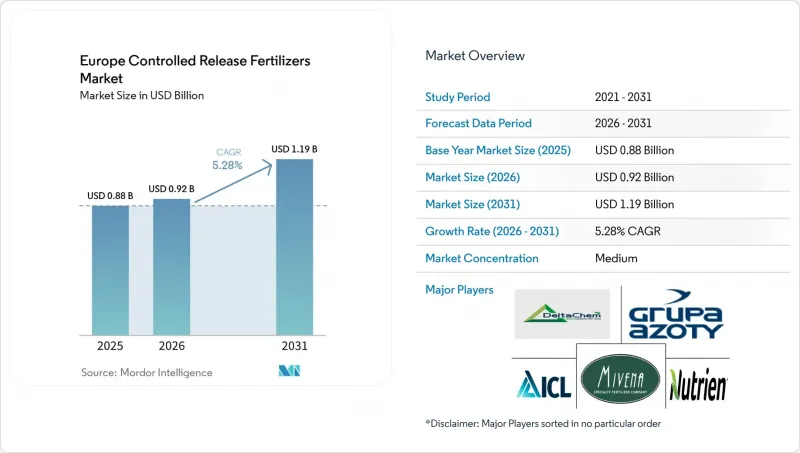
This report is Segmented by Coating Type (Polymer-Coated, Polymer-Sulfur Coated, and Others), Crop Type (Field Crops, Horticultural Crops, and Turf and Ornamental), and Geography (France, Germany, Italy, Netherlands, Russia, Spain, Ukraine, United Kingdom, and Rest of Europe). The Market Forecasts are Provided in Terms of Value (USD) and Volume (Metric Tons).
Europe Controlled Release Fertilizers Market Trends and Insights
Environmental-driven fertilizer bans in Northern EU pushing rapid CRF adoption
Seasonal bans on conventional fertilizers in Denmark and Sweden have lengthened restriction periods and forced growers to use nutrient forms that supply crops over an extended window. This led to a 40% jump in controlled release fertilizers penetration across Scandinavia between 2024 and 2025. The regulatory emphasis has shifted the agronomic mindset from short-term nutrient boosts to season-long availability. National enforcement agencies now hinge compliance on documented use of approved controlled release products, and manufacturers that demonstrate REACH compliance enjoy a first-mover edge.
EU Farm-to-Fork 2030 nutrient-loss mandates accelerating CRF subsidies
France earmarked EUR 150 million (USD 160.5 million) in Common Agricultural Policy eco-schemes to reimburse up to 40% of controlled release fertilizers purchases, making premium coatings economically viable for mid-sized farms. Germany's federal agriculture ministry is funding similar programs that prioritize nutrient-use-efficiency technologies. These subsidies neutralize the higher upfront cost of controlled release fertilizers and allow growers to recoup investment through reduced environmental compliance fees.
Slow regulatory path for certifying bio-based coating chemistries
The European Chemicals Agency's REACH registration process for novel biodegradable coating materials requires extensive toxicological and environmental fate studies that can extend approval timelines beyond 3 years, creating significant barriers for innovation in controlled release fertilizers technologies. This regulatory bottleneck prevents manufacturers from capitalizing on market demand for environmentally compliant coating systems, forcing continued reliance on conventional polymer technologies that face their own phase-out timelines. The approval delays create market uncertainty and discourage investment in research and development of next-generation coating materials. Companies must navigate parallel approval processes across multiple European jurisdictions, each with distinct requirements and timelines, further complicating market entry strategies for innovative coating technologies.
Other drivers and restraints analyzed in the detailed report include:
- Blended biodegradable polymer coatings cutting disposal costs for processors
- Digital twins linking soil-sensor data to CRF prescriptions on large estates
- Inflation-driven polymer cost spikes squeezing producer margins
For complete list of drivers and restraints, kindly check the Table Of Contents.
Segment Analysis
Polymer-coated controlled-release fertilizers accounted for the largest Europe controlled release fertilizers market share, representing 57.7% of the market in 2025. Their dominance reflects superior performance characteristics and a well-established manufacturing base across European production facilities. The segment benefits from proven nutrient-release profiles that can be precisely calibrated to match crop nutrient uptake patterns, with release durations ranging from two to 24 months depending on coating thickness and formulation. Companies such as ICL Group have invested heavily in next-generation polymer technologies, including biodegradable coating systems designed to improve nutrient-use efficiency and support sustainability objectives.
Polymer-sulfur-coated fertilizers are projected to be the fastest-growing segment, registering a CAGR of 7.4% during 2026-2031. These products combine the benefits of controlled nutrient release with supplemental sulfur nutrition, making them increasingly attractive in sulfur-deficient production systems. While polymer-sulfur-coated fertilizers currently account for a smaller share of the market, their cost-effectiveness and agronomic benefits are anticipated to support rapid adoption. The "Others" category includes emerging coating technologies such as natural wax-based and mineral-based formulations, which currently serve niche applications but face commercialization and scalability challenges. Regulatory and sustainability initiatives across Europe are accelerating research into biodegradable and bio-based coating materials, including starch-derived polymers and other renewable alternatives. This transition is anticipated to create opportunities for innovation leaders while increasing pressure on manufacturers to adapt their product portfolios to evolving environmental requirements.
Complete Report Scope:
- Coating Type
- Polymer Coated
- Polymer-Sulfur Coated
- Others
- Crop Type
- Field Crops
- Horticultural Crops
- Turf & Ornamental
- Country
- France
- Germany
- Italy
- Netherlands
- Russia
- Spain
- Ukraine
- United Kingdom
- Rest of Europe
List of Companies Covered in this Report:
- Ekompany International BV (DeltaChem)
- Grupa Azoty S.A. (Compo Expert)
- Haifa Group
- ICL Group Ltd
- Mivena BV
- Nutrien Ltd.
Additional Benefits:
- The market estimate (ME) sheet in Excel format
- 3 months of analyst support
TABLE OF CONTENTS
1 INTRODUCTION
- 1.1 Study Assumptions & Market Definition
- 1.2 Scope of the Study
- 1.3 Research Methodology
2 REPORT OFFERS
3 EXECUTIVE SUMMARY & KEY FINDINGS
4 KEY INDUSTRY TRENDS
- 4.1 Acreage Of Major Crop Types
- 4.1.1 Field Crops
- 4.1.2 Horticultural Crops
- 4.2 Average Nutrient Application Rates
- 4.2.1 Primary Nutrients
- 4.2.1.1 Field Crops
- 4.2.1.2 Horticultural Crops
- 4.2.1 Primary Nutrients
- 4.3 Regulatory Framework
- 4.4 Value Chain & Distribution Channel Analysis
- 4.5 Market Drivers
- 4.5.1 Environmental-driven fertilizer bans in Northern EU pushing rapid CRF adoption
- 4.5.2 EU "Farm-to-Fork" 2030 nutrient-loss mandates accelerating CRF subsidies
- 4.5.3 Blended biodegradable polymer coatings cutting disposal costs for processors
- 4.5.4 Digital twins linking soil-sensor data to CRF prescriptions on large estates
- 4.5.5 Surge in vineyard drip-fertigation retrofits requiring low-salt CRF formats
- 4.5.6 Vertical-farm operators standardizing on micro-dose CRF substrate cubes
- 4.6 Market Restraints
- 4.6.1 Slow regulatory path for certifying bio-based coating chemistries
- 4.6.2 Inflation-driven polymer cost spikes squeezing CRF producer margins
- 4.6.3 Patchy retailer agronomy skills limiting farmer uptake east of the Oder
- 4.6.4 Microparticle-shedding concerns triggering lobbying for coating traceability
5 MARKET SIZE AND GROWTH FORECASTS (VALUE AND VOLUME)
- 5.1 Coating Type
- 5.1.1 Polymer Coated
- 5.1.2 Polymer-Sulfur Coated
- 5.1.3 Others
- 5.2 Crop Type
- 5.2.1 Field Crops
- 5.2.2 Horticultural Crops
- 5.2.3 Turf & Ornamental
- 5.3 Country
- 5.3.1 France
- 5.3.2 Germany
- 5.3.3 Italy
- 5.3.4 Netherlands
- 5.3.5 Russia
- 5.3.6 Spain
- 5.3.7 Ukraine
- 5.3.8 United Kingdom
- 5.3.9 Rest of Europe
6 COMPETITIVE LANDSCAPE
- 6.1 Key Strategic Moves
- 6.2 Market Share Analysis
- 6.3 Company Landscape
- 6.4 Company Profiles (Includes Global Level Overview, Market Level Overview, Core Business Segments, Financials, Headcount, Key Information, Market Rank, Market Share, Products and Services, and Analysis of Recent Developments).
- 6.4.1 Ekompany International BV (DeltaChem)
- 6.4.2 Grupa Azoty S.A. (Compo Expert)
- 6.4.3 Haifa Group
- 6.4.4 ICL Group Ltd
- 6.4.5 Mivena BV
- 6.4.6 Nutrien Ltd.
7 KEY STRATEGIC QUESTIONS FOR FERTILIZER CEOS

