PUBLISHER: Mordor Intelligence | PRODUCT CODE: 2100736

PUBLISHER: Mordor Intelligence | PRODUCT CODE: 2100736
Middle-East and Africa Military Aircraft - Market Share Analysis, Industry Trends & Statistics, Growth Forecasts (2026 - 2031)
According to Mordor Intelligence, the middle east and Africa military aircraft market size is expected to grow from USD 9.81 billion in 2025 to USD 10.40 billion in 2026, and is forecast to reach USD 13.90 billion by 2031, at a 5.97% CAGR over 2026-2031.
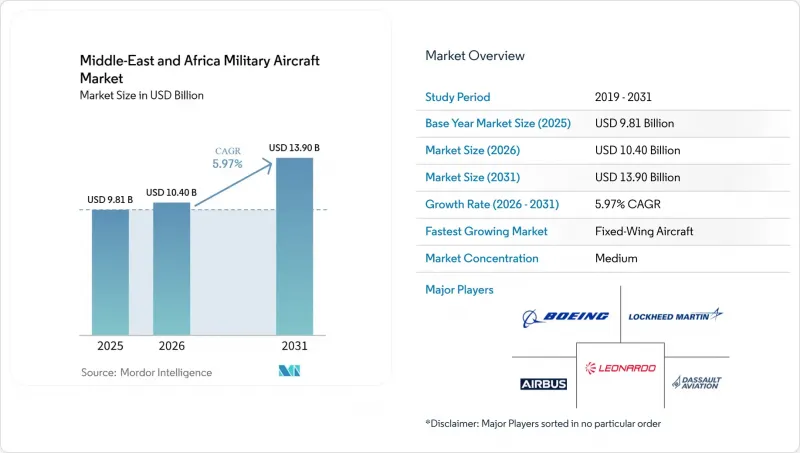
This report is Segmented by Aircraft Type (Fixed-Wing Aircraft and Rotorcraft), End-User Service (Air Force, Army Aviation, Naval/Marine Corps Aviation, Joint/Special Operations, and More), Propulsion Type (Turbofan, Turbojet, Turboprop, Turboshaft, and Fully Electric/Hybrid-Electric), and Geography (Middle East and Africa). The Market Forecasts are Provided in Terms of Value (USD).
Middle-East and Africa Military Aircraft Market Trends and Insights
Rapid Fleet Modernization Programs
Gulf air forces are moving through replacement and upgrade cycles faster than before because threat conditions remain elevated and budget support is strong. Saudi Arabia is pursuing F-15SA avionics refresh work, guided munitions replenishment, and engine sustainment partnerships simultaneously, which keeps demand active across upgrades, MRO, and new procurement. It is projected that 2,108 aircraft deliveries worth USD 110.10 billion will be made to Middle Eastern operators between 2026 and 2035, indicating a deep replacement and expansion pipeline. The Middle East and Africa military aircraft market is also being shaped by the fact that new fleet growth now comes with local sustainment buildout, not only import demand. That change reduces the share of lifetime revenue that foreign OEMs can retain after aircraft delivery, thereby increasing the market's structural complexity.
Indigenous Fighter and Trainer Development
Domestic fighter and trainer programs are shifting procurement away from simple imports toward co-development and local production models. Turkey has moved forward with the KAAN prototype activity and contract procedures for Turkish Air Force deliveries in 2026, thereby strengthening the platform's credibility as a regional export option. Morocco and Egypt are using local assembly arrangements to pull fighter and trainer value creation into their own industrial base. This means the Middle East and Africa military aircraft market is increasingly rewarding OEMs that can offer transfer of work, engineering participation, and durable production partnerships. It also means buyers are using aircraft procurement to build aerospace capability at home rather than only to expand fleet numbers.
Budget Re-Prioritization Toward Air Defense and Unmanned
Recent conflict patterns have pushed more defense funding toward interceptors, radar systems, and counter-drone capability. Though the Gulf states intercepted 537 ballistic missiles, 26 cruise missiles, and 2,256 UAVs during the Iran conflict, the ballistic missile defense costs alone may have approached USD 5 billion. It also notes that Washington approved up to USD 16.50 billion in air-defense systems, radars, and missiles for Middle Eastern allies in March 2026, a move that directly competes with manned aircraft budgets. This does not remove demand for aircraft, but it does slow procurement timing and reduces room for additional platform orders within fixed annual defense plans. The Middle East and Africa military aircraft market therefore faces a real budget tradeoff as unmanned and air-defense requirements rise.
Other drivers and restraints analyzed in the detailed report include:
- Multi-Domain Force Integration Requirements
- Maritime Patrol and Border Security Escalation
- Engine and Avionics Export-Control Constraints
For complete list of drivers and restraints, kindly check the Table Of Contents.
Segment Analysis
Fixed-wing aircraft accounted for 66.08% of the Middle East and Africa military aircraft market in 2025 and remained the largest platform category in the regional military aircraft industry. This leading position reflects the continued need for multirole fighters, advanced trainers, and tactical transport aircraft across both sub-regions. Within the segment, combat aircraft carry the highest value intensity because Gulf buyers continue to prioritize air-superiority and precision-strike missions. Transport aircraft are also gaining momentum, with the UAE signing for 20 Embraer C-390 Millennium aircraft in May 2026, becoming the first operator of the type in the Middle East. This keeps fixed-wing demand broad and prevents the segment from depending on any single aircraft mission alone.
Training aircraft activity adds another layer of support because newer trainer programs increasingly carry embedded combat capability. That has reduced the gap between training and light combat fleets in countries such as Nigeria and Egypt, where budgets favor versatile aircraft. Rotorcraft still account for the rest of the market and remain important for utility, reconnaissance, and shipboard missions, especially in African and naval roles. Nigeria's AH-1Z Viper and AW-109 Trekker acquisitions show how rotary-wing demand is tied to affordable multi-mission requirements. Even so, fixed-wing aircraft will continue to lead because the Middle East and Africa military aircraft market size for this segment is supported by both 66.08% revenue share in 2025 and a 6.92% CAGR through 2031.
Complete Report Scope:
- By Aircraft Type
- Fixed-Wing Aircraft
- Multi-role Aircraft
- Training Aircraft
- Transport Aircraft
- Others
- Rotorcraft
- Multi-Mission Helicopters
- Transport Helicopters
- Others
- Fixed-Wing Aircraft
- By End-User Service
- Air Force
- Army Aviation
- Naval/Marine Corps Aviation
- Joint/Special Operations
- Paramilitary and Coast Guard
- By Propulsion Type
- Turbofan
- Turbojet
- Turboprop
- Turboshaft
- Fully Electric/Hybrid-Electric
- By Geography
- Middle East
- Saudi Arabia
- United Arab Emirates
- Qatar
- Kuwait
- Israel
- Turkey
- Rest of Middle East
- Africa
- South Africa
- Egypt
- Algeria
- Nigeria
- Rest of Africa
- Middle East
List of Companies Covered in this Report:
- Airbus SE
- BAE Systems plc
- Dassault Aviation SA
- Embraer S.A.
- Elbit Systems Ltd.
- Hindustan Aeronautics Limited
- Israel Aerospace Industries Ltd.
- Korea Aerospace Industries, Ltd.
- Leonardo S.p.A.
- Lockheed Martin Corporation
- Northrop Grumman Corporation
- Saab AB
- The Boeing Company
- Turkish Aerospace Industries, Inc.
- United Aircraft Corporation
- Baykar Makine Sanayi ve Ticaret Anonim Sirketi
- Denel SOC Ltd.
- PT Dirgantara Indonesia (Persero)
- Pilatus Aircraft Ltd.
Additional Benefits:
- The market estimate (ME) sheet in Excel format
- 3 months of analyst support
TABLE OF CONTENTS
1 INTRODUCTION
- 1.1 Study Assumptions and Market Definition
- 1.2 Scope of the Study
2 RESEARCH METHODOLOGY
3 EXECUTIVE SUMMARY
4 KEY INDUSTRY TRENDS
- 4.1 Gross Domestic Product
- 4.2 Active Fleet Data
- 4.3 Defense Spending
5 MARKET LANDSCAPE
- 5.1 Market Overview
- 5.2 Market Drivers
- 5.2.1 Rapid fleet modernization programs
- 5.2.2 Indigenous fighter and trainer development
- 5.2.3 Multi-domain force integration requirements
- 5.2.4 Maritime patrol and border security escalation
- 5.2.5 Defense Offset policies favoring local assembly
- 5.2.6 Sustainment digitalization for aging fleets
- 5.3 Market Restraints
- 5.3.1 Budget re-prioritization toward air defense and unmanned systems
- 5.3.2 Engine and avionics export-control constraints
- 5.3.3 Long certification cycles for mission-critical upgrades
- 5.3.4 Maintenance skill gaps in Tier-2 African markets
- 5.4 Value Chain Analysis
- 5.5 Regulatory Landscape
- 5.6 Technological Outlook
- 5.7 Porter's Five Forces Analysis
- 5.7.1 Threat of New Entrants
- 5.7.2 Bargaining Power of Suppliers
- 5.7.3 Bargaining Power of Buyers
- 5.7.4 Threat of Substitutes
- 5.7.5 Intensity of Competitive Rivalry
6 MARKET SIZE AND GROWTH FORECASTS (VALUE)
- 6.1 By Aircraft Type
- 6.1.1 Fixed-Wing Aircraft
- 6.1.1.1 Multi-role Aircraft
- 6.1.1.2 Training Aircraft
- 6.1.1.3 Transport Aircraft
- 6.1.1.4 Others
- 6.1.2 Rotorcraft
- 6.1.2.1 Multi-Mission Helicopters
- 6.1.2.2 Transport Helicopters
- 6.1.2.3 Others
- 6.1.1 Fixed-Wing Aircraft
- 6.2 By End-User Service
- 6.2.1 Air Force
- 6.2.2 Army Aviation
- 6.2.3 Naval/Marine Corps Aviation
- 6.2.4 Joint/Special Operations
- 6.2.5 Paramilitary and Coast Guard
- 6.3 By Propulsion Type
- 6.3.1 Turbofan
- 6.3.2 Turbojet
- 6.3.3 Turboprop
- 6.3.4 Turboshaft
- 6.3.5 Fully Electric/Hybrid-Electric
- 6.4 By Geography
- 6.4.1 Middle East
- 6.4.1.1 Saudi Arabia
- 6.4.1.2 United Arab Emirates
- 6.4.1.3 Qatar
- 6.4.1.4 Kuwait
- 6.4.1.5 Israel
- 6.4.1.6 Turkey
- 6.4.1.7 Rest of Middle East
- 6.4.2 Africa
- 6.4.2.1 South Africa
- 6.4.2.2 Egypt
- 6.4.2.3 Algeria
- 6.4.2.4 Nigeria
- 6.4.2.5 Rest of Africa
- 6.4.1 Middle East
7 COMPETITIVE LANDSCAPE
- 7.1 Market Concentration
- 7.2 Strategic Moves
- 7.3 Market Share Analysis
- 7.4 Company Profiles (includes Global level Overview, Market level overview, Core Segments, Financials as available, Strategic Information, Market Rank/Share for key companies, Products and Services, and Recent Developments)
- 7.4.1 Airbus SE
- 7.4.2 BAE Systems plc
- 7.4.3 Dassault Aviation SA
- 7.4.4 Embraer S.A.
- 7.4.5 Elbit Systems Ltd.
- 7.4.6 Hindustan Aeronautics Limited
- 7.4.7 Israel Aerospace Industries Ltd.
- 7.4.8 Korea Aerospace Industries, Ltd.
- 7.4.9 Leonardo S.p.A.
- 7.4.10 Lockheed Martin Corporation
- 7.4.11 Northrop Grumman Corporation
- 7.4.12 Saab AB
- 7.4.13 The Boeing Company
- 7.4.14 Turkish Aerospace Industries, Inc.
- 7.4.15 United Aircraft Corporation
- 7.4.16 Baykar Makine Sanayi ve Ticaret Anonim Sirketi
- 7.4.17 Denel SOC Ltd.
- 7.4.18 PT Dirgantara Indonesia (Persero)
- 7.4.19 Pilatus Aircraft Ltd.
8 MARKET OPPORTUNITIES AND FUTURE OUTLOOK
- 8.1 White-space and Unmet-Need Assessment

