PUBLISHER: Mordor Intelligence | PRODUCT CODE: 2125518

PUBLISHER: Mordor Intelligence | PRODUCT CODE: 2125518
Europe Military Aircraft - Market Share Analysis, Industry Trends & Statistics, Growth Forecasts (2026 - 2031)
According to Mordor Intelligence, the Europe military aircraft market size is expected to grow from USD 18.61 billion in 2025 to USD 18.74 billion in 2026, and is forecast to reach USD 24.31 billion by 2031, at a 5.34% CAGR over 2026-2031.
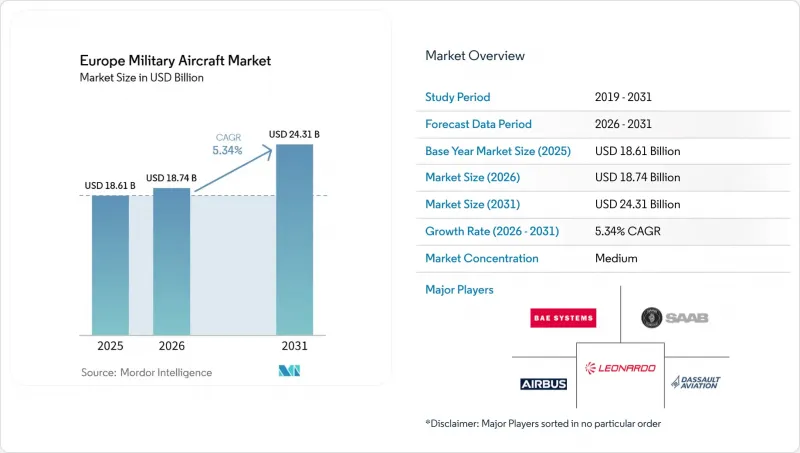
This report is Segmented by Aircraft Type (Fixed-Wing Aircraft and Rotorcraft), End-User Service (Air Force, Army Aviation, Naval/Marine Corps Aviation, Joint/Special Operations, and More), Propulsion Type (Turbofan, Turbojet, Turboprop, Turboshaft, and Fully Electric/Hybrid-Electric), and Geography (United Kingdom, France, Germany, and More). The Market Forecasts are Provided in Terms of Value (USD).
Europe Military Aircraft Market Trends and Insights
NATO Procurement Rebuild After Ukraine
The Ukraine conflict reset European defense budgeting at a speed not seen in decades, and the Europe military aircraft market is one of the clearest beneficiaries. The European military expenditure rose by 14% to USD 864 billion in 2025, the highest level recorded for the region. The spending mix also changed as governments shifted more money toward airpower and equipment procurement rather than simply raising baseline defense budgets. At the July 2026 NATO summit, allies moved to purchase up to 10 Saab GlobalEye aircraft, indicating a clear preference for a European platform in a collective program. That combination of higher budgets and shared procurement keeps near-term order visibility strong and supports the Europe military aircraft market beyond the current forecast window.
Fleet Ageing and Upgrade-Centric Demand
Fleet age is still forcing replacement and upgrade decisions across the Europe military aircraft market. Eurofighter partners plan to raise Typhoon production from 14 aircraft a year to 20 within 36 months, then to 30, while also pushing a mid-life upgrade to keep the platform relevant into the 2060s. Germany also approved a new Eurofighter Tranche 5 order and an SEAD upgrade package, which keeps retrofit demand moving alongside new-build demand. Germany is also taking delivery of F-35A aircraft in 2026 to replace Tornado jets, so procurement is occurring across two generations of combat aircraft simultaneously. That overlap supports fighter jets, avionics work, training assets, and support activities together rather than in separate cycles.
Acquisition Cost Inflation and Life-Cycle Burden
Acquisition costs are rising fast enough to slow order sizes in the Europe military aircraft market. The GCAP design contract alone totals GBP 4.60 billion (USD 6.10 billion) for an 18-month phase, underscoring how expensive sixth-generation work has become. Support costs also rise because Eurofighter fleets still include Tranche 1, 2, and 3 aircraft with different avionics and software baselines. That pushes sustainment complexity higher and makes life-cycle planning harder for smaller NATO members with tighter budgets. The result is that some governments can fund capability upgrades but still struggle to buy the volumes they would prefer.
Other drivers and restraints analyzed in the detailed report include:
- FCAS and GCAP Industrial Spillover
- Indigenous Content Rules Favor European Suppliers
- Engine-Core and Avionics Supply Bottlenecks
For complete list of drivers and restraints, kindly check the Table Of Contents.
Segment Analysis
Fixed-wing aircraft accounted for 62.48% of the Europe military aircraft market in 2025, keeping this category well ahead of rotorcraft. Fighter jets remain the core demand driver inside fixed-wing, with Germany's F-35A deliveries, continuing Rafale output, and the Eurofighter production ramp all extending backlog visibility. Training aircraft are also gaining weight because new combat fleets need dedicated lead-in training capacity before frontline induction. Leonardo's December 2025 order for 12 M-346 F Block 20 aircraft from Austria showed that demand for advanced trainers is moving with combat fleet renewal rather than after it. Transport aircraft are also shifting toward pooled procurement, with 7 NATO allies launching a shared A400M fleet in July 2026, which could change how smaller states budget future airlift needs.
Rotorcraft is projected to expand at 6.79% CAGR through 2031, making it the fastest-growing aircraft type in the Europe military aircraft market. Spain's EUR 4.50 billion (USD 5.30 billion) order for 100 Airbus helicopters in December 2025 covered the H145M, NH90, H135, and H175M platforms, giving the segment a large multiyear production base. That order also shows a clear move toward fewer, more flexible military helicopters that can cover training, maritime, special operations, and light-attack needs within a single procurement plan. NAHEMA's April 2026 NH90 Block 2 study adds another layer of demand by covering both new-build and retrofit pathways across a 15-nation operator base.
Complete Report Scope:
- By Aircraft Type
- Fixed-Wing Aircraft
- Multi-Role Aircraft
- Training Aircraft
- Transport Aircraft
- Others
- Rotorcraft
- Multi-Mission Helicopters
- Transport Helicopters
- Others
- Fixed-Wing Aircraft
- By End-User Service
- Air Force
- Army Aviation
- Naval/Marine Corps Aviation
- Joint/Special Operations
- Paramilitary and Coast Guard
- By Propulsion Type
- Turbofan
- Turbojet
- Turboprop
- Turboshaft
- Fully Electric and Hybrid-Electric
- By Geography
- United Kingdom
- France
- Germany
- Italy
- Netherlands
- Russia
- Spain
- Turkey
- Rest of Europe
List of Companies Covered in this Report:
- Airbus SE
- BAE Systems plc
- Dassault Aviation SA
- Embraer S.A.
- Elbit Systems Ltd.
- Hindustan Aeronautics Limited
- Israel Aerospace Industries Ltd.
- Korea Aerospace Industries, Ltd.
- Leonardo S.p.A.
- Lockheed Martin Corporation
- Northrop Grumman Corporation
- Saab AB
- The Boeing Company
- Turkish Aerospace Industries, Inc.
- United Aircraft Corporation
- Denel SOC Ltd.
- Pilatus Aircraft Ltd.
- Thales Group
Additional Benefits:
- The market estimate (ME) sheet in Excel format
- 3 months of analyst support
TABLE OF CONTENTS
1 INTRODUCTION
- 1.1 Study Assumptions and Market Definition
- 1.2 Scope of the Study
2 RESEARCH METHODOLOGY
3 EXECUTIVE SUMMARY
4 KEY INDUSTRY TRENDS
- 4.1 Gross Domestic Product
- 4.2 Active Fleet Data
- 4.3 Defense Spending
5 MARKET LANDSCAPE
- 5.1 Market Overview
- 5.2 Market Drivers
- 5.2.1 NATO procurement rebuild after Ukraine
- 5.2.2 Fleet ageing and upgrade-centric demand
- 5.2.3 FCAS and GCAP industrial spillover
- 5.2.4 Indigenous content rules favor European suppliers
- 5.2.5 Software-defined mission systems raise retrofit scope
- 5.2.6 Carbon-constrained defense procurement nudges hybrid-electric development
- 5.3 Market Restraints
- 5.3.1 Acquisition cost inflation and life-cycle burden
- 5.3.2 Engine-core and avionics supply bottlenecks
- 5.3.3 Certification delays for next-gen and retrofit platforms
- 5.3.4 Skilled labor shortages in aerospace integration
- 5.4 Value Chain Analysis
- 5.5 Regulatory Landscape
- 5.6 Technological Outlook
- 5.7 Porter's Five Forces Analysis
- 5.7.1 Threat of New Entrants
- 5.7.2 Bargaining Power of Suppliers
- 5.7.3 Bargaining Power of Buyers
- 5.7.4 Threat of Substitutes
- 5.7.5 Intensity of Competitive Rivalry
6 MARKET SIZE AND GROWTH FORECASTS (VALUE)
- 6.1 By Aircraft Type
- 6.1.1 Fixed-Wing Aircraft
- 6.1.1.1 Multi-Role Aircraft
- 6.1.1.2 Training Aircraft
- 6.1.1.3 Transport Aircraft
- 6.1.1.4 Others
- 6.1.2 Rotorcraft
- 6.1.2.1 Multi-Mission Helicopters
- 6.1.2.2 Transport Helicopters
- 6.1.2.3 Others
- 6.1.1 Fixed-Wing Aircraft
- 6.2 By End-User Service
- 6.2.1 Air Force
- 6.2.2 Army Aviation
- 6.2.3 Naval/Marine Corps Aviation
- 6.2.4 Joint/Special Operations
- 6.2.5 Paramilitary and Coast Guard
- 6.3 By Propulsion Type
- 6.3.1 Turbofan
- 6.3.2 Turbojet
- 6.3.3 Turboprop
- 6.3.4 Turboshaft
- 6.3.5 Fully Electric and Hybrid-Electric
- 6.4 By Geography
- 6.4.1 United Kingdom
- 6.4.2 France
- 6.4.3 Germany
- 6.4.4 Italy
- 6.4.5 Netherlands
- 6.4.6 Russia
- 6.4.7 Spain
- 6.4.8 Turkey
- 6.4.9 Rest of Europe
7 COMPETITIVE LANDSCAPE
- 7.1 Market Concentration
- 7.2 Strategic Moves
- 7.3 Market Share Analysis
- 7.4 Company Profiles (includes Global Level Overview, Market Level Overview, Core Segments, Financials as available, Strategic Information, Market Rank/Share, Products and Services, and Recent Developments)
- 7.4.1 Airbus SE
- 7.4.2 BAE Systems plc
- 7.4.3 Dassault Aviation SA
- 7.4.4 Embraer S.A.
- 7.4.5 Elbit Systems Ltd.
- 7.4.6 Hindustan Aeronautics Limited
- 7.4.7 Israel Aerospace Industries Ltd.
- 7.4.8 Korea Aerospace Industries, Ltd.
- 7.4.9 Leonardo S.p.A.
- 7.4.10 Lockheed Martin Corporation
- 7.4.11 Northrop Grumman Corporation
- 7.4.12 Saab AB
- 7.4.13 The Boeing Company
- 7.4.14 Turkish Aerospace Industries, Inc.
- 7.4.15 United Aircraft Corporation
- 7.4.16 Denel SOC Ltd.
- 7.4.17 Pilatus Aircraft Ltd.
- 7.4.18 Thales Group
8 MARKET OPPORTUNITIES AND FUTURE OUTLOOK
- 8.1 White-space and Unmet-Need Assessment

