PUBLISHER: Mordor Intelligence | PRODUCT CODE: 2100749

PUBLISHER: Mordor Intelligence | PRODUCT CODE: 2100749
E-commerce Personal Care Products - Market Share Analysis, Industry Trends & Statistics, Growth Forecasts (2026 - 2031)
According to Mordor Intelligence, the global E-commerce Personal Care Products Market size in 2026 is estimated at USD 138.91 billion, growing from 2025 value of USD 123.48 billion with 2031 projections showing USD 189.36 billion, growing at 6.39% CAGR over 2026-2031.
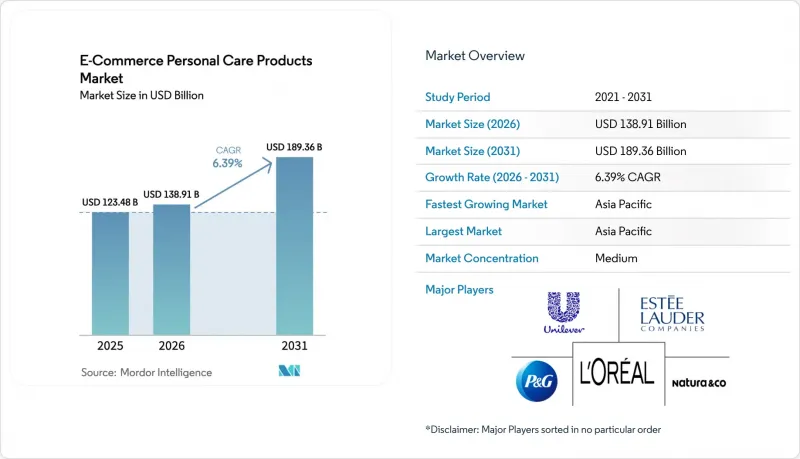
This report is Segmented by Product Type (Hair Care, Skin Care, Bath and Shower, Oral Care, and More), Ingredients (Conventional, and Natural/Organic), Category (Mass, and Premium), Platform Type (Third Party Marketplaces, and Company-Owned Platform), and Geography (North America, Europe, Asia-Pacific, South America, and More). The Market Forecasts are Provided in Terms of Value (USD).
Global E-commerce Personal Care Products Market Trends and Insights
Influence of social media and influencer marketing
The E-commerce Personal Care Products Market has transformed its promotional strategies, with social commerce emerging as a key growth driver. This shift is primarily due to the increasing reliance on digital platforms for product discovery and reviews. Creator-driven sales streamline the path from awareness to purchase by leveraging compelling short-form videos that trigger immediate purchases. Platforms such as LTK and Collabstr formalize affiliate partnerships, enabling micro-influencers to monetize niche audiences while brands access granular attribution data. Seamless integration of digital payments has further sped up this transformation. In July 2025, Press Information Bureau reported that Unified Payments Interface (UPI) processed INR 18.39 billion financial transactions in a single month, demonstrating its importance in India's e-commerce digital transformation . Influencers, particularly micro and nano influencers, build authentic trust with their followers, amplifying the influence of their endorsements. Brands leverage social media platforms like Instagram, TikTok, and YouTube for dynamic, visual engagement with audiences. This momentum broadens market access, boosts brand awareness, and drives direct consumer sales.
Availability of flexible payment methods
Flexible payment choices propel expansion in the E-commerce Personal Care Products Market by reshaping how consumers shop and boosting checkout completions. Buyers demand safe, tailored payment flows, from credit cards to digital wallets. These wallets now handle a large share of worldwide online transactions, enabling one-tap buys and stronger security to cut drop-offs and abandoned carts. In January 2025, PayPal reported 26.3 billion global payment transactions processed in 2024 . The integration of diverse payment solutions remains essential for e-commerce platforms to maintain market competitiveness and meet evolving consumer preferences in the personal care products segment. As digital payment technologies continue to advance, companies embracing these advancing digital payment innovations secure sustained growth in the online personal care arena.
Rise of counterfeit and substandard products
The growth of the global E-commerce Personal Care Products Market faces major hurdles from rampant counterfeit goods, which threaten consumer safety and undermine brand trust. This critical issue manifests predominantly within third-party e-commerce platforms, where product authentication mechanisms remain insufficient. U.S. Customs and Border Protection reported the seizure of personal care products worth USD 8 million and USD 57 million in perfumes in 2023 . E-commerce platforms are subject to increased regulatory accountability under revised frameworks, including the elimination of the de minimis exemption for low-value shipments, which has strengthened customs surveillance and necessitated the implementation of more rigorous seller verification protocols. Despite these challenges, the E-commerce Personal Care Products Market continues to grow via stronger compliance measures, advanced authentication tools, and fortified supply chains, safeguarding consumers and supporting ongoing expansion.
Other drivers and restraints analyzed in the detailed report include:
- AI-led personalization and product recommendations
- Growing preference for clean, sustainable, and ethical options
- Logistics hurdles in fulfillment and delivery
For complete list of drivers and restraints, kindly check the Table Of Contents.
Segment Analysis
The skin care segment leads the market with a 41.52% share in 2025, surpassing the overall personal care market. This dominance is driven by facial products enhanced with AR diagnostic tools and ingredient transparency, which clean-beauty advocates prioritize for routines targeting hydration, acne, and anti-aging concerns. The hair care segment exhibits the highest growth rate, achieving a 7.10% CAGR through 2031. This growth is fueled by customization platforms offering AI-driven formulas tailored to individual porosity, texture, and scalp needs. Consumers increasingly adopt personalized shampoos and treatments that deliver visible results, while demand for clean, bond-repair, and scalp-focused innovations rises across both mass and premium channels. Technological advancements, such as L'Oreal Groupe's AirLight Pro, a professional-grade hair drying instrument launched in January 2024, exemplify this trend.
The lip care segment is experiencing a significant recovery, driven by the resurgence of social activities post-pandemic, which has boosted demand for products offering both hydration and aesthetic benefits. The oral care and bath-and-shower segments continue to expand steadily, supported by subscription models that simplify replenishment. Meanwhile, the men's grooming category benefits from direct-to-consumer brands like Harry's and Dollar Shave Club, which normalize male self-care through razors and skincare products. Perfumes address counterfeit challenges by adopting blockchain-authenticated luxury solutions, such as Coty's Aura partnership. Additionally, sun care products leverage dermatologist endorsements, while deodorants gain traction with premium, natural aluminum-free options available on owned platforms.
Conventional ingredients dominate the global E-commerce Personal Care Products Market with a 70.78% market share, benefiting from established supply chains and lower price points that appeal to mass-market buyers. This dominance is attributed to well-established supply chains that ensure consistent product availability and cost advantages for manufacturers and retailers. Conventional formulations continue to appeal due to their proven efficacy, stability, and scalability, particularly among price-sensitive consumers in mass market segments where affordability and reliability are key. E-commerce sharpens the split, with price-sensitive shoppers chasing discounts on marketplaces and values-driven buyers favoring brand sites for certified, filterable options, erasing legacy retail's information edge through instant ingredient scans and badges.
Natural/organic formulations lead growth at 8.95% CAGR through 2031, outpacing the market average as consumers demand NATRUE, COSMOS, and USDA Organic certifications to cut through greenwashing and verify clean claims. These ingredients power shampoos, serums, and creams tailored for sensitive skin and scalps, with premium pricing justified by transparency and sustainability sourcing. Manufacturers are innovating with new formulations, adopting sustainable packaging, and obtaining certifications to align with consumer preferences. The combination of premium natural and organic products with digital marketing strategies is accelerating adoption across both developed and emerging markets.
Complete Report Scope:
- By Product Type
- Hair Care
- Shampoo
- Conditioner
- Hair Colorant
- Hair Styling Products
- Others
- Skin Care
- Facial Care Products
- Body Care Products
- Lip and Nail Care Products
- Bath and Shower
- Shower Gels
- Soaps
- Others
- Oral Care
- Toothbrush
- Toothpaste
- Mouthwash and Rinses
- Others
- Men's Grooming Products
- Sun Care Products
- Deodorants and Antiperspirants
- Perfumes and Fragrance
- Hair Care
- By Ingredients
- Conventional
- Natural/Organic
- By Category
- Mass
- Premium
- By Platform Type
- Third-Party Marketplace
- Company-owned Platform
- By Geography
- North America
- United States
- Canada
- Mexico
- Rest of North America
- Europe
- Germany
- United Kingdom
- Italy
- France
- Spain
- Netherlands
- Poland
- Belgium
- Sweden
- Rest of Europe
- Asia-Pacific
- China
- India
- Japan
- Australia
- Indonesia
- South Korea
- Thailand
- Singapore
- Rest of Asia-Pacific
- South America
- Brazil
- Argentina
- Colombia
- Chile
- Peru
- Rest of South America
- Middle East and Africa
- South Africa
- Saudi Arabia
- United Arab Emirates
- Nigeria
- Egypt
- Morocco
- Turkey
- Rest of Middle East and Africa
- North America
Geography Analysis
The Asia-Pacific region is expected to dominate the market with a 42.10% share by 2025, growing at a robust CAGR of 9.88% through 2031. This growth is fueled by the rapid evolution of China's digital retail landscape and India's Unified Payments Interface (UPI), which processed over 100 billion transactions in 2025, enabling platforms like Nykaa to expand into tier-2 and tier-3 cities. Mobile-first super-apps and data localization regulations further strengthen the region's leadership. Southeast Asia is emerging as a critical beauty e-commerce market, driven by a growing middle class and advancements in internet infrastructure. The region's dominance is underpinned by mobile-first consumer behavior and super-app ecosystems that integrate beauty with related services. Platforms such as Alibaba and Shopee play a pivotal role in providing market access to developing areas.
North America remains a leader in the E-commerce Personal Care Products Market, demonstrating steady growth despite political and market challenges, reflecting its maturity and saturation in urban centers. The region benefits from well-established logistics networks, high credit card penetration, and increasing competition from direct-to-consumer brands that bypass traditional retail channels. Growth is further supported by high disposable incomes, established personal care routines, same-day delivery options, loyalty programs, and a rising focus on dermatological and hair care needs among consumers.
European markets continue to hold a significant position in online beauty commerce, driven by heightened environmental awareness. According to IfD Allensbach data, 21.91 million German-speaking consumers expressed a willingness to increase spending on environmentally sustainable products in 2024. While GDPR compliance requirements impose higher operational costs, they also create a competitive advantage for brands investing in privacy-preserving personalization technologies. Meanwhile, the Middle East and Africa remain smaller markets, constrained by fragmented logistics and lower e-commerce adoption. However, Gulf Cooperation Council countries are experiencing rapid growth, supported by high smartphone penetration and government-led digital transformation initiatives.
- L'Oreal S.A.
- Procter & Gamble Company
- Unilever PLC
- Colgate-Palmolive Company
- Estee Lauder Companies Inc.
- Natura & Co Holding SA
- Kenvue Inc.
- Beiersdorf AG
- Shiseido Co. Ltd.
- Oriflame Holding AG
- Kao Corporation
- Coty Inc.
- Amorepacific Corporation
- Edgewell Personal Care Company
- Mary Kay Holding Corporation
- Glossier Inc.
- Reckitt Benckiser Group PLC
- Church & Dwight Co. Inc.
- Honest Company Inc.
- Function of Beauty Inc.
Additional Benefits:
- The market estimate (ME) sheet in Excel format
- 3 months of analyst support
TABLE OF CONTENTS
1 INTRODUCTION
- 1.1 Study Assumptions and Market Definition
- 1.2 Scope of the Study
2 RESEARCH METHODOLOGY
3 EXECUTIVE SUMMARY
4 MARKET LANDSCAPE
- 4.1 Market Overview
- 4.2 Market Drivers
- 4.2.1 Influence of social media and influencer marketing
- 4.2.2 Availability of flexible payment methods
- 4.2.3 Attractive promotion and discounts driving purchases
- 4.2.4 Growing preference for clean, sustainable, and ethical options
- 4.2.5 Surge in online shopping habits
- 4.2.6 AI-led personalization and product recommendations
- 4.3 Market Restraints
- 4.3.1 Rise of counterfeit and substandard products
- 4.3.2 Logistics hurdles in fulfillment and delivery
- 4.3.3 Intense price competition reduces profit margins
- 4.3.4 Data privacy issues restricting personalization
- 4.4 Consumer Behaviour Analysis
- 4.5 Regulatory Outlook
- 4.6 Porter's Five Forces Analysis
- 4.6.1 Bargaining Power of Suppliers
- 4.6.2 Bargaining Power of Buyers
- 4.6.3 Threat of New Entrants
- 4.6.4 Threat of Substitutes
- 4.6.5 Degree of Competition
5 MARKET SIZE AND GROWTH FORECASTS (VALUE)
- 5.1 By Product Type
- 5.1.1 Hair Care
- 5.1.1.1 Shampoo
- 5.1.1.2 Conditioner
- 5.1.1.3 Hair Colorant
- 5.1.1.4 Hair Styling Products
- 5.1.1.5 Others
- 5.1.2 Skin Care
- 5.1.2.1 Facial Care Products
- 5.1.2.2 Body Care Products
- 5.1.2.3 Lip and Nail Care Products
- 5.1.3 Bath and Shower
- 5.1.3.1 Shower Gels
- 5.1.3.2 Soaps
- 5.1.3.3 Others
- 5.1.4 Oral Care
- 5.1.4.1 Toothbrush
- 5.1.4.2 Toothpaste
- 5.1.4.3 Mouthwash and Rinses
- 5.1.4.4 Others
- 5.1.5 Men's Grooming Products
- 5.1.6 Sun Care Products
- 5.1.7 Deodorants and Antiperspirants
- 5.1.8 Perfumes and Fragrance
- 5.1.1 Hair Care
- 5.2 By Ingredients
- 5.2.1 Conventional
- 5.2.2 Natural/Organic
- 5.3 By Category
- 5.3.1 Mass
- 5.3.2 Premium
- 5.4 By Platform Type
- 5.4.1 Third-Party Marketplace
- 5.4.2 Company-owned Platform
- 5.5 By Geography
- 5.5.1 North America
- 5.5.1.1 United States
- 5.5.1.2 Canada
- 5.5.1.3 Mexico
- 5.5.1.4 Rest of North America
- 5.5.2 Europe
- 5.5.2.1 Germany
- 5.5.2.2 United Kingdom
- 5.5.2.3 Italy
- 5.5.2.4 France
- 5.5.2.5 Spain
- 5.5.2.6 Netherlands
- 5.5.2.7 Poland
- 5.5.2.8 Belgium
- 5.5.2.9 Sweden
- 5.5.2.10 Rest of Europe
- 5.5.3 Asia-Pacific
- 5.5.3.1 China
- 5.5.3.2 India
- 5.5.3.3 Japan
- 5.5.3.4 Australia
- 5.5.3.5 Indonesia
- 5.5.3.6 South Korea
- 5.5.3.7 Thailand
- 5.5.3.8 Singapore
- 5.5.3.9 Rest of Asia-Pacific
- 5.5.4 South America
- 5.5.4.1 Brazil
- 5.5.4.2 Argentina
- 5.5.4.3 Colombia
- 5.5.4.4 Chile
- 5.5.4.5 Peru
- 5.5.4.6 Rest of South America
- 5.5.5 Middle East and Africa
- 5.5.5.1 South Africa
- 5.5.5.2 Saudi Arabia
- 5.5.5.3 United Arab Emirates
- 5.5.5.4 Nigeria
- 5.5.5.5 Egypt
- 5.5.5.6 Morocco
- 5.5.5.7 Turkey
- 5.5.5.8 Rest of Middle East and Africa
- 5.5.1 North America
6 COMPETITIVE LANDSCAPE
- 6.1 Market Concentration
- 6.2 Strategic Moves
- 6.3 Market Share Analysis
- 6.4 Company Profiles (Includes Global-level Overview, Market-level Overview, Core Segments, Financials, Strategic Info, Market Rank/Share, Products and Services, Recent Developments)
- 6.4.1 L'Oreal S.A.
- 6.4.2 Procter & Gamble Company
- 6.4.3 Unilever PLC
- 6.4.4 Colgate-Palmolive Company
- 6.4.5 Estee Lauder Companies Inc.
- 6.4.6 Natura & Co Holding SA
- 6.4.7 Kenvue Inc.
- 6.4.8 Beiersdorf AG
- 6.4.9 Shiseido Co. Ltd.
- 6.4.10 Oriflame Holding AG
- 6.4.11 Kao Corporation
- 6.4.12 Coty Inc.
- 6.4.13 Amorepacific Corporation
- 6.4.14 Edgewell Personal Care Company
- 6.4.15 Mary Kay Holding Corporation
- 6.4.16 Glossier Inc.
- 6.4.17 Reckitt Benckiser Group PLC
- 6.4.18 Church & Dwight Co. Inc.
- 6.4.19 Honest Company Inc.
- 6.4.20 Function of Beauty Inc.
7 MARKET OPPORTUNITIES AND FUTURE OUTLOOK

