PUBLISHER: Mordor Intelligence | PRODUCT CODE: 2113189

PUBLISHER: Mordor Intelligence | PRODUCT CODE: 2113189
Thailand Crop Protection Chemicals - Market Share Analysis, Industry Trends & Statistics, Growth Forecasts (2026 - 2031)
According to Mordor Intelligence, the Thailand crop protection chemicals market size was valued at USD 386 million in 2025 and estimated to grow from USD 402.02 million in 2026 to reach USD 492.66 million by 2031, at a CAGR of 4.15% during the forecast period (2026-2031).
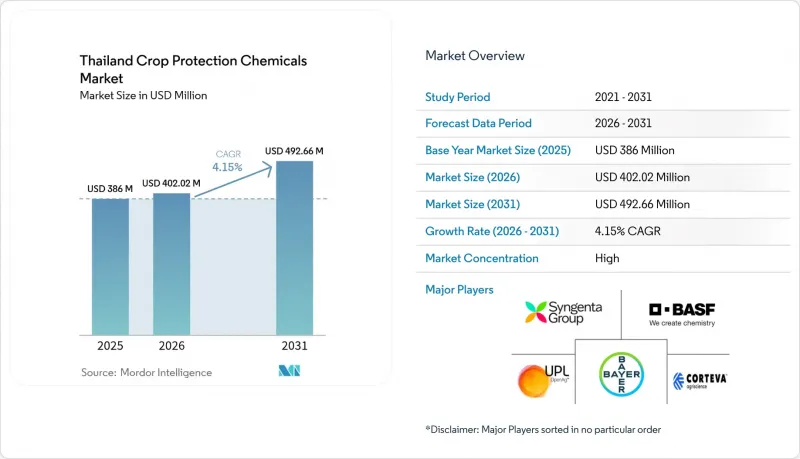
This report is Segmented by Origin (Synthetic and Biological), by Product (Herbicides, Insecticides, Fungicides, Molluscicides, Nematicides, and Bio-Pesticides), by Application Method (Foliar Spray, Seed Treatment, Soil Treatment, and More), and by Crop (Commercial Crops, Fruits and Vegetables, Grains and Cereals, and Others). The Market Forecasts are Provided in Terms of Value (USD).
Thailand Crop Protection Chemicals Market Trends and Insights
Intensifying rice blast outbreaks in the Central Plains
Disease severity has reached 27.85% in untreated plots, compelling growers to increase fungicide spray frequency. Tricyclazole-based programs raise yields by up to 3.93 metric ton/ha, helping sustain profitability despite tighter margins. Wetter La Nina patterns forecast through 2025 bolster inoculum pressure across the core rice belt. Close monitoring and timely applications, therefore, underpin demand stability for high-efficacy fungicides within the Thailand crop protection chemicals market. Climate variability associated with La Nina conditions is anticipated to intensify disease pressure through 2025, with increased rainfall creating favorable conditions for pathogen proliferation across major rice-growing regions.
Government subsidies for precision-sprayer adoption
The Ministry of Agriculture covers up to 40% of the cost of Global Positioning System (GPS)-enabled boom sprayers, distributing starter kits to smallholders in 26 provinces along the Chao Phraya River Basin. These starter kits include advanced application equipment and personal protective gear. Demonstrations show a 98.23% reduction in operator exposure and a 15% savings in active ingredients. These incentives strengthen the adoption of modern delivery technologies that optimize chemical volumes and compliance with re-entry intervals. The initiative aligns with broader digitalization objectives that integrate precision agriculture with sustainable farming practices. Regulatory compliance requirements under the Department of Agriculture's safety protocols further incentivize the adoption of advanced application technologies that minimize environmental exposure risks.
Stricter Hazardous Substance Act restrictions on paraquat and chlorpyrifos
On-farm inventories worth THB 10 billion (USD 307.7 million) were written off after the 2020 ban. Alternative chemistries command premium pricing while often delivering inferior efficacy against target pests, creating economic pressure on farmers who face yield penalties without access to previously relied-upon active ingredients. The ban's enforcement has been complicated by black market distribution channels that continue to supply prohibited substances, undermining regulatory objectives while creating unfair competitive advantages for non-compliant operatorsSubstitute chemistries carry premium pricing and sometimes lower efficacy, pressuring margins within the Thailand crop protection chemicals market.
Other drivers and restraints analyzed in the detailed report include:
- Expansion of contract-farming fruit exports
- Rapid growth of sugarcane ratoon herbicide programs
- Rising organic rice acreage in northern provinces
For complete list of drivers and restraints, kindly check the Table Of Contents.
Segment Analysis
Synthetic formulations controlled 83.92% of the Thailand crop protection chemicals market share in 2025, underscoring farmer reliance on proven active ingredients that deliver consistent results under high pest pressure. Biologicals, though starting from a small base, are advancing at a 9.49% CAGR through 2031, making them the fastest-growing slice of the Thailand crop protection chemicals market as exporters demand residue-compliant solutions for durian, mango, and longan. Cost remains a pivotal advantage for synthetics because large-scale manufacturing spreads fixed costs and keeps per-liter prices attractive to smallholders. The embedded dealer network that offers seasonal credit further locks many farmers into legacy products that require no new application training.
Regulatory shifts are changing the calculus. Department of Agriculture extension services now distribute Bacillus thuringiensis and Trichoderma powders at subsidized rates, signaling state backing for eco-friendly modes of action. Multinationals have responded by striking technology alliances. As stewardship programs emphasize integrated pest management, growers are likely to blend lower-dose synthetics with targeted biologicals, gradually reshaping the chemical mix without eroding the efficacy safeguards that intensive Thai agriculture still requires.
Herbicides held 44.32% of the Thailand crop protection chemicals market share in 2025, reflecting the weed-control needs of rice and cane systems. In contrast, bio-pesticides are growing at an 11.03% CAGR, bolstered by government support for Bacillus thuringiensis and pheromone-based products. Multinationals and local start-ups alike ramp up R&D spending to capture this opportunity. The Thailand crop protection chemicals market size allocated to insecticides remains resilient as armyworm incursions persist, while fungicides expand modestly on escalating rice blast prevalence.
Molluscicides and nematicides remain niche but benefit from intensifying root-knot nematode outbreaks documented in central paddies. Adoption barriers for biologicals' short shelf life, higher per-hectare cost are easing as field trials verify yield parity with synthetics. Syngenta's pheromone partnership targets nationwide commercial roll-out by 2026. Portfolio diversification protects growers from compliance risks and supports integrated pest-management strategies across the Thailand crop protection chemicals market.
Complete Report Scope:
- By Chemical Type
- Synthetic
- Biological
- By Product
- Herbicides
- Insecticides
- Fungicides
- Molluscicides
- Nematicides
- Bio-pesticides
- By Application Method
- Foliar Spray
- Seed Treatment
- Soil Treatment
- Chemigation
- Fumigation
- By Crop
- Commercial Crops
- Fruits and Vegetables
- Grains and Cereals
- Pulses and Oil seeds
- Ornamental and Turf
List of Companies Covered in this Report:
- Bayer AG
- BASF SE
- Syngenta Group
- Corteva Inc.
- UPL Ltd.
- Sumitomo Chemical Co. Ltd.(Mitsui Chemicals Agro, Inc.)
- Sotus International
- Gowan Company LLC
- Nufarm Ltd.
- Albaugh Asia-Pacific (Albaugh LLC)
- Helm AG
- Shandong Weifang Rainbow Chemical Co., Ltd
- ISK Biosciences Thailand (Ishihara Sangyo Kaisha Ltd.)
- FMC Corporation
- Nisso Chemical (Nippon Soda Co. Ltd.)
Additional Benefits:
- The market estimate (ME) sheet in Excel format
- 3 months of analyst support
TABLE OF CONTENTS
1 Introduction
- 1.1 Study Assumptions and Market Definition
- 1.2 Scope of the Study
2 Research Methodology
3 Executive Summary
4 Market Landscape
- 4.1 Market Overview
- 4.2 Market Drivers
- 4.2.1 Intensifying rice blast outbreaks in the Central Plains
- 4.2.2 Government subsidies for precision-sprayer adoption
- 4.2.3 Expansion of contract-farming fruit exports
- 4.2.4 Rapid growth of sugarcane ratoon herbicide programs
- 4.2.5 Surge in e-commerce ag-input platforms among smallholders
- 4.2.6 Biocontrol partnerships with royal research projects
- 4.3 Market Restraints
- 4.3.1 Stricter Hazardous Substance Act restrictions on paraquat and chlorpyrifos
- 4.3.2 Rising organic rice acreage in northern provinces
- 4.3.3 Seasonal labor migration limiting timely pesticide application
- 4.3.4 Consumer backlash against chemical residues in durian exports
- 4.4 Regulatory Landscape
- 4.5 Technological Outlook
- 4.6 Porter's Five Forces Analysis
- 4.6.1 Bargaining Power of Suppliers
- 4.6.2 Bargaining Power of Buyers
- 4.6.3 Threat of New Entrants
- 4.6.4 Threat of Substitutes
- 4.6.5 Intensity of Competitive Rivalry
5 Market Size and Growth Forecasts (Value)
- 5.1 By Chemical Type
- 5.1.1 Synthetic
- 5.1.2 Biological
- 5.2 By Product
- 5.2.1 Herbicides
- 5.2.2 Insecticides
- 5.2.3 Fungicides
- 5.2.4 Molluscicides
- 5.2.5 Nematicides
- 5.2.6 Bio-pesticides
- 5.3 By Application Method
- 5.3.1 Foliar Spray
- 5.3.2 Seed Treatment
- 5.3.3 Soil Treatment
- 5.3.4 Chemigation
- 5.3.5 Fumigation
- 5.4 By Crop
- 5.4.1 Commercial Crops
- 5.4.2 Fruits and Vegetables
- 5.4.3 Grains and Cereals
- 5.4.4 Pulses and Oil seeds
- 5.4.5 Ornamental and Turf
6 Competitive Landscape
- 6.1 Market Concentration
- 6.2 Strategic Moves
- 6.3 Market Share Analysis
- 6.4 Company Profiles (Includes Global Level Overview, Market Level Overview, Core Segments, Financials As Available, Strategic Information, Market Rank/Share For Key Companies, Products And Services, And Recent Developments)
- 6.4.1 Bayer AG
- 6.4.2 BASF SE
- 6.4.3 Syngenta Group
- 6.4.4 Corteva Inc.
- 6.4.5 UPL Ltd.
- 6.4.6 Sumitomo Chemical Co. Ltd.(Mitsui Chemicals Agro, Inc.)
- 6.4.7 Sotus International
- 6.4.8 Gowan Company LLC
- 6.4.9 Nufarm Ltd.
- 6.4.10 Albaugh Asia-Pacific (Albaugh LLC)
- 6.4.11 Helm AG
- 6.4.12 Shandong Weifang Rainbow Chemical Co., Ltd
- 6.4.13 ISK Biosciences Thailand (Ishihara Sangyo Kaisha Ltd.)
- 6.4.14 FMC Corporation
- 6.4.15 Nisso Chemical (Nippon Soda Co. Ltd.)
7 Market Opportunities and Future Outlook

