PUBLISHER: Mordor Intelligence | PRODUCT CODE: 2113885

PUBLISHER: Mordor Intelligence | PRODUCT CODE: 2113885
Latin America Crop Protection Chemicals (Pesticides) - Market Share Analysis, Industry Trends & Statistics, Growth Forecasts (2026 - 2031)
According to Mordor Intelligence, the Latin America crop protection chemicals (Pesticides) market size is expected to grow from USD 31.30 billion in 2025 to USD 32.66 billion in 2026 and is forecast to reach USD 40.44 billion by 2031 at 4.35% CAGR over 2026-2031.
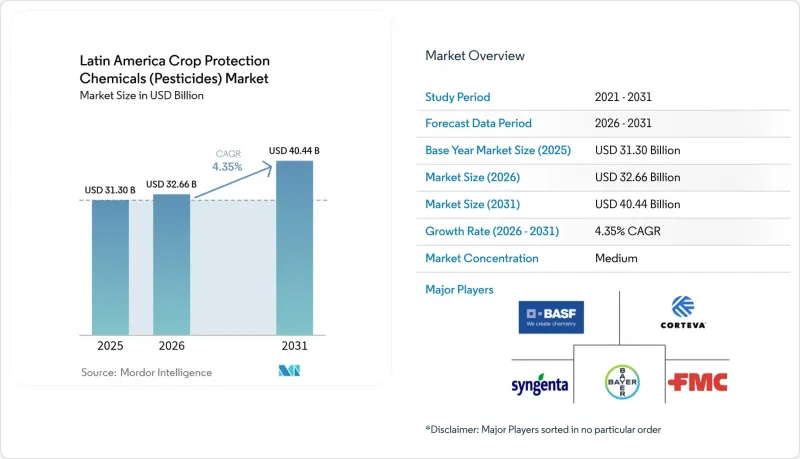
This report is Segmented by Mode of Action (Herbicide, Fungicide, and More), by Application (Grains and Cereals, Pulses and Oilseeds, Fruits and Vegetables, Commercial Crops, and Turf and Ornamentals), and by Geography (Brazil, Argentina, Chile, and Rest of Latin America). The Market Forecasts are Provided in Terms of Value (USD).
Latin America Crop Protection Chemicals (Pesticides) Market Trends and Insights
Rapid Expansion of Soybean and Corn Acreage
Brazil added 1.2 million hectares of soybeans in 2024, lifting herbicide demand as glyphosate-tolerant varieties require multiple passes per season. Argentina's corn area rebounded, renewing appetite for pre-emergence herbicides. Second-crop corn in Brazil's Center-West compresses application windows, favoring quick-acting formulations. Acreage growth in Paraguay and Bolivia extends market reach as deforestation-free certification raises input intensity. Together, these trends underpin herbicide volume resilience in the Latin America crop protection chemicals (Pesticides) market.
Increasing Pest Resistance to Older Chemistries
Field research confirmed cyantraniliprole-resistant Fall armyworm in Mato Grosso during 2024, forcing growers into newer diamide options. Argentina's soybean belt battles glyphosate-resistant Palmer amaranth across 30% of area, lifting residual herbicide layering costs by 20% to 25%. Mexico's vegetable sector reports declining pyrethroid efficacy, accelerating uptake of neonicotinoid seed treatments. Resistance escalates input spending and favors differentiated actives, benefiting innovators in the Latin America crop protection chemicals (Pesticides) market.
Stringent Maximum-Residue Limits in Key Export Markets
EU and North American buyers lowered residue thresholds, compelling Chile's blueberry sector to swap into biological fungicides despite higher costs. Peru's avocado exporters saw pre-harvest compliance expenses rise 12% in 2024. Mexico's berry industry invested in laboratory testing, yet smallholders lag. Export-oriented segments therefore gravitate to premium low-residue products, while domestic growers stay with legacy synthetics, segmenting demand in the Latin America crop protection chemicals (Pesticides) market.
Other drivers and restraints analyzed in the detailed report include:
- Intensifying Pressure from Invasive Species Such as Helicoverpa armigera
- Growing Adoption of Stacked-Trait Genetically Modified (GM) Seeds
- Escalating Activist-Driven Pesticide Bans
For complete list of drivers and restraints, kindly check the Table Of Contents.
Segment Analysis
Herbicides accounted for 46.60% of revenue in 2025, reflecting their foundational role in no-till soybean and corn programs. Regulatory headwinds spur formulators to innovate with lower-volatility dicamba, glufosinate, and novel HPPD inhibitors. Fungicides, although smaller in base, advance at a 4.95% CAGR, outpacing all other categories. Export fruit growers in Chile and Peru deploy Bacillus and botanical blends to satisfy supermarket standards.
Insecticide demand bifurcates, where synthetic pyrethroids taper in vegetables, while diamide classes grow in corn and cotton to combat armyworm. Mode-of-action diversification, therefore, accelerates rotation practices and cushions market value against individual active ingredient bans. Resistance management drives product mix shifts. Growers now rotate triazole, strobilurin, and SDHI fungicides for soybean rust to prolong synthetic efficacy. Suppliers leverage this need with pre-mix packs and tailored stewardship programs, enhancing stickiness within the Latin America crop protection chemicals (pesticides) market.
Complete Report Scope:
- Mode of Action
- Herbicide
- Fungicide
- Insecticide
- Other Modes of Action
- Application
- Grains and Cereals
- Pulses and Oilseeds
- Fruits and Vegetables
- Commercial Crops
- Turf and Ornamentals
- Geography
- Brazil
- Argentina
- Chile
- Rest of Latin America
List of Companies Covered in this Report:
- BASF SE
- Bayer CropScience AG
- Syngenta AG
- Corteva Agriscience
- FMC Corporation
- Sumitomo Chemical Company Limited
- UPL Limited
- American Vanguard Corporation
- ADAMA Ltd
- Isagro SpA
- Nutrien Ltd
- Bioceres Crop Solutions Corp
- Albaugh LLC
- Sipcam-Oxon Group
- Ihara do Brasil
- Ourofino Agrociencia
- Nortox S.A.
- Rainbow Agro
Additional Benefits:
- The market estimate (ME) sheet in Excel format
- 3 months of analyst support
TABLE OF CONTENTS
1 INTRODUCTION
- 1.1 Study Assumptions and Market Definition
- 1.2 Scope of the Study
2 RESEARCH METHODOLOGY
3 EXECUTIVE SUMMARY
4 MARKET LANDSCAPE
- 4.1 Market Overview
- 4.2 Market Drivers
- 4.2.1 Rapid expansion of soybean and corn acreage
- 4.2.2 Increasing pest resistance to older chemistries
- 4.2.3 Intensifying pressure from invasive species such as Helicoverpa armigera
- 4.2.4 Growing adoption of stacked-trait GM seeds
- 4.2.5 Integration of AI-based prescription spraying platforms
- 4.2.6 Carbon-credit programs rewarding yield-boosting inputs
- 4.3 Market Restraints
- 4.3.1 Stringent maximum-residue limits in key export markets
- 4.3.2 Escalating activist-driven pesticide bans
- 4.3.3 Tight farm-gate margins amid volatile commodity prices
- 4.3.4 Cross-border counterfeit product inflows from Asia
- 4.4 Regulatory Landscape
- 4.5 Technological Outlook
- 4.6 Porter's Five Forces Analysis
- 4.6.1 Bargaining Power of Suppliers
- 4.6.2 Bargaining Power of Buyers
- 4.6.3 Threat of New Entrants
- 4.6.4 Threat of Substitute Products
- 4.6.5 Intensity of Competitive Rivalry
5 MARKET SEGMENTATION
- 5.1 Mode of Action
- 5.1.1 Herbicide
- 5.1.2 Fungicide
- 5.1.3 Insecticide
- 5.1.4 Other Modes of Action
- 5.2 Application
- 5.2.1 Grains and Cereals
- 5.2.2 Pulses and Oilseeds
- 5.2.3 Fruits and Vegetables
- 5.2.4 Commercial Crops
- 5.2.5 Turf and Ornamentals
- 5.3 Geography
- 5.3.1 Brazil
- 5.3.2 Argentina
- 5.3.3 Chile
- 5.3.4 Rest of Latin America
6 COMPETITIVE LANDSCAPE
- 6.1 Market Share Analysis
- 6.2 Most Adopted Strategies
- 6.3 Company Profiles (Includes Global Level Overview, Market Level Overview, Core Segments, Financials as Available, Strategic Information, Market Rank/Share for Key Companies, Products and Services, and Recent Developments)
- 6.3.1 BASF SE
- 6.3.2 Bayer CropScience AG
- 6.3.3 Syngenta AG
- 6.3.4 Corteva Agriscience
- 6.3.5 FMC Corporation
- 6.3.6 Sumitomo Chemical Company Limited
- 6.3.7 UPL Limited
- 6.3.8 American Vanguard Corporation
- 6.3.9 ADAMA Ltd
- 6.3.10 Isagro SpA
- 6.3.11 Nutrien Ltd
- 6.3.12 Bioceres Crop Solutions Corp
- 6.3.13 Albaugh LLC
- 6.3.14 Sipcam-Oxon Group
- 6.3.15 Ihara do Brasil
- 6.3.16 Ourofino Agrociencia
- 6.3.17 Nortox S.A.
- 6.3.18 Rainbow Agro
7 MARKET OPPORTUNITIES AND FUTURE OUTLOOK

