PUBLISHER: Mordor Intelligence | PRODUCT CODE: 2113613

PUBLISHER: Mordor Intelligence | PRODUCT CODE: 2113613
Italy Crop Protection Chemicals (Pesticides) - Market Share Analysis, Industry Trends & Statistics, Growth Forecasts (2026 - 2031)
According to Mordor Intelligence, the Italy crop protection chemicals (pesticides) market size is expected to grow from USD 1.28 billion in 2025 to USD 1.33 billion in 2026 and is forecast to reach USD 1.58 billion by 2031 at 3.55% CAGR over 2026-2031.
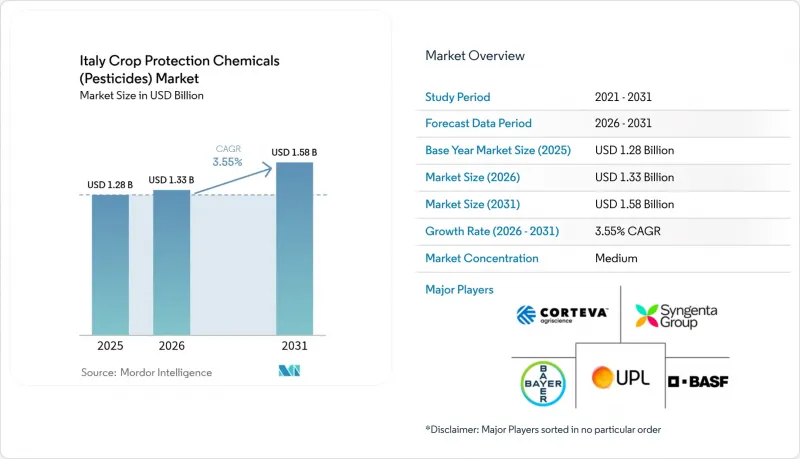
This report is Segmented by Product Type (Herbicides, Insecticides, Fungicides, and More), by Application (Chemigation, Foliar, Fumigation, Seed Treatment, and More), by Crop Type (Grains and Cereals, Oilseeds and Pulses, Fruits and Vegetables, Commercial Crops, and More). The Market Forecasts are Provided in Terms of Value (USD).
Italy Crop Protection Chemicals (Pesticides) Market Trends and Insights
Rising Demand for Food and Agricultural Productivity
Per-capita consumption of fresh vegetables climbed 3.2% a year between 2020 and 2024, locking growers into volume contracts with northern European retailers that penalize supply shortfalls. Shrinking farm labor prompts heavier reliance on crop protection chemicals market tools to avoid field losses that can reach 40% in untreated processing tomatoes. Extreme weather caused USD 8.9 billion in crop damage during 2024, much of it linked to fungal and bacterial outbreaks that overwhelmed basic integrated pest management practices . These forces keep budget allocations for proven fungicides and herbicides inelastic despite cost pressures.
Increasing Pest and Disease Outbreaks Driven by Climate Volatility
Since 2015, warmer winters added three weeks to the downy mildew season in vineyards, forcing two extra fungicide rounds that cost EUR 150 (USD 157) per hectare. The brown marmorated stink bug now infests 80% of hazelnut and pear acreage, raising insecticide rotations and straining the crop protection chemicals market. Xylella fastidiosa has destroyed one-third of Puglia's olives, yet growers still spray insect vectors and copper, illustrating chemistry's residual role under biological stress . BASF's Serifel biological fungicide secured 2024 approval as a copper alternative, showing how resistance pressure accelerates new product uptake.
Stringent European Union and National Pesticide Regulations
The Farm to Fork Strategy continues to aim for a significant reduction in pesticide use by 2030, despite the withdrawal of the Sustainable Use Regulation in February 2024. Italy has seen a decline in pesticide distribution over recent years. However, per-hectare usage among remaining growers has remained consistent, suggesting that regulation alone does not reduce usage intensity. In recent years, several active ingredients have lost approval, limiting disease control options to fewer chemical solutions and increasing the risk of resistance. In Trentino, buffer zones around schools have restricted aerial or drone spraying on a portion of apple acreage, resulting in notable sales losses for the Italy crop protection chemicals (pesticides) market.
Other drivers and restraints analyzed in the detailed report include:
- Growing Herbicide-Resistant Weed Populations
- Expansion of Export-Oriented Fruit and Vegetable Production Clusters
- Heightened Health and Environmental Risk Concerns Among Consumers
For complete list of drivers and restraints, kindly check the Table Of Contents.
Segment Analysis
Fungicides delivered 41.60% of the Italy crop protection chemicals (pesticides) market share in 2025, as 640,000 hectares of vineyards and 1.3 million hectares of tomatoes demanded season-long disease control. The fungicides expand at a 9.15% CAGR as copper limits and retailer mandates move growers toward Bacillus amyloliquefaciens or Trichoderma formulas priced 100% higher than synthetics. Herbicides follow because cereal rotations rely on glyphosate and pendimethalin, though uncertainty around glyphosate renewal after 2025 elevates interest in Corteva's Arylex and BASF's Luximo premium entrants. Insecticides demand is driven by Mediterranean fruit fly and brown marmorated stink bug, while molluscicides and other minor products share the remaining.
The Italy crop protection chemicals (pesticides) market size tied to fungicides will keep expanding as high-value grapes and greenhouse vegetables offset acreage loss in cereals. Biological fungicides win incremental share, but cost headwinds limit penetration outside audited chains. Herbicide growth stays modest given regulatory risk, yet resistance pressure supplies a floor for new mode-of-action launches. Insecticide demand pivots toward drone-ready suspensions with rapid knockdown, a niche where multinationals hold formulation advantages.
Complete Report Scope:
- By Product Type
- Herbicides
- Insecticides
- Fungicides
- Molluscicides
- Other Product Types
- By Application
- Chemigation
- Foliar
- Fumigation
- Seed Treatment
- Soil Treatment
- By Crop Type
- Grains and Cereals
- Oilseeds and Pulses
- Fruits and Vegetables
- Commercial Crops
- Turf and Ornamental
List of Companies Covered in this Report:
- Bayer CropScience AG
- BASF SE
- Syngenta Group
- Corteva Inc
- Adama Ltd
- UPL Ltd
- Sumitomo Chemical Co., Ltd.
- FMC Agro Italia S.r.l.
- Nufarm Limited
- Sipcam Oxon S.p.A.
- Certis Belchim B.V.
- Gowan Company, LLC
- Ascenza Agro SA
- CBC Europe S.p.A.
- Koppert Biological Systems BV
Additional Benefits:
- The market estimate (ME) sheet in Excel format
- 3 months of analyst support
TABLE OF CONTENTS
1 INTRODUCTION
- 1.1 Study Assumptions and Market Definition
- 1.2 Scope of the Study
2 RESEARCH METHODOLOGY
3 EXECUTIVE SUMMARY
4 MARKET LANDSCAPE
- 4.1 Market Overview
- 4.2 Market Drivers
- 4.2.1 Rising demand for food and agricultural productivity
- 4.2.2 Increasing pest and disease outbreaks driven by climate volatility
- 4.2.3 Growing herbicide-resistant weed populations
- 4.2.4 Expansion of export-oriented fruit and vegetable production clusters
- 4.2.5 Specialty vineyard growth boosting premium fungicide demand
- 4.2.6 Rapid adoption of drone-based spot-spraying favoring high-potency formulations
- 4.3 Market Restraints
- 4.3.1 Stringent European Union and national pesticide regulations
- 4.3.2 Heightened health and environmental risk concerns among consumers
- 4.3.3 Rising inflow of counterfeit or parallel-import pesticides
- 4.3.4 Retailer zero-residue standards reducing conventional chemical use
- 4.4 Regulatory Landscape
- 4.5 Porter's Five Forces Analysis
- 4.5.1 Bargaining Power of Suppliers
- 4.5.2 Bargaining Power of Buyers
- 4.5.3 Threat of New Entrants
- 4.5.4 Threat of Substitutes
- 4.5.5 Intensity of Competitive Rivalry
5 MARKET SIZE AND GROWTH FORECAST (VALUE)
- 5.1 By Product Type
- 5.1.1 Herbicides
- 5.1.2 Insecticides
- 5.1.3 Fungicides
- 5.1.4 Molluscicides
- 5.1.5 Other Product Types
- 5.2 By Application
- 5.2.1 Chemigation
- 5.2.2 Foliar
- 5.2.3 Fumigation
- 5.2.4 Seed Treatment
- 5.2.5 Soil Treatment
- 5.3 By Crop Type
- 5.3.1 Grains and Cereals
- 5.3.2 Oilseeds and Pulses
- 5.3.3 Fruits and Vegetables
- 5.3.4 Commercial Crops
- 5.3.5 Turf and Ornamental
6 COMPETITIVE LANDSCAPE
- 6.1 Market Concentration
- 6.2 Strategic Moves
- 6.3 Market Share Analysis
- 6.4 Company Profiles (Includes Global Level Overview, Market Level Overview, Core Segments, Financials as Available, Strategic Information, Market Rank/Share for Key Companies, Products and Services, and Recent Developments)
- 6.4.1 Bayer CropScience AG
- 6.4.2 BASF SE
- 6.4.3 Syngenta Group
- 6.4.4 Corteva Inc
- 6.4.5 Adama Ltd
- 6.4.6 UPL Ltd
- 6.4.7 Sumitomo Chemical Co., Ltd.
- 6.4.8 FMC Agro Italia S.r.l.
- 6.4.9 Nufarm Limited
- 6.4.10 Sipcam Oxon S.p.A.
- 6.4.11 Certis Belchim B.V.
- 6.4.12 Gowan Company, LLC
- 6.4.13 Ascenza Agro SA
- 6.4.14 CBC Europe S.p.A.
- 6.4.15 Koppert Biological Systems BV
7 MAEKET OPPORTUNITIES AND FUTURE OUTLOOK

