PUBLISHER: Mordor Intelligence | PRODUCT CODE: 2113192

PUBLISHER: Mordor Intelligence | PRODUCT CODE: 2113192
South America Cashew - Market Share Analysis, Industry Trends & Statistics, Growth Forecasts (2026 - 2031)
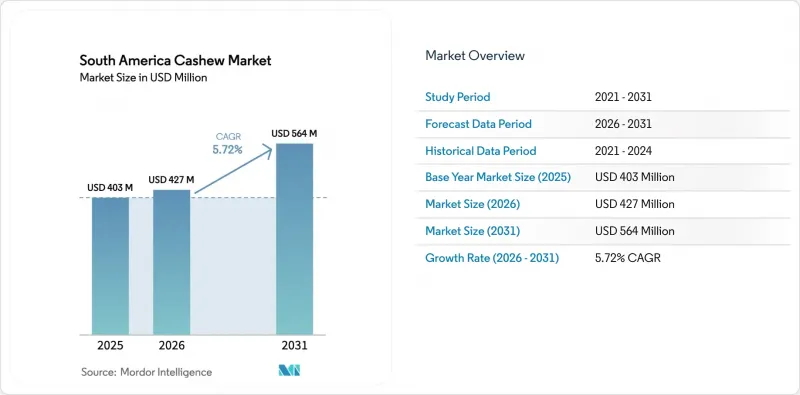
According to Mordor Intelligence, the South America cashew market size was valued at USD 403.00 million in 2025 and is estimated to grow from USD 427.00 million in 2026 to reach USD 564.00 million by 2031, at a CAGR of 5.72% during the forecast period (2026-2031).
This report is Segmented by Geography (Argentina, Brazil, Chile, Colombia, and More). The Report Includes Production Analysis (Volume), Consumption Analysis (Value and Volume), Import Analysis (Value and Volume), Export Analysis (Value and Volume), Wholesale Price Trend Analysis and Forecast, List of Key Players, and More. The Market Forecasts are Provided in Terms of Value (USD) and Volume (Metric Tons).
South America Cashew Market Trends and Insights
Expansion of Integrated Cashew-Cocoa Agro-Forestry Systems
Dual-crop planting of cashew and cocoa has shifted land-use economics in Bahia and southern Ceara, where trials posted net income 35% to 40% higher than in cashew monoculture between 2024 and 2025 . World Bank climate-smart funding of USD 22 million in 2025 accelerated adoption across 12,000 hectares by subsidizing seedlings and drip-irrigation. Cocoa's off-season cash flow smooths farmer revenue and reduces orchard abandonment, securing processors' raw-nut supply. Shade from cashew trees lowers cocoa heat stress, while cocoa's deeper roots improve soil moisture retention. Colombia began pilot programs in 2025, demonstrating early replication potential along the Caribbean coast.
Shift of Multinational Roasters Toward Brazilian Kernel Sourcing Contracts
Global snack brands decreased reliance on Vietnam, which supplied 65% of world kernels in 2024, by signing multi-year Brazilian contracts in 2025 . Olam International added 15 cooperatives to its Vitoria da Conquista buying desk, covering 4,500 smallholders. European Union imports of Brazilian kernels jumped 22% in 2025 as processors met stringent aflatoxin limits without fumigation. Locked-in 2026-2027 volumes offer processors the confidence to expand capacity, and spillover supplies are improving kernel availability for Chile and Argentina.
Recurring La Nina-Linked Drought Cycles
Rainfall in Ceara's cashew belt was 35% to 45% below normal during the 2024-2025 season, cutting flowering and nut-set rates by up to 22% in rain-fed orchards. Peru's Piura registered a 40% deficit in the same window, causing similar stress. Tree vigor does not fully recover in the next season, compounding losses. Climate models from the Intergovernmental Panel on Climate Change project a 15% increase in La Nina frequency by 2030, urging a faster rollout of irrigation. Only 8% of Brazilian cashew acreage held weather-indexed insurance in 2025, leaving most farmers exposed.
Other drivers and restraints analyzed in the detailed report include:
- Emergence of Carbon-Credit Revenue Streams for Cashew Orchards
- Digitized Farm-Gate Procurement Boosting Smallholder Throughput
- Labor Shortages During Peak Harvest in Ceara and Piaui
For complete list of drivers and restraints, kindly check the Table Of Contents.
Complete Report Scope:
- By Geography
- Argentina
- Production Analysis (Area Harvested, Yield, and Production Volume)
- Consumption Analysis (Consumption Value and Volume)
- Import Market Analysis (Import Value, Volume, and Key Supplying Markets)
- Export Market Analysis (Export Value, Volume, and Key Destination Markets)
- Wholesale Price Trend Analysis and Forecast
- Regulatory Framework
- List of Key Players
- Logistics and Infrastructure
- Seasonality Analysis
- Brazil
- Production Analysis (Area Harvested, Yield, and Production Volume)
- Consumption Analysis (Consumption Value and Volume)
- Import Market Analysis (Import Value, Volume, and Key Supplying Markets)
- Export Market Analysis (Export Value, Volume, and Key Destination Markets)
- Wholesale Price Trend Analysis and Forecast
- Regulatory Framework
- List of Key Players
- Logistics and Infrastructure
- Seasonality Analysis
- Chile
- Production Analysis (Area Harvested, Yield, and Production Volume)
- Consumption Analysis (Consumption Value and Volume)
- Import Market Analysis (Import Value, Volume, and Key Supplying Markets)
- Export Market Analysis (Export Value, Volume, and Key Destination Markets)
- Wholesale Price Trend Analysis and Forecast
- Regulatory Framework
- List of Key Players
- Logistics and Infrastructure
- Seasonality Analysis
- Colombia
- Production Analysis (Area Harvested, Yield, and Production Volume)
- Consumption Analysis (Consumption Value and Volume)
- Import Market Analysis (Import Value, Volume, and Key Supplying Markets)
- Export Market Analysis (Export Value, Volume, and Key Destination Markets)
- Wholesale Price Trend Analysis and Forecast
- Regulatory Framework
- List of Key Players
- Logistics and Infrastructure
- Seasonality Analysis
- Peru
- Production Analysis (Area Harvested, Yield, and Production Volume)
- Consumption Analysis (Consumption Value and Volume)
- Import Market Analysis (Import Value, Volume, and Key Supplying Markets)
- Export Market Analysis (Export Value, Volume, and Key Destination Markets)
- Wholesale Price Trend Analysis and Forecast
- Regulatory Framework
- List of Key Players
- Logistics and Infrastructure
- Seasonality Analysis
- Argentina
Additional Benefits:
- The market estimate (ME) sheet in Excel format
- 3 months of analyst support
TABLE OF CONTENTS
1 Introduction
- 1.1 Study Assumptions and Market Definition
- 1.2 Scope of the Study
2 Research Methodology
3 Executive Summary
4 Market Landscape
- 4.1 Market Overview
- 4.2 Market Drivers
- 4.2.1 Expansion of integrated cashew-cocoa agro-forestry systems
- 4.2.2 Shift of multinational roasters toward Brazilian kernel sourcing contracts
- 4.2.3 Emergence of carbon-credit revenue streams for cashew orchards
- 4.2.4 Digitized farm-gate procurement boosting smallholder throughput
- 4.2.5 State-backed irrigation in Brazil's Northeast cerrado
- 4.2.6 Port corridor upgrades lowering export freight costs
- 4.3 Market Restraints
- 4.3.1 Recurring La Nina-linked drought cycles
- 4.3.2 Labor shortages during peak harvest in Ceara and Piaui
- 4.3.3 Limited phytosanitary labs delaying export clearances
- 4.3.4 Vietnam kernel oversupply suppressing global reference prices
- 4.4 Opportunities
- 4.5 Challenges
- 4.6 Value Chain Analysis
- 4.7 Technologies and usage of AI in the Industry
- 4.8 Input Market Analysis
- 4.8.1 Seeds
- 4.8.2 Fertilizers
- 4.8.3 Crop Protection Chemicals
- 4.9 Distribution Channel Analysis
- 4.10 Market Sentiment Analysis
- 4.11 PESTLE Analysis
5 Market Size and Growth Forecasts (Value and Volume)
- 5.1 By Geography
- 5.1.1 Argentina
- 5.1.1.1 Production Analysis (Area Harvested, Yield, and Production Volume)
- 5.1.1.2 Consumption Analysis (Consumption Value and Volume)
- 5.1.1.3 Import Market Analysis (Import Value, Volume, and Key Supplying Markets)
- 5.1.1.4 Export Market Analysis (Export Value, Volume, and Key Destination Markets)
- 5.1.1.5 Wholesale Price Trend Analysis and Forecast
- 5.1.1.6 Regulatory Framework
- 5.1.1.7 List of Key Players
- 5.1.1.8 Logistics and Infrastructure
- 5.1.1.9 Seasonality Analysis
- 5.1.2 Brazil
- 5.1.2.1 Production Analysis (Area Harvested, Yield, and Production Volume)
- 5.1.2.2 Consumption Analysis (Consumption Value and Volume)
- 5.1.2.3 Import Market Analysis (Import Value, Volume, and Key Supplying Markets)
- 5.1.2.4 Export Market Analysis (Export Value, Volume, and Key Destination Markets)
- 5.1.2.5 Wholesale Price Trend Analysis and Forecast
- 5.1.2.6 Regulatory Framework
- 5.1.2.7 List of Key Players
- 5.1.2.8 Logistics and Infrastructure
- 5.1.2.9 Seasonality Analysis
- 5.1.3 Chile
- 5.1.3.1 Production Analysis (Area Harvested, Yield, and Production Volume)
- 5.1.3.2 Consumption Analysis (Consumption Value and Volume)
- 5.1.3.3 Import Market Analysis (Import Value, Volume, and Key Supplying Markets)
- 5.1.3.4 Export Market Analysis (Export Value, Volume, and Key Destination Markets)
- 5.1.3.5 Wholesale Price Trend Analysis and Forecast
- 5.1.3.6 Regulatory Framework
- 5.1.3.7 List of Key Players
- 5.1.3.8 Logistics and Infrastructure
- 5.1.3.9 Seasonality Analysis
- 5.1.4 Colombia
- 5.1.4.1 Production Analysis (Area Harvested, Yield, and Production Volume)
- 5.1.4.2 Consumption Analysis (Consumption Value and Volume)
- 5.1.4.3 Import Market Analysis (Import Value, Volume, and Key Supplying Markets)
- 5.1.4.4 Export Market Analysis (Export Value, Volume, and Key Destination Markets)
- 5.1.4.5 Wholesale Price Trend Analysis and Forecast
- 5.1.4.6 Regulatory Framework
- 5.1.4.7 List of Key Players
- 5.1.4.8 Logistics and Infrastructure
- 5.1.4.9 Seasonality Analysis
- 5.1.5 Peru
- 5.1.5.1 Production Analysis (Area Harvested, Yield, and Production Volume)
- 5.1.5.2 Consumption Analysis (Consumption Value and Volume)
- 5.1.5.3 Import Market Analysis (Import Value, Volume, and Key Supplying Markets)
- 5.1.5.4 Export Market Analysis (Export Value, Volume, and Key Destination Markets)
- 5.1.5.5 Wholesale Price Trend Analysis and Forecast
- 5.1.5.6 Regulatory Framework
- 5.1.5.7 List of Key Players
- 5.1.5.8 Logistics and Infrastructure
- 5.1.5.9 Seasonality Analysis
- 5.1.1 Argentina
6 End Use Applications and Industries
- 6.1 Primary Applications and Emerging Applications
- 6.2 Consumption Breakdown by Industries
7 Competitive Landscape
- 7.1 Overview of the Competition
- 7.2 Recent Developments
- 7.3 Market Concentration Analysis
8 Market Opportunities and Future Outlook

