PUBLISHER: Mordor Intelligence | PRODUCT CODE: 2113681

PUBLISHER: Mordor Intelligence | PRODUCT CODE: 2113681
Asia-Pacific Cashew - Market Share Analysis, Industry Trends & Statistics, Growth Forecasts (2026 - 2031)
According to Mordor Intelligence, the Asia-Pacific cashew market was valued at USD 7.57 billion in 2025 and is set to reach USD 7.91 billion in 2026, with an anticipated climb to USD 9.82 billion by 2031, reflecting a 4.44% CAGR for 2026-2031.
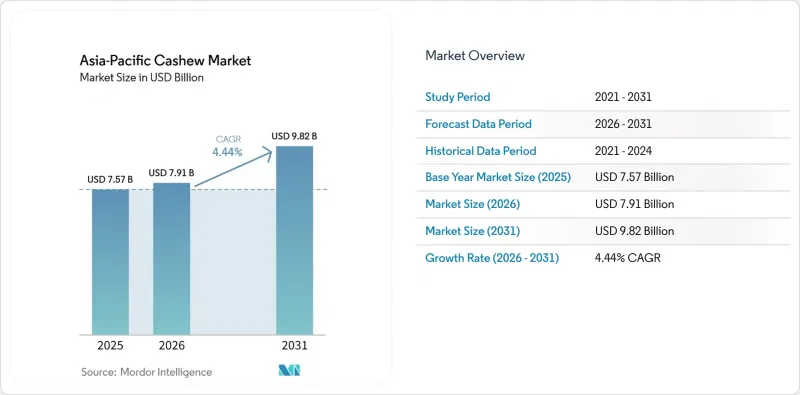
This report is Segmented by Product Form (Shelled and In-Shelled), by Geography (China, Vietnam, India, and More). The Report Includes Production Analysis (Volume), Consumption Analysis (Value and Volume), Export Analysis (Value and Volume), Import Analysis (Value and Volume), Wholesale Price Trend Analysis, and More. The Market Forecasts are Provided in Terms of Value (USD) and Volume (Metric Tons).
Asia-Pacific Cashew Market Trends and Insights
Robust Shift Toward Plant-Based Protein Snacks
Urban consumers in China, Japan, and South Korea are replacing meat snacks with tree nuts to achieve health and sustainability goals. China imported more than 150,000 metric tons of Vietnamese kernels in 2025, accounting for more than 20% of Vietnam's exports. Millennials and Generation Z drive this demand, favoring clean-label ingredients and transparent origin stories. Australia's per-capita cashew consumption has increased significantly over the past decade, reflecting growing consumer demand. Together, these trends are anticipated to sustain mid-single-digit growth in the Asia-Pacific cashew market despite stabilizing price volatility.
Rise in Intra-Asia Processing Clusters (Vietnam-Cambodia-Laos Corridor)
According to the Cashew Nut Association of Cambodia, Cambodia exported 1 million metric tons of raw cashew nuts valued at USD 1.5 billion in 2025, of which 90-95% were shipped tariff-free to Vietnam under ASEAN rules. Vietnamese shellers achieve higher yields and lower overhead than African peers, reinforcing their status as the largest exporters. Cambodia's National Cashew Policy aims to process 25% of domestic nuts by 2027, supported by a 400-hectare industrial park and new factories totaling 60,000 metric tons capacity opening in 2026. Laos also contributes to the regional processing corridor by supplying raw cashew nuts to Vietnam's major processing hubs. The integrated supply chain improves raw material availability, enhances processing efficiency, and strengthens the competitiveness and resilience of the Asia-Pacific cashew market.
Increasing Labor Shortages During Peak Harvest in Coastal India
Cashew processing hubs in Kerala and Tamil Nadu continue to face labor shortages during the peak harvest season, increasing processing costs and limiting operational efficiency. Rising wages for skilled workers, coupled with continued migration of younger workers to urban areas, have intensified labor constraints. At the same time, the slower adoption of automation compared to competing processing countries such as Vietnam has reduced the competitiveness of India's cashew processing industry. As a result, export competitiveness has weakened, with persistent labor shortages reducing profit margins and constraining India's ability to expand its share of the Asia-Pacific cashew market.
Other drivers and restraints analyzed in the detailed report include:
- Digitization of Farm-Gate Procurement Platforms
- Government Replanting Subsidies in India and Indonesia
- El Nino-Linked Yield Volatility in Southeast Asia
For complete list of drivers and restraints, kindly check the Table Of Contents.
Segment Analysis
Shelled cashew nuts commanded the largest share, accounting for 68% of the Asia-Pacific cashew market size in 2025, easily exceeding one-half of the Asia-Pacific cashew market size, as ready-to-eat formats dominated supermarket, bakery, and food-service shelves in China, Japan, and Australia. In-shell cashew nuts, while still the smaller of the two forms, are projected to post the fastest 5.4% CAGR during 2026-2031, as health-conscious consumers increasingly roast nuts at home to avoid added oils and verify freshness. Vietnamese processors now set aside specific in-shell lots for premium export channels, capturing price uplifts that run 15-20% above equivalent kernel grades. This simultaneous scale advantage for shelled kernels and growth momentum for in-shell products shapes a two-speed expansion path for the category.
Shelled cashews remain the industry workhorse, from which most enter confectionery, snack, and food-ingredient pipelines in China, the United States, and the European Union. Flavor innovation supports further gains, roasted and seasoned variants already account for a rising share of outbound shipments and attract 20-30% premiums over raw kernels in top Asian retail chains. By contrast, in-shell nuts appeal to niche channels such as organic stores and direct-to-consumer platforms, where shoppers pay extra for minimal processing and the theater of home roasting. As both forms extend reach one through convenience and the other through experiential consumption, the product-form landscape will continue to broaden market share opportunities for suppliers.
Complete Report Scope:
- By Form (Value)
- In-Shell
- Shelled (Kernels)
- By Geography
- Asia-Pacific
- China
- Production Analysis (Area Harvested, Yield, and Production Volume)
- Consumption Analysis (Consumption Value and Volume)
- Import Market Analysis (Import Value, Volume, and Key Supplying Markets)
- Export Market Analysis (Export Value, Volume, and Key Destination Markets)
- Wholesale Price Trend Analysis and Forecast
- Regulatory Framework
- List of Key Players
- Logistics and Infrastructure
- Seasonality Analysis
- India
- Production Analysis (Area Harvested, Yield, and Production Volume)
- Consumption Analysis (Consumption Value and Volume)
- Import Market Analysis (Import Value, Volume, and Key Supplying Markets)
- Export Market Analysis (Export Value, Volume, and Key Destination Markets)
- Wholesale Price Trend Analysis and Forecast
- Regulatory Framework
- List of Key Players
- Logistics and Infrastructure
- Seasonality Analysis
- Thailand
- Production Analysis (Area Harvested, Yield, and Production Volume)
- Consumption Analysis (Consumption Value and Volume)
- Import Market Analysis (Import Value, Volume, and Key Supplying Markets)
- Export Market Analysis (Export Value, Volume, and Key Destination Markets)
- Wholesale Price Trend Analysis and Forecast
- Regulatory Framework
- List of Key Players
- Logistics and Infrastructure
- Seasonality Analysis
- Vietnam
- Production Analysis (Area Harvested, Yield, and Production Volume)
- Consumption Analysis (Consumption Value and Volume)
- Import Market Analysis (Import Value, Volume, and Key Supplying Markets)
- Export Market Analysis (Export Value, Volume, and Key Destination Markets)
- Wholesale Price Trend Analysis and Forecast
- Regulatory Framework
- List of Key Players
- Logistics and Infrastructure
- Seasonality Analysis
- Indonesia
- Production Analysis (Area Harvested, Yield, and Production Volume)
- Consumption Analysis (Consumption Value and Volume)
- Import Market Analysis (Import Value, Volume, and Key Supplying Markets)
- Export Market Analysis (Export Value, Volume, and Key Destination Markets)
- Wholesale Price Trend Analysis and Forecast
- Regulatory Framework
- List of Key Players
- Logistics and Infrastructure
- Seasonality Analysis
- Philippines
- Production Analysis (Area Harvested, Yield, and Production Volume)
- Consumption Analysis (Consumption Value and Volume)
- Import Market Analysis (Import Value, Volume, and Key Supplying Markets)
- Export Market Analysis (Export Value, Volume, and Key Destination Markets)
- Wholesale Price Trend Analysis and Forecast
- Regulatory Framework
- List of Key Players
- Logistics and Infrastructure
- Seasonality Analysis
- China
- Asia-Pacific
Additional Benefits:
- The market estimate (ME) sheet in Excel format
- 3 months of analyst support
TABLE OF CONTENTS
1 INTRODUCTION
- 1.1 Study Assumptions and Market Definition
- 1.2 Scope of the Study
2 RESEARCH METHODOLOGY
3 EXECUTIVE SUMMARY
4 MARKET LANDSCAPE
- 4.1 Market Overview
- 4.2 Market Drivers
- 4.2.1 Robust shift toward plant-based protein snacks
- 4.2.2 Rise in intra-Asia processing clusters (Vietnam-Cambodia-Laos corridor)
- 4.2.3 Digitization of farm-gate procurement platforms
- 4.2.4 Government replanting subsidies in India and Indonesia
- 4.2.5 Growing demand for cashew shell liquid in bio-polyols
- 4.2.6 Near-shoring of Japanese roasters to Vietnam
- 4.3 Market Restraints
- 4.3.1 Increasing labor shortages during peak harvest in coastal India
- 4.3.2 El Nino-linked yield volatility in Southeast Asia
- 4.3.3 Stringent aflatoxin limits in China and Japan
- 4.3.4 Rising freight rates for refrigerated kernel exports
- 4.4 Opportunities
- 4.5 Challenges
- 4.6 Value Chain Analysis
- 4.7 Technologies and usage of AI in the Industry
- 4.8 Input Market Analysis
- 4.8.1 Seeds
- 4.8.2 Fertilizers
- 4.8.3 Crop Protection Chemicals
- 4.9 Distribution Channel Analysis
- 4.10 Market Sentiment Analysis
- 4.11 PESTLE Analysis
5 MARKET SIZE AND GROWTH FORECASTS (VALUE AND VOLUME)
- 5.1 By Form (Value)
- 5.1.1 In-Shell
- 5.1.2 Shelled (Kernels)
- 5.2 By Geography
- 5.2.1 Asia-Pacific
- 5.2.1.1 China
- 5.2.1.1.1 Production Analysis (Area Harvested, Yield, and Production Volume)
- 5.2.1.1.2 Consumption Analysis (Consumption Value and Volume)
- 5.2.1.1.3 Import Market Analysis (Import Value, Volume, and Key Supplying Markets)
- 5.2.1.1.4 Export Market Analysis (Export Value, Volume, and Key Destination Markets)
- 5.2.1.1.5 Wholesale Price Trend Analysis and Forecast
- 5.2.1.1.6 Regulatory Framework
- 5.2.1.1.7 List of Key Players
- 5.2.1.1.8 Logistics and Infrastructure
- 5.2.1.1.9 Seasonality Analysis
- 5.2.1.2 India
- 5.2.1.2.1 Production Analysis (Area Harvested, Yield, and Production Volume)
- 5.2.1.2.2 Consumption Analysis (Consumption Value and Volume)
- 5.2.1.2.3 Import Market Analysis (Import Value, Volume, and Key Supplying Markets)
- 5.2.1.2.4 Export Market Analysis (Export Value, Volume, and Key Destination Markets)
- 5.2.1.2.5 Wholesale Price Trend Analysis and Forecast
- 5.2.1.2.6 Regulatory Framework
- 5.2.1.2.7 List of Key Players
- 5.2.1.2.8 Logistics and Infrastructure
- 5.2.1.2.9 Seasonality Analysis
- 5.2.1.3 Thailand
- 5.2.1.3.1 Production Analysis (Area Harvested, Yield, and Production Volume)
- 5.2.1.3.2 Consumption Analysis (Consumption Value and Volume)
- 5.2.1.3.3 Import Market Analysis (Import Value, Volume, and Key Supplying Markets)
- 5.2.1.3.4 Export Market Analysis (Export Value, Volume, and Key Destination Markets)
- 5.2.1.3.5 Wholesale Price Trend Analysis and Forecast
- 5.2.1.3.6 Regulatory Framework
- 5.2.1.3.7 List of Key Players
- 5.2.1.3.8 Logistics and Infrastructure
- 5.2.1.3.9 Seasonality Analysis
- 5.2.1.4 Vietnam
- 5.2.1.4.1 Production Analysis (Area Harvested, Yield, and Production Volume)
- 5.2.1.4.2 Consumption Analysis (Consumption Value and Volume)
- 5.2.1.4.3 Import Market Analysis (Import Value, Volume, and Key Supplying Markets)
- 5.2.1.4.4 Export Market Analysis (Export Value, Volume, and Key Destination Markets)
- 5.2.1.4.5 Wholesale Price Trend Analysis and Forecast
- 5.2.1.4.6 Regulatory Framework
- 5.2.1.4.7 List of Key Players
- 5.2.1.4.8 Logistics and Infrastructure
- 5.2.1.4.9 Seasonality Analysis
- 5.2.1.5 Indonesia
- 5.2.1.5.1 Production Analysis (Area Harvested, Yield, and Production Volume)
- 5.2.1.5.2 Consumption Analysis (Consumption Value and Volume)
- 5.2.1.5.3 Import Market Analysis (Import Value, Volume, and Key Supplying Markets)
- 5.2.1.5.4 Export Market Analysis (Export Value, Volume, and Key Destination Markets)
- 5.2.1.5.5 Wholesale Price Trend Analysis and Forecast
- 5.2.1.5.6 Regulatory Framework
- 5.2.1.5.7 List of Key Players
- 5.2.1.5.8 Logistics and Infrastructure
- 5.2.1.5.9 Seasonality Analysis
- 5.2.1.6 Philippines
- 5.2.1.6.1 Production Analysis (Area Harvested, Yield, and Production Volume)
- 5.2.1.6.2 Consumption Analysis (Consumption Value and Volume)
- 5.2.1.6.3 Import Market Analysis (Import Value, Volume, and Key Supplying Markets)
- 5.2.1.6.4 Export Market Analysis (Export Value, Volume, and Key Destination Markets)
- 5.2.1.6.5 Wholesale Price Trend Analysis and Forecast
- 5.2.1.6.6 Regulatory Framework
- 5.2.1.6.7 List of Key Players
- 5.2.1.6.8 Logistics and Infrastructure
- 5.2.1.6.9 Seasonality Analysis
- 5.2.1.1 China
- 5.2.1 Asia-Pacific
6 END USE APPLICATIONS AND INDUSTRIES
- 6.1 Primary Applications and Emerging Applications
- 6.2 Consumption Breakdown by Industries
7 COMPETITIVE LANDSCAPE
- 7.1 Overview of the Competition
- 7.2 Recent Developments
- 7.3 Market Concentration Analysis
8 MARKET OPPORTUNITIES AND FUTURE OUTLOOK

