PUBLISHER: Mordor Intelligence | PRODUCT CODE: 2113238

PUBLISHER: Mordor Intelligence | PRODUCT CODE: 2113238
India Cashew - Market Share Analysis, Industry Trends & Statistics, Growth Forecasts (2026 - 2031)
According to Mordor Intelligence, the India cashew market size is projected to grow from USD 2.35 billion in 2025 to USD 2.46 billion in 2026 and is forecast to reach USD 3.07 billion by 2031 at 4.53% CAGR over 2026-2031.
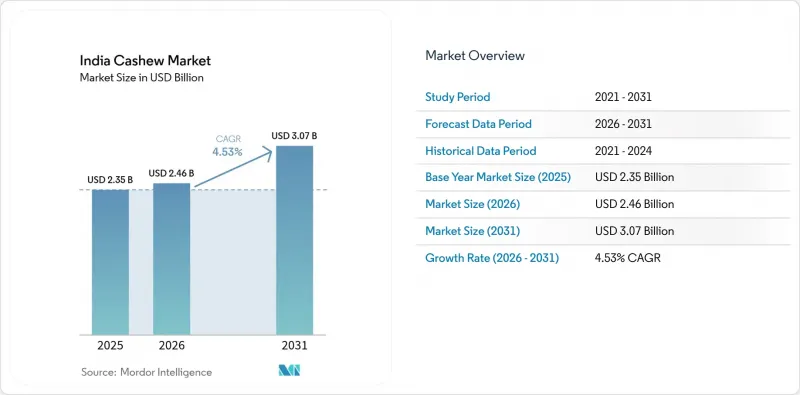
This report is Segmented by Form (Shelled Kernels and In-Shell). The Report Includes Production Analysis (Volume), Consumption Analysis (Value and Volume), Import Analysis (Value and Volume), Export Analysis (Value and Volume), Wholesale Price Trend Analysis and Forecast, List of Key Players, and More. The Market Forecasts are Provided in Terms of Value (USD) and Volume (Metric Tons).
India Cashew Market Trends and Insights
Growing Import Volumes from Africa
African suppliers now satisfy over 70% of import demand, ensuring continuous throughput for the India cashew market even when domestic harvests fluctuate. The Cashew Board's e-tender purchases and Kerala's support price protect farmer incomes while securing raw inputs for processors. Stable import pipelines also create arbitrage potential because processors can buy lower-priced crops during African gluts and release kernels when global prices tighten. Over the medium term, sustained import growth reinforces processing economies of scale and lifts the India cashew market.
Surge in Plant-Based Snacking Among Gen-Z Consumers
Gen-Z preference for protein-rich, minimally processed foods has pushed annual domestic cashew consumption specifically with the growth of the bakery and snacking industries. Social media messaging that links nuts to heart health amplifies demand for flavored, roasted, and single-serve packs. Processors upgrade packaging lines to deliver resealable pouches and nitrogen-flushed containers that extend shelf life and preserve flavor. Premium positioning allows brands to charge higher retail prices than traditional fried snacks, supporting revenue growth despite relatively flat per capita nut availability. The consumer shift enlarges the India cashew market while simultaneously diverting a larger share of kernels away from export channels.
Tightening Labor Market in Nut Processing
Women constitute 95% of the workforce that manually shells, peels, and grades kernels in India. Competing employment in manufacturing and services has lifted wage expectations well beyond the historical norm, raising unit processing costs. Some facilities have shuttered in Goa, shifting orders to lower-cost states and disrupting local supply networks. Automation vendors now market artificial-intelligence grading stations that cut labor needs per metric ton by half, yet high upfront costs deter smaller mills. Labor scarcity, therefore, continues to temper output expansion in the India cashew market. Automation requires significant capital investment and technical expertise, creating barriers for smaller processors who form the majority of India's cashew processing ecosystem.
Other drivers and restraints analyzed in the detailed report include:
- Expansion of Private-Label Cashew Offerings in Club Stores
- FDA-Qualified Health Claim for Nuts Driving Functional Foods
- Exposure to Ocean Freight Rate Volatility
For complete list of drivers and restraints, kindly check the Table Of Contents.
Segment Analysis
Shelled kernels held 93.7% of the India cashew market share in 2025 and captured USD 300.3 million in export revenues in 2024 according to the data from ITC Trade Map, highlighting the ability of local mills to extract value beyond raw nut trading. Automated shellers and deep-learning visual sorters raise recovery of premium W180 and W210 grades, reducing overall processing wastage. Efficiency gains allow processors to absorb higher farm-gate prices without passing full costs to buyers, increasing elasticity of demand in the India cashew market.
Shelled kernels are projected to register a 6.07% CAGR through 2031, the fastest among both forms, underpinned by expanding modern-trade aisles and flavored snack launches. Processors have adopted nitrogen-flush packaging that adds six months of shelf life, enabling entry into distant markets. In-shell nuts appeal to niche consumer segments that prefer whole-nut cracking and enjoy longer room-temperature storage. Their slower growth stems from minimal value addition and less marketing support.
Complete Report Scope:
- By Form (Value)
- Shelled Kernels
- In-shell
- India
- Production Analysis
- Production Volume
- Area Harvested and Yield
- Consumption Analysis (Value and Volume)
- Trade Analysis (Value and Volume)
- Import Market Analysis
- Import Value and Volume
- Key Supplying Markets
- Export Market Analysis
- Export Value and Volume
- Key Destinations Markets
- Import Market Analysis
- Wholesale Price Trend Analysis and Forecast
- Regulatory Framework
- Logistics and Infrastructure
- Seasonality Analysis
- Production Analysis
Additional Benefits:
- The market estimate (ME) sheet in Excel format
- 3 months of analyst support
TABLE OF CONTENTS
1 Introduction
- 1.1 Study Assumptions and Market Definition
- 1.2 Scope of the Study
2 Research Methodology
3 Executive Summary
4 Market Landscape
- 4.1 Market Overview
- 4.2 Market Drivers
- 4.2.1 Growing import volumes from Africa
- 4.2.2 Surge in plant-based snacking among Gen-Z consumers
- 4.2.3 Expansion of private-label cashew offerings in club stores
- 4.2.4 FDA-qualified health claim for nuts driving functional foods
- 4.2.5 Adoption of cold-chain logistics
- 4.2.6 Corporate carbon-neutral sourcing mandates
- 4.3 Market Restraints
- 4.3.1 Tightening labor market in nut processing
- 4.3.2 Exposure to ccean freight rate volatility
- 4.3.3 Stringent aflatoxin limits reduce usable imports
- 4.3.4 African Swine Fever-linked feed competition for broken grades
- 4.4 Opportunities
- 4.5 Challenges
- 4.6 Value Chain Analysis
- 4.7 Technologies and usage of AI in the Industry
- 4.8 Input Market Analysis
- 4.8.1 Seeds
- 4.8.2 Fertilizers
- 4.8.3 Crop Protection Chemicals
- 4.9 Distribution Channel Analysis
- 4.10 Market Sentiment Analysis
- 4.11 PESTLE Analysis
5 Market Size and Growth Forecasts (Value and Volume)
- 5.1 By Form (Value)
- 5.1.1 Shelled Kernels
- 5.1.2 In-shell
- 5.2 India
- 5.2.1 Production Analysis
- 5.2.1.1 Production Volume
- 5.2.1.2 Area Harvested and Yield
- 5.2.2 Consumption Analysis (Value and Volume)
- 5.2.3 Trade Analysis (Value and Volume)
- 5.2.3.1 Import Market Analysis
- 5.2.3.1.1 Import Value and Volume
- 5.2.3.1.2 Key Supplying Markets
- 5.2.3.2 Export Market Analysis
- 5.2.3.2.1 Export Value and Volume
- 5.2.3.2.2 Key Destinations Markets
- 5.2.3.1 Import Market Analysis
- 5.2.4 Wholesale Price Trend Analysis and Forecast
- 5.2.5 Regulatory Framework
- 5.2.6 Logistics and Infrastructure
- 5.2.7 Seasonality Analysis
- 5.2.1 Production Analysis
6 End Use Applications and Industries
- 6.1 Primary Applications and Emerging Applications
- 6.2 Consumption Breakdown by Industries
7 Competitive Landscape
- 7.1 Overview of the Competition
- 7.2 Recent Developments
- 7.3 Market Concentration Analysis
- 7.4 List of Key Players
- 7.4.1 Planters (Hormel Foods Corp.)
- 7.4.2 John B. Sanfilippo and Son
- 7.4.3 Olam International
- 7.4.4 ADM
- 7.4.5 Red River Foods Inc.
- 7.4.6 Superior Nut Company
- 7.4.7 Kirkland Signature (Costco Wholesale Corp.)
- 7.4.8 Blue Diamond Growers
- 7.4.9 Royal Nut Australia Pty Ltd
- 7.4.10 SunTree Snack Foods, LLC
- 7.4.11 Sam's West, Inc. (Walmart Inc.)
8 Market Opportunities and Future Outlook

