PUBLISHER: Mordor Intelligence | PRODUCT CODE: 2113195

PUBLISHER: Mordor Intelligence | PRODUCT CODE: 2113195
Asia-Pacific Freeze-Dried Products - Market Share Analysis, Industry Trends & Statistics, Growth Forecasts (2026 - 2031)
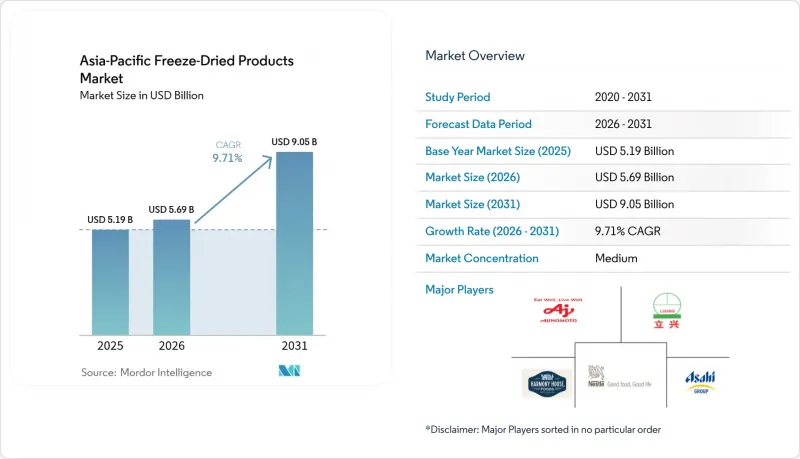
According to Mordor Intelligence, Asia-Pacific freeze-dried products market size in 2026 is estimated at USD 5.69 billion, growing from 2025 value of USD 5.19 billion with 2031 projections showing USD 9.05 billion, growing at 9.71% CAGR over 2026-2031.
This report is Segmented by Product Type (Freeze-Dried Fruits, Freeze-Dried Vegetables, and More), Nature (Conventional and Organic), Distribution Channel (Supermarkets/Hypermarkets, Convenience/Grocery Stores, and More), and Geography (China, Japan, India, Australia, and More). The Market Forecasts are Provided in Terms of Value (USD) and Volume (Tons).
Asia-Pacific Freeze-Dried Products Market Trends and Insights
Rising demand for long-shelf-life healthy snacks
Health-conscious consumers are increasingly opting for high-protein, fiber-rich snacks that are portable and don't require refrigeration. These snacks cater to the growing demand for convenient yet nutritious options, aligning with shifting dietary preferences. Freeze-drying, which preserves color, texture, and micronutrients more effectively than thermal dehydration, is becoming the preferred method for producing fruit, yogurt, and vegetable chips. This technique not only enhances the shelf life of products but also maintains their nutritional value, making them appealing to health-focused buyers. Japanese processors are witnessing triple-digit growth by promoting single-serve vegetable portions, catering to busy households that prioritize premium convenience and are willing to pay a premium for quality. In response to tightening additive limits from food safety agencies, brands are emphasizing their clean-label credentials and showcasing natural ingredient lists, which resonate strongly with consumers seeking transparency and healthier choices.
Expansion of e-grocery platforms
Mobile-first shoppers are turning to digital marketplaces for their pantry staples. Freeze-dried products, thanks to their low shipping weight, long shelf life, and tamper-evident packaging, navigate parcel networks with ease. In tier-one Chinese cities, same-day fulfillment fosters consumer trust. Meanwhile, click-and-collect services in Indonesia and Vietnam address local infrastructure challenges. The Indo-Pacific's mobile-centric shopping, bolstered by platforms like Tmall, Lazada, and Shopee, mitigates purchase risks with standardized policies and offers competitive listings for packaged goods . Supermarket chains are adapting by aligning their online assortments with in-store inventory, maintaining uniform pricing and promotions. Brands that prioritize product imagery, recipe videos, and localized keywords see a boost in search rankings and conversions.
High capital expenditure of freeze-drying equipment
Commercial freeze-dryers, priced between USD 1-3 million, pose a significant hurdle for small and mid-sized processors. Their large footprints necessitate purpose-built facilities, complete with reinforced floors and a clean-room design, leading to increased construction costs. On average, producing a kilogram of the finished product consumes 2.65 kWh of electricity, contributing to elevated operating expenses. While equipment manufacturers have introduced energy-efficient condensers and modular shelf systems that can nearly halve energy consumption, the payback periods for these investments still surpass three years. To navigate these challenges, contract manufacturing steps in, providing tolling services with minimal volume requirements, although scheduling queues can sometimes push back product launches.
Other drivers and restraints analyzed in the detailed report include:
- Rising consumer demand for convenient ready-to-eat meals
- Preference for clean-label, natural ingredients over additives
- Growing popularity of "fresh-equivalent" HPP and aseptic technologies
For complete list of drivers and restraints, kindly check the Table Of Contents.
Segment Analysis
In 2025, freeze-dried fruits dominated the Asia-Pacific freeze-dried products market, securing a 37.18% share. Their authentic flavor and versatility in snacks, breakfast cereals, and bakery fillings drove this popularity. With abundant local fruit harvests and a boom in domestic tourism, the demand for snacks and gifting surged. Freeze-dried fruits emerged as the go-to portable souvenir. Manufacturers, in collaboration with flavor houses, are crafting unique retail offerings by infusing tropical notes and botanicals. Innovations in snacks and custom cereal blends bolster the fruit segment's appeal. Sensory panels fine-tune sweetness and crunch to cater to diverse regional preferences. Thanks to advances in vacuum drying, throughput has surged by up to 20%, enabling large-scale supply while preserving nutrient integrity. Premium pet food brands harness freeze-drying to maintain amino acids and cut out preservatives, allowing them to command premium prices at specialty retailers.
While freeze-dried dairy holds a smaller market share, it's the fastest-growing segment, projected to leap at a 11.98% CAGR. This growth is fueled by consumers' heightened focus on protein quality and immune benefits. Processors are introducing yogurt bites, cheese crisps, and portable milk powder, targeting urban consumers and school lunchboxes in Asia-Pacific. Dairy-fruit fusion cubes for smoothies highlight innovative collaborations, introducing novel textures and flavors. The micro-encapsulation of heat-sensitive probiotics is steering product development, bolstering functional claims that resonate with health-conscious buyers. The market's growth is underpinned by a rising appetite for shelf-stable dairy and the ability to bridge cold-chain logistics gaps in rural areas with limited refrigeration. Several manufacturers are experimenting with proprietary vacuum profiles and advanced freeze-drying techniques, aiming to optimize cycle time and enhance product integrity, thus propelling both market growth and technological advancements in the segment.
Complete Report Scope:
- By Product Type
- Freeze-Dried Fruits
- Strawberry
- Raspberry
- Pineapple
- Apple
- Mango
- Other Fruits
- Freeze-Dried Vegetables
- Pea
- Corn
- Carrot
- Potato
- Mushroom
- Other Vegetables
- Freeze-Dried Meat and Seafood
- Freeze-Dried Dairy Products
- Freeze-Dried Beverages
- Prepared Meals
- Pet Food
- Freeze-Dried Fruits
- By Nature
- Conventional
- Organic
- Distribution Channel
- Supermarkets/Hypermarkets
- Convenience/Grocery Stores
- Online Retail Stores
- Other Distribution Channel
- By Geography
- China
- Japan
- India
- Australia
- New Zealand
- Indonesia
- Thailand
- Vietnam
- Malaysia
- Philippines
- Rest of Asia-Pacific
List of Companies Covered in this Report:
- Ajinomoto Co Inc.
- Asahi Group Holdings Ltd.
- Expedition Foods Ltd.
- Campers Pantry Pty Ltd.
- Harmony House Foods Inc.
- Nestle S.A.
- The Forager Food Co.
- Priffco Foods
- Fujian Lixing Foods Co Ltd.
- Nagatanien Holdings Co Ltd.
- Zhejiang Natural Foods Co Ltd.
- Chongqing Jinglong Freeze-Dry Co.
- Guangzhou Lvyuan Foods Co Ltd.
- Qingdao Liuting Food Co Ltd.
- Gansu Dunhuang Seed Freeze-Dry
- Lyofood Sp. z o.o. (APAC subsidiary)
- Kirin FreezeTech Co.
- Dalian Tianshan Freeze-Dry Foods
- Backpacker's Pantry (Asia operations)
- Thrive Life LLC (Asia distributors)
Additional Benefits:
- The market estimate (ME) sheet in Excel format
- 3 months of analyst support
TABLE OF CONTENTS
1 INTRODUCTION
- 1.1 Study Assumptions and Market Definition
- 1.2 Scope of the Study
2 RESEARCH METHODOLOGY
3 EXECUTIVE SUMMARY
4 MARKET LANDSCAPE
- 4.1 Market Overview
- 4.2 Market Drivers
- 4.2.1 Rising demand for long-shelf-life healthy snacks
- 4.2.2 Expansion of e-grocery platforms
- 4.2.3 Rising consumer demand for convenient ready-to-eat meals
- 4.2.4 Preference for clean-label, natural ingredients over additives
- 4.2.5 Plant-based meal-kit brands incorporating freeze-dried produce
- 4.2.6 Government-backed programs to valorise climate-impacted crops
- 4.3 Market Restraints
- 4.3.1 High capital expenditure of freeze-drying equipment
- 4.3.2 Growing popularity of fresh-equivalent" HPP and aseptic technologies"
- 4.3.3 Volatile upstream energy prices impacting process costs
- 4.3.4 Tightening Chinese export rules on agri-by-products
- 4.4 Consumer Behaviour Analysis
- 4.5 Regulatory Landscape
- 4.6 Technological Outlook
- 4.7 Porter's Five Forces
- 4.7.1 Bargaining Power of Suppliers
- 4.7.2 Bargaining Power of Buyers
- 4.7.3 Threat of New Entrants
- 4.7.4 Threat of Substitutes
- 4.7.5 Intensity of Competitive Rivalry
5 MARKET SIZE AND GROWTH FORECASTS (VALUE AND VOLUME)
- 5.1 By Product Type
- 5.1.1 Freeze-Dried Fruits
- 5.1.1.1 Strawberry
- 5.1.1.2 Raspberry
- 5.1.1.3 Pineapple
- 5.1.1.4 Apple
- 5.1.1.5 Mango
- 5.1.1.6 Other Fruits
- 5.1.2 Freeze-Dried Vegetables
- 5.1.2.1 Pea
- 5.1.2.2 Corn
- 5.1.2.3 Carrot
- 5.1.2.4 Potato
- 5.1.2.5 Mushroom
- 5.1.2.6 Other Vegetables
- 5.1.3 Freeze-Dried Meat and Seafood
- 5.1.4 Freeze-Dried Dairy Products
- 5.1.5 Freeze-Dried Beverages
- 5.1.6 Prepared Meals
- 5.1.7 Pet Food
- 5.1.1 Freeze-Dried Fruits
- 5.2 By Nature
- 5.2.1 Conventional
- 5.2.2 Organic
- 5.3 Distribution Channel
- 5.3.1 Supermarkets/Hypermarkets
- 5.3.2 Convenience/Grocery Stores
- 5.3.3 Online Retail Stores
- 5.3.4 Other Distribution Channel
- 5.4 By Geography
- 5.4.1 China
- 5.4.2 Japan
- 5.4.3 India
- 5.4.4 Australia
- 5.4.5 New Zealand
- 5.4.6 Indonesia
- 5.4.7 Thailand
- 5.4.8 Vietnam
- 5.4.9 Malaysia
- 5.4.10 Philippines
- 5.4.11 Rest of Asia-Pacific
6 COMPETITIVE LANDSCAPE
- 6.1 Market Concentration
- 6.2 Strategic Moves
- 6.3 Market Ranking Analysis
- 6.4 Company Profiles (includes Global level Overview, Market level overview, Core Segments, Financials as available, Strategic Information, Market Rank/Share for key companies, Products and Services, and Recent Developments)
- 6.4.1 Ajinomoto Co Inc.
- 6.4.2 Asahi Group Holdings Ltd.
- 6.4.3 Expedition Foods Ltd.
- 6.4.4 Campers Pantry Pty Ltd.
- 6.4.5 Harmony House Foods Inc.
- 6.4.6 Nestle S.A.
- 6.4.7 The Forager Food Co.
- 6.4.8 Priffco Foods
- 6.4.9 Fujian Lixing Foods Co Ltd.
- 6.4.10 Nagatanien Holdings Co Ltd.
- 6.4.11 Zhejiang Natural Foods Co Ltd.
- 6.4.12 Chongqing Jinglong Freeze-Dry Co.
- 6.4.13 Guangzhou Lvyuan Foods Co Ltd.
- 6.4.14 Qingdao Liuting Food Co Ltd.
- 6.4.15 Gansu Dunhuang Seed Freeze-Dry
- 6.4.16 Lyofood Sp. z o.o. (APAC subsidiary)
- 6.4.17 Kirin FreezeTech Co.
- 6.4.18 Dalian Tianshan Freeze-Dry Foods
- 6.4.19 Backpacker's Pantry (Asia operations)
- 6.4.20 Thrive Life LLC (Asia distributors)
7 MARKET OPPORTUNITIES AND FUTURE OUTLOOK

