PUBLISHER: Mordor Intelligence | PRODUCT CODE: 2114394

PUBLISHER: Mordor Intelligence | PRODUCT CODE: 2114394
Middle East And Africa Freeze-Dried Product - Market Share Analysis, Industry Trends & Statistics, Growth Forecasts (2026 - 2031)
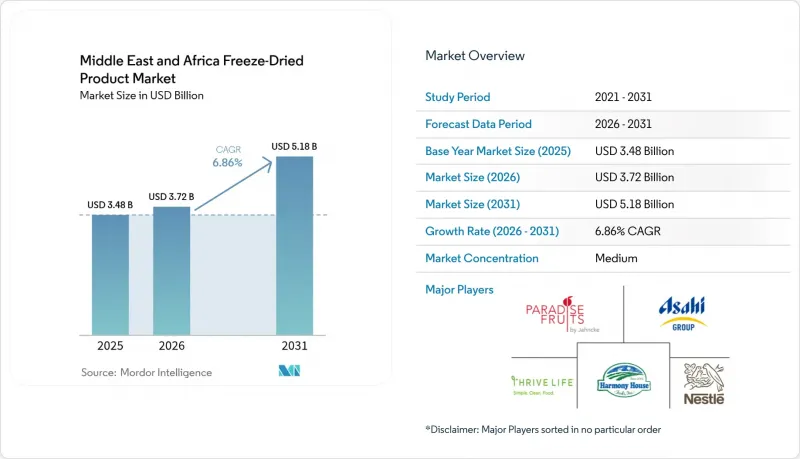
According to Mordor Intelligence, the Middle East and Africa freeze-dried product market size is expected to grow from USD 3.48 billion in 2025 to USD 3.72 billion in 2026 and is forecast to reach USD 5.18 billion by 2031 at 6.86% CAGR over 2026-2031.
This report is Segmented by Product Type (Freeze-Dried Fruits, Freeze-Dried Vegetables, and More), Nature (Conventional, Organic), Distribution Channel (Supermarkets/Hypermarkets, and More), and Geography (United Arab Emirates, South Africa, Saudi Arabia, Nigeria, Egypt, Morocco, Turkey, Rest of Middle East and Africa). The Market Forecasts are Provided in Terms of Value (USD).
Middle East And Africa Freeze-Dried Product Market Trends and Insights
Rising demand for shelf-stable foods
Modern, convenience-focused lifestyles are driving the demand for shelf-stable freeze-dried foods. These products provide nutritious, ready-to-eat options that are simple to store and transport. Demand is particularly high among busy urban consumers, outdoor enthusiasts, and in regions with limited cold chain infrastructure or elevated ambient temperatures, where fresh food has a short shelf life and logistics are challenging. Food security challenges across the region have transformed shelf-stable products from convenience items into strategic essentials. To address global economic instability and rising food prices, Egypt's Cabinet Information and Decision Support Center implemented comprehensive food security frameworks. Similarly, Nigeria introduced a 150-day duty-free import window for essential staples, highlighting the critical need for supply chain resilience. In 2024, flooding in Nigeria destroyed crops that fed 8.5 million people, while food inflation surged, according to the International Organization for Migration. These factors have driven institutional procurement of freeze-dried products for emergency preparedness programs. This shift goes beyond crisis response, as governments increasingly recognize that shelf-stable foods can help bridge seasonal supply gaps and reduce reliance on fresh produce imports, which are often affected by geopolitical issues and climate-related transport disruptions.
Increasing tourism and outdoor activities
The Middle East's tourism growth is driving demand for portable and nutritious meal solutions. Saudi Arabia's NEOM project and the UAE's luxury camping initiatives have positioned outdoor hospitality as a key growth driver. This premium focus encourages tourists to spend more on freeze-dried gourmet meals that maintain both taste and nutritional value. The region's tourism sector is thriving, with international arrivals increasing from 93.4 million in 2023 to 101.2 million in 2024, according to the World Tourism Organization (UN Tourism). Travelers and outdoor adventurers need foods that are compact, temperature-resistant, and easy to store, making freeze-dried products ideal for extended trips. The seasonal nature of Gulf tourism, with peak activity occurring outside the May-September period, aligns well with the ambient storage capabilities of freeze-dried products. This eliminates the cold chain limitations that fresh meals face during the extreme summer heat. The expansion of tourism infrastructure is also driving investments in modernizing the food supply chain, supporting consistent market growth and emphasizing the importance of freeze-dried foods for international events, expeditions, and luxury hotel services.
High capital and energy cost of freeze-drying
Market entry continues to face significant challenges, particularly for small and medium enterprises, due to the high capital requirements associated with freeze-drying equipment. These enterprises play a crucial role in Africa's food processing industry, yet the financial burden of adopting traditional freeze-drying systems remains a major barrier. Commercial-scale operations typically require investments ranging from USD 500,000 to USD 5 million, making it difficult for smaller players to compete. Additionally, in regions where grid reliability is limited, energy consumption becomes a critical factor, accounting for 60-80% of operating costs. However, advancements in hybrid technologies are beginning to address these issues. EnWave Corporation's REV (Radiant Energy Vacuum) platforms have emerged as a noteworthy solution, offering faster processing times and lower costs compared to traditional freeze-drying methods, while also delivering higher-quality results than air or spray drying techniques. Moreover, the introduction of modular, containerized freeze-drying units and solar-assisted systems presents a promising opportunity to lower both capital investments and operational expenses. These innovations are particularly relevant in Africa, where abundant solar resources can be leveraged to enhance the feasibility and sustainability of freeze-drying operations.
Other drivers and restraints analyzed in the detailed report include:
- Technological advancements in freeze-drying
- Government food-security investments
- Premium-price perception among mid-income consumers
For complete list of drivers and restraints, kindly check the Table Of Contents.
Segment Analysis
Freeze-dried fruits accounted for 32.07% of the Middle East and Africa's freeze-dried product market in 2025, highlighting strong consumer familiarity with dried formats and robust demand across breakfast items, confectionery, and on-the-go snacks. Regional food processors are enhancing cereals and bakery mixes by adding raspberries, mangoes, and dates, boosting flavor intensity without affecting shelf life. Institutional buyers, such as airlines and defense caterers, prefer berries and citrus for their ability to retain vitamin C during extended storage, driving consistent reorder volumes. Vegetables, led by peas, corn, and mushrooms, hold a significant secondary position, catering to ready-meal manufacturers, particularly those fulfilling humanitarian aid contracts. Additionally, innovations like seasoning-infused vegetable cubes are expanding culinary applications in soups and stews, especially in North and West African cuisines.
Freeze-dried meat and seafood are experiencing the fastest growth, with a 7.17% CAGR, and are expected to capture a larger share of the Middle East and Africa's freeze-dried product market by 2031. Halal certification standards provide a competitive advantage, as controlled lyophilization environments simplify traceability compared to traditional methods like sun-drying or salting. Outdoor recreation retailers in Saudi Arabia and the UAE report increasing sales of beef, chicken, and shrimp meal kits designed for overnight desert camping. Additionally, innovations such as low-sodium spice marinades applied before freeze-drying are improving flavor while adhering to health guidelines. Meanwhile, the dairy and beverage segments are steadily growing, with instant coffee and tea formats benefiting from premiumization, particularly in Gulf coffeehouse chains.
Complete Report Scope:
- By Product Type
- Freeze-Dried Fruits
- Berries
- Tropical Fruits
- Citrus Fruits
- Other Fruits
- Freeze-Dried Vegetables
- Peas and Corn
- Mushrooms
- Other Vegetables
- Freeze-Dried Meat and Seafood
- Freeze-Dried Dairy Products
- Freeze-Dried Beverages (Instant Coffee, Tea)
- Freeze-Dried Prepared Meals
- Freeze-Dried Pet foods
- Freeze-Dried Fruits
- By nature
- Conventional
- Organic
- By Distribution Channel
- Supermarkets/Hypermarkets
- Convenience Stores
- Online Retail Stores
- Other Distribution Channels
- By Geography
- United Arab Emirates
- South Africa
- Saudi Arabia
- Nigeria
- Egypt
- Morocco
- Turkey
- Rest of Middle East and Africa
List of Companies Covered in this Report:
- Nestle S.A.
- Asahi Group Holdings, Ltd.
- Harmony House Foods Inc.
- Paradise Fruits Solutions
- Expedition Foods Limited
- Thrive Life LLC
- Blue Chip Group
- Saraf Foods Ltd.
- Mondelez International Inc.
- Kerry Group Plc
- European Freeze Dry Ltd.
- Chaucer Foods Ltd.
- Brandstorm Inc.
- Kenegrade Ltd.
- Valley Food Storage
- The Kraft Heinz Company
- Honeyville
- Rodelle Inc.
- Farmer's Pantry
- Al Bayara Food Industries
Additional Benefits:
- The market estimate (ME) sheet in Excel format
- 3 months of analyst support
TABLE OF CONTENTS
1 INTRODUCTION
- 1.1 Study Assumptions and Market Definition
- 1.2 Scope of the Study
2 RESEARCH METHODOLOGY
3 EXECUTIVE SUMMARY
4 MARKET LANDSCAPE
- 4.1 Market Overview
- 4.2 Market Drivers
- 4.2.1 Rising demand for shelf-stable foods
- 4.2.2 Increasing tourism and outdoor activities
- 4.2.3 Technological advancements in freeze-drying
- 4.2.4 Busy lifestyles and convenience demand
- 4.2.5 Halal-certified freeze-dried food launches
- 4.2.6 Government food-security investments
- 4.3 Market Restraints
- 4.3.1 Sensory and texture challenges
- 4.3.2 High capital and energy cost of freeze-drying
- 4.3.3 Availability of alternative products
- 4.3.4 Premium-price perception among mid-income consumers
- 4.4 Consumer Behaviour Analysis
- 4.5 Regulatory Landscape
- 4.6 Technological Outlook
- 4.7 Porter's Five Forces
- 4.7.1 Threat of New Entrants
- 4.7.2 Bargaining Power of Buyers
- 4.7.3 Bargaining Power of Suppliers
- 4.7.4 Threat of Substitutes
- 4.7.5 Competitive Rivalry
5 MARKET SIZE AND GROWTH FORECASTS (VALUE)
- 5.1 By Product Type
- 5.1.1 Freeze-Dried Fruits
- 5.1.1.1 Berries
- 5.1.1.2 Tropical Fruits
- 5.1.1.3 Citrus Fruits
- 5.1.1.4 Other Fruits
- 5.1.2 Freeze-Dried Vegetables
- 5.1.2.1 Peas and Corn
- 5.1.2.2 Mushrooms
- 5.1.2.3 Other Vegetables
- 5.1.3 Freeze-Dried Meat and Seafood
- 5.1.4 Freeze-Dried Dairy Products
- 5.1.5 Freeze-Dried Beverages (Instant Coffee, Tea)
- 5.1.6 Freeze-Dried Prepared Meals
- 5.1.7 Freeze-Dried Pet foods
- 5.1.1 Freeze-Dried Fruits
- 5.2 By nature
- 5.2.1 Conventional
- 5.2.2 Organic
- 5.3 By Distribution Channel
- 5.3.1 Supermarkets/Hypermarkets
- 5.3.2 Convenience Stores
- 5.3.3 Online Retail Stores
- 5.3.4 Other Distribution Channels
- 5.4 By Geography
- 5.4.1 United Arab Emirates
- 5.4.2 South Africa
- 5.4.3 Saudi Arabia
- 5.4.4 Nigeria
- 5.4.5 Egypt
- 5.4.6 Morocco
- 5.4.7 Turkey
- 5.4.8 Rest of Middle East and Africa
6 COMPETITIVE LANDSCAPE
- 6.1 Market Concentration
- 6.2 Strategic Moves
- 6.3 Market Share Analysis
- 6.4 Company Profiles (includes Global level Overview, Market level overview, Core Segments, Financials as available, Strategic Information, Market Rank/Share for key companies, Products and Services, and Recent Developments)
- 6.4.1 Nestle S.A.
- 6.4.2 Asahi Group Holdings, Ltd.
- 6.4.3 Harmony House Foods Inc.
- 6.4.4 Paradise Fruits Solutions
- 6.4.5 Expedition Foods Limited
- 6.4.6 Thrive Life LLC
- 6.4.7 Blue Chip Group
- 6.4.8 Saraf Foods Ltd.
- 6.4.9 Mondelez International Inc.
- 6.4.10 Kerry Group Plc
- 6.4.11 European Freeze Dry Ltd.
- 6.4.12 Chaucer Foods Ltd.
- 6.4.13 Brandstorm Inc.
- 6.4.14 Kenegrade Ltd.
- 6.4.15 Valley Food Storage
- 6.4.16 The Kraft Heinz Company
- 6.4.17 Honeyville
- 6.4.18 Rodelle Inc.
- 6.4.19 Farmer's Pantry
- 6.4.20 Al Bayara Food Industries
7 MARKET OPPORTUNITIES AND FUTURE OUTLOOK

