PUBLISHER: Mordor Intelligence | PRODUCT CODE: 2113198

PUBLISHER: Mordor Intelligence | PRODUCT CODE: 2113198
North America Agricultural Irrigation Machinery - Market Share Analysis, Industry Trends & Statistics, Growth Forecasts (2026 - 2031)
According to Mordor Intelligence, North America agricultural irrigation machinery market size in 2026 is estimated at USD 3.48 billion, growing from 2025 value of USD 3.25 billion with 2031 projections showing USD 4.91 billion, growing at 7.12% CAGR over 2026-2031.
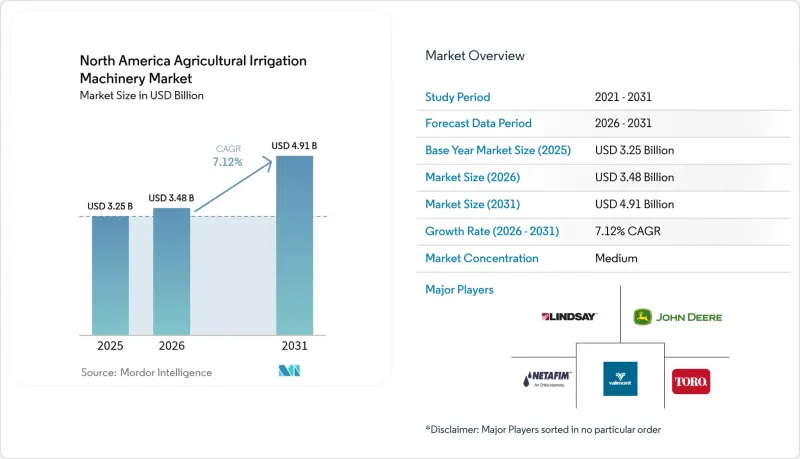
This report is Segmented by Irrigation Type (Sprinkler Irrigation, Drip Irrigation, Pivot Irrigation, and More), by Application Type (Grains and Cereals, Fruits and Vegetables, Pulses and Oilseeds, and More), and by Geography (United States, Canada, Mexico, and More). The Market Forecasts are Provided in Terms of Value (USD).
North America Agricultural Irrigation Machinery Market Trends and Insights
Digital-Twin Enabled Design Optimization
Virtual modeling platforms shorten center-pivot retrofit planning from weeks to days, trimming engineering outlays by as much as 18%. The CropTwin project, with heavy funding in 2024, uses soil maps, weather forecasts, and crop coefficients to simulate nozzle packages before hardware is ordered. Growers in Nebraska and Kansas report that the software highlights pressure bottlenecks and span mismatches overlooked during manual sizing, preventing yield loss tied to uneven distribution. Variable-rate retrofits benefit most because correct zone mapping is critical for water savings. As manufacturers embed these simulators into customer portals, mid-sized farms with limited technical staff gain affordable access to advanced design capability.
Increasing Area Under Irrigation
The United States Department of Agriculture (USDA) data show a gradual expansion of irrigated acreage in the High Plains and Mississippi Delta, while Canadian programs subsidize up to 50% of new irrigation districts in Alberta and Saskatchewan . Mexico's northern states are phasing out flood irrigation in favor of pressurized systems eligible for Conagua subsidies, boosting equipment demand despite higher upfront costs. Producers view irrigation infrastructure as insurance against erratic rainfall. Even with elevated interest rates, many operations stretch repayment schedules because stabilized yields support long-term profitability.
High Investment and Maintenance Costs
Modern drip systems cost USD 1,000 to USD 3,000 per acre, while pivots can range from USD 50,000 to USD 150,000 depending on span length and automation features. Annual upkeep averages 4% of capital value, a heavy burden for farms operating on slim margins. Conagua subsidies reduce acquisition costs for Mexican smallholders but do not offset recurring expenses such as filter cleaning and electricity bills. When grain prices soften, payback timelines lengthen, deterring upgrades.
Other drivers and restraints analyzed in the detailed report include:
- Government Support to Enhance Mechanized Irrigation
- Climate-Resilience Funding Tied to Smart Irrigation
- Scarcity of Skilled Irrigation Technologists
For complete list of drivers and restraints, kindly check the Table Of Contents.
Segment Analysis
Pivot irrigation held a 38.72% share of the North America agricultural irrigation machinery market in 2025, reflecting its fit with large-scale row-crop geometry. Variable-rate retrofits, which swap fixed nozzles for zone-controlled heads, are adding momentum. Drip-sensor solutions remain the fastest rising subsegment at a 12.05% CAGR, buoyed by California distribution uniformity mandates and permanent-crop adoption. Tubing, filters, and pressure regulators dominate component sales, while pressure-compensating emitters cut maintenance intervals. Traveling guns and solid-set systems capture the balance of niche demand in sod and nursery operations.
Valmont's Valley brand saw the pivot revenue decline in the third quarter of 2024, but the firm invested significantly to expand variable-rate pivot production, signaling long-term confidence. Flow meters and telemetry modules are now standard to satisfy water-reporting rules in Ogallala Aquifer counties. Solar-hybrid pumps and variable-frequency drives lower operating electricity costs, while retrofit kits extend service life for aging pivots. Edge-computing panels record run-time data, enabling growers to claim carbon credits for energy savings.
Complete Report Scope:
- By Irrigation type
- Sprinkler Irrigation
- Pumping Unit
- Injectors
- Sensors
- Controllers
- Fittings and Accessories
- Spray/Sprinklers Heads
- Tubing
- Couplers
- Flow Meters
- Other Sprinkler Irrigations
- Drip Irrigation
- Tubing
- Backflow Preventers
- Pressure Regulators
- Emitters
- Valves
- Filters
- Other Drip Irrigations
- Pivot Irrigation
- Other Irrigation Types
- Sprinkler Irrigation
- By Application Type
- Grains and Cereals
- Fruits and Vegetables
- Pulses and Oilseeds
- Other Application Types
- By Geography
- United States
- Canada
- Mexico
- Rest of North America
List of Companies Covered in this Report:
- Netafim Ltd.
- T-L Irrigation Co.
- Jain Irrigation Systems Ltd.
- Lindsay Corporation
- Nelson Irrigation Corporation
- Deere & Company
- The Toro Company
- Rain Bird Corporation
- Hunter Industries, Inc.
- Valmont Industries, Inc.
- Rivulis Irrigation Ltd.
- Reinke Manufacturing Co., Inc.
- Irritec S.p.A.
- AquaSpy, Inc.
- CropX Technologies Ltd.
- Trimble Inc.
- Hunter Industries Inc.
- Pessl Instruments GmbH
- Hosur Plastics
Additional Benefits:
- The market estimate (ME) sheet in Excel format
- 3 months of analyst support
TABLE OF CONTENTS
1 INTRODUCTION
- 1.1 Study Assumptions and Market Definition
- 1.2 Scope of the Study
2 RESEARCH METHODOLOGY
3 EXECUTIVE SUMMARY
4 MARKET LANDSCAPE
- 4.1 Market Overview
- 4.2 Market Drivers
- 4.2.1 Digital-Twin Enabled Design Optimization
- 4.2.2 Increasing Area Under Irrigation
- 4.2.3 Government Support to Enhance Mechanized Irrigation
- 4.2.4 Climate-Resilience Funding Tied to Smart Irrigation
- 4.2.5 Adoption of New Technological Irrigation Methods
- 4.2.6 Edge-Artificial Intelligence (AI) Based Predictive Maintenance Lowers OPEX
- 4.3 Market Restraints
- 4.3.1 High Investment and Maintenance Costs
- 4.3.2 Complex Functioning of High-Tech Systems
- 4.3.3 Scarcity of Skilled Irrigation Technologists
- 4.3.4 Cyber-Security Risks in Connected Irrigation Assets
- 4.4 Regulatory Landscape
- 4.5 Technological Outlook
- 4.6 Porter's Five Forces Analysis
- 4.6.1 Threat of New Entrants
- 4.6.2 Bargaining Power of Buyers/Consumers
- 4.6.3 Bargaining Power of Suppliers
- 4.6.4 Threat of Substitute Products
- 4.6.5 Intensity of Competitive Rivalry
5 MARKET SIZE AND GROWTH FORECASTS (VALUE)
- 5.1 By Irrigation type
- 5.1.1 Sprinkler Irrigation
- 5.1.1.1 Pumping Unit
- 5.1.1.2 Injectors
- 5.1.1.3 Sensors
- 5.1.1.4 Controllers
- 5.1.1.5 Fittings and Accessories
- 5.1.1.6 Spray/Sprinklers Heads
- 5.1.1.7 Tubing
- 5.1.1.8 Couplers
- 5.1.1.9 Flow Meters
- 5.1.1.10 Other Sprinkler Irrigations
- 5.1.2 Drip Irrigation
- 5.1.2.1 Tubing
- 5.1.2.2 Backflow Preventers
- 5.1.2.3 Pressure Regulators
- 5.1.2.4 Emitters
- 5.1.2.5 Valves
- 5.1.2.6 Filters
- 5.1.2.7 Other Drip Irrigations
- 5.1.3 Pivot Irrigation
- 5.1.4 Other Irrigation Types
- 5.1.1 Sprinkler Irrigation
- 5.2 By Application Type
- 5.2.1 Grains and Cereals
- 5.2.2 Fruits and Vegetables
- 5.2.3 Pulses and Oilseeds
- 5.2.4 Other Application Types
- 5.3 By Geography
- 5.3.1 United States
- 5.3.2 Canada
- 5.3.3 Mexico
- 5.3.4 Rest of North America
6 COMPETITIVE LANDSCAPE
- 6.1 Market Concentration
- 6.2 Strategic Moves
- 6.3 Market Share Analysis
- 6.4 Company Profiles (Includes Global Level Overview, Market Level Overview, Core Segments, Financials as Available, Strategic Information, Market Rank/Share for Key Companies, Products and Services, and Recent Developments)
- 6.4.1 Netafim Ltd.
- 6.4.2 T-L Irrigation Co.
- 6.4.3 Jain Irrigation Systems Ltd.
- 6.4.4 Lindsay Corporation
- 6.4.5 Nelson Irrigation Corporation
- 6.4.6 Deere & Company
- 6.4.7 The Toro Company
- 6.4.8 Rain Bird Corporation
- 6.4.9 Hunter Industries, Inc.
- 6.4.10 Valmont Industries, Inc.
- 6.4.11 Rivulis Irrigation Ltd.
- 6.4.12 Reinke Manufacturing Co., Inc.
- 6.4.13 Irritec S.p.A.
- 6.4.14 AquaSpy, Inc.
- 6.4.15 CropX Technologies Ltd.
- 6.4.16 Trimble Inc.
- 6.4.17 Hunter Industries Inc.
- 6.4.18 Pessl Instruments GmbH
- 6.4.19 Hosur Plastics
7 MARKET OPPORTUNITIES AND FUTURE OUTLOOK

