PUBLISHER: Mordor Intelligence | PRODUCT CODE: 2113566

PUBLISHER: Mordor Intelligence | PRODUCT CODE: 2113566
Africa Agricultural Irrigation Machinery - Market Share Analysis, Industry Trends & Statistics, Growth Forecasts (2026 - 2031)
According to Mordor Intelligence, the Africa agricultural irrigation machinery market size was valued at USD 1.45 billion in 2025 and estimated to grow from USD 1.59 billion in 2026 to reach USD 2.51 billion by 2031, at a CAGR of 9.54% during the forecast period (2026-2031).
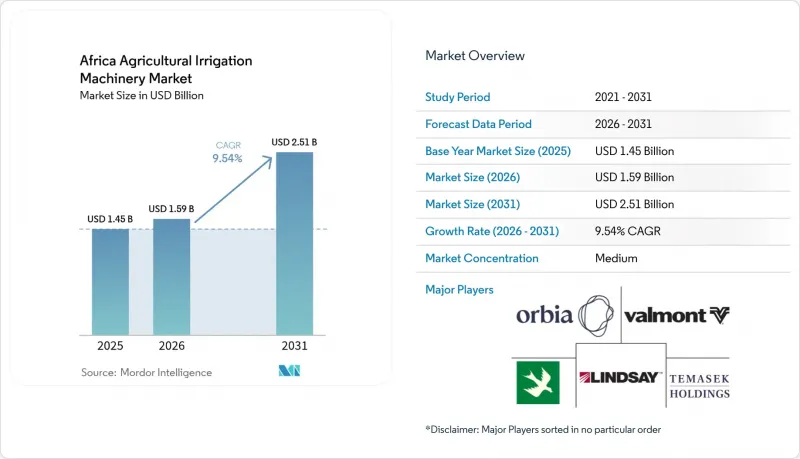
This report is Segmented by Application (Crop Based and Non-Crop Based), Irrigation Type (Sprinkler Irrigation, Drip Irrigation, and More), and Geography (South Africa, Egypt, and Rest of Africa). The Market Forecasts are Provided in Terms of Value (USD).
Africa Agricultural Irrigation Machinery Market Trends and Insights
Intensifying Water Scarcity and Food Security Mandates
Only a small percentage of Africa's cultivated land is irrigated compared to a significantly higher proportion in Asia, even as the continent's population is anticipated to grow substantially, doubling food demand. Consecutive below-average rainy seasons in the Sahel have led to emergency drip-irrigation programs for rice and vegetable plots in countries such as Burkina Faso, Niger, and Mali. Southern Africa recently faced its most severe drought in decades, prompting efforts to retrofit precision irrigation systems on maize and soybean farmland. Water allocations from the Nile to Egypt have decreased, resulting in mandatory use of drip or sprinkler irrigation systems for new agricultural projects of a certain size. Projections indicate that water availability in North Africa will decline further, highlighting the importance of improving irrigation efficiency to ensure food security.
Expansion of Government Micro-Irrigation Subsidy Schemes
Egypt's National Program for Lining Canals and Conversion to Modern Irrigation focuses on subsidizing a significant portion of equipment costs for small farms. Morocco's Green Generation 2020-2030 program supports smallholder farmers by covering a large share of drip irrigation costs, with plans to expand micro-irrigation across a substantial area. In South Africa, efforts are underway to upgrade smallholder schemes with solar-powered drip irrigation kits. Kenya's Galana-Kulalu project is expanding its coverage, integrating pivots and drip lines under a financial arrangement that includes a grant component. These initiatives significantly lower the capital expenditure for farmers, making modern irrigation systems more affordable.
High Upfront Capex versus Traditional Flood Irrigation
Precision irrigation systems are significantly more expensive for smallholders compared to furrow infrastructure, making them inaccessible for the majority of growers. High interest rates for loans in Nigeria extend the payback period for drip irrigation systems, even though they result in notable yield improvements. In Ghana, the lack of formal land titles among many farmers limits their access to adequate microfinance loans, which are insufficient for implementing drip irrigation on typical farm sizes. In Tanzania, most smallholder irrigation schemes continue to rely on gravity-fed systems, as the upfront costs remain a major obstacle despite subsidies. Furthermore, dependence on imported parts increases costs due to regional tariff duties.
Other drivers and restraints analyzed in the detailed report include:
- Rapid Pivot toward Climate-Smart Agriculture Financing
- Mainstream Adoption of Center-Pivot Retrofits on Large Estates
- Limited Technical Skills for Precision-System Maintenance
For complete list of drivers and restraints, kindly check the Table Of Contents.
Segment Analysis
Crop-based uses generated 38.60% of 2025 revenue in the African agricultural irrigation machinery market, led by maize, wheat, and soybean production on 280,000 hectares of center-pivot and drip-equipped estates in South Africa's Free State and Mpumalanga regions. Non-crop segments turf, ornamental, and nursery irrigation are set to outpace with a 12.17% CAGR as urban landscaping proliferates in Lagos, Nairobi, and Johannesburg, and export floriculture expands in Kenya and Ethiopia. Turf applications logged a 14% year-on-year rise in 2024, due to weather-based sprinkler controllers that cut water use by 35% on golf courses, aligning with municipal restrictions.
The fruits and vegetables sub-segment is the fastest-growing within crop-based uses, driven by Egypt's 85,000-hectare drip expansion for tomatoes, peppers, and citrus between 2024 and 2025. Africa agricultural irrigation machinery market size for fruits and vegetables is projected to advance at a 12.04% CAGR through 2031, aided by subsidies that defray up to 60% of drip costs. Oilseeds use pivots on 95,000 hectares yet lag due to lower per-hectare returns, while nursery crops now cover 12,000 hectares under micro-sprinklers that satisfy GlobalGAP water-efficiency rules for exports. Regulatory audits under Kenya's Water Act 2016 further propel precision adoption across both crop and non-crop categories.
Complete Report Scope:
- By Application
- Food Crop Based
- Cereals and Grains
- Oilseeds
- Fruits and Vegetables
- Non-Food Crop Based
- Turf and Ornamental
- Nursery Crops
- Food Crop Based
- By Irrigation Type
- Sprinkler Irrigation
- Drip Irrigation
- Pivot Irrigation
- Other Irrigation Types
- By Geography
- South Africa
- Egypt
- Rest of Africa
List of Companies Covered in this Report:
- Netafim Limited (Orbia Advance Corporation)
- Valmont Industries
- Lindsay Corporation
- Rain Bird Corporation
- Rivulis (Temasek Holdings)
- Jain Irrigation Systems
- Nelson Irrigation Corporation
- Hunter Industries
- Toro Company
- Reinke Manufacturing
- T-L Irrigation
- Agrico
- Metzer
- Amiad Water Systems
- Rainfine Irrigation
Additional Benefits:
- The market estimate (ME) sheet in Excel format
- 3 months of analyst support
TABLE OF CONTENTS
1 Introduction
- 1.1 Study Assumptions and Market Definition
- 1.2 Scope of the Study
2 Research Methodology
3 Executive Summary
4 Market Landscape
- 4.1 Market Overview
- 4.2 Market Drivers
- 4.2.1 Intensifying water scarcity and food-security mandates
- 4.2.2 Expansion of government micro-irrigation subsidy schemes
- 4.2.3 Rapid pivot toward climate-smart agriculture financing
- 4.2.4 Mainstream adoption of center-pivot retrofits on large estates
- 4.2.5 Underground drip systems for high-value horticulture niches
- 4.2.6 Agritech-enabled pay-per-use irrigation-as-a-service models
- 4.3 Market Restraints
- 4.3.1 High upfront capex versus traditional flood irrigation
- 4.3.2 Limited technical skills for precision-system maintenance
- 4.3.3 Foreign-exchange volatility affecting imported components
- 4.3.4 Fragmented land holdings limiting economies of scale
- 4.4 Regulatory Landscape
- 4.5 Technological Outlook
- 4.6 Porter's Five Forces
- 4.6.1 Threat of New Entrants
- 4.6.2 Bargaining Power of Buyers
- 4.6.3 Bargaining Power of Suppliers
- 4.6.4 Threat of Substitute Products
- 4.6.5 Intensity of Competitive Rivalry
5 Market Size and Growth Forecasts (Value)
- 5.1 By Application
- 5.1.1 Food Crop Based
- 5.1.1.1 Cereals and Grains
- 5.1.1.2 Oilseeds
- 5.1.1.3 Fruits and Vegetables
- 5.1.2 Non-Food Crop Based
- 5.1.2.1 Turf and Ornamental
- 5.1.2.2 Nursery Crops
- 5.1.1 Food Crop Based
- 5.2 By Irrigation Type
- 5.2.1 Sprinkler Irrigation
- 5.2.2 Drip Irrigation
- 5.2.3 Pivot Irrigation
- 5.2.4 Other Irrigation Types
- 5.3 By Geography
- 5.3.1 South Africa
- 5.3.2 Egypt
- 5.3.3 Rest of Africa
6 Competitive Landscape
- 6.1 Market Concentration
- 6.2 Strategic Moves
- 6.3 Market Share Analysis
- 6.4 Company Profiles (Includes Global level Overview, Market level overview, Core Segments, Financials as available, Strategic Information, Market Rank/Share for key companies, Products and Services, and Recent Developments)
- 6.4.1 Netafim Limited (Orbia Advance Corporation)
- 6.4.2 Valmont Industries
- 6.4.3 Lindsay Corporation
- 6.4.4 Rain Bird Corporation
- 6.4.5 Rivulis (Temasek Holdings)
- 6.4.6 Jain Irrigation Systems
- 6.4.7 Nelson Irrigation Corporation
- 6.4.8 Hunter Industries
- 6.4.9 Toro Company
- 6.4.10 Reinke Manufacturing
- 6.4.11 T-L Irrigation
- 6.4.12 Agrico
- 6.4.13 Metzer
- 6.4.14 Amiad Water Systems
- 6.4.15 Rainfine Irrigation
7 Market Opportunities and Future Outlook

