PUBLISHER: Mordor Intelligence | PRODUCT CODE: 2113232

PUBLISHER: Mordor Intelligence | PRODUCT CODE: 2113232
Indonesia Retail - Market Share Analysis, Industry Trends & Statistics, Growth Forecasts (2026 - 2031)
According to Mordor Intelligence, the Indonesia retail market size is expected to grow from USD 56.87 billion in 2025 to USD 60.09 billion in 2026 and is forecast to reach USD 79.11 billion by 2031 at a 5.65% CAGR over 2026-2031.
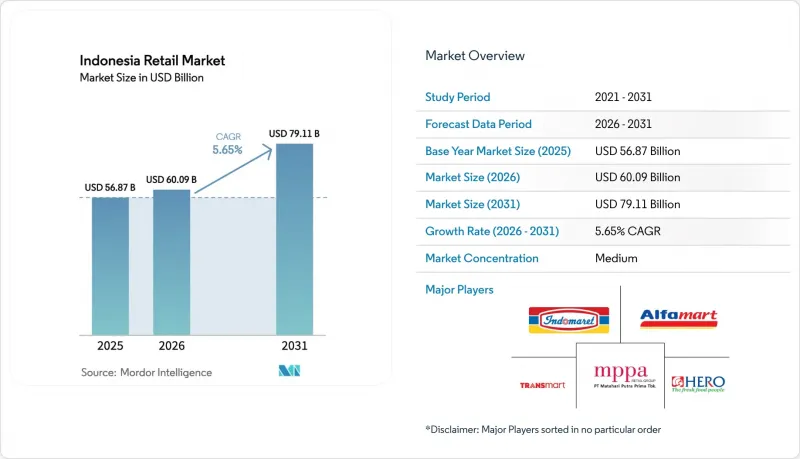
This report is Segmented by Product Category (Food & Beverage, Apparel & Footwear, and More), Distribution Channel (Hypermarkets & Supermarkets, Department Stores, and More), Payment Method (Cash, Debit & Credit Cards, E-Wallets, and Bank Transfers / Pay-Later), and Geography (Greater Jakarta, Rest of Java, Sumatra, and More). The Market Forecasts are Provided in Terms of Value (USD).
Indonesia Retail Market Trends and Insights
Rapid Urban-Middle Class Expansion in Tier-2 Indonesian Cities
Indonesia's tier-2 cities are experiencing faster consumption growth than the capital, driven by a rising number of middle-income households and improved infrastructure that reduces service costs and expands brand reach. In 2024, Jakarta's gross regional domestic product per capita reached roughly IDR 344 million (USD 20,600), far exceeding most other provinces and highlighting the concentration of spending power in core metropolitan markets. Nevertheless, companies report stronger comparable growth outside Jakarta, supported by new mall developments and retail densification in provincial hubs . For example, UNIQLO operated 77 stores across Indonesia by August 2025 and noted higher growth outside the capital in FY2024, consistent with continued momentum across Southeast Asia, India, and the Australia region. This consumption trend is further reinforced by the share of middle and near-middle-class households in national spending, alongside rising consumer confidence through mid-2025 before a late-summer dip. As second-tier cities expand modern retail infrastructure, the Indonesian market is witnessing sustained upgrades in categories such as health and beauty, quick-service dining, and select apparel segments.
Government Push for Cashless Society Accelerating Modern Retail Adoption
The widespread adoption of the Quick Response Code Indonesian Standard (QRIS) across tens of millions of merchants has significantly increased digital retail transactions. Usage of QRIS surged alongside BI-FAST, Bank Indonesia's 24/7 real-time payment system connecting over 100 financial institutions, facilitating instant transfers and merchant collections. Policy rate cuts in 2025, together with the Payment System Blueprint, further supported transaction growth while keeping inflation near target. Additionally, the central bank expanded QRIS cross-border interoperability within ASEAN, with ongoing sandbox testing and phased rollouts to additional corridors. Retailers that implemented QRIS and BI-FAST experienced higher transaction volumes and smoother checkouts, enhancing conversion rates for convenience stores and supermarket formats in dense urban areas.
Persistently High Logistics Costs Across the Archipelago
Inter-island shipping costs and long lead times weigh on margins and store rollout outside Java, which narrows the addressable footprint for large-format retail. Sea-toll routes helped bulk-haul costs on selected lanes, but last-mile frictions persist due to uneven warehouse density and cold-chain gaps in Eastern Indonesia. The policy response improved import administration and clarified sanctions, yet structural infrastructure gaps remain, especially for temperature-controlled logistics. Retailers concentrate distribution centers near provincial hubs, add automation, and use store clusters to meet service time targets while protecting unit economics. The Indonesia retail market outside Java therefore favors capital-light franchising and digital fulfillment models until operating costs improve more broadly.
Other drivers and restraints analyzed in the detailed report include:
- Rising Penetration of Affordable Smartphones Driving Mobile-First E-commerce
- Domestic FMCG Manufacturers' Shift to Direct-to-Retailer Distribution
- Price-Sensitive Consumer Base Limiting Premiumization
For complete list of drivers and restraints, kindly check the Table Of Contents.
Segment Analysis
Food and beverages held 37.24% of 2025 category sales, supported by inelastic staples that anchor household budgets even when confidence dips, which keeps base volumes stable for grocery channels. Health, beauty, and personal care is forecast to grow at an 8.48% CAGR during 2026-2031, signaling the premium-growth pocket within an otherwise value-driven landscape for the Indonesia retail market. Halal compliance is rising in importance ahead of the 2026 certification expansion, and leading chains introduced formats and merchandising to capture the trade-up. Category momentum is tied to influencer-led discovery and social video that surfaces new brands at attractive price points. The Indonesia retail market continues to direct floor space and content investments toward high-turnover beauty, wellness, and personal care, where shopper engagement is trending higher.
The noodles and pantry staple base stays vital for basket frequency, while beauty adds ticket lift for stores and marketplaces that curate fast-moving SKUs. Indofood posted sizeable branded sales in 2024, supported by its extensive manufacturing and distribution footprint across the country, which underpins shelf availability in both modern outlets and warungs. Corporate disclosures point to direct supply relationships with major convenience chains, aligning replenishment with store-level demand and reducing latency from factory to shelf. As retailers test hybrid digital-physical floor concepts, beauty and wellness brands gain visibility through interactive screens and personalized recommendations that boost conversion. This combination of staples stability and beauty-led trade-up keeps the retail industry in Indonesia on a balanced path, where value formats capture volume and curated lines deliver margin.
Complete Report Scope:
- By Product Category
- Food and Beverage
- Apparel and Footwear
- Consumer Electronics and Appliances
- Home and Furniture
- Health, Beauty and Personal Care
- Others
- By Distribution Channel
- Hypermarkets and Supermarkets
- Department Stores
- Convenience Stores and Mini-markets
- Specialty Stores
- Traditional (Warung / Kiosks)
- Online
- By Payment Method
- Cash
- Debit & Credit Cards
- E-Wallets
- Bank Transfers / Pay-Later
- By Region
- Greater Jakarta
- Rest of Java
- Sumatra
- Kalimantan
- Sulawesi
- Bali & Nusa Tenggara
- Papua & Maluku
List of Companies Covered in this Report:
- Indomaret (PT Indomarco Prismatama)
- Alfamart (PT Sumber Alfaria Trijaya Tbk)
- Hypermart & Foodmart (PT Matahari Putra Prima Tbk)
- Transmart Carrefour (PT Trans Retail Indonesia)
- Hero Supermarket & Guardian (PT Hero Supermarket Tbk)
- Mitra Adiperkasa (MAP Group)
- Ramayana Department Store (PT Ramayana Lestari Sentosa Tbk)
- Lotte Mart Indonesia
- Ace Hardware Indonesia (PT Ace Hardware Indonesia Tbk)
- Erajaya Swasembada Tbk
- Blibli (PT Global Digital Niaga Tbk)
- Tokopedia (PT Tokopedia)
- Shopee Indonesia (Sea Ltd)
- Lazada Indonesia
- Bukalapak Tbk
- IKEA Indonesia
- Uniqlo Indonesia
- Circle K Indonesia
- Watsons Indonesia
Additional Benefits:
- The market estimate (ME) sheet in Excel format
- 3 months of analyst support
TABLE OF CONTENTS
1 Introduction
- 1.1 Study Assumptions & Market Definition
- 1.2 Scope of the Study
2 Research Methodology
3 Executive Summary
4 Market Landscape
- 4.1 Market Overview
- 4.2 Market Drivers
- 4.2.1 Rapid Urban-Middle Class Expansion in Tier-2 Indonesian Cities
- 4.2.2 Government Push for Cashless Society Accelerating Modern Retail Adoption
- 4.2.3 Rising Penetration of Affordable Smartphones Driving Mobile-First E-commerce
- 4.2.4 Domestic FMCG Manufacturers' Shift to Direct-to-Retailer Distribution
- 4.2.5 Relaxation of Foreign Investment Caps in Retail Sub-sectors
- 4.2.6 Tourism Rebound Boosting Bali and Secondary Leisure Retail Hubs
- 4.3 Market Restraints
- 4.3.1 Persistently High Logistics Costs Across the Archipelago
- 4.3.2 Price-Sensitive Consumer Base Limiting Premiumization
- 4.3.3 Fragmented Traditional "Warung" Network Hindering Modern Trade Growth
- 4.3.4 Complex Provincial Licensing and Zoning Regulations
- 4.4 Value / Supply-Chain Analysis
- 4.5 Regulatory Outlook
- 4.6 Technological Outlook
- 4.7 Porter's Five Forces
- 4.7.1 Threat of New Entrants
- 4.7.2 Bargaining Power of Suppliers
- 4.7.3 Bargaining Power of Buyers
- 4.7.4 Threat of Substitutes
- 4.7.5 Competitive Rivalry
5 Market Size & Growth Forecasts (Value)
- 5.1 By Product Category
- 5.1.1 Food and Beverage
- 5.1.2 Apparel and Footwear
- 5.1.3 Consumer Electronics and Appliances
- 5.1.4 Home and Furniture
- 5.1.5 Health, Beauty and Personal Care
- 5.1.6 Others
- 5.2 By Distribution Channel
- 5.2.1 Hypermarkets and Supermarkets
- 5.2.2 Department Stores
- 5.2.3 Convenience Stores and Mini-markets
- 5.2.4 Specialty Stores
- 5.2.5 Traditional (Warung / Kiosks)
- 5.2.6 Online
- 5.3 By Payment Method
- 5.3.1 Cash
- 5.3.2 Debit & Credit Cards
- 5.3.3 E-Wallets
- 5.3.4 Bank Transfers / Pay-Later
- 5.4 By Region
- 5.4.1 Greater Jakarta
- 5.4.2 Rest of Java
- 5.4.3 Sumatra
- 5.4.4 Kalimantan
- 5.4.5 Sulawesi
- 5.4.6 Bali & Nusa Tenggara
- 5.4.7 Papua & Maluku
6 Competitive Landscape
- 6.1 Market Concentration
- 6.2 Strategic Moves
- 6.3 Market Share Analysis
- 6.4 Company Profiles (includes Global level Overview, Market level overview, Core Segments, Financials as available, Strategic Information, Market Rank/Share for key companies, Products & Services, and Recent Developments)
- 6.4.1 Indomaret (PT Indomarco Prismatama)
- 6.4.2 Alfamart (PT Sumber Alfaria Trijaya Tbk)
- 6.4.3 Hypermart & Foodmart (PT Matahari Putra Prima Tbk)
- 6.4.4 Transmart Carrefour (PT Trans Retail Indonesia)
- 6.4.5 Hero Supermarket & Guardian (PT Hero Supermarket Tbk)
- 6.4.6 Mitra Adiperkasa (MAP Group)
- 6.4.7 Ramayana Department Store (PT Ramayana Lestari Sentosa Tbk)
- 6.4.8 Lotte Mart Indonesia
- 6.4.9 Ace Hardware Indonesia (PT Ace Hardware Indonesia Tbk)
- 6.4.10 Erajaya Swasembada Tbk
- 6.4.11 Blibli (PT Global Digital Niaga Tbk)
- 6.4.12 Tokopedia (PT Tokopedia)
- 6.4.13 Shopee Indonesia (Sea Ltd)
- 6.4.14 Lazada Indonesia
- 6.4.15 Bukalapak Tbk
- 6.4.16 IKEA Indonesia
- 6.4.17 Uniqlo Indonesia
- 6.4.18 Circle K Indonesia
- 6.4.19 Watsons Indonesia
- 6.5 Market Opportunities & Future Outlook
- 6.5.1 White-space & Unmet-Need Assessment

