PUBLISHER: Mordor Intelligence | PRODUCT CODE: 2113271

PUBLISHER: Mordor Intelligence | PRODUCT CODE: 2113271
South America Orange - Market Share Analysis, Industry Trends & Statistics, Growth Forecasts (2026 - 2031)
According to Mordor Intelligence, the South America orange market size is projected to be USD 4.55 billion in 2025, USD 4.8 billion in 2026, and reach USD 6.3 billion by 2031, growing at a CAGR of 5.59% from 2026-2031.
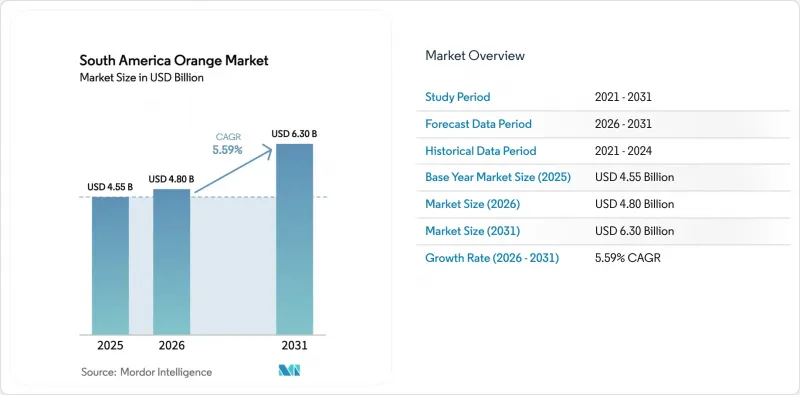
This report is Segmented by Geography (Brazil, Argentina, Venezuela, and Chile). The Report Includes Production Analysis (Volume), Consumption Analysis (Value and Volume), Import Analysis (Value and Volume), Export Analysis (Value and Volume), Wholesale Price Trend Analysis and Forecast, List of Key Players and More. The Market Forecasts are Provided in Terms of Value (USD) and Volume (Metric Tons).
South America Orange Market Trends and Insights
Surging Regional Consumption of Fresh Oranges
South American consumers are increasingly prioritizing locally sourced produce, with 80% opting for home-grown products when available. Among these, 75.2% identify fruit as their primary local purchase category. Post-pandemic surveys indicate that 41.7% of households have increased their consumption of fruits and vegetables. However, only 17% meet the WHO (World Health Organization)'s recommended five-a-day guideline. In Argentina, austerity measures have pushed up poverty levels, leading to a decline in household spending on fresh fruit. Overall, robust local demand supports baseline production volumes in the South America orange market.
Export-Led Boom in Frozen Concentrated Orange Juice
In the 2025/26 period, Brazil was the leading producer of 66 Brix frozen concentrated orange juice, accounting for a significant share of the global supply and generating significant export revenue. Global brands, such as Tropicana, now source 75% of their fruit from Brazilian processors, indicating a significant shift in the supply chain. Argentina's juice exports nearly doubled in value during early 2025, while Chile exported 103,000 metric tons of fresh oranges in 2024/25, capitalizing on counter-seasonal opportunities in the United States market. However, export taxes and currency controls in Argentina continue to suppress farm-gate returns, limiting reinvestment potential.
Spreading Citrus Greening Across Sao Paulo Groves
Huanglongbing (HLB) incidence in Sao Paulo increased from 19% in 2024 to 22.7% in 2025, reducing productive potential by approximately 35% and requiring growers to replant every five to seven years. As no commercially viable resistant rootstock is widely available, early detection and the removal of infected trees remain essential. Brazil's 330 million-box orange harvest in 2025/26 grew by only 3.7% compared to the previous season, highlighting the impact of the disease. In Argentina, lower planting density helps slow the spread of vectors, but the threat persists. If left unchecked, Huanglongbing (HLB) could significantly reduce the growth rate.
Other drivers and restraints analyzed in the detailed report include:
- Rapid Adoption of High-Density Orchards and Micro-Irrigation
- Government-Backed Replanting Subsidies in Brazil and Argentina
- Volatile Farm-Gate Prices Tied to Currency Swings
For complete list of drivers and restraints, kindly check the Table Of Contents.
Complete Report Scope:
- By Geography
- Brazil
- Production Analysis (Area Harvested, Yield, and Production Volume)
- Consumption Analysis (Consumption Value and Volume)
- Import Market Analysis (Import Value, Volume, and Key Supplying Markets)
- Export Market Analysis (Export Value, Volume, and Key Destination Markets)
- Wholesale Price Trend Analysis and Forecast
- Regulatory Framework
- List of Key Players
- Logistics and Infrastructure
- Seasonality Analysis
- Argentina
- Production Analysis (Area Harvested, Yield, and Production Volume)
- Consumption Analysis (Consumption Value and Volume)
- Import Market Analysis (Import Value, Volume, and Key Supplying Markets)
- Export Market Analysis (Export Value, Volume, and Key Destination Markets)
- Wholesale Price Trend Analysis and Forecast
- Regulatory Framework
- List of Key Players
- Logistics and Infrastructure
- Seasonality Analysis
- Venezuela
- Production Analysis (Area Harvested, Yield, and Production Volume)
- Consumption Analysis (Consumption Value and Volume)
- Import Market Analysis (Import Value, Volume, and Key Supplying Markets)
- Export Market Analysis (Export Value, Volume, and Key Destination Markets)
- Wholesale Price Trend Analysis and Forecast
- Regulatory Framework
- List of Key Players
- Logistics and Infrastructure
- Seasonality Analysis
- Chile
- Production Analysis (Area Harvested, Yield, and Production Volume)
- Consumption Analysis (Consumption Value and Volume)
- Import Market Analysis (Import Value, Volume, and Key Supplying Markets)
- Export Market Analysis (Export Value, Volume, and Key Destination Markets)
- Wholesale Price Trend Analysis and Forecast
- Regulatory Framework
- List of Key Players
- Logistics and Infrastructure
- Seasonality Analysis
- Brazil
Additional Benefits:
- The market estimate (ME) sheet in Excel format
- 3 months of analyst support
TABLE OF CONTENTS
1 Introduction
- 1.1 Study Assumptions and Market Definition
- 1.2 Scope of the Study
2 Research Methodology
3 Executive Summary
4 Market Landscape
- 4.1 Market Overview
- 4.2 Market Drivers
- 4.2.1 Surging Regional Consumption of Fresh Oranges
- 4.2.2 Export-Led Boom in Frozen Concentrated Orange Juice
- 4.2.3 Rapid Adoption of High-Density Orchards and Micro-Irrigation
- 4.2.4 Government-Backed Replanting Subsidies in Brazil and Argentina
- 4.2.5 Rise of Functional Beverages Using South American Citrus Extracts
- 4.2.6 Blockchain-Enabled Traceability Premiums from European Importers
- 4.3 Market Restraints
- 4.3.1 Spreading Citrus Greening Across Sao Paulo Groves
- 4.3.2 Volatile Farm-Gate Prices Tied to Currency Swings
- 4.3.3 Water-Stress Risks in Semi-Arid Brazilian Northeast
- 4.3.4 Rising Labor Shortages Due to Rural-Urban Migration
- 4.4 Opportunities
- 4.5 Challenges
- 4.6 Value Chain Analysis
- 4.7 Technologies and usage of AI in the Industry
- 4.8 Input Market Analysis
- 4.8.1 Seeds
- 4.8.2 Fertilizers
- 4.8.3 Crop Protection Chemicals
- 4.9 Distribution Channel Analysis
- 4.10 Market Sentiment Analysis
- 4.11 PESTLE Analysis
5 Market Size and Growth Forecast (Value and Volume)
- 5.1 By Geography
- 5.1.1 Brazil
- 5.1.1.1 Production Analysis (Area Harvested, Yield, and Production Volume)
- 5.1.1.2 Consumption Analysis (Consumption Value and Volume)
- 5.1.1.3 Import Market Analysis (Import Value, Volume, and Key Supplying Markets)
- 5.1.1.4 Export Market Analysis (Export Value, Volume, and Key Destination Markets)
- 5.1.1.5 Wholesale Price Trend Analysis and Forecast
- 5.1.1.6 Regulatory Framework
- 5.1.1.7 List of Key Players
- 5.1.1.8 Logistics and Infrastructure
- 5.1.1.9 Seasonality Analysis
- 5.1.2 Argentina
- 5.1.2.1 Production Analysis (Area Harvested, Yield, and Production Volume)
- 5.1.2.2 Consumption Analysis (Consumption Value and Volume)
- 5.1.2.3 Import Market Analysis (Import Value, Volume, and Key Supplying Markets)
- 5.1.2.4 Export Market Analysis (Export Value, Volume, and Key Destination Markets)
- 5.1.2.5 Wholesale Price Trend Analysis and Forecast
- 5.1.2.6 Regulatory Framework
- 5.1.2.7 List of Key Players
- 5.1.2.8 Logistics and Infrastructure
- 5.1.2.9 Seasonality Analysis
- 5.1.3 Venezuela
- 5.1.3.1 Production Analysis (Area Harvested, Yield, and Production Volume)
- 5.1.3.2 Consumption Analysis (Consumption Value and Volume)
- 5.1.3.3 Import Market Analysis (Import Value, Volume, and Key Supplying Markets)
- 5.1.3.4 Export Market Analysis (Export Value, Volume, and Key Destination Markets)
- 5.1.3.5 Wholesale Price Trend Analysis and Forecast
- 5.1.3.6 Regulatory Framework
- 5.1.3.7 List of Key Players
- 5.1.3.8 Logistics and Infrastructure
- 5.1.3.9 Seasonality Analysis
- 5.1.4 Chile
- 5.1.4.1 Production Analysis (Area Harvested, Yield, and Production Volume)
- 5.1.4.2 Consumption Analysis (Consumption Value and Volume)
- 5.1.4.3 Import Market Analysis (Import Value, Volume, and Key Supplying Markets)
- 5.1.4.4 Export Market Analysis (Export Value, Volume, and Key Destination Markets)
- 5.1.4.5 Wholesale Price Trend Analysis and Forecast
- 5.1.4.6 Regulatory Framework
- 5.1.4.7 List of Key Players
- 5.1.4.8 Logistics and Infrastructure
- 5.1.4.9 Seasonality Analysis
- 5.1.1 Brazil
6 End Use Applications and Industries
- 6.1 Primary Applications and Emerging Applications
- 6.2 Consumption Breakdown by Industries
7 Competitive Landscape
- 7.1 Overview of the Competition
- 7.2 Recent Developments
- 7.3 Market Concentration Analysis
8 Market Opportunities and Future Outlook

