PUBLISHER: Mordor Intelligence | PRODUCT CODE: 2113322

PUBLISHER: Mordor Intelligence | PRODUCT CODE: 2113322
India Food Sweeteners - Market Share Analysis, Industry Trends & Statistics, Growth Forecasts (2026 - 2031)
According to Mordor Intelligence, the India food sweeteners market size was valued at USD 3.34 billion in 2025 and estimated to grow from USD 3.49 billion in 2026 to reach USD 4.34 billion by 2031, at a CAGR of 4.49% during the forecast period (2026-2031).
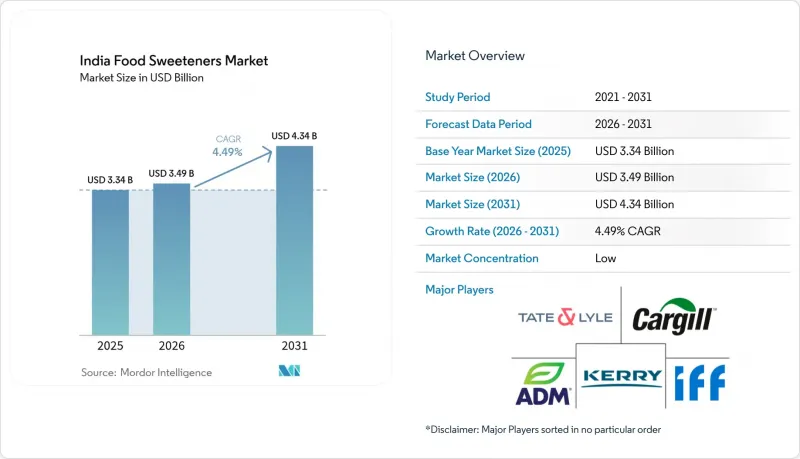
This report is Segmented by Product Type (Sucrose, Starch Sweeteners and Sugar Alcohols, High-Intensity Sweeteners), Source (Plant-Based, Artificial, Fermentation-Derived), Application (Bakery and Confectionery, Dairy and Desserts, Sauces Dressings and Spreads, and More), and Geography (North India, West India, East India, South India). The Market Forecasts are Provided in Terms of Value (USD).
India Food Sweeteners Market Trends and Insights
Expansion of processed food and beverage manufacturing
The government's Production Linked Incentive Scheme (PLISFPI), along with complementary initiatives, has played a transformative role in accelerating the growth of the food processing market, achieving a remarkable 15.2% CAGR. These initiatives have focused on building modern infrastructure and strengthening export capabilities, positioning the sector for sustained growth. Between 2014-15 and 2022-23, the share of processed food exports in total agricultural exports witnessed a significant rise, increasing from 13.7% to 25.6%. This expansion in food processing has fueled a growing demand for sweeteners, particularly in the ready-to-eat and beverage segments, which continue to be major contributors to this trend. The increasing consumer preference for convenience foods and beverages, coupled with the rising disposable incomes and urbanization, has further amplified the demand for sweeteners. Moreover, state-level policies and fiscal incentives have been pivotal in attracting private investments, driving industrial development, and generating employment opportunities. These measures collectively underscore the sector's potential for long-term growth and its critical role in the broader economic landscape, Invest India, 2024.
Rising demand for clean-label formulations
As consumers increasingly prioritize transparency and natural ingredients, a pronounced demand for clean labels emerges, especially in metropolitan and Tier 1 cities. Here, shoppers meticulously examine ingredient lists, showing a clear preference for plant-based or minimally processed sweeteners. This shift in consumer behavior is driving significant changes in the food and beverage industry. Regulatory bodies, notably the FSSAI, are playing a pivotal role. They've revamped labelling and display standards, pushing for clearer nutritional information. This move not only bolsters consumer trust but also hastens reformulation initiatives among manufacturers. Companies are responding by innovating their product offerings, leveraging this trend to differentiate their products and tap into premium market segments. This alignment with consumer preferences and regulatory requirements is expected to shape the competitive landscape in the coming years, according to the Food Compliance International, 2024.
Slow adoption of natural sweeteners in traditional recipes
India's culinary heritage, steeped in tradition, often favors sucrose and jaggery for their familiar taste. Even with regulatory nods and health campaigns championing natural sweeteners, their adoption in these age-old recipes has been sluggish. Cultural habits and a lack of awareness beyond urban locales pose hurdles, stalling broader market growth. The preference for traditional sweeteners is deeply ingrained, as they are not only integral to the flavor profile of many dishes but also hold cultural and emotional significance. While manufacturers dabble in hybrid formulations and ramp up educational efforts, the advancements remain modest. These efforts include introducing products that blend traditional and natural sweeteners to ease the transition for consumers and conducting targeted campaigns to raise awareness about the health benefits of natural alternatives. However, overcoming the structural challenges tied to cultural inertia and limited outreach in rural areas will require sustained and innovative strategies.
Other drivers and restraints analyzed in the detailed report include:
- Technological advancements in extraction and processing
- Strong regulatory support for the use of natural sweeteners
- Growing health consciousness among wider population
For complete list of drivers and restraints, kindly check the Table Of Contents.
Segment Analysis
India's sweeteners market is witnessing a notable shift, with high-intensity sweeteners projected to lead the growth at a 5.33% CAGR from 2026 to 2031. This trend is largely attributed to expanding regulatory approvals for ingredients like stevia and allulose, steering the market away from traditional bulk sweeteners. While starch sweeteners and sugar alcohols currently dominate the market, holding a 62.58% share in 2025, they continue to be favored for their cost-effectiveness in mass-market processed foods and beverages. Recent patent advancements, including the stabilization of allulose syrup and innovations in stevia Reb M, have enhanced taste profiles and solubility. This progress positions high-intensity sweeteners as formidable contenders in both mainstream and premium market segments.
The transition is further bolstered by the FSSAI's regulatory influence and its alignment with global additive standards, especially as beverage and bakery manufacturers adapt to shifting consumer preferences, as noted by Tate & Lyle PLC in 2024. Meanwhile, other product segments such as dextrose, HFCS, maltodextrin, and sugar alcohols like xylitol and sorbitol continue to cater to specific functional and cost requirements, especially in confectionery and dairy sectors. Yet, as health-driven innovations and reformulations gain momentum, the market share of these segments is anticipated to stabilize.
Complete Report Scope:
- Product Type
- Sucrose
- Starch Sweeteners and Sugar Alcohols
- Dextrose
- High-Fructose Corn Syrup (HFCS)
- Maltodextrin
- Sorbitol
- Xylitol
- Other Starch Sweeteners and Sugar Alcohols
- High-Intensity Sweeteners (HIS)
- Sucralose
- Aspartame
- Saccharin
- Cyclamate
- Ace-K
- Neotame
- Stevia
- Other High-Intensity Sweeteners
- Source
- Plant-Based
- Artificial
- Fermentation-Drived
- Application
- Bakery and Confectionery
- Dairy and Desserts
- Sauces Dressings and Spreads
- Beverages
- Other Applications
- Geography
- North India
- West India
- East India
- South India
List of Companies Covered in this Report:
- Tate & Lyle PLC
- Cargill Incorporated
- Archer Daniels Midland Company
- International Flavors & Fragrances Inc.
- Ingredion Incorporated
- Ajinomoto Co. Inc.
- Kesar Enterprises Limited
- GLG Life Tech Corporation
- Agrana Group
- Kerry Group PLC
- Balrampur Chini Mills Ltd.
- Shree Renuka Sugars Ltd.
- EID Parry (India) Ltd.
- Dhampur Bio Organics Ltd.
- Bajaj Hindusthan Sugar Ltd.
- Roquette Freres (India)
- Sweegen India Pvt. Ltd.
- Zydus Wellness Ltd.
- PureCircle by Ingredion
- Gulshan Polyols Ltd.
- Jubilant Ingrevia Ltd.
Additional Benefits:
- The market estimate (ME) sheet in Excel format
- 3 months of analyst support
TABLE OF CONTENTS
1 INTRODUCTION
- 1.1 Study Assumptions and Market Definition
- 1.2 Scope of the Study
2 RESEARCH METHODOLOGY
3 EXECUTIVE SUMMARY
4 MARKET LANDSCAPE
- 4.1 Market Overview
- 4.2 Market Drivers
- 4.2.1 Rising diabetes and obesity spur demand for low-/no-calorie sweeteners
- 4.2.2 Expansion of processed food and beverage manufacturing
- 4.2.3 Rising demand for clean-label formulations
- 4.2.4 Technological advancements in extraction and processing
- 4.2.5 Strong regulatory support for the use of natural sweeteners
- 4.2.6 Fermentation-derived rare-sugar start-ups scaling in India
- 4.3 Market Restraints
- 4.3.1 Slow Adoption of natural sweeteners in traditional recipes
- 4.3.2 growing health consciousness among wider population
- 4.3.3 growing preference on calorie reduction
- 4.3.4 rising type 2 diabetes linked to high sugar consumption
- 4.4 Supply Chain Analysis
- 4.5 Regulatory Outlook
- 4.6 Porter's Five Forces
- 4.6.1 Threat of New Entrants
- 4.6.2 Bargaining Power of Buyers/Consumers
- 4.6.3 Bargaining Power of Suppliers
- 4.6.4 Threat of Substitute Products
- 4.6.5 Intensity of Competitive Rivalry
5 MARKET SIZE AND GROWTH FORECAST
- 5.1 Product Type
- 5.1.1 Sucrose
- 5.1.2 Starch Sweeteners and Sugar Alcohols
- 5.1.2.1 Dextrose
- 5.1.2.2 High-Fructose Corn Syrup (HFCS)
- 5.1.2.3 Maltodextrin
- 5.1.2.4 Sorbitol
- 5.1.2.5 Xylitol
- 5.1.2.6 Other Starch Sweeteners and Sugar Alcohols
- 5.1.3 High-Intensity Sweeteners (HIS)
- 5.1.3.1 Sucralose
- 5.1.3.2 Aspartame
- 5.1.3.3 Saccharin
- 5.1.3.4 Cyclamate
- 5.1.3.5 Ace-K
- 5.1.3.6 Neotame
- 5.1.3.7 Stevia
- 5.1.3.8 Other High-Intensity Sweeteners
- 5.2 Source
- 5.2.1 Plant-Based
- 5.2.2 Artificial
- 5.2.3 Fermentation-Derived
- 5.3 Application
- 5.3.1 Bakery and Confectionery
- 5.3.2 Dairy and Desserts
- 5.3.3 Sauces Dressings and Spreads
- 5.3.4 Beverages
- 5.3.5 Other Applications
- 5.4 Geography
- 5.4.1 North India
- 5.4.2 West India
- 5.4.3 East India
- 5.4.4 South India
6 COMPETITIVE LANDSCAPE
- 6.1 Market Concentration
- 6.2 Strategic Moves
- 6.3 Market Ranking Analysis
- 6.4 Company Profiles (includes Global-level Overview, Market-level Overview, Core Segments, Financials (if available), Strategic Information, Market Rank/Share, Products and Services, Recent Developments)
- 6.4.1 Tate & Lyle PLC
- 6.4.2 Cargill Incorporated
- 6.4.3 Archer Daniels Midland Company
- 6.4.4 International Flavors & Fragrances Inc.
- 6.4.5 Ingredion Incorporated
- 6.4.6 Ajinomoto Co. Inc.
- 6.4.7 Kesar Enterprises Limited
- 6.4.8 GLG Life Tech Corporation
- 6.4.9 Agrana Group
- 6.4.10 Kerry Group PLC
- 6.4.11 Balrampur Chini Mills Ltd.
- 6.4.12 Shree Renuka Sugars Ltd.
- 6.4.13 EID Parry (India) Ltd.
- 6.4.14 Dhampur Bio Organics Ltd.
- 6.4.15 Bajaj Hindusthan Sugar Ltd.
- 6.4.16 Roquette Freres (India)
- 6.4.17 Sweegen India Pvt. Ltd.
- 6.4.18 Zydus Wellness Ltd.
- 6.4.19 PureCircle by Ingredion
- 6.4.20 Gulshan Polyols Ltd.
- 6.4.21 Jubilant Ingrevia Ltd.
7 MARKET OPPORTUNITIES AND FUTURE OUTLOOK

