PUBLISHER: Mordor Intelligence | PRODUCT CODE: 2113591

PUBLISHER: Mordor Intelligence | PRODUCT CODE: 2113591
United States Food Sweetener - Market Share Analysis, Industry Trends & Statistics, Growth Forecasts (2026 - 2031)
According to Mordor Intelligence, the United States food sweetener market size was valued at USD 11.74 billion in 2025 and estimated to grow from USD 12.12 billion in 2026 to reach USD 14.19 billion by 2031, at a CAGR of 3.22% during the forecast period (2026-2031).
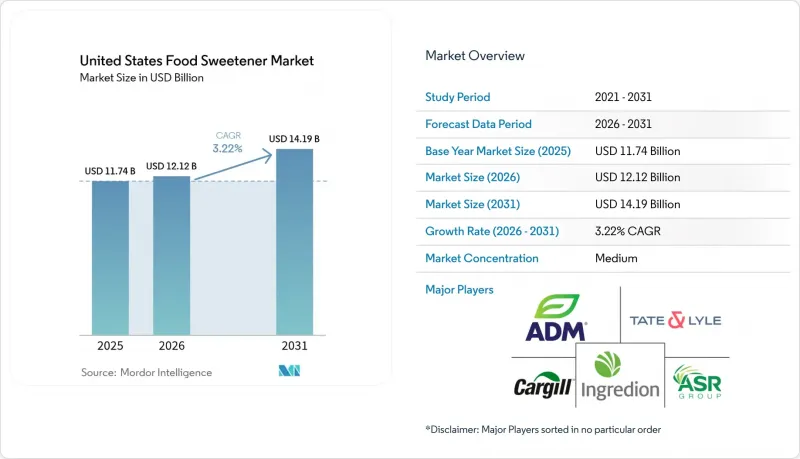
This report is Segmented by Product Type (Sucrose, Starch Sweeteners and Sugar Alcohols, and More), Application (Bakery and Confectionery, Dairy and Desserts and More), Form (Powder, Liquid, and Crystal), and Category (Conventional, and Organic). The Market Forecasts are Provided in Terms of Value (USD) and Volume (Units).
United States Food Sweetener Market Trends and Insights
Increasing obesity and diabetes in the United States drive demand for sugar reduction and alternatives
Adult obesity prevalence reached 40.3% during the 2021-2023 National Health and Nutrition Examination Survey (NHANES) cycle, with 23 states reporting rates at or above 35% in 2024. This widespread public health issue has a direct impact on sweetener demand: 38.4 million Americans are currently living with diabetes, while an additional 97.6 million individuals have prediabetes. Together, these conditions contribute to an economic burden of USD 413 billion annually in medical expenses and lost productivity . This significant financial strain has prompted payers, employers, and policymakers to actively support sugar-reduction initiatives, fostering a regulatory environment that is increasingly favorable for alternative sweeteners. Additionally, the growing use of glucagon-like peptide-1 (GLP-1) receptor agonist medications, such as semaglutide and tirzepatide, has introduced another dynamic. Users of these medications have been observed to reduce their spending on sweet baked goods by approximately 10% within six months, indicating a behavioral shift that further erodes baseline demand. As a result, product formulators are now tasked with addressing a dual challenge: replacing sugar to align with health guidelines while simultaneously creating products that remain appealing to consumers whose taste preferences are being influenced by these medications.
Health awareness and label scrutiny promote low-calorie and "better-for-you" sweetener reformulations
Label literacy has reached a critical juncture: 66% of Americans actively limited their sugar intake in 2024, an increase from 61% in the previous year. Among these consumers, 60% specifically targeted added sugars rather than naturally occurring sugars . This heightened awareness is compelling brands to reformulate their products or risk becoming obsolete on store shelves. PepsiCo surpassed its 2025 target a year early, achieving 67% of its beverage volume meeting the less than or equal to 100 calories per 12-ounce threshold in 2024. Similarly, Coca-Cola reported that 30% of its global beverage volume now consists of low-calorie or no-calorie options, alongside the launch of 250 reduced-sugar products in 2024. However, a paradox remains: only 16% of sugar-limiting consumers prefer low-calorie sweeteners, while 30% still favor traditional sugars despite associated health concerns. This gap between consumer preferences and behavior underscores that taste and texture continue to be decisive factors for market success. It also highlights the strategic importance of next-generation sweeteners that replicate sucrose-like sensory profiles without the added caloric content.
Stringent Food and Drug Administration (FDA) regulations and Generally Recognized as Safe (GRAS) approval processes delay novel sweeteners' market entry
The United States Food and Drug Administration's (FDA) Generally Recognized as Safe (GRAS) notification pathway requires the submission of detailed safety dossiers. These dossiers must include toxicology studies, assessments of metabolic fate, and exposure estimates. The preparation of such dossiers can cost between USD 500,000 and USD 2 million per ingredient and typically takes 18 to 36 months to complete. Once submitted, the FDA's stated 180-day review period often extends to 12 to 18 months if additional data is requested. For instance, Rebaudioside M (Reb M), a high-purity stevia glycoside, has been under FDA review since late 2024 (GRN 1184), delaying its commercial launch despite its widespread acceptance in other markets. This regulatory process tends to favor established companies such as Cargill and Tate & Lyle, which can spread compliance costs across their extensive global portfolios. In contrast, startups often face significant challenges due to limited financial resources, making it difficult to sustain the lengthy approval cycles. Furthermore, the January 2024 ban on Red Dye Number 3, which affects approximately 9,200 products, underscores how sudden regulatory changes can lead to significant reformulation costs. Such developments further discourage investment in innovative ingredients with uncertain approval timelines.
Other drivers and restraints analyzed in the detailed report include:
- Expansion of reduced-sugar and sugar-free products in beverages, bakery, confectionery, and dairy
- Innovations in high-intensity and natural sweeteners enhance taste and functionality
- Complex United States labeling rules increase compliance costs and reformulation challenges
For complete list of drivers and restraints, kindly check the Table Of Contents.
Segment Analysis
Sucrose accounted for 67.85% of the market share in 2025, maintaining its dominance due to its versatile functionality, including bulk, browning, moisture retention, and use as a fermentation substrate across bakery, confectionery, and dairy applications. However, high-intensity sweeteners are projected to grow at a compound annual growth rate (CAGR) of 3.84% from 2026 to 2031, marking the fastest growth among product types. This growth is driven by beverage reformulation efforts and regulatory initiatives aimed at reducing added sugars. Within the high-intensity sweeteners category, natural options such as stevia and monk fruit are increasingly replacing artificial alternatives like aspartame and sucralose, as clean-label requirements gain traction.
Stevia extract is now featured in over 14,000 global stock-keeping units (SKUs), with U.S. beverage brands accounting for 45% of its adoption. Monk fruit extract, while more expensive, offers a cleaner sweetness profile and has become the preferred choice for premium reformulations. For instance, Capri Sun achieved a 40% sugar reduction by utilizing monk fruit concentrate to maintain taste quality. Starch sweeteners and sugar alcohols serve as a middle-ground option, providing bulk and moderate sweetness at a lower cost compared to sucrose. Dextrose and high-fructose corn syrup (HFCS) continue to be widely used in processed foods, although HFCS faces reputational challenges. In 2024, Nestle USA removed HFCS from over 60 beverage recipes.
The beverages segment accounted for 44.55% of the application share in 2025, driven by its ability to reformulate products effectively. Liquid systems can incorporate high-intensity sweeteners without the textural challenges often encountered in solid foods. For instance, PepsiCo achieved 67% compliance with its target of less than 100 calories per 12-ounce serving, while Coca-Cola reported that 30% of its product volume consists of low- or no-calorie options. These achievements underscore the adaptability of beverage companies in addressing both regulatory requirements and evolving consumer preferences. The ability to pivot quickly has positioned the beverages segment as a leader in the adoption of alternative sweeteners.
However, the bakery and confectionery segment is projected to grow at the fastest rate of 3.61% during the forecast period of 2026 to 2031. This growth is attributed to manufacturers leveraging multi-ingredient sweetener systems to replicate the functional properties of sugar, such as bulk, browning, and moisture retention. Ingredients like allulose and erythritol have become integral to reduced-sugar cookie and cake formulations, offering Maillard browning and crumb structure improvements that earlier generations of polyols could not achieve. Meanwhile, dairy and desserts represent a high-value application area where sweeteners must withstand processes like pasteurization, homogenization, and cold-chain distribution. Brazzein, a protein-based sweetener known for its heat stability, has emerged as a viable option for retorted dairy products, a niche where artificial sweeteners like aspartame and sucralose often degrade under high temperatures.
Complete Report Scope:
- By Product Type
- Sucrose
- Starch Sweeteners and Sugar Alcohols
- Dextrose
- High Fructose Corn Syrup (HFCS)
- Maltodextrin
- Sorbitol
- Xylitol
- Other Starch Sweeteners and Sugar Alcohols
- High-Intensity Sweeteners
- Artificial High-Intensity Sweeteners
- Sucralose
- Aspartame
- Saccharin
- Neotame
- Cyclamate
- Acesulfame Potassium (Ace-K)
- Other Artificial HIS
- Natural High-Intensity Sweeteners
- Stevia Extract
- Monk Fruit Extract
- Other Natural HIS
- Artificial High-Intensity Sweeteners
- Other Sweeteners
- By Application
- Bakery and Confectionery
- Dairy and Desserts
- Beverages
- Soups, Sauces, and Dressings
- Other Applications
- By Form
- Powder
- Liquid
- Crystal
- By Category
- Conventional
- Organic
List of Companies Covered in this Report:
- Cargill, Incorporated
- Archer-Daniels-Midland Company
- Tate & Lyle PLC
- Ingredion Incorporated
- ASR Group International, Inc.
- Roquette Freres S.A.
- Ajinomoto Co., Inc.
- Sudzucker AG
- Guilin Layn Natural Ingredients
- Stevia First Corp.
- Manus Bio Inc.
- Barentz International BV
- Sweet Green Fields
- GLG Life Tech Corp.
- Whole Earth Brands
- Batory Foods
- PureCircle by Ingredion
- Global Organics Ltd.
- Sanxinyuan Food Industry
- Bonumose Inc.
Additional Benefits:
- The market estimate (ME) sheet in Excel format
- 3 months of analyst support
TABLE OF CONTENTS
1 INTRODUCTION
- 1.1 Study Assumptions and Market Definition
- 1.2 Scope of the Study
2 RESEARCH METHODOLOGY
3 EXECUTIVE SUMMARY
4 MARKET LANDSCAPE
- 4.1 Market Overview
- 4.2 Market Drivers
- 4.2.1 Increasing obesity and diabetes in the United States drive demand for sugar reduction and alternatives
- 4.2.2 Health awareness and label scrutiny promote low-calorie and "better-for-you" sweetener reformulations
- 4.2.3 Expansion of reduced-sugar and sugar-free products in beverages, bakery, confectionery, and dairy
- 4.2.4 Innovations in high-intensity and natural sweeteners enhance taste and functionality
- 4.2.5 Technological advancements minimize off-tastes and bitterness in sweetener formulations
- 4.2.6 Clean-label trends boost demand for plant-based and minimally processed sweeteners
- 4.3 Market Restraints
- 4.3.1 Stringent Food and Drug Administration (FDA) regulations and Generally Recognized as Safe (GRAS) approval processes delay novel sweeteners' market entry
- 4.3.2 Complex United States labeling rules increase compliance costs and reformulation challenges
- 4.3.3 Taste issues of low-calorie sweeteners limit their application in certain products
- 4.3.4 Technical difficulties in replicating sugar's properties require multi-ingredient solutions in bakery and confectionery
- 4.4 Supply-Chain Analysis
- 4.5 Regulatory Landscape
- 4.6 Technological Outlook
- 4.7 Porter's Five Forces Analysis
- 4.7.1 Threat of New Entrants
- 4.7.2 Bargaining Power of Buyers/Consumers
- 4.7.3 Bargaining Power of Suppliers
- 4.7.4 Threat of Substitute Products
- 4.7.5 Intensity of Competitive Rivalry
5 MARKET SIZE AND GROWTH FORECASTS (VALUE AND VOLUME)
- 5.1 By Product Type
- 5.1.1 Sucrose
- 5.1.2 Starch Sweeteners and Sugar Alcohols
- 5.1.2.1 Dextrose
- 5.1.2.2 High Fructose Corn Syrup (HFCS)
- 5.1.2.3 Maltodextrin
- 5.1.2.4 Sorbitol
- 5.1.2.5 Xylitol
- 5.1.2.6 Other Starch Sweeteners and Sugar Alcohols
- 5.1.3 High-Intensity Sweeteners
- 5.1.3.1 Artificial High-Intensity Sweeteners
- 5.1.3.1.1 Sucralose
- 5.1.3.1.2 Aspartame
- 5.1.3.1.3 Saccharin
- 5.1.3.1.4 Neotame
- 5.1.3.1.5 Cyclamate
- 5.1.3.1.6 Acesulfame Potassium (Ace-K)
- 5.1.3.1.7 Other Artificial HIS
- 5.1.3.2 Natural High-Intensity Sweeteners
- 5.1.3.2.1 Stevia Extract
- 5.1.3.2.2 Monk Fruit Extract
- 5.1.3.2.3 Other Natural HIS
- 5.1.3.1 Artificial High-Intensity Sweeteners
- 5.1.4 Other Sweeteners
- 5.2 By Application
- 5.2.1 Bakery and Confectionery
- 5.2.2 Dairy and Desserts
- 5.2.3 Beverages
- 5.2.4 Soups, Sauces, and Dressings
- 5.2.5 Other Applications
- 5.3 By Form
- 5.3.1 Powder
- 5.3.2 Liquid
- 5.3.3 Crystal
- 5.4 By Category
- 5.4.1 Conventional
- 5.4.2 Organic
6 COMPETITIVE LANDSCAPE
- 6.1 Market Concentration
- 6.2 Strategic Moves
- 6.3 Market Ranking Analysis
- 6.4 Company Profiles (includes Global level Overview, Market level overview, Core Segments, Financials as available, Strategic Information, Market Rank/Share for key companies, Products and Services, Recent Developments)
- 6.4.1 Cargill, Incorporated
- 6.4.2 Archer-Daniels-Midland Company
- 6.4.3 Tate & Lyle PLC
- 6.4.4 Ingredion Incorporated
- 6.4.5 ASR Group International, Inc.
- 6.4.6 Roquette Freres S.A.
- 6.4.7 Ajinomoto Co., Inc.
- 6.4.8 Sudzucker AG
- 6.4.9 Guilin Layn Natural Ingredients
- 6.4.10 Stevia First Corp.
- 6.4.11 Manus Bio Inc.
- 6.4.12 Barentz International BV
- 6.4.13 Sweet Green Fields
- 6.4.14 GLG Life Tech Corp.
- 6.4.15 Whole Earth Brands
- 6.4.16 Batory Foods
- 6.4.17 PureCircle by Ingredion
- 6.4.18 Global Organics Ltd.
- 6.4.19 Sanxinyuan Food Industry
- 6.4.20 Bonumose Inc.
7 MARKET OPPORTUNITIES AND FUTURE OUTLOOK

