PUBLISHER: Mordor Intelligence | PRODUCT CODE: 2113686

PUBLISHER: Mordor Intelligence | PRODUCT CODE: 2113686
Japan Food Sweetener - Market Share Analysis, Industry Trends & Statistics, Growth Forecasts (2026 - 2031)
According to Mordor Intelligence, Japan food sweeteners market size in 2026 is estimated at USD 8.36 billion, growing from 2025 value of USD 8.10 billion with 2031 projections showing USD 9.81 billion, growing at 3.25% CAGR over 2026-2031.
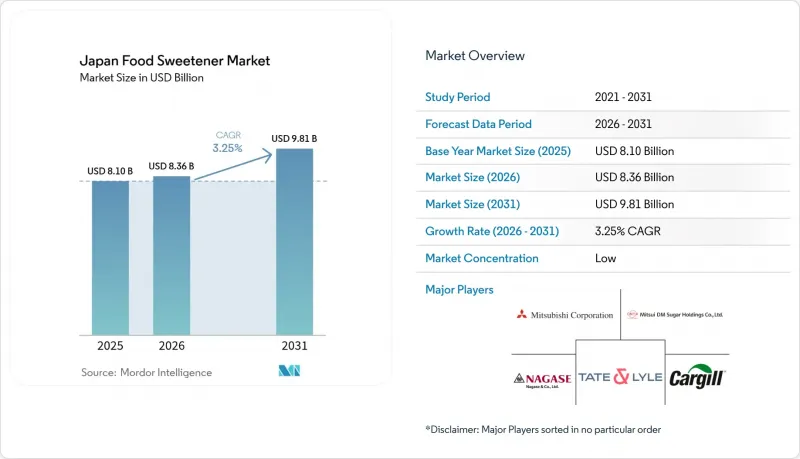
This report is Segmented by Product Type (Sucrose, Starch Sweeteners and Sugar Alcohols, High-Intensity Sweeteners), Source (Artificial, Plant-Based), Application (Bakery Products, Confectionery Products, Dairy and Desserts, Sauces, Dressings and Spreads, Beverages, Other Applications). The Market Forecasts are Provided in Terms of Value (USD).
Japan Food Sweetener Market Trends and Insights
Rising Demand for Low-Calorie Sweeteners
With Japan's aging population and growing health awareness, the demand for low-calorie sweeteners is rapidly increasing. The National Institute of Health and Nutrition's Health Japan 21 initiative seeks to reduce obesity rates among males aged 20-60 from 31.2% to 28% by 2025, driving the adoption of sugar alternatives. Consumer surveys indicate that 73% of Japanese adults now prefer zero-sugar or low-sugar products. This preference extends beyond beverages to confectionery, where major retailers have reported a remarkable 209% growth in zero-sugar products, while traditional sugary options have declined by 9%. Japan's Gen Z demographic is particularly embracing this trend, with SHIBUYA109 lab surveys showing a strong preference for "no-guilt" desserts made with natural sweeteners. Additionally, regulatory support from the Foods for Specified Health Use (FOSHU) system validates the use of low-calorie sweeteners in functional food categories.
Expansion of Processed Food and Beverage Manufacturing
Japan's processed food market is experiencing significant growth, driving increased demand for a wide range of sweetening solutions as manufacturers adapt their products to align with shifting consumer preferences. The ready-to-drink (RTD) tea segment serves as a prominent example of this trend, with the emphasis on convenience encouraging the incorporation of sweeteners into new product categories. According to Cross Marketing's 2024 consumer survey, polyethylene terephthalate (PET) bottle formats are the most preferred packaging option due to their "easy to drink" features and resealability, which favor pre-sweetened formulations over consumer-added sugar. Substantial investments by major food processors, such as Nisshin OilliO's "Value UpX" business plan, which extends through the fiscal year 2028 (FY2028), underscore ongoing capacity expansion efforts. This growth particularly benefits high-intensity sweeteners, which deliver cost efficiencies in large-scale production while maintaining flavor consistency across a variety of applications. Additionally, Japan's strategic role as a regional export hub for processed foods further strengthens this trend, as manufacturers seek sweetening solutions that meet both domestic consumer preferences and international regulatory standards.
Stringent Additive Approval & Labeling Rules
Japan's rigorous food additive regulations create substantial challenges for sweetener manufacturers, prolonging product development timelines and complicating market entry. The Ministry of Health, Labour and Welfare enforces a positive list system that requires extensive safety documentation, often resulting in multi-year approval processes for novel sweeteners, particularly synthetic alternatives. Recent regulatory issues underscore the cautious approach of Japanese authorities. For example, in February 2025, the Consumer Affairs Agency addressed concerns about the Red No. 3 dye, stating "no data" on health risks despite warnings from the FDA. The Food Safety Commission requires comprehensive toxicology studies for risk assessments, a process that can take 3-5 years and cost millions of dollars. These regulatory barriers are especially challenging for international sweetener suppliers aiming to enter Japan's market. They must navigate complex documentation requirements while competing with established domestic players who already have regulatory approval. Additionally, these strict regulations can delay product reformulations. Manufacturers must secure regulatory clearance for new sweetener combinations, limiting their ability to quickly adapt to changing consumer trends.
Other drivers and restraints analyzed in the detailed report include:
- Rising Demand for Clean-Label Formulations
- Strong Regulatory Support for the Use of Natural Sweeteners
- Consumer Skepticism on Artificial Sweetener Safety
For complete list of drivers and restraints, kindly check the Table Of Contents.
Segment Analysis
In 2025, traditional sucrose holds a significant 42.86% share of the market, highlighting Japan's strong confectionery traditions and the indispensable role of sugar's functional properties. At the same time, high-intensity sweeteners are experiencing rapid growth, with a projected CAGR of 5.22% through 2031, driven by beverage reformulations and regulatory support for low-calorie alternatives. Starch sweeteners and sugar alcohols maintain a balanced position. Sorbitol, in particular, is gaining prominence in Japan's food-grade market, currently valued at USD 0.22 billion and expected to reach USD 0.29 billion by 2031, reflecting a 4.71% CAGR. Beyond its traditional food uses, sorbitol is establishing itself in pharmaceutical and cosmetic applications. This evolving market underscores Japan's dual structure: traditional applications continue to drive sucrose demand, while health-conscious consumers are fueling the rise of high-intensity sweeteners.
Within the high-intensity sweetener segment, stevia leads as the preferred natural option, while sucralose dominates among synthetic alternatives. JK Sucralose Inc. stands out with its compliance with Japanese standards and a strong global presence. Neotame and Ace-K cater to specialized markets, where their intense sweetness justifies premium pricing, particularly in pharmaceutical formulations designed to mask bitterness. The Food Safety Commission of Japan significantly influences product development, prioritizing natural high-intensity sweeteners with faster approval processes over synthetic options. This regulatory environment provides a competitive advantage to stevia and monk fruit suppliers, positioning them ahead of traditional artificial alternatives.
Complete Report Scope:
- Product Type
- Sucrose
- Starch Sweeteners & Sugar Alcohols
- Dextrose
- High-Fructose Corn Syrup (HFCS)
- Maltodextrin
- Sorbitol
- Xylitol
- Other Starch Sweeteners & Sugar Alcohols
- High-Intensity Sweeteners (HIS)
- Sucralose
- Aspartame
- Saccharin
- Cyclamate
- Ace-K
- Neotame
- Stevia
- Other High-Intensity Sweeteners
- Application
- Bakery Products
- Confectionery Products
- Dairy and Desserts
- Sauces Dressings and Spreads
- Beverages
- Other Applications
List of Companies Covered in this Report:
- Cargill Inc.
- Ajinomoto Co. Inc.
- Mitsui DM Sugar Holdings Co. Ltd
- Mitsubishi Corporation
- Nagase & Co. Ltd
- Tate & Lyle PLC
- Showa Sangyo Co. Ltd
- Morita Kagaku Kogyo Co. Ltd
- Toyo Sugar Refining Co. Ltd
- Matsutani Chemical Industry Co. Ltd
- Ingredion Japan
- Roquette Freres
- JK Sucralose Inc.
- Conagen Japan GK
- Tereos Asia
- Wilmar-Oleo Nisshin JV
- Nissin Sugar Co. Ltd
- Nippon Paper Industries (cellulose sweeteners)
- Ueno Fine Chemicals Industry Ltd
- Ikeda Tohka Industries Co. Ltd
Additional Benefits:
- The market estimate (ME) sheet in Excel format
- 3 months of analyst support
TABLE OF CONTENTS
1 INTRODUCTION
- 1.1 Study Assumptions & Market Definition
- 1.2 Scope of the Study
2 RESEARCH METHODOLOGY
3 EXECUTIVE SUMMARY
4 MARKET LANDSCAPE
- 4.1 Market Overview
- 4.2 Market Drivers
- 4.2.1 Rising Demand for Low-Calorie Sweeteners
- 4.2.2 Expansion of processed food & beverage manufacturing
- 4.2.3 Rising Demand for Clean-Label Formulations
- 4.2.4 Technological Advencements in Extraction and Processing
- 4.2.5 Strong regulatory support for the use of Natural Sweeteners
- 4.2.6 Market growth fueled by imports of specialty and fermentation-derived sweeteners.
- 4.3 Market Restraints
- 4.3.1 Stringent additive approval and labeling rules
- 4.3.2 Consumer skepticism on artificial sweetener safety
- 4.3.3 Growing preference on calorie reduction
- 4.3.4 Rising type 2 diabetes linked to high sugar consumption
- 4.4 Supply Chain Analysis
- 4.5 Regulatory Outlook
- 4.6 Porter's Five Forces
- 4.6.1 Threat of New Entrants
- 4.6.2 Bargaining Power of Buyers/Consumers
- 4.6.3 Bargaining Power of Suppliers
- 4.6.4 Threat of Substitute Products
- 4.6.5 Intensity of Competitive Rivalry
5 MARKET SIZE AND GROWTH FORECAST
- 5.1 Product Type
- 5.1.1 Sucrose
- 5.1.2 Starch Sweeteners & Sugar Alcohols
- 5.1.2.1 Dextrose
- 5.1.2.2 High-Fructose Corn Syrup (HFCS)
- 5.1.2.3 Maltodextrin
- 5.1.2.4 Sorbitol
- 5.1.2.5 Xylitol
- 5.1.2.6 Other Starch Sweeteners & Sugar Alcohols
- 5.1.3 High-Intensity Sweeteners (HIS)
- 5.1.3.1 Sucralose
- 5.1.3.2 Aspartame
- 5.1.3.3 Saccharin
- 5.1.3.4 Cyclamate
- 5.1.3.5 Ace-K
- 5.1.3.6 Neotame
- 5.1.3.7 Stevia
- 5.1.3.8 Other High-Intensity Sweeteners
- 5.2 Application
- 5.2.1 Bakery Products
- 5.2.2 Confectionery Products
- 5.2.3 Dairy and Desserts
- 5.2.4 Sauces Dressings and Spreads
- 5.2.5 Beverages
- 5.2.6 Other Applications
6 COMPETITIVE LANDSCAPE
- 6.1 Market Concentration
- 6.2 Strategic Moves
- 6.3 Market Ranking Analysis
- 6.4 Company Profiles (includes Global-level Overview, Market-level Overview, Core Segments, Financials (if available), Strategic Information, Market Rank/Share, Products & Services, Recent Developments)
- 6.4.1 Cargill Inc.
- 6.4.2 Ajinomoto Co. Inc.
- 6.4.3 Mitsui DM Sugar Holdings Co. Ltd
- 6.4.4 Mitsubishi Corporation
- 6.4.5 Nagase & Co. Ltd
- 6.4.6 Tate & Lyle PLC
- 6.4.7 Showa Sangyo Co. Ltd
- 6.4.8 Morita Kagaku Kogyo Co. Ltd
- 6.4.9 Toyo Sugar Refining Co. Ltd
- 6.4.10 Matsutani Chemical Industry Co. Ltd
- 6.4.11 Ingredion Japan
- 6.4.12 Roquette Freres
- 6.4.13 JK Sucralose Inc.
- 6.4.14 Conagen Japan GK
- 6.4.15 Tereos Asia
- 6.4.16 Wilmar-Oleo Nisshin JV
- 6.4.17 Nissin Sugar Co. Ltd
- 6.4.18 Nippon Paper Industries (cellulose sweeteners)
- 6.4.19 Ueno Fine Chemicals Industry Ltd
- 6.4.20 Ikeda Tohka Industries Co. Ltd
7 MARKET OPPORTUNITIES AND FUTURE OUTLOOK

