PUBLISHER: Mordor Intelligence | PRODUCT CODE: 2113353

PUBLISHER: Mordor Intelligence | PRODUCT CODE: 2113353
Asia-Pacific Seasoning And Spices - Market Share Analysis, Industry Trends & Statistics, Growth Forecasts (2026 - 2031)
According to Mordor Intelligence, the Asia Pacific seasoning and spices market size was valued at USD 11.27 billion in 2025 and estimated to grow from USD 11.91 billion in 2026 to reach USD 15.70 billion by 2031, at a CAGR of 5.68% during the forecast period (2026-2031).
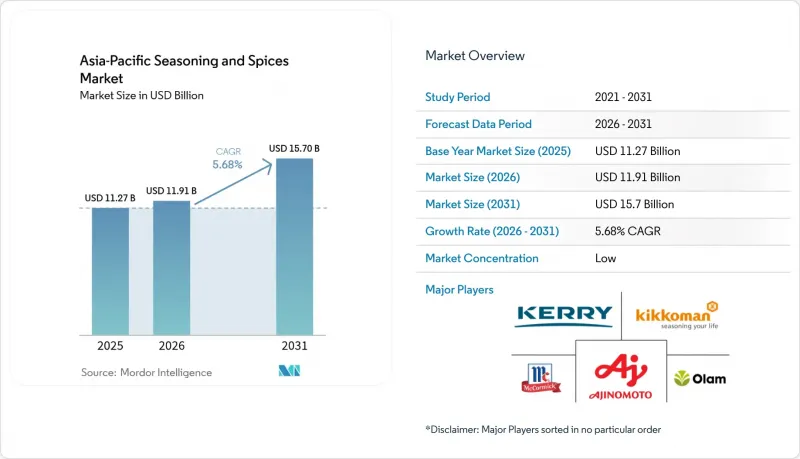
This report is Segmented by Product Type (Herbs, Spices, and Seasoning Blends), End-Use (Retail, Food Processing, Foodservice/HoReCa), and Geography (China, India, Japan, Australia, South Korea, Indonesia, Thailand, Rest of Asia-Pacific). The Market Forecasts are Provided in Terms of Value (USD) and Volume (Units).
Asia-Pacific Seasoning And Spices Market Trends and Insights
Rising demand for convenience foods with ethnic flavours
The market is experiencing significant growth, driven by the rising demand for convenience foods infused with ethnic flavors. Consumers in the region are increasingly seeking ready-to-eat or easy-to-prepare meals that offer authentic taste experiences reflective of diverse cultural cuisines. This trend is fueled by changing lifestyles, urbanization, and the growing influence of global food culture. As per a UN-Habitat report, Asia is home to 54% of the world's urban population, translating to over 2.2 billion individuals. Projections indicate that by 2050, Asia's urban populace will swell by another 1.2 billion, marking a 50% increase . This rapid urbanization is contributing to the growing demand for convenient food options, including those with ethnic flavors, as urban consumers often have busier lifestyles and limited time for meal preparation. Additionally, the preference for ethnic flavors is supported by the expanding middle-class population, which has greater disposable income to spend on premium and diverse food products. Manufacturers are capitalizing on this demand by introducing innovative seasoning and spice blends tailored to regional and international tastes, further propelling the market's growth. Moreover, the increasing penetration of international cuisines in the Asia-Pacific region has amplified the demand for ethnic seasonings and spices.
Growing consumer shift toward natural/organic seasonings
The clean label trend has transformed the spice industry, now including not just basic ingredients but also flavorings and extracts, with natural herbs and spices gaining prominence. Heightened consumer awareness and a growing demand for transparency in food products have driven changes in spice procurement and certification processes. The FAO's World of Organic Agriculture 2024 report reveals that organic agriculture spans 188 countries, with at least 4.5 million farmers managing over 96 million hectares of land organically . This trend has replaced synthetic flavor enhancers with natural spice extracts, creating opportunities for suppliers of standardized natural alternatives. Consumers willingly pay a premium for certified organic and clean-label spices, prompting manufacturers to expand their organic portfolios, enforce stricter quality control, and improve sourcing practices. Companies now provide detailed information about product origins, processing methods, and sustainability efforts to align with consumer preferences for minimally processed products without artificial additives.
Concerns regarding food safety and quality
Food safety incidents and contamination concerns pose significant challenges to the growth of the spice market. Regulatory authorities are tightening testing requirements, and consumers are becoming more discerning about product quality. In 2023, the European Union documented 248 safety issues related to spices and herbs. Common issues included violations of pesticide residue limits and salmonella contamination. These concerns prompted the EU to increase inspection frequencies for certain products and their origins. Meanwhile, China's GACC registration requirements for overseas exporters add another layer of compliance challenges. In the U.S., the FDA's heightened scrutiny on spice safety, spurred by notable contamination incidents, has escalated testing and certification costs throughout the supply chain. Smaller producers, often lacking the resources for thorough testing protocols, feel the brunt of these safety concerns. This has led to market consolidation, benefiting larger players with established quality management systems. Additionally, new traceability requirements complicate operations and inflate costs. Companies are now mandated to keep meticulous records across the supply chain, ensuring swift action during recall scenarios.
Other drivers and restraints analyzed in the detailed report include:
- Increasing product offerings and retail penetration
- Expansion of processed and ready-to-eat food industry
- Presence of additives affecting sensory experience
For complete list of drivers and restraints, kindly check the Table Of Contents.
Segment Analysis
Herbs hold the largest market share in the Asia Pacific seasoning and spices market, accounting for a substantial 47.92% of the market in 2025. This dominance is deeply rooted in the region's rich culinary heritage, where fresh and dried herbs are integral to the preparation of traditional dishes. The widespread use of herbs across diverse regional cuisines highlights their importance as essential flavoring agents that enhance taste and aroma. Consumers in the Asia Pacific continue to favor herbs for their natural qualities and health benefits, further cementing their market leadership. Culinary practices in countries like India, China, and Southeast Asia emphasize herb-based seasoning, which boosts consistent demand. This strong preference for herbs reflects the cultural significance and versatility they bring to cooking across the region.
Seasoning blends represent the fastest-growing segment in the Asia Pacific seasoning and spices market, exhibiting a robust CAGR of 6.04% through 2031. This rapid growth is primarily driven by the food processing industry's increasing need for standardized and consistent flavor profiles in their products. Seasoning blends offer a convenient solution for both manufacturers and consumers, simplifying the cooking process while ensuring reliable taste outcomes. The expanding urban population and hectic lifestyles further fuel consumers' demand for ready-to-use blends that save time without compromising flavor. Additionally, foodservice sectors such as restaurants and quick-service outlets are adopting seasoning blends extensively to maintain product quality across multiple outlets. As consumers seek convenience combined with authentic taste experiences, seasoning blends continue to gain traction, positioning themselves as a key growth driver in the market.
Complete Report Scope:
- By Product Type
- Herbs
- Thyme
- Basil
- Oregano
- Parsley
- Other Herbs and Seasoning
- Spices
- Pepper
- Cardamom
- Cinnamon
- Clove
- Nutmeg
- Turmeric
- Other Spices
- Seasoning Blends
- Herbs
- By End-Use
- Retail
- Food Processing
- Bakery and Confectionery
- Soup, Noodles and Pasta
- Meat and Seafood
- Sauces, Salads and Dressings
- Savoury Snacks
- Other Applications
- Foodservice/HoReCa
- By Geography
- China
- India
- Japan
- Australia
- South Korea
- Indonesia
- Thailand
- Rest of Asia-Pacific
List of Companies Covered in this Report:
- McCormick & Company, Inc.
- Olam International
- Ajinomoto Co., Inc.
- Kerry Group plc
- Kikkoman Corporation
- Sensient Technologies Corp.
- House Foods Group Inc.
- Everest Food Products Pvt Ltd
- MDH Spices
- Lee Kum Kee Co. Ltd
- Vietnam Pepper Association (VPA)
- Wingreens Farms
- Thai President Foods PLC
- Sichuan Baijia Food Co.
- Shinho Food
- Unilever PLC
- Frontier Co-op
- Dohler GmbH
- Cargill, Incorporated
- Schulze & Co. KG
Additional Benefits:
- The market estimate (ME) sheet in Excel format
- 3 months of analyst support
TABLE OF CONTENTS
1 INTRODUCTION
- 1.1 Study Assumptions and Market Definition
- 1.2 Scope of the Study
2 RESEARCH METHODOLOGY
3 EXECUTIVE SUMMARY
4 MARKET LANDSCAPE
- 4.1 Market Overview
- 4.2 Market Drivers
- 4.2.1 Rising demand for convenience foods with ethnic flavours
- 4.2.2 Growing consumer shift toward natural/organic seasonings
- 4.2.3 Increasing product offerings and retail penetration
- 4.2.4 Expansion of processed and ready-to-eat food industry
- 4.2.5 Innovation in spice blends and seasonings
- 4.2.6 Increasing use of spices as natural preservatives and functional ingredients
- 4.3 Market Restraints
- 4.3.1 Concerns regarding food safety and quality
- 4.3.2 Presence of additives affecting sensory experience
- 4.3.3 Higher cost of organic and chemical-free ingredients
- 4.3.4 Geopolitical trade-route disruptions
- 4.4 Supply-Chain Analysis
- 4.5 Regulatory Landscape
- 4.6 Porter's Five Forces
- 4.6.1 Bargaining Power of Buyers/Consumers
- 4.6.2 Bargaining Power of Suppliers
- 4.6.3 Threat of New Entrants
- 4.6.4 Threat of Substitute Products
- 4.6.5 Intensity of Competitive Rivalry
5 MARKET SIZE AND GROWTH FORECASTS (VALUE AND VOLUME)
- 5.1 By Product Type
- 5.1.1 Herbs
- 5.1.1.1 Thyme
- 5.1.1.2 Basil
- 5.1.1.3 Oregano
- 5.1.1.4 Parsley
- 5.1.1.5 Other Herbs and Seasoning
- 5.1.2 Spices
- 5.1.2.1 Pepper
- 5.1.2.2 Cardamom
- 5.1.2.3 Cinnamon
- 5.1.2.4 Clove
- 5.1.2.5 Nutmeg
- 5.1.2.6 Turmeric
- 5.1.2.7 Other Spices
- 5.1.3 Seasoning Blends
- 5.1.1 Herbs
- 5.2 By End-Use
- 5.2.1 Retail
- 5.2.2 Food Processing
- 5.2.2.1 Bakery and Confectionery
- 5.2.2.2 Soup, Noodles and Pasta
- 5.2.2.3 Meat and Seafood
- 5.2.2.4 Sauces, Salads and Dressings
- 5.2.2.5 Savoury Snacks
- 5.2.2.6 Other Applications
- 5.2.3 Foodservice/HoReCa
- 5.3 By Geography
- 5.3.1 China
- 5.3.2 India
- 5.3.3 Japan
- 5.3.4 Australia
- 5.3.5 South Korea
- 5.3.6 Indonesia
- 5.3.7 Thailand
- 5.3.8 Rest of Asia-Pacific
6 COMPETITIVE LANDSCAPE
- 6.1 Market Concentration
- 6.2 Strategic Moves
- 6.3 Market Ranking Analysis
- 6.4 Company Profiles (includes Global Overview, Market-level Overview, Core Segments, Financials, Strategic Information, Market Rank/Share, Products & Services, Recent Developments)
- 6.4.1 McCormick & Company, Inc.
- 6.4.2 Olam International
- 6.4.3 Ajinomoto Co., Inc.
- 6.4.4 Kerry Group plc
- 6.4.5 Kikkoman Corporation
- 6.4.6 Sensient Technologies Corp.
- 6.4.7 House Foods Group Inc.
- 6.4.8 Everest Food Products Pvt Ltd
- 6.4.9 MDH Spices
- 6.4.10 Lee Kum Kee Co. Ltd
- 6.4.11 Vietnam Pepper Association (VPA)
- 6.4.12 Wingreens Farms
- 6.4.13 Thai President Foods PLC
- 6.4.14 Sichuan Baijia Food Co.
- 6.4.15 Shinho Food
- 6.4.16 Unilever PLC
- 6.4.17 Frontier Co-op
- 6.4.18 Dohler GmbH
- 6.4.19 Cargill, Incorporated
- 6.4.20 Schulze & Co. KG
7 MARKET OPPORTUNITIES AND FUTURE OUTLOOK

