PUBLISHER: Mordor Intelligence | PRODUCT CODE: 2113370

PUBLISHER: Mordor Intelligence | PRODUCT CODE: 2113370
Philippines Prefabricated Construction - Market Share Analysis, Industry Trends & Statistics, Growth Forecasts (2026 - 2031)
According to Mordor Intelligence, the Philippines prefabricated construction market size is estimated at USD 16.04 billion in 2026, and is expected to reach USD 27.11 billion by 2031, at a CAGR of 11.07% during the forecast period (2026-2031).
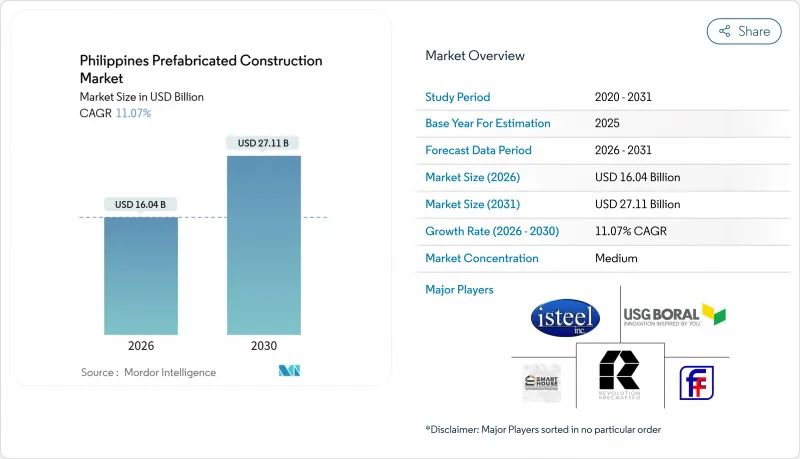
This report is Segmented by Material (Concrete, Glass, Metal, Timber, Other Materials), by Application (Residential, Commercial, Others), by Product Type (Modular Buildings, Panelized & Componentized Systems, Other Prefab Types), and by Geography (NCR Metro Manila, Calabarzon, Central Luzon, Rest of Philippines). The Market Forecasts are Provided in Terms of Value (USD).
Philippines Prefabricated Construction Market Trends and Insights
Rapid Urbanization and Classroom/Clinic Backlogs Drive Fast, Scalable Delivery
A 6.94 million-unit housing deficit running through 2028 forces local governments to favor solutions that can be finished within one election cycle. Prefabricated packages trim foundation-to-turnover schedules from 18 months to 9 months, aligning ribbon-cutting dates with political calendars. The Department of Education's 9,000-classroom target for 2024 and the Department of Health's plan for 700 rural health stations through 2028 both specify repeatable modular designs that can be copied across remote sites without re-engineering. Pag-IBIG's USD 43,200 average housing loan pushes developers to cut waste and labor costs so homes remain under that threshold. Commercial builders also tap prefabrication to secure Philippine Green Building Code compliance, because factory runs spread certification fees across large volumes.
Disaster Resilience Needs Favor Modular, Code-Compliant Systems
Under Presidential Decree 1096 Chapter 15, prefabricated units must clear third-party tests for wind load and seismic capacity before occupancy permits are issued, giving compliant suppliers an instant go-ahead once a calamity hits. The Post-Disaster Shelter Recovery Framework keeps a roster of firms able to roll out 500 dwellings within 60 days, a capability activated after Typhoon Odette and again in 2024 for Cebu and Leyte. Average typhoon landfalls of 8-10 per year sustain recurring orders for relocatable health-care and classroom modules. The National Structural Code's 40-millimeter concrete cover and Grade 275 rebar rules are easier to hit in a factory than on a rain-soaked site, so insurers now discount premiums for certified modular assets. Together, these factors steer replacement budgets toward suppliers with documented factory quality logs.
Reliance on Imported Materials and Systems Raises Costs and Lead-Time Risk
Philippine builders imported 5.9 million t of steel worth USD 4.2 billion in 2023, exposing project budgets to exchange-rate swings and container delays that can stretch procurement by 8-12 weeks. Although SteelAsia's USD 1.5 billion plant pipeline will cover H-beams and sheet piles by 2027, niche items such as insulated panel cores and low-e glazing still rely on foreign factories. A pending safeguard investigation on steel dumping could lift duties and squeeze fixed-price contracts. Even ASEAN tariff perks come with logistics lags: pre-engineered kits from Vietnam need 10-14 days at sea plus a week to clear Manila ports, forcing contractors to pad schedules. Lead-time anxiety often keeps developers anchored to conventional methods until financing and permits finish their own slow march.
Other drivers and restraints analyzed in the detailed report include:
- Tourism and BPO/Industrial Growth Support Hotels, Dorms, and Light-Industrial Prefab
- Public Programs and PPPs Increasingly Specify Offsite for Speed and Cost Certainty
- Fragmented Permitting and Standards Enforcement Slow Adoption
For complete list of drivers and restraints, kindly check the Table Of Contents.
Segment Analysis
Concrete secured 57.8% of the 2025 Philippines prefabricated construction market share. That dominance rests on DPWH rules that specify hollow-core slabs and load-bearing wall panels for disaster housing and public schools. The segment is projected to grow at a 10.9% CAGR through 2031 as SteelAsia's new mills lower structural steel cost, encouraging hybrid concrete-steel frames that slash import bills by 15%. ISO-certified Frey-Fil's supply to elevated expressways demonstrates how factory casting guarantees consistent strength even during monsoon months.
Timber starts from a smaller base yet is expected to rise at an 11.81% CAGR, the fastest among materials. Resort developers in Palawan, Boracay, and Siargao pay premiums for Forest Stewardship Council-certified plywood that boosts eco-branding credibility. PERI Philippines, which imports kiln-dried lumber to meet chain-of-custody rules, illustrates how specialty suppliers fill the gap while domestic sawmills catch up. Metal maintains steady demand as Kirby Building Systems exploits ASEAN duty waivers, funneling kits from its 40,000 t per-year Vietnam plant to Mindanao projects where local fabricators remain scarce.
Complete Report Scope:
- By Material
- Concrete
- Glass
- Metal
- Timber
- Other Materials
- By Application
- Residential
- Commercial
- Others
- By Product Type
- Modular Buildings
- Panelized & Componentized Systems
- Other Prefab Types
- By Region
- NCR (Metro Manila)
- Calabarzon
- Central Luzon
- Rest of Philippines
List of Companies Covered in this Report:
- iSteel Inc
- USG Boral Building Products
- Frey-Fil Corporation (FFC)
- Revolution Precrafted
- Smarthouse Corporation
- Karmod Prefabricated Building Technologies
- Toh Builders Inc
- Indigo Prefab House
- WallCrete Company Inc
- Prefab Philippines
- JEA Steel Industries Inc
- Power Steel Corporation
- Kirby Building Systems
- Cornerstone Building Brands
- Zamil Steel Buildings
- Sekisui Chemical Co Ltd
- Dongguan Toppre Modular House
- Hebei Weizhengheng Modular House
- PT Teak Bali
- Laras Bali Prefab
- AMD Modular Systems
Additional Benefits:
- The market estimate (ME) sheet in Excel format
- 3 months of analyst support
TABLE OF CONTENTS
1 Introduction
- 1.1 Study Assumptions & Market Definition
- 1.2 Scope of the Study
2 Research Methodology
3 Executive Summary
4 Market Insight and Dynamics
- 4.1 Market Overview
- 4.2 Market Drivers
- 4.2.1 Rapid urbanization and classroom/clinic backlogs drive fast, scalable delivery.
- 4.2.2 Disaster resilience needs (typhoon/quake) favor modular, code-compliant systems.
- 4.2.3 Tourism and BPO/industrial growth support hotels, dorms, and light-industrial prefab.
- 4.2.4 Archipelago logistics benefit from standardized kits and relocatable units.
- 4.2.5 Public programs and PPPs increasingly specify offsite for speed and cost certainty.
- 4.3 Market Restraints
- 4.3.1 Reliance on imported materials/systems raises costs and lead-time risk.
- 4.3.2 Fragmented permitting/standards and enforcement gaps slow adoption.
- 4.3.3 Affordability constraints and limited local manufacturing depth cap scale.
- 4.4 Value / Supply-Chain Analysis
- 4.5 Regulatory Landscape
- 4.6 Technological Outlook
- 4.7 Porter's Five Forces
- 4.7.1 Threat of New Entrants
- 4.7.2 Bargaining Power of Buyers
- 4.7.3 Bargaining Power of Suppliers
- 4.7.4 Threat of Substitutes
- 4.7.5 Intensity of Competitive Rivalry
- 4.8 Brief on Different Structures Used in Prefabricated Buildings
- 4.9 Cost Structure Analysis of Prefabricated Buildings
5 Market Size & Growth Forecasts (Value, 2026-2031)
- 5.1 By Material
- 5.1.1 Concrete
- 5.1.2 Glass
- 5.1.3 Metal
- 5.1.4 Timber
- 5.1.5 Other Materials
- 5.2 By Application
- 5.2.1 Residential
- 5.2.2 Commercial
- 5.2.3 Others
- 5.3 By Product Type
- 5.3.1 Modular Buildings
- 5.3.2 Panelized & Componentized Systems
- 5.3.3 Other Prefab Types
- 5.4 By Region
- 5.4.1 NCR (Metro Manila)
- 5.4.2 Calabarzon
- 5.4.3 Central Luzon
- 5.4.4 Rest of Philippines
6 Competitive Landscape
- 6.1 Market Concentration
- 6.2 Strategic Moves
- 6.3 Market Share Analysis
- 6.4 Company Profiles (includes Global level Overview, Market level overview, Core Segments, Financials as available, Strategic Information, Products & Services, and Recent Developments)
- 6.4.1 iSteel Inc
- 6.4.2 USG Boral Building Products
- 6.4.3 Frey-Fil Corporation (FFC)
- 6.4.4 Revolution Precrafted
- 6.4.5 Smarthouse Corporation
- 6.4.6 Karmod Prefabricated Building Technologies
- 6.4.7 Toh Builders Inc
- 6.4.8 Indigo Prefab House
- 6.4.9 WallCrete Company Inc
- 6.4.10 Prefab Philippines
- 6.4.11 JEA Steel Industries Inc
- 6.4.12 Power Steel Corporation
- 6.4.13 Kirby Building Systems
- 6.4.14 Cornerstone Building Brands
- 6.4.15 Zamil Steel Buildings
- 6.4.16 Sekisui Chemical Co Ltd
- 6.4.17 Dongguan Toppre Modular House
- 6.4.18 Hebei Weizhengheng Modular House
- 6.4.19 PT Teak Bali
- 6.4.20 Laras Bali Prefab
- 6.4.21 AMD Modular Systems
7 Market Opportunities & Future Outlook
- 7.1 White-space & Unmet-Need Assessment

