PUBLISHER: Mordor Intelligence | PRODUCT CODE: 2115906

PUBLISHER: Mordor Intelligence | PRODUCT CODE: 2115906
France Prefabricated Construction - Market Share Analysis, Industry Trends & Statistics, Growth Forecasts (2026 - 2031)
According to Mordor Intelligence, the France prefabricated construction market size is projected to expand from USD 7.33 billion in 2025 and USD 7.72 billion in 2026 to USD 10.02 billion by 2031, registering a CAGR of 5.35% between 2026 to 2031.
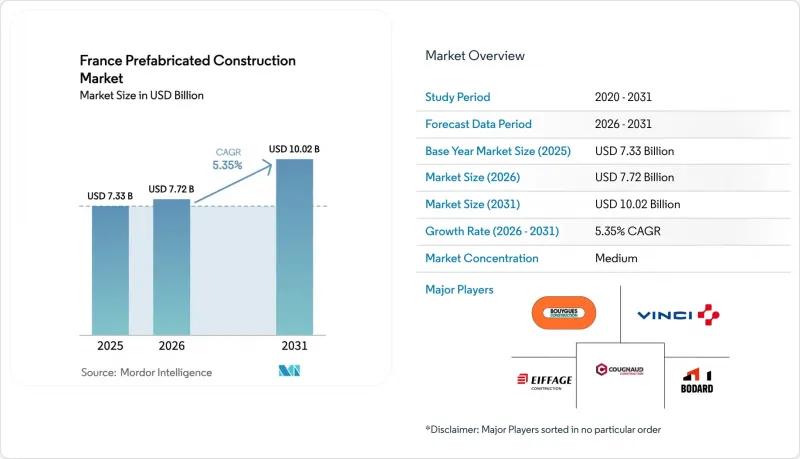
This report is Segmented by Material Type (Concrete, Glass, Metal, Timber, Other Materials), by Application (Residential, Commercial, Others), by Product Type (Modular Buildings, Panelized & Componentized Systems, Other Prefab Types), and by City (Paris, Lyon, Marseille, Rest of France). The Market Forecasts are Provided in Terms of Value (USD).
France Prefabricated Construction Market Trends and Insights
RE2020 Energy and Carbon Standards
France's RE2020 code adds lifecycle-carbon caps that tighten in 2025, 2028, and 2031, forcing developers to quantify embodied emissions from structure to end-of-life. Factory-built envelopes minimize waste, assure airtightness, and allow detailed tracing of material provenance, helping projects document compliance without costly redesigns. Carbon accounting rules credit each cubic meter of structural timber with about 1 tonne of stored CO2, a benefit that offsets emissions from foundations and MEP services. These advantages translate into lower risk premiums for lenders and insurers, accelerating specification of modular and panelized solutions in new tenders. As the caps tighten, manufacturers that certify product footprints now are positioned to win repeat orders later.
Public-Sector Programs
French ministries responsible for education, health, and defense now embed offsite delivery in bid documents to shorten schedules and hold contractors to fixed price points. A 12-classroom primary school in Bagneux opened in 2024 after only four months on site, demonstrating how volumetric units limit noise complaints in dense neighborhoods. Hospital extensions in Argenteuil and Rennes used modular patient rooms to maintain sterile zones while building new capacity, an approach that would have required phased closures with conventional methods. The military quietly deploys containerized barracks that relocate with troop rotations, proving the versatility of prefabrication for mission-critical assets. These examples build political confidence, ensuring that future public budgets continue to earmark funds for factory-made solutions.
Complex Permitting and Heritage Protections
Municipal planners apply varied aesthetic rules under the Code de l'urbanisme, and heritage officials may veto modular facades within 500 meters of protected monuments. A 2024 survey by the French Building Federation found modular permits in historic districts average 14 months, five months longer than conventional builds. Custom tweaks required to satisfy local appearance guidelines erase some factory efficiencies and inflate design fees. National agencies are drafting pre-approved typologies, yet uptake remains slow because mayors fear backlash if projects seem "industrial." Until zoning harmonizes, developers must budget extra time and contingency funds for landmark sites.
Other drivers and restraints analyzed in the detailed report include:
- Timber and Hybrid Prefab for Decarbonization
- Urban Infill and Brownfield Redevelopment
- Transport and Cranage Limits
For complete list of drivers and restraints, kindly check the Table Of Contents.
Segment Analysis
Concrete retained a 45.2% France prefabricated construction market share in 2025 thanks to its dominance in multi-story social housing and industrial sheds. Pre-cast stair cores and bathroom pods made with low-carbon cement allow developers to meet fire and acoustic codes while leveraging established supply chains. However, RE2020 charges higher embodied-carbon penalties on ordinary Portland cement, nudging contractors to adopt blends with granulated slag or calcined clay. Timber is the fastest climber, expanding at a 6.12% CAGR toward 2031 as CLT prices fall in line with rising domestic capacity, exemplified by Hexaom's investment in POBI Industrie's Vendee plant. Hybrid frames that marry timber floors to concrete podiums now anchor many 8-10 story towers, demonstrating how the France prefabricated construction market can balance structural resilience with decarbonization.
Growth momentum favors materials that meet both carbon and schedule targets. Timber cores cut building weight by up to 30%, enabling shallower foundations on weak soils and lowering spoil disposal costs in brownfield sites. Regional sawmills around Auvergne now machine CLT panels to 3.2-meter widths, maximizing truck payloads within French road limits. Meanwhile, steel holds a steady niche in wide-span logistics halls yet faces slower growth because virgin steel attracts hefty carbon coefficients. Composite sandwich panels and recycled-aggregate blocks are emerging as wildcard options for facades and interior partitions, but they still command a fraction of current demand. Overall, material substitution trends enrich supplier diversity and reinforce competitive dynamics within the France prefabricated construction market.
Complete Report Scope:
- By Material Type
- Concrete
- Glass
- Metal
- Timber
- Other Materials
- By Application
- Residential
- Commercial
- Others
- By Product Type
- Modular Buildings
- Panelized & Componentized Systems
- Other Prefab Types
- By City
- Paris
- Lyon
- Marseille
- Rest of France
List of Companies Covered in this Report:
- Bouygues Construction
- VINCI Construction
- Eiffage Construction
- Cougnaud Construction
- Bodard Construction Modulaire
- OBM Construction
- MARC SA
- Legoupil Industrie
- Algeco (Modulaire Group)
- Portakabin
- ALHO Systembau GmbH
- Skanska AB
- Fertighaus Weiss
- Trecobat
- Hexaom (POBI Industrie)
- Siblu France
- Millet Modulaires
- XL Habitat
- In Haus
- Timber Production BCL
Additional Benefits:
- The market estimate (ME) sheet in Excel format
- 3 months of analyst support
TABLE OF CONTENTS
1 Introduction
- 1.1 Study Assumptions & Market Definition
- 1.2 Scope of the Study
2 Research Methodology
3 Executive Summary
4 Market Insight and Dynamics
- 4.1 Market Overview
- 4.2 Market Drivers
- 4.2.1 RE2020 energy/carbon standards boosting demand for high-performance modular envelopes and systems.
- 4.2.2 Public-sector programs (schools, healthcare, defense) adopting modular for speed, cost certainty, and low site disruption.
- 4.2.3 Timber (CLT/GLT) and hybrid prefab favored for decarbonization and circular-economy goals.
- 4.2.4 Urban infill and brownfield redevelopment benefiting from offsite methods that minimize nuisance and accelerate delivery.
- 4.2.5 Industrial/logistics and data center growth supporting panelized, steel modular, and MEP-heavy assemblies.
- 4.3 Market Restraints
- 4.3.1 Complex permitting, heritage protections, and municipal variability slowing approvals and standardization.
- 4.3.2 Transport/cranage limits and dense urban logistics raising delivered costs for large modules.
- 4.3.3 Cultural preference for traditional masonry and perceived cost premium hampering wider adoption.
- 4.4 Value / Supply-Chain Analysis
- 4.5 Regulatory Landscape
- 4.6 Technological Outlook
- 4.7 Porter's Five Forces
- 4.7.1 Threat of New Entrants
- 4.7.2 Bargaining Power of Buyers
- 4.7.3 Bargaining Power of Suppliers
- 4.7.4 Threat of Substitutes
- 4.7.5 Intensity of Competitive Rivalry
- 4.8 Brief on Different Structures Used in Prefabricated Buildings
- 4.9 Cost Structure Analysis of Prefabricated Buildings
5 Market Size & Growth Forecasts (Value)
- 5.1 By Material Type
- 5.1.1 Concrete
- 5.1.2 Glass
- 5.1.3 Metal
- 5.1.4 Timber
- 5.1.5 Other Materials
- 5.2 By Application
- 5.2.1 Residential
- 5.2.2 Commercial
- 5.2.3 Others
- 5.3 By Product Type
- 5.3.1 Modular Buildings
- 5.3.2 Panelized & Componentized Systems
- 5.3.3 Other Prefab Types
- 5.4 By City
- 5.4.1 Paris
- 5.4.2 Lyon
- 5.4.3 Marseille
- 5.4.4 Rest of France
6 Competitive Landscape
- 6.1 Market Concentration
- 6.2 Strategic Moves
- 6.3 Market Share Analysis
- 6.4 Company Profiles (includes global overview, core segments, financials, strategic info, products & developments)
- 6.4.1 Bouygues Construction
- 6.4.2 VINCI Construction
- 6.4.3 Eiffage Construction
- 6.4.4 Cougnaud Construction
- 6.4.5 Bodard Construction Modulaire
- 6.4.6 OBM Construction
- 6.4.7 MARC SA
- 6.4.8 Legoupil Industrie
- 6.4.9 Algeco (Modulaire Group)
- 6.4.10 Portakabin
- 6.4.11 ALHO Systembau GmbH
- 6.4.12 Skanska AB
- 6.4.13 Fertighaus Weiss
- 6.4.14 Trecobat
- 6.4.15 Hexaom (POBI Industrie)
- 6.4.16 Siblu France
- 6.4.17 Millet Modulaires
- 6.4.18 XL Habitat
- 6.4.19 In Haus
- 6.4.20 Timber Production BCL
7 Market Opportunities & Future Outlook
- 7.1 White-space & Unmet-Need Assessment

