PUBLISHER: Mordor Intelligence | PRODUCT CODE: 2113416

PUBLISHER: Mordor Intelligence | PRODUCT CODE: 2113416
Africa Ice Cream - Market Share Analysis, Industry Trends & Statistics, Growth Forecasts (2026 - 2031)
According to Mordor Intelligence, the Africa ice cream market size is expected to grow from USD 1.70 billion in 2025 to USD 1.79 billion in 2026 and is forecast to reach USD 2.29 billion by 2031 at 5.07% CAGR over 2026-2031.
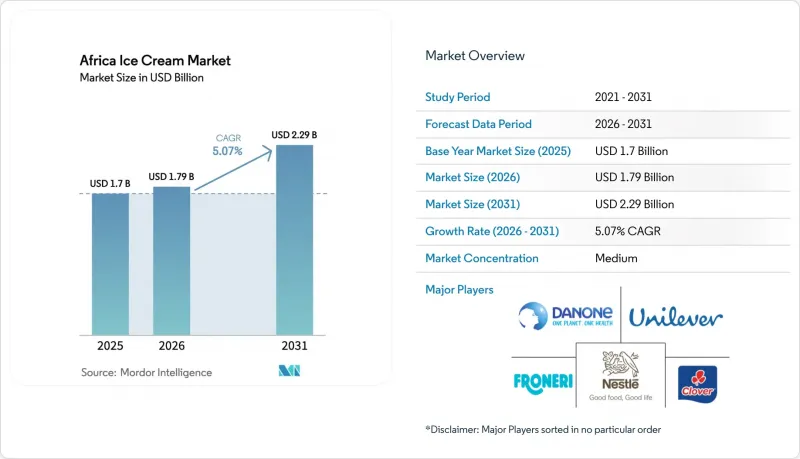
This report is Segmented by Product Type (Impulse, Take-Home, Artisanal), Flavor (Chocolate, Fruit), Form (Cups/Tubs, Bars/Sticks, Cones), Distribution Channel (On-Trade, Off-Trade), and Geography (Nigeria, South Africa, Kenya, Tanzania, Ghana, Rest of Africa). The Market Forecasts are Provided in Terms of Value (USD).
Africa Ice Cream Market Trends and Insights
Strengthening household purchasing power in emerging urban clusters
Rising employment and income security in emerging urban clusters across Africa are enhancing household purchasing power, driving demand for affordable indulgences such as ice cream and other FMCG products. The International Labour Organization reports that Africa's employed population grew to approximately 529.4 million in 2024, up from 514 million in 2023, reflecting a steady increase in earners who are gradually shifting spending from basic staples to occasional treats . This trend is encouraging companies to adapt their offerings by tailoring pack sizes and price points to suit constrained but improving household budgets. For instance, Unilever leverages single-serve products sold through informal kiosks, while local players like Bakhresa Group's Azam Dairy in Tanzania utilize localized cold-chain networks to maintain affordability. As households gain regular wages, purchasing behavior diversifies, with consumers increasingly favoring modern trade channels and quick-service outlets. Brands such as Famous Brands' Milky Lane promote family sharing through sit-in formats and take-home tubs, fostering higher basket sizes within budget constraints. This evolution in consumer behavior, combined with investments in distribution and retail partnerships, reduces inefficiencies and stabilizes pricing. As affordable quality becomes consistent, brand loyalty deepens, encouraging firms to innovate with new flavors and culturally relevant formats, further aligning with emerging middle-class aspirations.
Proliferation of organized retail and supermarket chains
The expansion of organized retail and supermarket chains is a key driver of structural growth in the ice cream market across Africa. Formal retail networks are improving product visibility, ensuring cold-chain reliability, and fostering consumer trust. The rise of hypermarkets and supermarkets in urban centers is shifting sales from informal kiosks to regulated retail environments, where consistent refrigeration safeguards product quality and enhances brand credibility. International retailers like Carrefour are accelerating this transformation by establishing outlets in high-growth cities, introducing modern freezer infrastructure to support a wider range of ice cream formats. Regional players such as Pick n Pay are strengthening private-label offerings and dedicating freezer aisles to ice cream, encouraging planned purchases during routine shopping trips. Premium positioning is further advanced by chains like Woolworths Holdings Limited, which focus on artisanal and higher-margin products appealing to brand-conscious consumers. Manufacturers, including FanMilk, benefit from structured distribution agreements and scalable access to urban markets through centralized procurement systems. Standardized merchandising, promotional cycles, and in-store sampling increase consumer exposure to new flavors and formats, driving trial and repeat purchases. Reliable cold storage, improved inventory management, and promotional bundling further enhance consumer confidence, elevating ice cream consumption patterns across Africa's evolving retail landscape.
Fluctuating milk procurement costs and supply volatility
Fluctuating milk procurement costs and supply volatility significantly impact the production economics and pricing strategies of ice cream manufacturers in Africa. Dairy remains a critical raw material, and its cost directly influences profitability. As reported by Milk South Africa, the average price of unprocessed milk in South Africa rose from ZAR 5.86 per litre in 2022 to ZAR 7.75 per litre in 2024, reflecting input cost inflation that compresses manufacturer margins . This volatility complicates cost planning, making it challenging to maintain stable pricing without eroding profitability or passing higher costs to price-sensitive consumers. Companies like Clover Industries Limited, which are integrated with local dairy supply chains, are particularly exposed to farm-level price fluctuations that affect their frozen dessert portfolios. Rising procurement costs also limit promotional activities, reducing competitiveness in impulse-driven segments where affordability is essential. Furthermore, inconsistent milk supply due to climatic variability, feed costs, and farm-level challenges disrupts production schedules and increases reliance on spot-market sourcing. For manufacturers targeting urban and semi-urban markets, higher raw material costs restrict expansion into lower-income segments, where pricing sensitivity is acute. These combined factors narrow operating margins and intensify competition from non-dairy alternatives, creating structural challenges for scalability and long-term profitability.
Other drivers and restraints analyzed in the detailed report include:
- Large youth demographic driving on-the-go indulgence
- Adoption of solar-powered refrigeration in semi-urban and off-grid zones
- Rising implementation of sugar taxation policies
For complete list of drivers and restraints, kindly check the Table Of Contents.
Segment Analysis
Take-home ice cream accounted for the largest share of 39.61% in 2025, driven by its strong alignment with household consumption patterns in Africa. Multi-liter tubs and family packs offer significant per-serving cost advantages, making them particularly appealing to multi-generational households that prioritize bulk purchases for shared consumption and effective budget management. Manufacturers such as Froneri focus on value-oriented tubs and larger formats to secure high-volume placements in supermarkets and neighborhood stores. This segment benefits from planned grocery shopping behaviors, with ice cream increasingly included in monthly or weekly baskets rather than being purchased impulsively. Impulse formats, including cones, bars, and sticks, cater to on-the-go demand but face margin pressures from informal vendors offering lower-priced alternatives. These dynamics position take-home ice cream as a critical volume driver, ensuring scale efficiencies and consistent turnover despite broader economic fluctuations.
Artisanal ice cream, while representing a smaller market share, is projected to grow at a 6.82% CAGR through 2031, reflecting increasing premiumization in metropolitan areas. Affluent consumers are willing to pay a premium for craft formulations and exotic flavors, highlighting a clear market divide. Value-driven households remain focused on bulk formats, while urban middle- and upper-income consumers seek differentiated taste experiences and perceived quality. Companies like Famous Brands leverage this trend through premium dessert concepts and cafe-linked offerings that emphasize indulgence, provenance, and experiential consumption. This dual-speed evolution compels manufacturers to balance high-volume affordability with high-margin exclusivity, showcasing the market's simultaneous growth across value and premium segments.
Chocolate flavor held the largest market share at 48.77% in 2025, underscoring its widespread appeal and strong familiarity among African consumers across various age groups. This dominance reflects entrenched taste preferences, cultural acceptance, and its role as a reliable indulgence in both take-home and impulse purchase formats. Global brands such as Mars Incorporated leverage chocolate's popularity by extending their confectionery lines into ice cream, fostering brand loyalty and repeat purchases. Vanilla and strawberry flavors maintain secondary but stable positions, with vanilla valued for its versatility as a base for mix-ins, syrups, and toppings in family-sized tubs, while strawberry resonates strongly with children and female consumers in single-serve formats. These core flavors act as volume drivers, ensuring consistent sales and reducing demand fluctuations. Manufacturers rely on chocolate and vanilla to stabilize revenues while using them as platforms for innovations such as swirls, inclusions, and hybrid dessert concepts.
Fruit flavors are projected to grow at a 7.05% CAGR through 2031, driven by localization strategies and the use of indigenous African ingredients like baobab, mango, and hibiscus. These ingredients align with consumer preferences for authenticity and health-conscious options. The popularity of baobab ice-lollies and frozen juices in Malawi demonstrates strong consumer acceptance of fruit-based frozen desserts rooted in regional taste profiles. Companies such as Increda Ingredients support this trend by promoting locally sourced fruit inclusions, which enhance flavor differentiation and streamline supply chains. Fruit-based innovations appeal to younger, experimental consumers and enable premium pricing due to their perceived naturalness and functional benefits, creating a strategic balance between traditional and emerging flavors.
Complete Report Scope:
- By Product Type
- Impulse Ice Cream
- Take-Home Ice Cream
- Artisanal Ice Cream
- By Flavor
- Chocolate
- Fruit
- By Form
- Cups and Tubs
- Bars and Sticks
- Cones
- By Distribution Channel
- On-Trade
- Off-Trade
- Supermarkets/Hypermarkets
- Convenience Stores
- Specialist Stores
- Online Retail Stores
- Other Distribution Channels
- By Geography
- Nigeria
- South Africa
- Kenya
- Tanzania
- Ghana
- Rest of Africa
List of Companies Covered in this Report:
- Unilever PLC
- Danone S.A. (Fan Milk)
- Nestle S.A.
- Froneri International Ltd
- Mars, Incorporated
- Clover Industries Ltd
- Brookside Dairy Ltd
- Lactalis Group (Parmalat SA)
- Bakhresa Group (Azam Dairy)
- Pearl Dairy Farms Ltd (Lato)
- Dairyland Kenya Ltd
- Cold Stone Creamery (Kahala Brands)
- Rich Ice Cream Co. (Nigeria)
- King Cone Egypt
- La Tropicale Glacier
- Simply Ice Cream Ghana
- Yoli Ice Cream Kenya
- Moremi Dairy Nigeria
- Happy Cow Ltd
- Mihan Dairy Ethiopia
- MGP Ingredients Inc.
Additional Benefits:
- The market estimate (ME) sheet in Excel format
- 3 months of analyst support
TABLE OF CONTENTS
1 INTRODUCTION
- 1.1 Study Assumptions and Market Definition
- 1.2 Scope of the Study
2 RESEARCH METHODOLOGY
3 EXECUTIVE SUMMARY
4 MARKET DYNAMICS
- 4.1 Market Overview
- 4.2 Market Drivers
- 4.2.1 Strengthening household purchasing power in emerging urban clusters
- 4.2.2 Proliferation of organized retail and supermarket chains
- 4.2.3 Large youth demographic driving on-the-go indulgence
- 4.2.4 Heightened capital deployment by global and regional manufacturers
- 4.2.5 Adoption of solar-powered refrigeration in semi-urban and off-grid zones
- 4.2.6 Micro-entrepreneurship and mobile distribution models
- 4.3 Market Restraints
- 4.3.1 Limited cold-chain penetration in deep rural markets
- 4.3.2 Fluctuating milk procurement costs and supply volatility
- 4.3.3 Rising implementation of sugar taxation policies
- 4.3.4 Shift toward clean-label formulations increasing production costs
- 4.4 Consumer Behavior Analysis
- 4.5 Regulatory Landscape
- 4.6 Technological Outlook
- 4.7 Porter's Five Forces Analysis
- 4.7.1 Threat of New Entrants
- 4.7.2 Bargaining Power of Suppliers
- 4.7.3 Bargaining Power of Buyers
- 4.7.4 Threat of Substitutes
- 4.7.5 Intensity of Competitive Rivalry
5 MARKET SIZE AND GROWTH FORECASTS (VALUE AND VOLUME)
- 5.1 By Product Type
- 5.1.1 Impulse Ice Cream
- 5.1.2 Take-Home Ice Cream
- 5.1.3 Artisanal Ice Cream
- 5.2 By Flavor
- 5.2.1 Chocolate
- 5.2.2 Fruit
- 5.3 By Form
- 5.3.1 Cups and Tubs
- 5.3.2 Bars and Sticks
- 5.3.3 Cones
- 5.4 By Distribution Channel
- 5.4.1 On-Trade
- 5.4.2 Off-Trade
- 5.4.2.1 Supermarkets/Hypermarkets
- 5.4.2.2 Convenience Stores
- 5.4.2.3 Specialist Stores
- 5.4.2.4 Online Retail Stores
- 5.4.2.5 Other Distribution Channels
- 5.5 By Geography
- 5.5.1 Nigeria
- 5.5.2 South Africa
- 5.5.3 Kenya
- 5.5.4 Tanzania
- 5.5.5 Ghana
- 5.5.6 Rest of Africa
6 COMPETITIVE LANDSCAPE
- 6.1 Market Concentration
- 6.2 Strategic Moves
- 6.3 Market Share Analysis
- 6.4 Company Profiles (includes Global level Overview, Market level overview, Core Segments, Financials as available, Strategic Information, Market Rank/Share for key companies, Products and Services, and Recent Developments)
- 6.4.1 Unilever PLC
- 6.4.2 Danone S.A. (Fan Milk)
- 6.4.3 Nestle S.A.
- 6.4.4 Froneri International Ltd
- 6.4.5 Mars, Incorporated
- 6.4.6 Clover Industries Ltd
- 6.4.7 Brookside Dairy Ltd
- 6.4.8 Lactalis Group (Parmalat SA)
- 6.4.9 Bakhresa Group (Azam Dairy)
- 6.4.10 Pearl Dairy Farms Ltd (Lato)
- 6.4.11 Dairyland Kenya Ltd
- 6.4.12 Cold Stone Creamery (Kahala Brands)
- 6.4.13 Rich Ice Cream Co. (Nigeria)
- 6.4.14 King Cone Egypt
- 6.4.15 La Tropicale Glacier
- 6.4.16 Simply Ice Cream Ghana
- 6.4.17 Yoli Ice Cream Kenya
- 6.4.18 Moremi Dairy Nigeria
- 6.4.19 Happy Cow Ltd
- 6.4.20 Mihan Dairy Ethiopia
- 6.4.21 MGP Ingredients Inc.
7 MARKET OPPORTUNITIES AND FUTURE OUTLOOK

