PUBLISHER: Mordor Intelligence | PRODUCT CODE: 2121485

PUBLISHER: Mordor Intelligence | PRODUCT CODE: 2121485
Asia-Pacific Ice Cream - Market Share Analysis, Industry Trends & Statistics, Growth Forecasts (2026 - 2031)
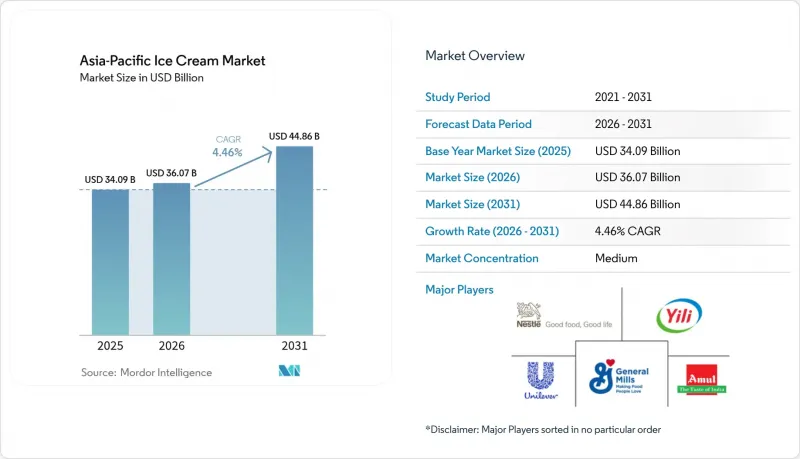
According to Mordor Intelligence, the Asia-Pacific ice cream market size is expected to grow from USD 34.09 billion in 2025 to USD 36.07 billion in 2026 and is forecast to reach USD 44.86 billion by 2031 at 4.46% CAGR over 2026-2031.
This report is Segmented by Product Type (Artisanal, Impulse, Take-Home), Category (Dairy and Non-Dairy), Packaging Type (Pints, Tubs/Cups, Sticks, Others), Distribution Channel (On-Trade and Off-Trade), and Geography (China, India, Japan, South Korea, Australia, New Zealand, Indonesia, and More). The Market Forecasts are Provided in Terms of Value (USD) and Volume (Liters).
Asia-Pacific Ice Cream Market Trends and Insights
Rising urbanization and changing lifetsyles
Urbanization is reshaping ice cream consumption patterns, with city dwellers preferring convenience-oriented products and consuming more per capita. A UN-Habitat report states that Asia hosts 54% of the world's urban population, or over 2.2 billion people. By 2050, this figure is expected to grow by 1.2 billion, a 50% increase. Rapid metropolitan growth in India and China has concentrated consumers with rising disposable incomes, boosting demand for premium ice cream products and increasing purchase frequency. Urban lifestyles have driven demand for quick-consumption formats. In cities like Jakarta, Manila, and Mumbai, working professionals are replacing sit-down desserts with grab-and-go options, favoring stick and cone formats over tubs. Yili's 2024 acquisition of Thailand's Chomthana reflects a strategy to capitalize on this trend, leveraging Chomthana's 60-year distribution network to make single-serve SKUs easily accessible to commuters. Urbanization also accelerates cold-chain investments, as cities attract logistics infrastructure faster than rural areas. This reduces spoilage risks and enables multinationals to introduce premium lines requiring strict temperature control.
Growing demand for premium and artisanal ice cream with innovative flavors
Consumers in China, Japan, and Australia are driving the premiumization trend by willingly paying 30-50% more for artisanal brands that emphasize provenance, unique ingredients, and limited-edition offerings. According to the Japan Ice Cream Association, the average household spending on ice cream for households with two or more people rose to approximately JPY 12,295 in 2024, up from JPY 11,580 in 2023, marking a new record high and highlighting growing consumer demand. Nestle's Movenpick responded to this trend in 2024 by launching in China with Swiss-origin positioning and flavors like caramelized almond and Madagascar vanilla, securing distribution in over 5,000 premium retail outlets within six months. Barry Callebaut's 2024 trend report revealed that 80% of Asian consumers prefer multi-texture experiences such as crunchy inclusions, swirls, and layered cores-over single-note flavors. This preference is pushing brands to adopt advanced co-extrusion and variegation technologies, which were previously cost-prohibitive for mid-tier players. Artisanal brands like Singapore's Inside Scoop and Malaysia's Udders are leveraging local ingredients, including pandan, black sesame, and yuzu, to differentiate themselves from multinational portfolios.
Rising health concerns regarding sugar, fat content, and calorie intake
Health consciousness increasingly constrains traditional ice cream consumption as consumers become more aware of nutritional content and its health implications, particularly in developed Asia-Pacific markets where obesity rates and diabetes prevalence drive dietary behavior changes. In 2024, the International Diabetes Federation highlighted that around 107 million individuals in Southeast Asia are contending with diabetes, further influencing dietary choices. For example, Singapore's Nutri-Grade initiative, which imposes stricter regulations on sodium and fat content, emphasizes the pivotal role of government interventions in altering product formulations and marketing tactics. In response to this divide, manufacturers are increasingly investing in Research and Development, particularly in sugar reduction technologies and alternative sweetening systems. As consumer education campaigns highlight nutritional content, consumers are scrutinizing ingredient lists more than ever. This heightened scrutiny has prompted brands to adopt transparent labeling strategies and healthier formulations, all to maintain their market access. Significantly, this trend is influencing impulse purchase decisions.
Other drivers and restraints analyzed in the detailed report include:
- Surging demand for functional, low-sugar, and plant-based ice cream options
- Expansion of foodservice outlets, dessert cafes, and experiential dining concepts
- Limited cold chain infrastructure and refrigeration challenges in rural and emerging markets
For complete list of drivers and restraints, kindly check the Table Of Contents.
Segment Analysis
Impulse ice cream accounted for the largest revenue share in the Asia-Pacific ice cream market, capturing 45.63% of total market revenue in 2025. The dominance of this segment is primarily driven by strong consumer demand for convenient, single-serve formats that cater to on-the-go consumption and impulse purchasing behavior. Wide product availability across supermarkets, convenience stores, and vending channels further strengthens its market position. Manufacturers continue to invest in innovative flavors, attractive packaging, and affordable pricing strategies to maintain high purchase frequency among younger consumers and urban populations. Seasonal demand spikes, particularly during warmer months, also contribute significantly to the segment's consistent sales performance.
Artisanal ice cream is emerging as the fastest-growing segment in the Asia-Pacific ice cream market, projected to expand at a CAGR of 5.04% through 2031. Growth in this segment is largely driven by increasing consumer preference for premium, authentic, and locally sourced products that emphasize quality and uniqueness. Rising disposable incomes and evolving taste preferences are encouraging consumers to explore small-batch and craft ice cream offerings with natural ingredients and innovative flavor profiles. The expansion of specialty ice cream parlors and boutique dessert outlets across urban centers is further accelerating demand. Consumers are also showing greater interest in products perceived as less processed and more indulgent, supporting the shift toward artisanal formats.
In 2025, dairy ice cream commanded a dominant 86.26% share of the Asia-Pacific ice cream market. This stronghold is bolstered by well-established supply chains that guarantee consistent quality, availability, and affordability. Consumers across diverse markets associate traditional dairy formulations with superior taste and creaminess. Furthermore, a long-standing cultural affinity for dairy-based desserts solidifies this preference, making dairy the go-to choice for indulgence. With broad distribution channels spanning supermarkets, convenience stores, and foodservice outlets, dairy ice cream's accessibility is unparalleled. These combined advantages not only position dairy ice cream as the bedrock of the regional industry but also underscore its continued influence in mainstream market dynamics, even amidst a rising interest in alternatives.
While dairy ice cream maintains its dominance, non-dairy ice cream is swiftly carving out a niche as the fastest-growing segment, projected to grow at a CAGR of 6.31% through 2031. This surge is a testament to evolving consumer preferences, driven by heightened health consciousness and a growing awareness of lactose intolerance in the Asia-Pacific. Plant-based alternatives are winning over consumers who desire lighter, allergen-free options that don't skimp on taste. Moreover, as consumers become increasingly concerned about environmental sustainability, the perception of plant-based options as more eco-friendly than traditional dairy is driving their adoption. Additionally, global trends in veganism and flexitarianism are encouraging experimentation, especially among younger, urban consumers with greater purchasing power.
Complete Report Scope:
- By Product Type
- Artisanal Ice Cream
- Impulse Ice Cream
- Take-home Ice Cream
- By Category
- Dairy
- Non-Dairy
- By Packaging Type
- Pints
- Tubs/Cups
- Sticks
- Others
- Distribution Channel
- On-Trade
- Off-Trade
- Supermarkets/Hypermarkets
- Specialist Retailers
- Convenience Stores
- Online Retail Stores
- Other Distribution Channels
- By Geography
- China
- India
- Japan
- South Korea
- Australia
- New Zealand
- Indonesia
- Thailand
- Vietnam
- Malaysia
- Philippines
- Rest of Asia-Pacific
List of Companies Covered in this Report:
- Unilever PLC
- Nestle S.A.
- General Mills Inc.
- Gujarat Cooperative Milk Marketing Federation Ltd
- Inner Mongolia Yili Industrial Group Co., Ltd.
- The Magnum Ice Cream Company N.V.
- Froneri Ltd
- China Mengniu Dairy Company Limited
- Lotte Confectionery Co., Ltd.
- Meiji Holdings Co., Ltd.
- Morinaga & Co., Ltd.
- Bright Dairy & Food Co., Ltd.
- Ezaki Glico Co., Ltd.
- Wells Enterprises, Inc.
- Bulla Dairy Foods Pty Ltd
- Peters Ice Cream (Froneri Australia Pty Ltd)
- Campina Ice Cream Industry Tbk.
- Diamond Food Indonesia Tbk.
- Aice Group Holdings Pte. Ltd.
- Pacific Ice Cream Co., Ltd.
Additional Benefits:
- The market estimate (ME) sheet in Excel format
- 3 months of analyst support
TABLE OF CONTENTS
1 INTRODUCTION
- 1.1 Study Assumptions and Market Definition
- 1.2 Scope of the Study
2 RESEARCH METHODOLOGY
3 EXECUTIVE SUMMARY
4 MARKET LANDSCAPE
- 4.1 Market Overview
- 4.2 Market Drivers
- 4.2.1 Rising urbanization and changing lifetsyles
- 4.2.2 Growing demand for premium and artisanal ice cream with innovative flavors
- 4.2.3 Surging demand for functional, low-sugar, and plant-based ice cream options
- 4.2.4 Expansion of foodservice outlets, dessert cafes, and experiential dining concepts
- 4.2.5 Rising adoption of Western-style desserts fueling the demand
- 4.2.6 Strong influence of social media and digital marketing increasing product visibility
- 4.3 Market Restraints
- 4.3.1 Rising health concerns regarding sugar, fat content, and calorie intake
- 4.3.2 Fluctuating raw material prices including milk, sugar, and cocoa
- 4.3.3 Limited cold chain infrastructure and refrigeration challenges in rural and emerging markets
- 4.3.4 High energy costs impacting frozen storage and distribution efficiency
- 4.4 Consumer Behavior Analysis
- 4.5 Regulatory Landscape
- 4.6 Technological Outlook
- 4.7 Porter's Five Forces
- 4.7.1 Bargaining Power of Buyers/Consumers
- 4.7.2 Bargaining Power of Suppliers
- 4.7.3 Threat of New Entrants
- 4.7.4 Threat of Substitute Products
- 4.7.5 Intensity of Competitive Rivalry
5 MARKET SIZE AND GROWTH FORECASTS (VALUE AND VOLUME)
- 5.1 By Product Type
- 5.1.1 Artisanal Ice Cream
- 5.1.2 Impulse Ice Cream
- 5.1.3 Take-home Ice Cream
- 5.2 By Category
- 5.2.1 Dairy
- 5.2.2 Non-Dairy
- 5.3 By Packaging Type
- 5.3.1 Pints
- 5.3.2 Tubs/Cups
- 5.3.3 Sticks
- 5.3.4 Others
- 5.4 Distribution Channel
- 5.4.1 On-Trade
- 5.4.2 Off-Trade
- 5.4.2.1 Supermarkets/Hypermarkets
- 5.4.2.2 Specialist Retailers
- 5.4.2.3 Convenience Stores
- 5.4.2.4 Online Retail Stores
- 5.4.2.5 Other Distribution Channels
- 5.5 By Geography
- 5.5.1 China
- 5.5.2 India
- 5.5.3 Japan
- 5.5.4 South Korea
- 5.5.5 Australia
- 5.5.6 New Zealand
- 5.5.7 Indonesia
- 5.5.8 Thailand
- 5.5.9 Vietnam
- 5.5.10 Malaysia
- 5.5.11 Philippines
- 5.5.12 Rest of Asia-Pacific
6 COMPETITIVE LANDSCAPE
- 6.1 Market Concentration
- 6.2 Strategic Moves
- 6.3 Market Share Analysis
- 6.4 Company Profiles (includes Global Overview, Market-level Overview, Core Segments, Financials, Strategic Information, Market Rank/Share, Products & Services, Recent Developments)
- 6.4.1 Unilever PLC
- 6.4.2 Nestle S.A.
- 6.4.3 General Mills Inc.
- 6.4.4 Gujarat Cooperative Milk Marketing Federation Ltd
- 6.4.5 Inner Mongolia Yili Industrial Group Co., Ltd.
- 6.4.6 The Magnum Ice Cream Company N.V.
- 6.4.7 Froneri Ltd
- 6.4.8 China Mengniu Dairy Company Limited
- 6.4.9 Lotte Confectionery Co., Ltd.
- 6.4.10 Meiji Holdings Co., Ltd.
- 6.4.11 Morinaga & Co., Ltd.
- 6.4.12 Bright Dairy & Food Co., Ltd.
- 6.4.13 Ezaki Glico Co., Ltd.
- 6.4.14 Wells Enterprises, Inc.
- 6.4.15 Bulla Dairy Foods Pty Ltd
- 6.4.16 Peters Ice Cream (Froneri Australia Pty Ltd)
- 6.4.17 Campina Ice Cream Industry Tbk.
- 6.4.18 Diamond Food Indonesia Tbk.
- 6.4.19 Aice Group Holdings Pte. Ltd.
- 6.4.20 Pacific Ice Cream Co., Ltd.
7 MARKET OPPORTUNITIES AND FUTURE OUTLOOK

