PUBLISHER: Mordor Intelligence | PRODUCT CODE: 2121582

PUBLISHER: Mordor Intelligence | PRODUCT CODE: 2121582
South America Ice Cream - Market Share Analysis, Industry Trends & Statistics, Growth Forecasts (2026 - 2031)
According to Mordor Intelligence, the south american ice cream market size is expected to grow from USD 10.17 billion in 2025 to USD 10.65 billion in 2026 and is forecast to reach USD 13.39 billion by 2031 at 4.68% CAGR over 2026-2031.
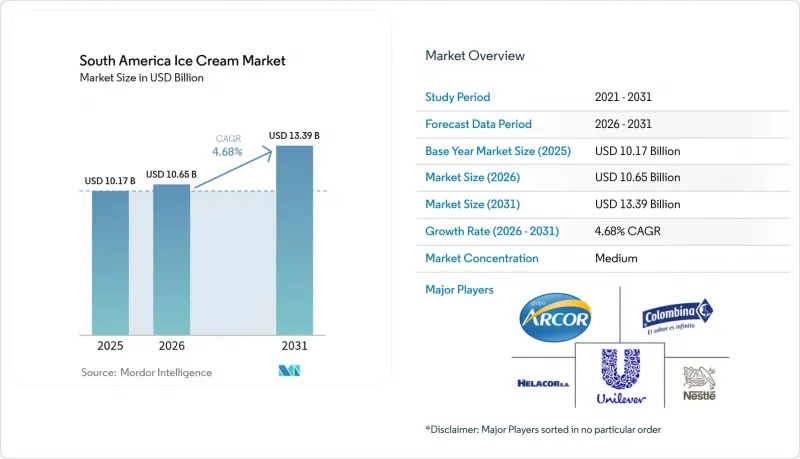
This report is Segmented by Flavor (Vanilla, Chocolate, and More), Product Type (Artisanal Ice Cream, Impulse Ice Cream, and Take-Home Ice Cream), Category (Dairy and Non-Dairy), Distribution Channel (On-Trade and Off-Trade), and Geography (Brazil, Argentina, Chile, and Rest of South America). The Market Forecasts are Provided in Terms of Value (USD).
South America Ice Cream Market Trends and Insights
Rising urbanization shifts lifestyles toward convenience snacking
Urbanization across South America is driving a shift in consumer behavior toward convenience-focused snacking, creating high-demand consumption corridors where modern retail formats integrate with delivery platforms. According to the World Bank, urban populations in 2024 reached 88% in Brazil and 92% in Argentina. This trend significantly benefits the ice cream market, as urban centers see heightened impulse purchases, particularly during peak summer months when rising temperatures boost demand. Discounters and e-commerce platforms are enhancing accessibility for cost-conscious consumers, while rapid delivery services such as iFood and Rappi strengthen the convenience proposition by offering near-instant delivery. These factors collectively position ice cream as a key indulgence in metropolitan markets, driven by urban migration, multi-channel retail strategies, and the growth of digital food ecosystems.
Demand for premium artisanal flavors like tropical fruits
The South American market for premium artisanal ice cream is undergoing significant growth, driven by affluent urban consumers seeking unique flavors and superior taste experiences. This trend is reflected in the increasing demand for tropical and regionally sourced fruits such as acai, cupuacu, and camu-camu, highlighting both a commitment to local biodiversity and a shift away from synthetic or conventional flavor profiles. Companies, including startups and established brands, are leveraging this opportunity by introducing small-batch, sustainability-focused products. These offerings often feature upcycled ingredients and single-origin inputs, enhancing their premium positioning. The proliferation of artisanal parlors and branded ice cream shops across major cities demonstrates strong confidence in high-margin, experience-oriented foodservice formats.
Health concerns over high sugar and calories
In South America, health concerns over high sugar and calorie content are curbing ice cream consumption, especially among urban consumers who now view it more as an indulgent treat than a daily snack. The Chilean Ministry of Health has advised in its 2024 dietary guidelines to limit frozen dessert consumption to just once a week. This poses challenges, especially for impulse buys near schools . Many countries are expanding front-of-pack labeling and implementing sugar-related fiscal measures, further discouraging these impulse purchases and intensifying regulatory scrutiny on manufacturers. While companies are rolling out reduced-sugar and reformulated variants in response, these changes often come with higher ingredient costs or compromises on taste. This not only compresses profit margins but also raises competitive barriers. Larger multinational corporations can better absorb these reformulation costs thanks to their global research and development scale. In contrast, regional players find themselves at a crossroads, having to choose between premium pricing and potential profit erosion. Additionally, the growing emphasis on health and wellness trends is reshaping consumer preferences, compelling manufacturers to innovate while navigating regulatory complexities. Companies that fail to adapt to these evolving dynamics risk losing market share in an increasingly competitive landscape. rejection if sensory profiles deviate significantly from established expectations.
Other drivers and restraints analyzed in the detailed report include:
- Growth in e-commerce and food delivery platforms
- Health trends boost low-sugar and functional ice creams
- Supply chain disruptions in cold chain logistics
For complete list of drivers and restraints, kindly check the Table Of Contents.
Segment Analysis
In 2025, traditional flavors such as vanilla, commanding a 33.12% market share, remained a cornerstone of the South American ice cream market due to their broad consumer appeal and cost-efficient formulation. Chocolate, underpinned by the region's cocoa heritage, continued to experience strong demand. However, fluctuations in cocoa prices have compelled manufacturers to optimize formulations and explore alternative ingredients to maintain profitability. Conversely, fruit and tropical flavors represent the fastest-growing segment, with a projected CAGR of 5.72% through 2031. This growth is driven by the region's strong preference for ingredients like acai, cupuacu, guava, and passion fruit. These flavors resonate particularly well in Brazil, where biodiversity-inspired formulations and locally sourced ingredients are gaining consumer acceptance and visibility.
Beyond traditional offerings, flavors such as dulce de leche, cookies-and-cream, and salted caramel are serving as platforms for premium and limited-edition product innovations. To comply with stricter labeling regulations and address the increasing demand for vegan options, manufacturers are introducing reduced-sugar and plant-based tropical variants. Flavor development is increasingly aligned with sustainability initiatives, incorporating upcycled fruit ingredients, single-origin cocoa, and traceable vanilla to enhance premium positioning. As a result, flavor innovation is evolving beyond basic taste differentiation to deliver a comprehensive value proposition centered on health, authenticity, and environmental sustainability.
In 2025, take-home ice cream led the South American market, capturing a 45.78% share, primarily driven by the popularity of family-size tubs and multi-packs distributed through supermarkets and hypermarkets. Impulse products, such as single-serve bars and cones, benefit from extensive distribution networks; however, profitability is constrained by aggressive promotional activities and fluctuations in raw material costs. Conversely, the artisanal ice cream segment is experiencing robust growth, with a CAGR of 5.71% projected through 2031. This expansion is supported by the proliferation of parlors in major urban centers and the entry of foodservice chains into the category, capitalizing on higher-margin opportunities and the increasing demand for premium, experience-oriented offerings.
Premiumization is driving innovation across all product categories. High-value offerings, including single-origin cocoa, exotic fruit sorbets, and alcohol-infused variants, are commanding price premiums and appealing to affluent millennial consumers. In response, take-home ice cream products are introducing smaller premium tubs designed for urban singles and couples, while investments in cold-chain infrastructure are enhancing accessibility in rural areas. Although weather variability continues to influence overall sales, premium brands and artisanal collaborations are achieving significant growth, reflecting a regional shift toward quality, innovation, and differentiated consumer experiences in the ice cream market.
Complete Report Scope:
- By Flavor
- Vanilla
- Chocolate
- Fruit and Tropical
- Others
- By Product Type
- Artisanal Ice Cream
- Impulse Ice Cream
- Take-home Ice Cream
- By Category
- Dairy
- Non-Dairy
- By Distribution Channel
- On-Trade
- Off-Trade
- Supermarkets/Hypermarkets
- Specialist Retailers
- Convenience Stores
- Online Retail Stores
- Other Distribution Channels
- By Geography
- Brazil
- Argentina
- Chile
- Columbia
- Peru
- Paraguay
- Uraguay
- Rest of South America
List of Companies Covered in this Report:
- Unilever PLC
- Nestle S.A.
- Arcor S.A.I.C.
- Helacor S.A.
- Colombina S.A.
- Frutos do Brasil
- Sorvetes Jundia
- Froneri
- Chiquinho Sorvetes
- Grupo Nutresa
- Diletto
- Los Paleteros
- Creme Mel Sorvetes
- General Mills
- Mars Inc.
- Cacau Show
- Emporio La Rosa
- Savory
- Danone
- Grupo Bimbo
Additional Benefits:
- The market estimate (ME) sheet in Excel format
- 3 months of analyst support
TABLE OF CONTENTS
1 INTRODUCTION
- 1.1 Study Assumptions and Market Definition
- 1.2 Scope of the Study
2 RESEARCH METHODOLOGY
3 EXECUTIVE SUMMARY
4 MARKET LANDSCAPE
- 4.1 Market Overview
- 4.2 Market Drivers
- 4.2.1 Rising urbanization shifts lifestyles toward convenience snacking
- 4.2.2 Demand for premium artisanal flavors like tropical fruits
- 4.2.3 Growth in e-commerce and food delivery platforms
- 4.2.4 Health trends boost low-sugar and functional ice creams
- 4.2.5 Popularity of plant-based dairy-free alternatives
- 4.2.6 Lactose intolerance awareness drives non-dairy options
- 4.3 Market Restraints
- 4.3.1 Health concerns over high sugar and calories
- 4.3.2 Supply chain disruptions in cold chain logistics
- 4.3.3 Raw material price volatility for dairy and sugar
- 4.3.4 Intense competition from multinationals and locals
- 4.4 Supply Chain Analysis
- 4.5 Regulatory Outlook
- 4.6 Porter's Five Forces
- 4.6.1 Threat of New Entrants
- 4.6.2 Bargaining Power of Buyers/Consumers
- 4.6.3 Bargaining Power of Suppliers
- 4.6.4 Threat of Substitute Products
- 4.6.5 Intensity of Competitive Rivalry
5 MARKET SIZE AND GROWTH FORECASTS (VALUE)
- 5.1 By Flavor
- 5.1.1 Vanilla
- 5.1.2 Chocolate
- 5.1.3 Fruit and Tropical
- 5.1.4 Others
- 5.2 By Product Type
- 5.2.1 Artisanal Ice Cream
- 5.2.2 Impulse Ice Cream
- 5.2.3 Take-home Ice Cream
- 5.3 By Category
- 5.3.1 Dairy
- 5.3.2 Non-Dairy
- 5.4 By Distribution Channel
- 5.4.1 On-Trade
- 5.4.2 Off-Trade
- 5.4.2.1 Supermarkets/Hypermarkets
- 5.4.2.2 Specialist Retailers
- 5.4.2.3 Convenience Stores
- 5.4.2.4 Online Retail Stores
- 5.4.2.5 Other Distribution Channels
- 5.5 By Geography
- 5.5.1 Brazil
- 5.5.2 Argentina
- 5.5.3 Chile
- 5.5.4 Columbia
- 5.5.5 Peru
- 5.5.6 Paraguay
- 5.5.7 Uraguay
- 5.5.8 Rest of South America
6 COMPETITIVE LANDSCAPE
- 6.1 Market Concentration
- 6.2 Strategic Moves
- 6.3 Market Ranking Analysis
- 6.4 Company Profiles (includes Global-level Overview, Market-level Overview, Core Segments, Financials (if available), Strategic Information, Market Rank/Share, Products and Services, Recent Developments)
- 6.4.1 Unilever PLC
- 6.4.2 Nestle S.A.
- 6.4.3 Arcor S.A.I.C.
- 6.4.4 Helacor S.A.
- 6.4.5 Colombina S.A.
- 6.4.6 Frutos do Brasil
- 6.4.7 Sorvetes Jundia
- 6.4.8 Froneri
- 6.4.9 Chiquinho Sorvetes
- 6.4.10 Grupo Nutresa
- 6.4.11 Diletto
- 6.4.12 Los Paleteros
- 6.4.13 Creme Mel Sorvetes
- 6.4.14 General Mills
- 6.4.15 Mars Inc.
- 6.4.16 Cacau Show
- 6.4.17 Emporio La Rosa
- 6.4.18 Savory
- 6.4.19 Danone
- 6.4.20 Grupo Bimbo
7 MARKET OPPORTUNITIES AND FUTURE OUTLOOK

