PUBLISHER: Mordor Intelligence | PRODUCT CODE: 2113487

PUBLISHER: Mordor Intelligence | PRODUCT CODE: 2113487
South America Wheat - Market Share Analysis, Industry Trends & Statistics, Growth Forecasts (2026 - 2031)
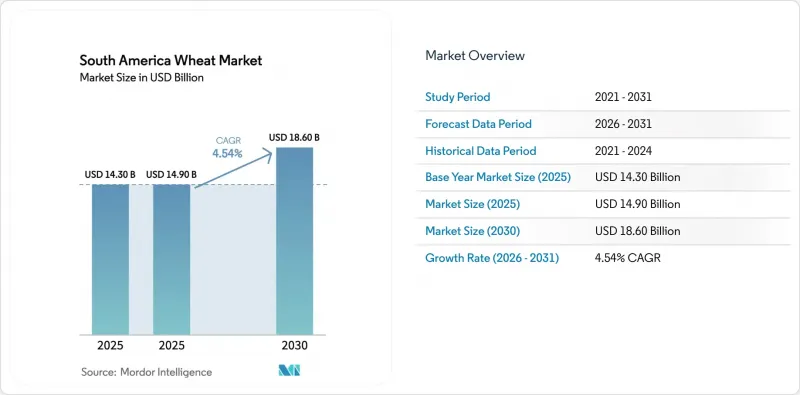
According to Mordor Intelligence, the South America wheat market size is projected to be USD 14.3 billion in 2025, USD 14.9 billion in 2026, and reach USD 18.6 billion by 2031, growing at a CAGR of 4.54% from 2026 to 2031.
This report is Segmented by Geography (Brazil, Argentina, and More). The Report Includes Production Analysis (Volume), Consumption Analysis (Value and Volume), Import Analysis (Value and Volume), Export Analysis (Value and Volume), Wholesale Price Trend Analysis and Forecast, List of Key Players, and More. The Market Forecasts are Provided in Terms of Value (USD) and Volume (Metric Tons).
South America Wheat Market Trends and Insights
Increasing Domestic Wheat-Based Food Demand
Urban income growth has lifted Brazil's per-capita wheat intake from 58 kg in 2020 to 63 kg in 2025, bolstering flour, pasta, and biscuit factories. Bakeries in Sao Paulo and Rio de Janeiro alone absorbed 4.2 million metric tons of flour in 2025, up 11% from 2023. Parallel demand is emerging in Argentina, where pasta exporters increased durum imports by 23% year-over-year to satisfy Chilean and Peruvian contracts. This sustained pull encourages acreage gains in Brazil's Cerrado and Paraguay's eastern departments, even though yield gaps remain 1.5-2.0 metric tons per hectare relative to temperate zones.
Government Push for Wheat Self-Sufficiency in Brazil
Brazil targets 4 million hectares by 2030, up from 2.8 million hectares in 2025, by subsidizing seed, crop insurance, and rural credit at 7.5% interest versus the 12% market rate . Cerrado plantings rose 22% year-on-year in 2025, mostly in municipalities in Mato Grosso practicing double-cropping. Heat-tolerant cultivars such as BRS 264 yield 6 metric tons per hectare, doubling yields in Rio Grande do Sul. Freight remains a hurdle because wheat must travel up to 2,200 km to reach southern mills, adding USD 45-60 per metric ton to the haulage cost.
Climate Variability (Drought, Frost)
Late-season frosts cut Argentina's 2024 harvest by 2.8 million metric tons and pushed Buenos Aires flour prices up 12%. Rio Grande do Sul lost 680,000 metric tons in 2025 after a 45-day drought. Rainfall outside historical norms now hits major producers every 2 to 3 years, exposing 1.8 million hectares without insurance coverage. The South America wheat market, therefore, carries a persistent weather premium, which complicates long-range hedging. Unless subsidized insurance expands beyond the current 28% of sown area, yield shocks will continue to inflate growers' borrowing costs and curb technology upgrades.
Other drivers and restraints analyzed in the detailed report include:
- Port and Rail Upgrades Lowering Inland Freight Cost
- Mercado Comum do Sul (MERCOSUR) tariff preferences stimulating intra-bloc trade
- Farm-gate price volatility linked to Chicago Board of Trade (CBOT) futures
For complete list of drivers and restraints, kindly check the Table Of Contents.
Complete Report Scope:
- By Geography
- Argentina
- Production Analysis (Area Harvested, Yield, and Production Volume)
- Consumption Analysis (Consumption Value and Volume)
- Import Market Analysis (Import Value, Volume, and Key Supplying Markets)
- Export Market Analysis (Export Value, Volume, and Key Destination Markets)
- Wholesale Price Trend Analysis and Forecast
- Regulatory Framework
- List of Key Players
- Logistics and Infrastructure
- Seasonality Analysis
- Brazil
- Production Analysis (Area Harvested, Yield, and Production Volume)
- Consumption Analysis (Consumption Value and Volume)
- Import Market Analysis (Import Value, Volume, and Key Supplying Markets)
- Export Market Analysis (Export Value, Volume, and Key Destination Markets)
- Wholesale Price Trend Analysis and Forecast
- Regulatory Framework
- List of Key Players
- Logistics and Infrastructure
- Seasonality Analysis
- Paraguay
- Production Analysis (Area Harvested, Yield, and Production Volume)
- Consumption Analysis (Consumption Value and Volume)
- Import Market Analysis (Import Value, Volume, and Key Supplying Markets)
- Export Market Analysis (Export Value, Volume, and Key Destination Markets)
- Wholesale Price Trend Analysis and Forecast
- Regulatory Framework
- List of Key Players
- Logistics and Infrastructure
- Seasonality Analysis
- Chile
- Production Analysis (Area Harvested, Yield, and Production Volume)
- Consumption Analysis (Consumption Value and Volume)
- Import Market Analysis (Import Value, Volume, and Key Supplying Markets)
- Export Market Analysis (Export Value, Volume, and Key Destination Markets)
- Wholesale Price Trend Analysis and Forecast
- Regulatory Framework
- List of Key Players
- Logistics and Infrastructure
- Seasonality Analysis
- Argentina
Additional Benefits:
- The market estimate (ME) sheet in Excel format
- 3 months of analyst support
TABLE OF CONTENTS
1 Introduction
- 1.1 Study Assumptions and Market Definition
- 1.2 Scope of the Study
2 Research Methodology
3 Executive Summary
4 Market Landscape
- 4.1 Market Overview
- 4.2 Market Drivers
- 4.2.1 Increasing domestic wheat-based food demand
- 4.2.2 Government push for wheat self-sufficiency in Brazil
- 4.2.3 Port and rail upgrades lowering inland freight cost
- 4.2.4 Mercado Comum do Sul (MERCOSUR) tariff preferences stimulating intra-bloc trade
- 4.2.5 Adoption of drought-tolerant Cerrado wheat cultivars
- 4.2.6 Carbon-credit premiums for regenerative wheat farming
- 4.3 Market Restraints
- 4.3.1 Climate variability (drought, frost)
- 4.3.2 Farm-gate price volatility linked to Chicago Board of Trade (CBOT) futures
- 4.3.3 Wheat blast disease outbreaks (Magnaporthe oryzae pathotype Triticum)
- 4.3.4 Limited rural credit access for smallholders
- 4.4 Opportunities
- 4.5 Challenges
- 4.6 Value Chain Analysis
- 4.7 Technologies and usage of AI in the Industry
- 4.8 Input Market Analysis
- 4.8.1 Seeds
- 4.8.2 Fertilizers
- 4.8.3 Crop Protection Chemicals
- 4.9 Distribution Channel Analysis
- 4.10 Market Sentiment Analysis
- 4.11 PESTLE Analysis
5 Market Size and Growth Forecasts (Value and Volume)
- 5.1 By Geography
- 5.1.1 Argentina
- 5.1.1.1 Production Analysis (Area Harvested, Yield, and Production Volume)
- 5.1.1.2 Consumption Analysis (Consumption Value and Volume)
- 5.1.1.3 Import Market Analysis (Import Value, Volume, and Key Supplying Markets)
- 5.1.1.4 Export Market Analysis (Export Value, Volume, and Key Destination Markets)
- 5.1.1.5 Wholesale Price Trend Analysis and Forecast
- 5.1.1.6 Regulatory Framework
- 5.1.1.7 List of Key Players
- 5.1.1.8 Logistics and Infrastructure
- 5.1.1.9 Seasonality Analysis
- 5.1.2 Brazil
- 5.1.2.1 Production Analysis (Area Harvested, Yield, and Production Volume)
- 5.1.2.2 Consumption Analysis (Consumption Value and Volume)
- 5.1.2.3 Import Market Analysis (Import Value, Volume, and Key Supplying Markets)
- 5.1.2.4 Export Market Analysis (Export Value, Volume, and Key Destination Markets)
- 5.1.2.5 Wholesale Price Trend Analysis and Forecast
- 5.1.2.6 Regulatory Framework
- 5.1.2.7 List of Key Players
- 5.1.2.8 Logistics and Infrastructure
- 5.1.2.9 Seasonality Analysis
- 5.1.3 Paraguay
- 5.1.3.1 Production Analysis (Area Harvested, Yield, and Production Volume)
- 5.1.3.2 Consumption Analysis (Consumption Value and Volume)
- 5.1.3.3 Import Market Analysis (Import Value, Volume, and Key Supplying Markets)
- 5.1.3.4 Export Market Analysis (Export Value, Volume, and Key Destination Markets)
- 5.1.3.5 Wholesale Price Trend Analysis and Forecast
- 5.1.3.6 Regulatory Framework
- 5.1.3.7 List of Key Players
- 5.1.3.8 Logistics and Infrastructure
- 5.1.3.9 Seasonality Analysis
- 5.1.4 Chile
- 5.1.4.1 Production Analysis (Area Harvested, Yield, and Production Volume)
- 5.1.4.2 Consumption Analysis (Consumption Value and Volume)
- 5.1.4.3 Import Market Analysis (Import Value, Volume, and Key Supplying Markets)
- 5.1.4.4 Export Market Analysis (Export Value, Volume, and Key Destination Markets)
- 5.1.4.5 Wholesale Price Trend Analysis and Forecast
- 5.1.4.6 Regulatory Framework
- 5.1.4.7 List of Key Players
- 5.1.4.8 Logistics and Infrastructure
- 5.1.4.9 Seasonality Analysis
- 5.1.1 Argentina
6 End Use Applications and Industries
- 6.1 Primary Applications and Emerging Applications
- 6.2 Consumption Breakdown by Industries
7 Competitive Landscape
- 7.1 Overview of the Competition
- 7.2 Recent Developments
- 7.3 Market Concentration Analysis
8 Market Opportunities and Future Outlook

