PUBLISHER: Mordor Intelligence | PRODUCT CODE: 2113777

PUBLISHER: Mordor Intelligence | PRODUCT CODE: 2113777
Asia-Pacific Wheat - Market Share Analysis, Industry Trends & Statistics, Growth Forecasts (2026 - 2031)
According to Mordor Intelligence, the Asia-Pacific wheat market size was valued at USD 90 billion in 2025 and estimated to grow from USD 93.65 billion in 2026 to reach USD 114.27 billion by 2031, at a CAGR of 4.05% during the forecast period (2026-2031).
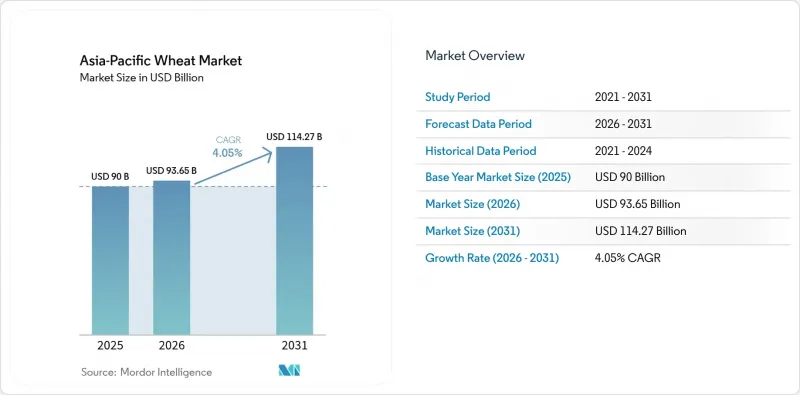
This report is Segmented by Geography (India, China, Japan, Australia, and Pakistan). The Report Provides Production Analysis (Volume), Consumption Analysis (Value and Volume), Import Analysis (Value and Volume), Export Analysis (Value and Volume), and Price Trend Analysis. The Market Forecasts are Provided in Terms of Value (USD) and Volume (Metric Tons).
Asia-Pacific Wheat Market Trends and Insights
Rising Demand for High-Protein Wheat-Based Functional Foods
Consumer shift toward protein-enriched and fiber-rich formulations is reshaping product portfolios across the Asia-Pacific wheat market. Nisshin Seifun Group's Amuria flour, launched in 2024, with significantly more fiber than standard flour, achieved rapid adoption in Japanese retail channels. Rising life expectancy in developed economies and health awareness among millennials bolster sustained premium-priced demand. Manufacturers capitalize on this by bundling protein claims with clean labels to strengthen brand differentiation.
Government Subsidies for Climate-Resilient Wheat Varieties
Long-range food-security programs are accelerating the diffusion of drought-tolerant and heat-resistant seeds across the Asia-Pacific wheat market. China enlarged direct grain subsidies in 2024, boosting farm productivity in leading provinces. India's minimum-support-price mechanism guaranteed returns on roughly 17% of wheat during the 2021/2022 marketing year, anchoring farmer incomes and encouraging uptake of hardy cultivars. Australian trials of gene-edited wheat targeting high-yield gains complement these policies by supplying temperate-zone germplasm to regional breeders. Subsidy alignment with climate goals secures medium-term supply resilience and trims import bills.
Vulnerability to Climate Change and Extreme Weather Events
The 2024 Asia-Pacific Climate Report projected wheat yields in developing Asia could fall up to 45% under unchecked emissions scenarios by 2070. Australia's wheat production demonstrates resilience through adaptive farming practices, with farmers achieving higher yields despite reduced rainfall, but climate risks remain elevated. Indian provinces registered production drops, stressing the need for irrigation investment and resilient genetics. These weather shocks undermine consistent raw-material flows and inflate insurance and hedging costs throughout the Asia-Pacific wheat market.
Other drivers and restraints analyzed in the detailed report include:
- Growing Urban Middle Class Adopting Westernized Bakery Products
- Expansion of Asia-Pacific Flour-Milling Capacity
- Geopolitical Export Restrictions Creating Price Volatility
For complete list of drivers and restraints, kindly check the Table Of Contents.
Complete Report Scope:
- By Geography
- India
- Production Analysis (Volume)
- Consumption Analysis (Value and Volume)
- Import Analysis (Value and Volume)
- Export Analysis (Value and Volume)
- Price Trend Analysis
- China
- Production Analysis (Volume)
- Consumption Analysis (Value and Volume)
- Import Analysis (Value and Volume)
- Export Analysis (Value and Volume)
- Price Trend Analysis
- Japan
- Production Analysis (Volume)
- Consumption Analysis (Value and Volume)
- Import Analysis (Value and Volume)
- Export Analysis (Value and Volume)
- Price Trend Analysis
- Australia
- Production Analysis (Volume)
- Consumption Analysis (Value and Volume)
- Import Analysis (Value and Volume)
- Export Analysis (Value and Volume)
- Price Trend Analysis
- Pakistan
- Production Analysis (Volume)
- Consumption Analysis (Value and Volume)
- Import Analysis (Value and Volume)
- Export Analysis (Value and Volume)
- Price Trend Analysis
- India
Additional Benefits:
- The market estimate (ME) sheet in Excel format
- 3 months of analyst support
TABLE OF CONTENTS
1 Introduction
- 1.1 Study Assumptions and Market Definition
- 1.2 Scope of the Study
2 Research Methodology
3 Executive Summary
4 Market Landscape
- 4.1 Market Overview
- 4.2 Market Drivers
- 4.2.1 Rising demand for high-protein wheat-based functional foods
- 4.2.2 Government subsidies for climate-resilient wheat varieties
- 4.2.3 Growing urban middle class adopting Westernized bakery products
- 4.2.4 Expansion of Asia-Pacific flour-milling capacity
- 4.2.5 Surge in cross-border e-commerce for specialty wheat flours
- 4.2.6 Adoption of blockchain-based traceability
- 4.3 Market Restraints
- 4.3.1 Increasing competition from alternative crops like rice and corn
- 4.3.2 Vulnerability to climate change and extreme weather events
- 4.3.3 Soil degradation in major wheat belts reducing yields
- 4.3.4 Geopolitical export restrictions creating price volatility
- 4.4 Regulatory Landscape
- 4.5 Technological Outlook
- 4.6 Value/Supply-Chain Analysis
- 4.7 PESTEL
5 Market Size and Growth Forecasts (Value and Volume)
- 5.1 By Geography
- 5.1.1 India
- 5.1.1.1 Production Analysis (Volume)
- 5.1.1.2 Consumption Analysis (Value and Volume)
- 5.1.1.3 Import Analysis (Value and Volume)
- 5.1.1.4 Export Analysis (Value and Volume)
- 5.1.1.5 Price Trend Analysis
- 5.1.2 China
- 5.1.2.1 Production Analysis (Volume)
- 5.1.2.2 Consumption Analysis (Value and Volume)
- 5.1.2.3 Import Analysis (Value and Volume)
- 5.1.2.4 Export Analysis (Value and Volume)
- 5.1.2.5 Price Trend Analysis
- 5.1.3 Japan
- 5.1.3.1 Production Analysis (Volume)
- 5.1.3.2 Consumption Analysis (Value and Volume)
- 5.1.3.3 Import Analysis (Value and Volume)
- 5.1.3.4 Export Analysis (Value and Volume)
- 5.1.3.5 Price Trend Analysis
- 5.1.4 Australia
- 5.1.4.1 Production Analysis (Volume)
- 5.1.4.2 Consumption Analysis (Value and Volume)
- 5.1.4.3 Import Analysis (Value and Volume)
- 5.1.4.4 Export Analysis (Value and Volume)
- 5.1.4.5 Price Trend Analysis
- 5.1.5 Pakistan
- 5.1.5.1 Production Analysis (Volume)
- 5.1.5.2 Consumption Analysis (Value and Volume)
- 5.1.5.3 Import Analysis (Value and Volume)
- 5.1.5.4 Export Analysis (Value and Volume)
- 5.1.5.5 Price Trend Analysis
- 5.1.1 India
6 Competitive Landscape
- 6.1 List of Stakeholders
- 6.1.1 COFCO Corporation
- 6.1.2 Wilmar International Limited
- 6.1.3 GrainCorp Limited
- 6.1.4 Cargill, Inc.
- 6.1.5 ITC Limited
- 6.1.6 Olam Group
- 6.1.7 Nisshin Seifun Group Inc.
- 6.1.8 Louis Dreyfus Company BV
- 6.1.9 GoodMills Group GmbH
- 6.1.10 ADM
- 6.1.11 CJ CheilJedang Corporation
7 Market Opportunities and Future Outlook

