PUBLISHER: Mordor Intelligence | PRODUCT CODE: 2121939

PUBLISHER: Mordor Intelligence | PRODUCT CODE: 2121939
Wheat - Market Share Analysis, Industry Trends & Statistics, Growth Forecasts (2026 - 2031)
According to Mordor Intelligence, the wheat market size was valued at USD 185.92 billion in 2025 and estimated to grow from USD 198.51 billion in 2026 to reach USD 248.32 billion by 2031, at a CAGR of 4.58% during the forecast period (2026-2031).
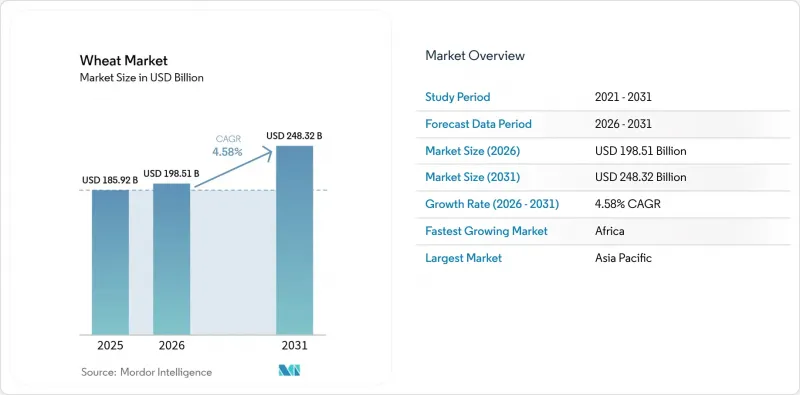
This report is Segmented by Geography (North America, Europe, Asia-Pacific, South America, The Middle East, and Africa). The Report Includes Production Analysis (Volume), Consumption Analysis (Value and Volume), Export Analysis (Value and Volume), Import Analysis (Value and Volume), Wholesale Price Trend Analysis, and More. The Market Forecasts are Provided in Terms of Value (USD) and Volume (Metric Tons).
Global Wheat Market Trends and Insights
Growth in Fortified Wheat Products Demand
Mandatory and voluntary flour-fortification programs now operate in 89 countries, embedding iron, zinc, and folic acid into industrial milling streams. Public procurement in Pakistan and Ethiopia specifies fortified flour for school meals, creating structural demand that commands a 3-5% retail premium. Private millers invest in traceability systems aligned with Codex Alimentarius, while donor-funded initiatives expand premix availability in sub-Saharan Africa. The driver is strongest where anemia and neural tube defect prevalence remain high, notably in India's National Iron Plus Initiative and Nigeria's mandatory standards. Rising health-conscious urban populations reinforce volume growth and sustain the positive price differential that boosts processor margins.
Expansion of Convenience Wheat-Based Foods
Urbanization and higher female labor-force participation lift demand for instant noodles, frozen dough, and ready-to-eat flatbreads. According to the World Instant Noodles Association (WINA), global instant noodle consumption surpassed 123,067 million servings in 2024, up from 118,180 million in 2021. This growth highlights the rising demand for convenient and affordable food options worldwide. China, Indonesia, India, and Vietnam reported the highest per capita consumption, driven by their large populations and rising preference for instant noodles as a staple. Supermarkets extend shelf life to 12 months through blast freezing and modified-atmosphere packaging, while e-commerce favors shelf-stable SKUs that tolerate multi-day delivery. Processors specify higher-protein, lower-moisture flour for automated lines, directing premiums to farmers who adopt improved cultivars. Adoption is cascading across Asia-Pacific and increasingly shaping bakery aisles in North America and Europe.
Geopolitical Export Restrictions
India's export ban, extended through 2024, and Russia's shipment quota capped at 30 million metric tons, have collectively reduced availability for countries like Egypt and Bangladesh. This has created significant challenges for importers, who are now stockpiling inventory to mitigate supply uncertainties. As a result, storage costs have risen, and importers are expanding credit lines to manage financial pressures. Additionally, futures markets are pricing in higher geopolitical risk premiums, reflecting the uncertainty surrounding global trade dynamics. The World Trade Organization's limited enforcement capabilities suggest that such trade restrictions may persist, further discouraging long-term contracting and complicating global supply chain planning.
Other drivers and restraints analyzed in the detailed report include:
- Commercial Roll-Out of Heat-Tolerant Wheat Genetics
- Artificial Intelligence Enabled Yield-Forecasting Adoption
- Mycotoxin Contamination Incidents
For complete list of drivers and restraints, kindly check the Table Of Contents.
Geography Analysis
Asia-Pacific is the largest geography segment and contributed 37.2% of the wheat market share in 2025. According to the Indian Rice Exporters Federation, India's wheat production in 2025 reached a record 117.5 million metric tons. Wheat was planted across 6.62 million hectares in 2025, reflecting a 17% increase compared to the previous year, based on data from the Ministry of Agriculture and Farmers' Welfare. In India, wheat sowing for the 2025/26 season is projected to increase by 5% from the previous year's record of 34.16 million hectares. In the 2025/26 period, China achieved a production of 140.1 million metric tons. Import-dependent countries such as Japan and those in Southeast Asia purchased higher-protein wheat from Australia and Canada, driven by urban preferences for convenience foods like noodles and baked snacks, which is positively influencing the outlook for the wheat market.
Africa is experiencing the fastest growth, with a CAGR of 5.0%, and imports accounting for half of its consumption. According to the ITC Trade Map, Egypt is projected to lead global imports in 2024, with a value of USD 4,442,761 thousand, primarily for a subsidized bread program benefiting 70 million citizens. Limited irrigation and fertilizer usage, at less than 15 kilograms per hectare, constrain local yields. However, continental initiatives supported by the African Development Bank aim to enhance production in countries such as Ethiopia, Kenya, and Tanzania. Efforts to expand cultivation in the Ethiopian highlands and the East African Rift Valley are projected to gradually reduce dependence on imports.
North America and Europe continue to serve as major export hubs, collectively shipping significant volumes annually. The United States is a key producer, with hard red wheat varieties comprising the majority of shipments to Asia. Canada is another important supplier, providing premium bread wheat and durum primarily to Italy and Algeria. The European Union maintains substantial harvests despite occasional yield declines due to heat stress and continues to export to North Africa. Meanwhile, competitive supplies from the Black Sea region, particularly Russia, continue to impact price benchmarks at Mediterranean ports.
- The market estimate (ME) sheet in Excel format
- 3 months of analyst support
TABLE OF CONTENTS
1 Introduction
- 1.1 Study Assumptions and Market Definition
- 1.2 Scope of the Study
2 Research Methodology
3 Executive Summary
4 Market Landscape
- 4.1 Market Overview
- 4.2 Market Drivers
- 4.2.1 Growth in fortified wheat products demand
- 4.2.2 Expansion of convenience wheat-based foods
- 4.2.3 Government biofuel-blend mandates
- 4.2.4 Global trade liberalization in cereals
- 4.2.5 Commercial roll-out of heat-tolerant wheat genetics
- 4.2.6 Artifical intelligence enabled yield-forecasting adoption
- 4.3 Market Restraints
- 4.3.1 Volatility in fertilizer prices
- 4.3.2 Geopolitical export restrictions
- 4.3.3 Mycotoxin contamination incidents
- 4.3.4 Water-stress-induced yield loss
- 4.4 Opportunities
- 4.5 Challenges
- 4.6 Value Chain Analysis
- 4.7 Technologies and usage of AI in the Industry
- 4.8 Input Market Analysis
- 4.8.1 Seeds
- 4.8.2 Fertilizers
- 4.8.3 Crop Protection Chemicals
- 4.9 Distribution Channel Analysis
- 4.10 Market Sentiment Analysis
- 4.11 PESTLE Analysis
5 Market Size and Growth Forecasts (Value and Volume)
- 5.1 By Geography
- 5.1.1 North America
- 5.1.1.1 United States
- 5.1.1.1.1 Production Analysis (Area Harvested, Yield, and Production Volume)
- 5.1.1.1.2 Consumption Analysis (Consumption Value and Volume)
- 5.1.1.1.3 Import Market Analysis (Import Value, Volume, and Key Supplying Markets)
- 5.1.1.1.4 Export Market Analysis (Export Value, Volume, and Key Destination Markets)
- 5.1.1.1.5 Wholesale Price Trend Analysis and Forecast
- 5.1.1.1.6 Regulatory Framework
- 5.1.1.1.7 List of Key Players
- 5.1.1.1.8 Logistics and Infrastructure
- 5.1.1.1.9 Seasonality Analysis
- 5.1.1.2 Mexico
- 5.1.1.2.1 Production Analysis (Area Harvested, Yield, and Production Volume)
- 5.1.1.2.2 Consumption Analysis (Consumption Value and Volume)
- 5.1.1.2.3 Import Market Analysis (Import Value, Volume, and Key Supplying Markets)
- 5.1.1.2.4 Export Market Analysis (Export Value, Volume, and Key Destination Markets)
- 5.1.1.2.5 Wholesale Price Trend Analysis and Forecast
- 5.1.1.2.6 Regulatory Framework
- 5.1.1.2.7 List of Key Players
- 5.1.1.2.8 Logistics and Infrastructure
- 5.1.1.2.9 Seasonality Analysis
- 5.1.1.3 Canada
- 5.1.1.3.1 Production Analysis (Area Harvested, Yield, and Production Volume)
- 5.1.1.3.2 Consumption Analysis (Consumption Value and Volume)
- 5.1.1.3.3 Import Market Analysis (Import Value, Volume, and Key Supplying Markets)
- 5.1.1.3.4 Export Market Analysis (Export Value, Volume, and Key Destination Markets)
- 5.1.1.3.5 Wholesale Price Trend Analysis and Forecast
- 5.1.1.3.6 Regulatory Framework
- 5.1.1.3.7 List of Key Players
- 5.1.1.3.8 Logistics and Infrastructure
- 5.1.1.3.9 Seasonality Analysis
- 5.1.1.1 United States
- 5.1.2 Europe
- 5.1.2.1 Germany
- 5.1.2.1.1 Production Analysis (Area Harvested, Yield, and Production Volume)
- 5.1.2.1.2 Consumption Analysis (Consumption Value and Volume)
- 5.1.2.1.3 Import Market Analysis (Import Value, Volume, and Key Supplying Markets)
- 5.1.2.1.4 Export Market Analysis (Export Value, Volume, and Key Destination Markets)
- 5.1.2.1.5 Wholesale Price Trend Analysis and Forecast
- 5.1.2.1.6 Regulatory Framework
- 5.1.2.1.7 List of Key Players
- 5.1.2.1.8 Logistics and Infrastructure
- 5.1.2.1.9 Seasonality Analysis
- 5.1.2.2 United Kingdom
- 5.1.2.2.1 Production Analysis (Area Harvested, Yield, and Production Volume)
- 5.1.2.2.2 Consumption Analysis (Consumption Value and Volume)
- 5.1.2.2.3 Import Market Analysis (Import Value, Volume, and Key Supplying Markets)
- 5.1.2.2.4 Export Market Analysis (Export Value, Volume, and Key Destination Markets)
- 5.1.2.2.5 Wholesale Price Trend Analysis and Forecast
- 5.1.2.2.6 Regulatory Framework
- 5.1.2.2.7 List of Key Players
- 5.1.2.2.8 Logistics and Infrastructure
- 5.1.2.2.9 Seasonality Analysis
- 5.1.2.3 France
- 5.1.2.3.1 Production Analysis (Area Harvested, Yield, and Production Volume)
- 5.1.2.3.2 Consumption Analysis (Consumption Value and Volume)
- 5.1.2.3.3 Import Market Analysis (Import Value, Volume, and Key Supplying Markets)
- 5.1.2.3.4 Export Market Analysis (Export Value, Volume, and Key Destination Markets)
- 5.1.2.3.5 Wholesale Price Trend Analysis and Forecast
- 5.1.2.3.6 Regulatory Framework
- 5.1.2.3.7 List of Key Players
- 5.1.2.3.8 Logistics and Infrastructure
- 5.1.2.3.9 Seasonality Analysis
- 5.1.2.4 Poland
- 5.1.2.4.1 Production Analysis (Area Harvested, Yield, and Production Volume)
- 5.1.2.4.2 Consumption Analysis (Consumption Value and Volume)
- 5.1.2.4.3 Import Market Analysis (Import Value, Volume, and Key Supplying Markets)
- 5.1.2.4.4 Export Market Analysis (Export Value, Volume, and Key Destination Markets)
- 5.1.2.4.5 Wholesale Price Trend Analysis and Forecast
- 5.1.2.4.6 Regulatory Framework
- 5.1.2.4.7 List of Key Players
- 5.1.2.4.8 Logistics and Infrastructure
- 5.1.2.4.9 Seasonality Analysis
- 5.1.2.5 Italy
- 5.1.2.5.1 Production Analysis (Area Harvested, Yield, and Production Volume)
- 5.1.2.5.2 Consumption Analysis (Consumption Value and Volume)
- 5.1.2.5.3 Import Market Analysis (Import Value, Volume, and Key Supplying Markets)
- 5.1.2.5.4 Export Market Analysis (Export Value, Volume, and Key Destination Markets)
- 5.1.2.5.5 Wholesale Price Trend Analysis and Forecast
- 5.1.2.5.6 Regulatory Framework
- 5.1.2.5.7 List of Key Players
- 5.1.2.5.8 Logistics and Infrastructure
- 5.1.2.5.9 Seasonality Analysis
- 5.1.2.6 Spain
- 5.1.2.6.1 Production Analysis (Area Harvested, Yield, and Production Volume)
- 5.1.2.6.2 Consumption Analysis (Consumption Value and Volume)
- 5.1.2.6.3 Import Market Analysis (Import Value, Volume, and Key Supplying Markets)
- 5.1.2.6.4 Export Market Analysis (Export Value, Volume, and Key Destination Markets)
- 5.1.2.6.5 Wholesale Price Trend Analysis and Forecast
- 5.1.2.6.6 Regulatory Framework
- 5.1.2.6.7 List of Key Players
- 5.1.2.6.8 Logistics and Infrastructure
- 5.1.2.6.9 Seasonality Analysis
- 5.1.2.7 Russia
- 5.1.2.7.1 Production Analysis (Area Harvested, Yield, and Production Volume)
- 5.1.2.7.2 Consumption Analysis (Consumption Value and Volume)
- 5.1.2.7.3 Import Market Analysis (Import Value, Volume, and Key Supplying Markets)
- 5.1.2.7.4 Export Market Analysis (Export Value, Volume, and Key Destination Markets)
- 5.1.2.7.5 Wholesale Price Trend Analysis and Forecast
- 5.1.2.7.6 Regulatory Framework
- 5.1.2.7.7 List of Key Players
- 5.1.2.7.8 Logistics and Infrastructure
- 5.1.2.7.9 Seasonality Analysis
- 5.1.2.1 Germany
- 5.1.3 Asia-Pacific
- 5.1.3.1 China
- 5.1.3.1.1 Production Analysis (Area Harvested, Yield, and Production Volume)
- 5.1.3.1.2 Consumption Analysis (Consumption Value and Volume)
- 5.1.3.1.3 Import Market Analysis (Import Value, Volume, and Key Supplying Markets)
- 5.1.3.1.4 Export Market Analysis (Export Value, Volume, and Key Destination Markets)
- 5.1.3.1.5 Wholesale Price Trend Analysis and Forecast
- 5.1.3.1.6 Regulatory Framework
- 5.1.3.1.7 List of Key Players
- 5.1.3.1.8 Logistics and Infrastructure
- 5.1.3.1.9 Seasonality Analysis
- 5.1.3.2 India
- 5.1.3.2.1 Production Analysis (Area Harvested, Yield, and Production Volume)
- 5.1.3.2.2 Consumption Analysis (Consumption Value and Volume)
- 5.1.3.2.3 Import Market Analysis (Import Value, Volume, and Key Supplying Markets)
- 5.1.3.2.4 Export Market Analysis (Export Value, Volume, and Key Destination Markets)
- 5.1.3.2.5 Wholesale Price Trend Analysis and Forecast
- 5.1.3.2.6 Regulatory Framework
- 5.1.3.2.7 List of Key Players
- 5.1.3.2.8 Logistics and Infrastructure
- 5.1.3.2.9 Seasonality Analysis
- 5.1.3.3 Japan
- 5.1.3.3.1 Production Analysis (Area Harvested, Yield, and Production Volume)
- 5.1.3.3.2 Consumption Analysis (Consumption Value and Volume)
- 5.1.3.3.3 Import Market Analysis (Import Value, Volume, and Key Supplying Markets)
- 5.1.3.3.4 Export Market Analysis (Export Value, Volume, and Key Destination Markets)
- 5.1.3.3.5 Wholesale Price Trend Analysis and Forecast
- 5.1.3.3.6 Regulatory Framework
- 5.1.3.3.7 List of Key Players
- 5.1.3.3.8 Logistics and Infrastructure
- 5.1.3.3.9 Seasonality Analysis
- 5.1.3.4 Australia
- 5.1.3.4.1 Production Analysis (Area Harvested, Yield, and Production Volume)
- 5.1.3.4.2 Consumption Analysis (Consumption Value and Volume)
- 5.1.3.4.3 Import Market Analysis (Import Value, Volume, and Key Supplying Markets)
- 5.1.3.4.4 Export Market Analysis (Export Value, Volume, and Key Destination Markets)
- 5.1.3.4.5 Wholesale Price Trend Analysis and Forecast
- 5.1.3.4.6 Regulatory Framework
- 5.1.3.4.7 List of Key Players
- 5.1.3.4.8 Logistics and Infrastructure
- 5.1.3.4.9 Seasonality Analysis
- 5.1.3.1 China
- 5.1.4 South America
- 5.1.4.1 Brazil
- 5.1.4.1.1 Production Analysis (Area Harvested, Yield, and Production Volume)
- 5.1.4.1.2 Consumption Analysis (Consumption Value and Volume)
- 5.1.4.1.3 Import Market Analysis (Import Value, Volume, and Key Supplying Markets)
- 5.1.4.1.4 Export Market Analysis (Export Value, Volume, and Key Destination Markets)
- 5.1.4.1.5 Wholesale Price Trend Analysis and Forecast
- 5.1.4.1.6 Regulatory Framework
- 5.1.4.1.7 List of Key Players
- 5.1.4.1.8 Logistics and Infrastructure
- 5.1.4.1.9 Seasonality Analysis
- 5.1.4.2 Argentina
- 5.1.4.2.1 Production Analysis (Area Harvested, Yield, and Production Volume)
- 5.1.4.2.2 Consumption Analysis (Consumption Value and Volume)
- 5.1.4.2.3 Import Market Analysis (Import Value, Volume, and Key Supplying Markets)
- 5.1.4.2.4 Export Market Analysis (Export Value, Volume, and Key Destination Markets)
- 5.1.4.2.5 Wholesale Price Trend Analysis and Forecast
- 5.1.4.2.6 Regulatory Framework
- 5.1.4.2.7 List of Key Players
- 5.1.4.2.8 Logistics and Infrastructure
- 5.1.4.2.9 Seasonality Analysis
- 5.1.4.3 Chile
- 5.1.4.3.1 Production Analysis (Area Harvested, Yield, and Production Volume)
- 5.1.4.3.2 Consumption Analysis (Consumption Value and Volume)
- 5.1.4.3.3 Import Market Analysis (Import Value, Volume, and Key Supplying Markets)
- 5.1.4.3.4 Export Market Analysis (Export Value, Volume, and Key Destination Markets)
- 5.1.4.3.5 Wholesale Price Trend Analysis and Forecast
- 5.1.4.3.6 Regulatory Framework
- 5.1.4.3.7 List of Key Players
- 5.1.4.3.8 Logistics and Infrastructure
- 5.1.4.3.9 Seasonality Analysis
- 5.1.4.1 Brazil
- 5.1.5 Middle East
- 5.1.5.1 United Arab Emirates
- 5.1.5.1.1 Production Analysis (Area Harvested, Yield, and Production Volume)
- 5.1.5.1.2 Consumption Analysis (Consumption Value and Volume)
- 5.1.5.1.3 Import Market Analysis (Import Value, Volume, and Key Supplying Markets)
- 5.1.5.1.4 Export Market Analysis (Export Value, Volume, and Key Destination Markets)
- 5.1.5.1.5 Wholesale Price Trend Analysis and Forecast
- 5.1.5.1.6 Regulatory Framework
- 5.1.5.1.7 List of Key Players
- 5.1.5.1.8 Logistics and Infrastructure
- 5.1.5.1.9 Seasonality Analysis
- 5.1.5.2 Turkey
- 5.1.5.2.1 Production Analysis (Area Harvested, Yield, and Production Volume)
- 5.1.5.2.2 Consumption Analysis (Consumption Value and Volume)
- 5.1.5.2.3 Import Market Analysis (Import Value, Volume, and Key Supplying Markets)
- 5.1.5.2.4 Export Market Analysis (Export Value, Volume, and Key Destination Markets)
- 5.1.5.2.5 Wholesale Price Trend Analysis and Forecast
- 5.1.5.2.6 Regulatory Framework
- 5.1.5.2.7 List of Key Players
- 5.1.5.2.8 Logistics and Infrastructure
- 5.1.5.2.9 Seasonality Analysis
- 5.1.5.3 Saudi Arabia
- 5.1.5.3.1 Production Analysis (Area Harvested, Yield, and Production Volume)
- 5.1.5.3.2 Consumption Analysis (Consumption Value and Volume)
- 5.1.5.3.3 Import Market Analysis (Import Value, Volume, and Key Supplying Markets)
- 5.1.5.3.4 Export Market Analysis (Export Value, Volume, and Key Destination Markets)
- 5.1.5.3.5 Wholesale Price Trend Analysis and Forecast
- 5.1.5.3.6 Regulatory Framework
- 5.1.5.3.7 List of Key Players
- 5.1.5.3.8 Logistics and Infrastructure
- 5.1.5.3.9 Seasonality Analysis
- 5.1.5.1 United Arab Emirates
- 5.1.6 Africa
- 5.1.6.1 Egypt
- 5.1.6.1.1 Production Analysis (Area Harvested, Yield, and Production Volume)
- 5.1.6.1.2 Consumption Analysis (Consumption Value and Volume)
- 5.1.6.1.3 Import Market Analysis (Import Value, Volume, and Key Supplying Markets)
- 5.1.6.1.4 Export Market Analysis (Export Value, Volume, and Key Destination Markets)
- 5.1.6.1.5 Wholesale Price Trend Analysis and Forecast
- 5.1.6.1.6 Regulatory Framework
- 5.1.6.1.7 List of Key Players
- 5.1.6.1.8 Logistics and Infrastructure
- 5.1.6.1.9 Seasonality Analysis
- 5.1.6.2 South Africa
- 5.1.6.2.1 Production Analysis (Area Harvested, Yield, and Production Volume)
- 5.1.6.2.2 Consumption Analysis (Consumption Value and Volume)
- 5.1.6.2.3 Import Market Analysis (Import Value, Volume, and Key Supplying Markets)
- 5.1.6.2.4 Export Market Analysis (Export Value, Volume, and Key Destination Markets)
- 5.1.6.2.5 Wholesale Price Trend Analysis and Forecast
- 5.1.6.2.6 Regulatory Framework
- 5.1.6.2.7 List of Key Players
- 5.1.6.2.8 Logistics and Infrastructure
- 5.1.6.2.9 Seasonality Analysis
- 5.1.6.3 Kenya
- 5.1.6.3.1 Production Analysis (Area Harvested, Yield, and Production Volume)
- 5.1.6.3.2 Consumption Analysis (Consumption Value and Volume)
- 5.1.6.3.3 Import Market Analysis (Import Value, Volume, and Key Supplying Markets)
- 5.1.6.3.4 Export Market Analysis (Export Value, Volume, and Key Destination Markets)
- 5.1.6.3.5 Wholesale Price Trend Analysis and Forecast
- 5.1.6.3.6 Regulatory Framework
- 5.1.6.3.7 List of Key Players
- 5.1.6.3.8 Logistics and Infrastructure
- 5.1.6.3.9 Seasonality Analysis
- 5.1.6.1 Egypt
- 5.1.1 North America
6 End Use Applications and Industries
- 6.1 Primary Applications and Emerging Applications
- 6.2 Consumption Breakdown by Industries
7 Competitive Landscape
- 7.1 Overview of the Competition
- 7.2 Recent Developments
- 7.3 Market Concentration Analysis
8 Market Opportunities and Future Outlook

