PUBLISHER: Mordor Intelligence | PRODUCT CODE: 2113535

PUBLISHER: Mordor Intelligence | PRODUCT CODE: 2113535
Clinical EHR - Market Share Analysis, Industry Trends & Statistics, Growth Forecasts (2026 - 2031)
According to Mordor Intelligence, the clinical EHR market size is expected to grow from USD 22.15 billion in 2025 to USD 23.34 billion in 2026 and is forecast to reach USD 30.33 billion by 2031 at 5.38% CAGR over 2026-2031.
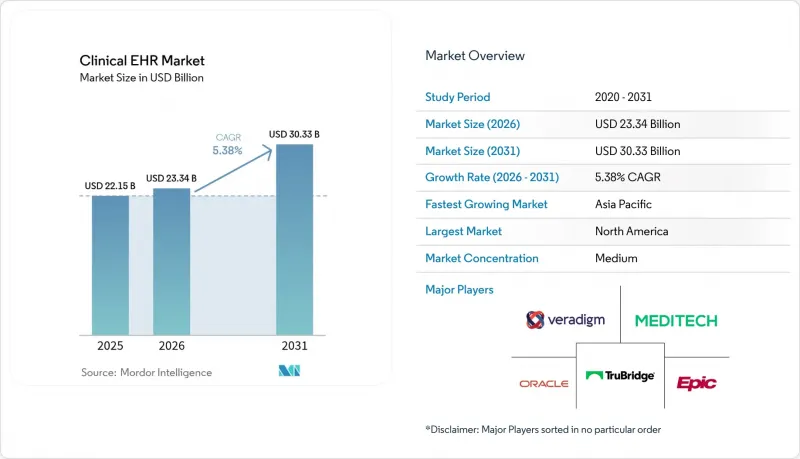
This report is Segmented by (Hardware, Software, Services), Delivery Mode (Cloud-Based Solutions and More), End-User (Hospitals and More), and Geography (North America, Europe, Asia-Pacific, Middle-East and Africa, and South America). The Market Forecasts are Provided in Terms of Value (USD).
Global Clinical EHR Market Trends and Insights
Government incentives drive nationwide EHR adoption
Financial rewards embedded in updated Medicare Promoting Interoperability rules and Medicaid programs keep capital flowing toward certified records. Hospitals can receive as much as USD 63,750 per provider by exhibiting meaningful use, and penalties now target organizations that block information sharing. The 21st Century Cures Act further ties reimbursement to interoperability, creating durable demand for platforms that satisfy data-exchange benchmarks.
Integrated care coordination demands drive system convergence
Fragmented records impede clinicians from accessing longitudinal patient histories. TEFCA, effective January 2025, compels vendors to support national exchange specifications, steering procurement toward enterprise-wide solutions that eliminate data silos.
Data privacy and interoperability concerns constrain adoption
New HIPAA security revisions propose mandatory encryption and multi-factor authentication, escalating compliance complexity. The cumulative exposure from 136 million breached records in 2023 reinforces cautious budgeting for fresh deployments.
Other drivers and restraints analyzed in the detailed report include:
- Telehealth integration accelerates remote care capabilities
- AI-assisted voice documentation reduces clinical burden
- Health-IT workforce shortage limits implementation capacity
For complete list of drivers and restraints, kindly check the Table Of Contents.
Segment Analysis
Software held 71.10% of the clinical EHR market share in 2025, reflecting provider preference for functionality over hardware. Services, though smaller, are advancing at 6.02% CAGR thanks to rising demand for implementation, optimization, and data migration engagements. The clinical EHR market benefits from AI-driven documentation, analytics, and predictive modules that layer onto core software. Vendors now embed natural-language interfaces so physicians speak, the system transcribes, and discrete fields update in real time.
Services expansion indicates recognition that change management often determines return on investment. Managed-service contracts cover interoperability upgrades, cybersecurity hardening, and regulatory reporting cycles. Hardware now accounts for a modest slice as cloud models offload server procurement.
Complete Report Scope:
- By Component
- Hardware
- Software
- Services
- By Delivery Mode
- Cloud-based Solutions
- On-premise Solutions
- Hybrid Solutions
- By End-User
- Hospitals
- Clinics & Ambulatory Centers
- Other End-Users
- By Geography
- North America
- United States
- Canada
- Mexico
- Europe
- Germany
- United Kingdom
- France
- Italy
- Spain
- Rest of Europe
- Asia-Pacific
- China
- Japan
- India
- Australia
- South Korea
- Rest of Asia-Pacific
- Middle East and Africa
- GCC
- South Africa
- Rest of Middle East and Africa
- South America
- Brazil
- Argentina
- Rest of South America
- North America
Geography Analysis
North America retained leadership with 39.10% share of the clinical EHR market size in 2025, underpinned by mature health IT policy, broad broadband coverage, and well-capitalized hospital chains. CMS incentive structures continue to fund upgrades, while private insurers increasingly require electronic records for network participation.
Europe experiences steady but slower migration as General Data Protection Regulation compliance introduces additional validation steps. National health services in the United Kingdom, Germany, and France invest in cloud migration programs that promise unified care records across regional trusts. Procurement cycles often synchronize with multi-year funding windows, creating periodic spikes in contract awards.
Asia-Pacific registers the fastest 6.31% CAGR through 2031. Large-scale public projects in India, China, and Southeast Asian nations combine infrastructure grants with mandatory reporting frameworks. Governments offer tax credits for cloud use and sponsor workforce-training programs to accelerate adoption. The Middle East and Africa follow similar trajectories; Gulf Cooperation Council members connect public hospitals via centralized exchanges, while African nations leverage donor financing for open-source rollouts.
- AdvancedMD
- Athenahealth
- CompuGroup Medical SE & Co. KGaA
- DrChrono Inc.
- eClinicalWorks
- Epic Systems
- GE Healthcare
- Greenway Health
- InterSystems Corp.
- Kareo Inc.
- McKesson Corp.
- Medical Information Technology
- MediTab Software Inc.
- Modernizing Medicine, Inc. (ModMed)
- NextGen Healthcare
- Oracle
- Practice Fusion, Inc.
- PracticeSuite Inc.
- TruBridge, Inc.
- Veradigm Inc.
Additional Benefits:
- The market estimate (ME) sheet in Excel format
- 3 months of analyst support
TABLE OF CONTENTS
1 Introduction
- 1.1 Study Assumptions & Market Definition
- 1.2 Scope of the Study
2 Research Methodology
3 Executive Summary
4 Market Landscape
- 4.1 Market Overview
- 4.2 Market Drivers
- 4.2.1 Government Incentives for Nationwide EHR Adoption
- 4.2.2 Demand for Integrated Care Coordination Across Settings
- 4.2.3 Growing Tele-Health & Remote Monitoring Volume
- 4.2.4 Shift to Value-Based Reimbursement in Emerging APAC Nations
- 4.2.5 Rise of AI-Assisted Voice Documentation Reducing Clinician Burnout
- 4.2.6 Cyber-Security Insurance Rebates Tied to Certified EHR Platforms
- 4.3 Market Restraints
- 4.3.1 Data Privacy & Interoperability Concerns
- 4.3.2 Shortage of Trained Health-It Workforce
- 4.3.3 Rising Cost of Cloud Egress Fees for Large Image Datasets
- 4.3.4 Vendor Lock-In Slowing Modular Migration
- 4.4 Value Chain Analysis
- 4.5 Technological Outlook
- 4.6 Porter's Five Forces Analysis
- 4.6.1 Threat of New Entrants
- 4.6.2 Bargaining Power of Buyers/Consumers
- 4.6.3 Bargaining Power of Suppliers
- 4.6.4 Threat of Substitute Products
- 4.6.5 Intensity of Competitive Rivalry
5 Market Size & Growth Forecasts (Value)
- 5.1 By Component
- 5.1.1 Hardware
- 5.1.2 Software
- 5.1.3 Services
- 5.2 By Delivery Mode
- 5.2.1 Cloud-based Solutions
- 5.2.2 On-premise Solutions
- 5.2.3 Hybrid Solutions
- 5.3 By End-User
- 5.3.1 Hospitals
- 5.3.2 Clinics & Ambulatory Centers
- 5.3.3 Other End-Users
- 5.4 By Geography
- 5.4.1 North America
- 5.4.1.1 United States
- 5.4.1.2 Canada
- 5.4.1.3 Mexico
- 5.4.2 Europe
- 5.4.2.1 Germany
- 5.4.2.2 United Kingdom
- 5.4.2.3 France
- 5.4.2.4 Italy
- 5.4.2.5 Spain
- 5.4.2.6 Rest of Europe
- 5.4.3 Asia-Pacific
- 5.4.3.1 China
- 5.4.3.2 Japan
- 5.4.3.3 India
- 5.4.3.4 Australia
- 5.4.3.5 South Korea
- 5.4.3.6 Rest of Asia-Pacific
- 5.4.4 Middle East and Africa
- 5.4.4.1 GCC
- 5.4.4.2 South Africa
- 5.4.4.3 Rest of Middle East and Africa
- 5.4.5 South America
- 5.4.5.1 Brazil
- 5.4.5.2 Argentina
- 5.4.5.3 Rest of South America
- 5.4.1 North America
6 Competitive Landscape
- 6.1 Market Concentration
- 6.2 Competitive Benchmarking
- 6.3 Market Share Analysis
- 6.4 Company Profiles (includes Global level Overview, Market level overview, Core Segments, Financials as available, Strategic Information, Market Rank/Share for key companies, Products & Services, and Recent Developments)
- 6.4.1 AdvancedMD Inc.
- 6.4.2 athenahealth Inc.
- 6.4.3 CompuGroup Medical SE & Co. KGaA
- 6.4.4 DrChrono Inc.
- 6.4.5 eClinicalWorks, LLC
- 6.4.6 Epic Systems Corporation
- 6.4.7 GE HealthCare
- 6.4.8 Greenway Health LLC
- 6.4.9 InterSystems Corp.
- 6.4.10 Kareo Inc.
- 6.4.11 McKesson Corp.
- 6.4.12 Medical Information Technology, Inc. (Meditech)
- 6.4.13 MediTab Software Inc.
- 6.4.14 Modernizing Medicine, Inc. (ModMed)
- 6.4.15 NextGen Healthcare, Inc.
- 6.4.16 Oracle Corporation
- 6.4.17 Practice Fusion, Inc.
- 6.4.18 PracticeSuite Inc.
- 6.4.19 TruBridge, Inc.
- 6.4.20 Veradigm Inc.
7 Market Opportunities & Future Outlook
- 7.1 White-space & Unmet-need Assessment

