PUBLISHER: Mordor Intelligence | PRODUCT CODE: 2113537

PUBLISHER: Mordor Intelligence | PRODUCT CODE: 2113537
Asia-Pacific Nutraceutical - Market Share Analysis, Industry Trends & Statistics, Growth Forecasts (2026 - 2031)
According to Mordor Intelligence, the Asia-Pacific nutraceutical market size is expected to grow from USD 116.32 billion in 2025 to USD 125.41 billion in 2026 and is forecast to reach USD 182.65 billion by 2031 at 7.81% CAGR over 2026-2031.
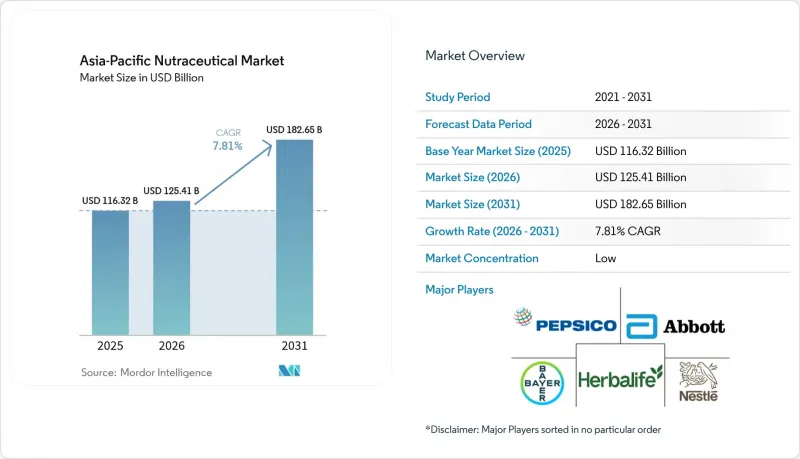
This report is Segmented by Product Type (Functional Food, Functional Beverage, and Dietary Supplements), Distribution Channel (Supermarkets and Hypermarkets, Convenience Stores, Specialty Stores, Online Retail, and Others), and Geography (China, India, Japan, Australia, and More). The Market Forecasts are Provided in Terms of Value (USD/Tonnes).
Asia-Pacific Nutraceutical Market Trends and Insights
Rising Health Consciousness and Awareness About Preventive Care
Consumer behavior in Asia-Pacific has experienced a notable transformation toward proactive health management, with a significant portion of ASEAN populations incorporating nutraceuticals into their daily routines. This evolution extends beyond traditional wellness approaches, embracing personalized nutrition solutions that target individual biomarkers and genetic characteristics. Singaporean consumers have become increasingly mindful of ingredient origins and nutritional profiles, while Japanese consumers demonstrate a sophisticated understanding of functional food science, actively seeking products backed by clinical evidence . The market continues to evolve as digital health platforms integrate seamlessly with nutraceutical consumption patterns, facilitating continuous health monitoring and personalized supplementation recommendations. Japan's Foods for Specified Health Uses (FOSHU) regulatory framework instills consumer confidence through comprehensive pre-market evaluation processes, enabling premium pricing strategies for products with scientific validation.
Increasing Prevalence of Lifestyle-Related Diseases
The increasing shift toward urban lifestyles and Western dietary patterns across emerging Asia-Pacific markets has triggered widespread health challenges, particularly diabetes, cardiovascular disease, and metabolic disorders. India's nutraceutical market has experienced substantial expansion, demonstrating remarkable growth, directly reflecting the rising prevalence of non-communicable diseases. In China, health-conscious middle-class consumers are increasingly seeking sophisticated supplement solutions, particularly gravitating toward products addressing blood sugar management and cardiovascular health, resulting in significant market growth. The mounting health challenges create sustained demand for targeted nutritional interventions, specifically omega-3 fatty acids, plant sterols, and blood glucose management formulations. As healthcare systems in developing markets face mounting pressure from increased patient loads, nutraceuticals emerge as cost-effective preventive alternatives, receiving additional support through government initiatives that promote functional food consumption and the integration of traditional medicine practices.
Allergens and Dietary Restrictions Limiting Scope
The complex landscape of dietary requirements across Asia-Pacific markets presents manufacturers with intricate formulation challenges. In Muslim-majority Southeast Asian countries, obtaining halal certification involves rigorous compliance processes, while manufacturers must simultaneously accommodate Hindu dietary practices in India and Buddhist preferences in other regional markets. These requirements fundamentally impact ingredient selection and manufacturing methodologies. The operation of shared production facilities introduces substantial cross-contamination risks, while varying allergen labeling regulations across different jurisdictions create additional compliance burdens. The growing incidence of food allergies in developed Asia-Pacific markets requires manufacturers to implement extensive testing protocols and maintain strictly separated supply chains. While ISO 22000 and HACCP standards offer structured operational frameworks, they introduce additional layers of complexity and financial considerations, particularly impacting smaller manufacturers attempting to establish a presence across multiple regional markets.
Other drivers and restraints analyzed in the detailed report include:
- Growing Popularity of Plant-Based and Vegan Products
- Ageing Population Seeking Functional Products
- Prevalence of Counterfeit and Substandard Products
For complete list of drivers and restraints, kindly check the Table Of Contents.
Segment Analysis
Functional foods continue to dominate the APAC nutraceutical market, commanding a substantial 43.10% share in 2025. This dominance stems from widespread consumer acceptance across diverse Asian markets, where products like fortified cereals, probiotic dairy items, and nutrient-enhanced snacks have become dietary staples. The market's foundation remains strong through traditional functional food categories, with fortified rice maintaining its significance in Southeast Asian countries and fermented dairy products showing consistent demand in East Asian regions, providing established companies with reliable revenue streams.
The functional beverages segment emerges as the fastest-growing category, projecting a robust CAGR of 8.74% through 2031. This growth aligns with increasing urbanization trends and evolving consumer preferences for convenient, on-the-go consumption options. The segment's expansion is particularly notable in two distinct consumer groups: younger demographics gravitating toward energy drinks and sports beverages, and health-conscious consumers who prefer fortified juices and dairy alternatives. These beverages successfully combine nutritional enhancement with familiar product formats, meeting the dual consumer demands for health benefits and taste preferences.
Complete Report Scope:
- By Product Type
- Functional Food
- Cereals
- Bakery and Confectionery
- Dairy
- Snacks
- Other Functional Foods
- Functional Beverage
- Energy Drinks
- Sports Drinks
- Fortified Juice
- Dairy and Dairy-Alternative Beverages
- Other Functional Beverages
- Dietary Supplements
- Vitamins and Minerals
- Botanicals
- Enzymes
- Fatty Acids
- Proteins
- Other Dietary Supplements
- Functional Food
- By Distribution Channel
- Supermarkets and Hypermarkets
- Convenience Stores
- Specialty Stores
- Online Retail
- Others
- By Geography
- China
- India
- Japan
- Australia
- Indonesia
- South Korea
- Thailand
- Singapore
- Rest of Asia-Pacific
List of Companies Covered in this Report:
- Nestle SA
- PepsiCo Inc.
- Herbalife International of America, Inc.
- Bayer AG
- Abbott Laboratories
- Haleon plc
- Kellogg Co.
- General Mills Inc.
- Danone SA
- Suntory Holdings
- Yakult Honsha
- Meiji Co. Ltd.
- H&H Group
- Korea Ginseng Corp. (Jung Kwan Jang)
- BY-HEALTH Co. Ltd.
- Otsuka Holdings
- Amway (Alticor)
- Remedy Drinks
- Pure Harvest Smart Farms
- Barentz
Additional Benefits:
- The market estimate (ME) sheet in Excel format
- 3 months of analyst support
TABLE OF CONTENTS
1 INTRODUCTION
- 1.1 Study Assumptions and Market Definition
- 1.2 Scope of the Study
2 RESEARCH METHODOLOGY
3 EXECUTIVE SUMMARY
4 MARKET LANDSCAPE
- 4.1 Market Overview
- 4.2 Market Drivers
- 4.2.1 Rising health consciousness and awareness about preventive care
- 4.2.2 Increasing prevalence of lifestyle-related diseases
- 4.2.3 Growing popularity of plant-based and vegan products
- 4.2.4 Ageing population seeking functional products
- 4.2.5 Increased consumer interest in functional beverages
- 4.2.6 Enhanced distribution channels, including e-commerce
- 4.3 Market Restraints
- 4.3.1 Allergens and dietary restrictions limiting scope
- 4.3.2 Prevalence of counterfeit and substandard products
- 4.3.3 Supply chain disruptions impacting raw material quality
- 4.3.4 High research and development costs for innovation and compliance
- 4.4 Technology Outlook
- 4.5 Regulatory Outlook
- 4.6 Porter's Five Forces
- 4.6.1 Threat of New Entrants
- 4.6.2 Bargaining Power of Buyers/Consumers
- 4.6.3 Bargaining Power of Suppliers
- 4.6.4 Threat of Substitute Products
- 4.6.5 Intensity of Competitive Rivalry
5 MARKET SIZE and GROWTH FORECASTS (VALUE AND VOLUME)
- 5.1 By Product Type
- 5.1.1 Functional Food
- 5.1.1.1 Cereals
- 5.1.1.2 Bakery and Confectionery
- 5.1.1.3 Dairy
- 5.1.1.4 Snacks
- 5.1.1.5 Other Functional Foods
- 5.1.2 Functional Beverage
- 5.1.2.1 Energy Drinks
- 5.1.2.2 Sports Drinks
- 5.1.2.3 Fortified Juice
- 5.1.2.4 Dairy and Dairy-Alternative Beverages
- 5.1.2.5 Other Functional Beverages
- 5.1.3 Dietary Supplements
- 5.1.3.1 Vitamins and Minerals
- 5.1.3.2 Botanicals
- 5.1.3.3 Enzymes
- 5.1.3.4 Fatty Acids
- 5.1.3.5 Proteins
- 5.1.3.6 Other Dietary Supplements
- 5.1.1 Functional Food
- 5.2 By Distribution Channel
- 5.2.1 Supermarkets and Hypermarkets
- 5.2.2 Convenience Stores
- 5.2.3 Specialty Stores
- 5.2.4 Online Retail
- 5.2.5 Others
- 5.3 By Geography
- 5.3.1 China
- 5.3.2 India
- 5.3.3 Japan
- 5.3.4 Australia
- 5.3.5 Indonesia
- 5.3.6 South Korea
- 5.3.7 Thailand
- 5.3.8 Singapore
- 5.3.9 Rest of Asia-Pacific
6 COMPETITIVE LANDSCAPE
- 6.1 Market Concentration
- 6.2 Strategic Moves
- 6.3 Market Share Analysis
- 6.4 Company Profiles (includes Global-level Overview, Market-level Overview, Core Segments, Financials (if available), Strategic Information, Market Rank/Share, Products and Services, Recent Developments)
- 6.4.1 Nestle SA
- 6.4.2 PepsiCo Inc.
- 6.4.3 Herbalife International of America, Inc.
- 6.4.4 Bayer AG
- 6.4.5 Abbott Laboratories
- 6.4.6 Haleon plc
- 6.4.7 Kellogg Co.
- 6.4.8 General Mills Inc.
- 6.4.9 Danone SA
- 6.4.10 Suntory Holdings
- 6.4.11 Yakult Honsha
- 6.4.12 Meiji Co. Ltd.
- 6.4.13 H&H Group
- 6.4.14 Korea Ginseng Corp. (Jung Kwan Jang)
- 6.4.15 BY-HEALTH Co. Ltd.
- 6.4.16 Otsuka Holdings
- 6.4.17 Amway (Alticor)
- 6.4.18 Remedy Drinks
- 6.4.19 Pure Harvest Smart Farms
- 6.4.20 Barentz
7 MARKET OPPORTUNITIES AND FUTURE OUTLOOK

