PUBLISHER: Mordor Intelligence | PRODUCT CODE: 2113675

PUBLISHER: Mordor Intelligence | PRODUCT CODE: 2113675
Africa Nutraceutical - Market Share Analysis, Industry Trends & Statistics, Growth Forecasts (2026 - 2031)
According to Mordor Intelligence, african nutraceuticals market size in 2026 is estimated at USD 13.2 billion, growing from 2025 value of USD 12.13 billion with 2031 projections showing USD 20.15 billion, growing at 8.83% CAGR over 2026-2031.
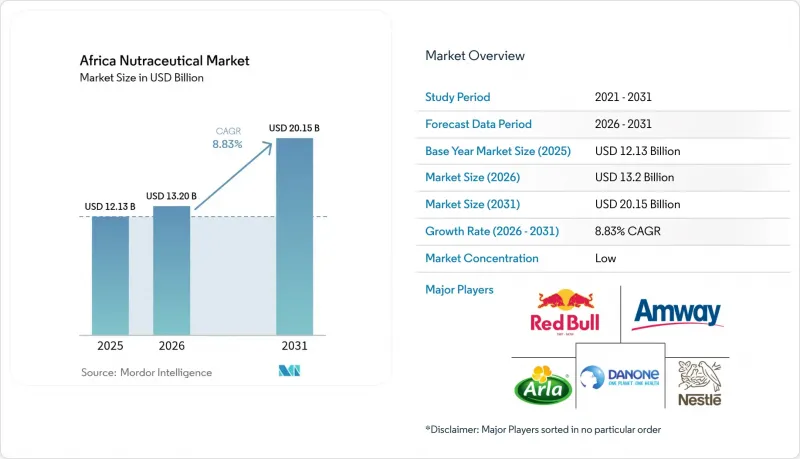
This report is Segmented by Product Type (Functional Food, Functional Beverages, Dietary Supplements), Function (General Health, Weight Management, Sports Nutrition, Immunity, Healthy Aging, Women's Health), End-User (Adults, Children), Distribution Channels (Supermarkets, Convenience Stores, Drug Stores, Online Retail), and Geography. The Market Forecasts are Provided in Terms of Value (USD).
Africa Nutraceutical Market Trends and Insights
Rising Prevalence of Chronic Diseases Drives Preventive Healthcare Adoption
The rise in non-communicable diseases across Africa is driving a shift in consumer preferences toward preventive nutrition. By 2024, diabetes prevalence in Nigeria reached 4.9%, while 46% of South African adults were affected by hypertension. This shift in health trends is creating consistent demand for functional foods and dietary supplements aimed at improving metabolic health, supporting cardiovascular function, and managing weight. WHO data shows that obesity rates in urban Africa doubled between 2010 and 2024, with significant increases among women-68% in South Africa and 35% in urban Nigeria. This rise in obesity has led to increased consumption of targeted nutraceuticals, as reported by the WHO Global Health Observatory. The annual economic cost of treating diabetes and hypertension in sub-Saharan Africa is estimated at USD 25 billion, encouraging governments to adopt preventive nutrition policies. Healthcare systems are increasingly recognizing the cost-effectiveness of nutraceuticals, with South Africa's National Department of Health incorporating functional foods into dietary guidelines for chronic disease management. These endorsements from the medical community are boosting the credibility of nutraceuticals, particularly among older adults who have traditionally relied on pharmaceutical treatments.
Health Awareness and Lifestyle Changes Accelerate Urban Market Penetration
Digital health campaigns and social media influence fundamentally alter African consumer perceptions of nutrition, with smartphone penetration reaching 84% in South Africa and 51% in Nigeria by 2024, enabling widespread health information dissemination. Urban millennials and Generation Z consumers increasingly prioritize wellness over traditional status symbols, driving demand for premium functional beverages and sports nutrition products that signal health-conscious lifestyles. Fitness influencer culture, particularly strong in South Africa and Nigeria, normalizes supplement consumption among younger demographics who previously viewed such products as unnecessary. Corporate wellness programs in major cities increasingly include nutraceutical benefits, with companies like MTN and Standard Bank providing health allowances that employees use for functional foods and dietary supplements, creating institutional demand channels beyond individual consumer purchases.
Economic Volatility Constrains Market Expansion Across Key Geographies
In 2024, Nigeria's naira depreciated by 68% against the USD, reducing the affordability of nutraceuticals. This currency devaluation forced Nigerian consumers to focus on essential goods rather than discretionary health products. Variations in purchasing power have created a distinct market divide: premium functional beverages are accessible to affluent urban consumers, while basic vitamin supplements face challenges in gaining adoption in rural areas with limited disposable income. Although health awareness is increasing, inflation rates exceeding 20% in several African countries in 2024 constrained middle-class spending on non-essential items, including nutraceuticals, as highlighted in the World Bank's Africa Economic Update. The market's dependence on imports exposes it to foreign exchange volatility, as most raw materials and finished products require hard currency, which becomes significantly more expensive during currency crises. Economic instability has led companies to implement frequent price changes, causing consumer confusion and weakening brand loyalty. Meanwhile, retailers struggle with inventory management due to unpredictable cost fluctuations.
Other drivers and restraints analyzed in the detailed report include:
- Expansion of Health Clubs and Wellness Programs Creates Distribution Synergies
- Demand for Natural and Organic Products Reflects Cultural Values Integration
- Cultural Preferences for Traditional Medicine Limit Modern Nutraceutical Adoption
For complete list of drivers and restraints, kindly check the Table Of Contents.
Segment Analysis
In 2025, functional beverages hold a 38.18% market share, highlighting a consumer preference for convenient, ready-to-consume nutrition solutions that align with fast-paced urban lifestyles. Energy drinks and fortified juices appeal strongly to younger consumers, who associate these products with improved performance and enhanced social status. Dietary supplements represent the fastest-growing segment, with a projected 12.12% CAGR through 2031. This growth is driven by increasing health awareness and a focus on nutritional solutions for specific health conditions, such as diabetes management and immune system support. Vitamins and minerals dominate supplement demand, followed by botanical extracts featuring traditional African ingredients like baobab and moringa.
Functional foods, including cereals, dairy, and snacks, are securing a significant market share by providing nutritional benefits that go beyond basic sustenance. Nestle's expansion of fortified cereals into African markets underscores the category's growing potential. At the same time, local companies are leveraging this opportunity by developing products with indigenous grains and nutrients. Additionally, regulatory bodies such as SAHPRA and NAFDAC are increasingly recognizing functional food categories, streamlining pathways for product approvals and marketing claims, which further supports the category's growth.
General health applications command 32.18% market share in 2025, encompassing broad-spectrum multivitamins and general wellness products that appeal to consumers seeking comprehensive nutritional support. This category's dominance reflects African consumers' preference for holistic health approaches rather than targeted interventions for specific conditions. Weight management emerges as the fastest-growing function at 10.19% CAGR, driven by rising obesity rates and increasing awareness of metabolic health risks across urban populations.
Sports nutrition and performance applications gain traction among fitness enthusiasts, particularly in South Africa's well-developed gym culture and Nigeria's growing fitness industry. Immunity and digestive health functions maintain steady growth, supported by post-COVID health consciousness and traditional African emphasis on gut health through fermented foods and probiotics. Women's health represents a specialized but growing segment, addressing unique nutritional needs during pregnancy, lactation, and menopause that traditional diets may not adequately support.
Complete Report Scope:
- Product Type
- Functional Food
- Cereals
- Bakery and Confectionery Products
- Dairy
- Snacks
- Other Functional Foods
- Functional Beverages
- Energy Drinks
- Sports Drinks
- Fortified Juice
- Dairy and Dairy Alternative Beverages
- Other Functional Beverages
- Dietary Supplements
- Vitamins
- Minerals
- Botanicals
- Enzymes
- Fatty Acids
- Proteins
- Other Dietary Supplements
- Functional Food
- Function
- General Health
- Weight Management
- Sports Nutrition and Performance
- Immunity and Digestive Health
- Healthy Aging
- Women's Health
- Other Applications
- End-User
- Adults
- Children
- Distribution Channels
- Supermarkets / Hypermarkets
- Convenience Stores
- Drug Stores / Pharmacies
- Online Retail Stores
- Other Channels
- Geography
- South Africa
- Nigeria
- Egypt
- Morocco
- Rest of Africa
List of Companies Covered in this Report:
- Nestle SA
- Kellogg Co.
- Arla Foods
- Amway Corp.
- Danone S.A.
- Herbalife International
- Red Bull GmbH
- GlaxoSmithKline PLC
- Coca-Cola Company
- DSM-Firmenich
- Afriplex Pty Ltd
- Real Foods Group
- BAyoba (Baobab Foods)
- GNC (General Nutrition Centers)
- Aduna Ltd
- Kuli Kuli Inc.
- Unilever Plc
- Abbott Laboratories
- Bayer AG
- Pfizer (Centrum)
- Symrise AG
Additional Benefits:
- The market estimate (ME) sheet in Excel format
- 3 months of analyst support
TABLE OF CONTENTS
1 INTRODUCTION
- 1.1 Study Assumptions & Market Definition
- 1.2 Scope of the Study
2 RESEARCH METHODOLOGY
3 EXECUTIVE SUMMARY
4 MARKET LANDSCAPE
- 4.1 Market Overview
- 4.2 Market Drivers
- 4.2.1 Rising prevalence of chronic diseases such as diabetes, hypertension, obesity, and Others
- 4.2.2 Growing health awareness and lifestyle changes promoting physical fitness
- 4.2.3 Expansion of health clubs, fitness centers, and wellness programs driving nutraceutical consumption.
- 4.2.4 Demand for natural and organic nutraceutical products
- 4.2.5 Growing elderly population with increased focus on healthy aging
- 4.2.6 Increasing availability of international nutraceutical brands in the African market.
- 4.3 Market Restraints
- 4.3.1 Limited availability of high-quality raw materials locally.
- 4.3.2 Economic volatility and purchasing power disparity across regions
- 4.3.3 Cultural preferences and reliance on traditional medicine
- 4.3.4 Counterfeit products and quality control issues
- 4.4 Supply Chain Analysis
- 4.5 Regulatory Outlook
- 4.6 Porter's Five Forces
- 4.6.1 Threat of New Entrants
- 4.6.2 Bargaining Power of Buyers/Consumers
- 4.6.3 Bargaining Power of Suppliers
- 4.6.4 Threat of Substitute Products
- 4.6.5 Intensity of Competitive Rivalry
5 MARKET SIZE AND GROWTH FORECAST
- 5.1 Product Type
- 5.1.1 Functional Food
- 5.1.1.1 Cereals
- 5.1.1.2 Bakery and Confectionery Products
- 5.1.1.3 Dairy
- 5.1.1.4 Snacks
- 5.1.1.5 Other Functional Foods
- 5.1.2 Functional Beverages
- 5.1.2.1 Energy Drinks
- 5.1.2.2 Sports Drinks
- 5.1.2.3 Fortified Juice
- 5.1.2.4 Dairy and Dairy Alternative Beverages
- 5.1.2.5 Other Functional Beverages
- 5.1.3 Dietary Supplements
- 5.1.3.1 Vitamins
- 5.1.3.2 Minerals
- 5.1.3.3 Botanicals
- 5.1.3.4 Enzymes
- 5.1.3.5 Fatty Acids
- 5.1.3.6 Proteins
- 5.1.3.7 Other Dietary Supplements
- 5.1.1 Functional Food
- 5.2 Function
- 5.2.1 General Health
- 5.2.2 Weight Management
- 5.2.3 Sports Nutrition and Performance
- 5.2.4 Immunity and Digestive Health
- 5.2.5 Healthy Aging
- 5.2.6 Women's Health
- 5.2.7 Other Applications
- 5.3 End-User
- 5.3.1 Adults
- 5.3.2 Children
- 5.4 Distribution Channels
- 5.4.1 Supermarkets / Hypermarkets
- 5.4.2 Convenience Stores
- 5.4.3 Drug Stores / Pharmacies
- 5.4.4 Online Retail Stores
- 5.4.5 Other Channels
- 5.5 Geography
- 5.5.1 South Africa
- 5.5.2 Nigeria
- 5.5.3 Egypt
- 5.5.4 Morocco
- 5.5.5 Rest of Africa
6 COMPETITIVE LANDSCAPE
- 6.1 Market Concentration
- 6.2 Strategic Moves
- 6.3 Market Ranking Analysis
- 6.4 Company Profiles (includes Global-level Overview, Market-level Overview, Core Segments, Financials (if available), Strategic Information, Market Rank/Share, Products & Services, Recent Developments)
- 6.4.1 Nestle SA
- 6.4.2 Kellogg Co.
- 6.4.3 Arla Foods
- 6.4.4 Amway Corp.
- 6.4.5 Danone S.A.
- 6.4.6 Herbalife International
- 6.4.7 Red Bull GmbH
- 6.4.8 GlaxoSmithKline PLC
- 6.4.9 Coca-Cola Company
- 6.4.10 DSM-Firmenich
- 6.4.11 Afriplex Pty Ltd
- 6.4.12 Real Foods Group
- 6.4.13 BAyoba (Baobab Foods)
- 6.4.14 GNC (General Nutrition Centers)
- 6.4.15 Aduna Ltd
- 6.4.16 Kuli Kuli Inc.
- 6.4.17 Unilever Plc
- 6.4.18 Abbott Laboratories
- 6.4.19 Bayer AG
- 6.4.20 Pfizer (Centrum)
- 6.4.21 Symrise AG
7 MARKET OPPORTUNITIES AND FUTURE OUTLOOK

