PUBLISHER: Mordor Intelligence | PRODUCT CODE: 2186138

PUBLISHER: Mordor Intelligence | PRODUCT CODE: 2186138
United States Nutraceuticals - Market Share Analysis, Industry Trends & Statistics, Growth Forecasts (2027 - 2032)
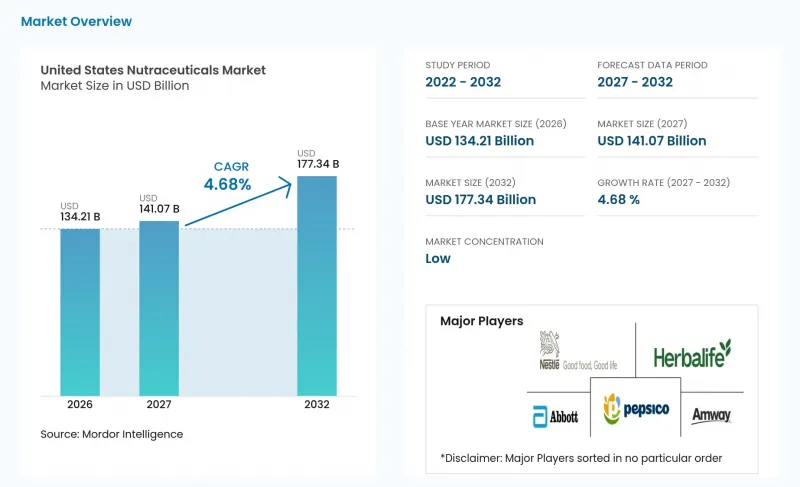
According to Mordor Intelligence, the United States nutraceuticals market size is expected to grow from USD 134.21 billion in 2026 to USD 141.07 billion in 2027 and is forecast to reach USD 177.34 billion by 2032 at 4.68% CAGR over 2027-2032.
United States Nutraceuticals Market Trends and Insights
Increasing Consumer Focus on Preventive Healthcare and Wellness
The United States nutraceuticals market benefits as consumers make supplements part of routines for energy, cognition, digestive health, and healthy aging. This use pattern favors repeat purchasing because several health goals can sit within the same daily regimen. GLP-1 medication users may shift purchases toward protein, digestive products, and micronutrient replenishment, rather than leave the category entirely. This shift brings nutrition needs into discussions that previously focused mainly on weight management. Products supported by clear ingredient information and appropriate scientific evidence are better placed to serve consumers who are building more deliberate wellness routines. The market therefore has room for products that address everyday health needs without relying on broad or unclear claims.
Rising Demand for Dietary Supplements to Address Nutritional Deficiencies
Growing awareness of micronutrient deficiencies and the importance of preventive healthcare is supporting demand for dietary supplements in the United States nutraceuticals market. Consumers are increasingly incorporating vitamins, minerals, multivitamins, and targeted nutritional formulations into their daily routines to address potential dietary gaps and maintain overall wellness. According to the U.S. Centers for Disease Control and Prevention (CDC), approximately 1 in 8 women aged 12-49 years in the United States has iron deficiency, highlighting the importance of adequate nutrient intake among specific population groups.The CDC also identifies infants, children, adolescent girls, pregnant women, and women of reproductive age as groups particularly vulnerable to micronutrient deficiencies. These concerns are encouraging demand for supplements formulated to support iron intake, bone health, immunity, and other nutritional needs.
Stringent Regulatory Requirements and Limitations on Health Claims
The regulatory framework governing nutraceutical products in the United States creates compliance challenges for manufacturers, particularly regarding product labeling, ingredient safety, and health-related marketing claims. The U.S. Food and Drug Administration (FDA) distinguishes between health claims, nutrient content claims, and structure/function claims, each of which is subject to specific regulatory requirements. Health claims generally require FDA authorization or must meet applicable qualified-claim procedures, while supplement manufacturers must substantiate structure/function claims and submit the required notification to the FDA within 30 days of marketing. Manufacturers must also ensure that claims are truthful and not misleading, with applicable disclaimers displayed on supplement labels.
Other drivers and restraints analyzed in the detailed report include:
- Growing Consumer Interest in Immunity-supporting Products
- Increasing Prevalence of Lifestyle-related Health Conditions
- Consumer Concerns Regarding Product Safety and Adverse Effects
For complete list of drivers and restraints, kindly check the Table Of Contents.
Segment Analysis
Dietary Supplements accounted for the largest share of the United States nutraceuticals market by product type, capturing 41.12% of total revenue in 2026. The segment's leading position is supported by growing consumer awareness of preventive healthcare and the increasing adoption of products that address specific nutritional requirements. Consumers increasingly incorporate vitamins, minerals, probiotics, protein supplements, and other nutritional formulations into their daily wellness routines. Rising interest in immunity support, digestive health, bone health, and healthy aging further sustains demand for dietary supplements across different age groups.
Functional Beverages are projected to be the fastest-growing product type in the United States nutraceuticals market, registering a CAGR of 6.25% through 2032. Growth is driven by increasing consumer preference for convenient beverage formats that combine hydration with added nutritional and functional benefits. Products fortified with vitamins, minerals, probiotics, protein, prebiotics, and plant-based ingredients are gaining traction among health-conscious consumers. The growing demand for energy support, digestive wellness, immunity enhancement, and sports nutrition is encouraging manufacturers to diversify their functional beverage portfolios.
Complete Report Scope:
- By Product Type
- Functional Food
- Cereals
- Bakery and Confectionery
- Dairy
- Snacks
- Other Functional Foods
- Functional Beverage
- Energy Drinks
- Sports Drinks
- Fortified Juice
- Dairy and Dairy-Alternative Beverages
- Other Functional Beverages
- Dietary Supplements
- Vitamins and Minerals
- Botanicals
- Enzymes
- Fatty Acids
- Collagen
- Other Dietary Supplements
- Functional Food
- By Distribution Channel
- Supermarkets and Hypermarkets
- Convenience Stores
- Specialty Stores
- Online Retail Stores
- Other Distribution Channels
List of Companies Covered in this Report:
- Nestle S.A.
- Abbott Laboratories
- PepsiCo, Inc.
- Herbalife Ltd.
- Amway Corporation
- General Mills, Inc.
- Bayer Aktiengesellschaft
- Haleon plc
- Glanbia plc
- Church & Dwight Co., Inc.
- The Procter & Gamble Company
- Reckitt Benckiser Group plc
- Danone S.A.
- Kellanova
- The Coca-Cola Company
- The Clorox Company
- Pfizer Inc.
- USANA Health Sciences, Inc.
- Jamieson Wellness Inc.
- NOW Health Group, Inc.
Additional Benefits:
- The market estimate (ME) sheet in Excel format
- 3 months of analyst support
TABLE OF CONTENTS
1 INTRODUCTION
- 1.1 Study Assumptions and Market Definition
- 1.2 Scope of the Study
2 RESEARCH METHODOLOGY
3 EXECUTIVE SUMMARY
4 MARKET LANDSCAPE
- 4.1 Market Overview
- 4.2 Market Drivers
- 4.2.1 Increasing consumer focus on preventive healthcare and wellness
- 4.2.2 Rising demand for dietary supplements to address nutritional deficiencies
- 4.2.3 Growing consumer interest in immunity-supporting products
- 4.2.4 Increasing prevalence of lifestyle-related health conditions
- 4.2.5 Rising demand for functional foods and beverages with added health benefits
- 4.2.6 Growing adoption of sports nutrition and protein supplements
- 4.3 Market Restraints
- 4.3.1 Stringent regulatory requirements and limitations on health claims
- 4.3.2 Consumer concerns regarding product safety and adverse effects
- 4.3.3 Inconsistent product quality and risks of contamination or adulteration
- 4.3.4 Limited scientific evidence supporting certain nutraceutical health claims
- 4.4 Consumer Behavior Analysis
- 4.5 Regulatory Landscape
- 4.6 Technological Outlook
- 4.7 Porter's Five Forces Analysis
- 4.7.1 Bargaining Power of Suppliers
- 4.7.2 Bargaining Power of Buyers
- 4.7.3 Threat of New Entrants
- 4.7.4 Threat of Substitutes
- 4.7.5 Intensity of Competitive Rivalry
5 MARKET SIZE AND GROWTH FORECASTS (VALUE)
- 5.1 By Product Type
- 5.1.1 Functional Food
- 5.1.1.1 Cereals
- 5.1.1.2 Bakery and Confectionery
- 5.1.1.3 Dairy
- 5.1.1.4 Snacks
- 5.1.1.5 Other Functional Foods
- 5.1.2 Functional Beverage
- 5.1.2.1 Energy Drinks
- 5.1.2.2 Sports Drinks
- 5.1.2.3 Fortified Juice
- 5.1.2.4 Dairy and Dairy-Alternative Beverages
- 5.1.2.5 Other Functional Beverages
- 5.1.3 Dietary Supplements
- 5.1.3.1 Vitamins and Minerals
- 5.1.3.2 Botanicals
- 5.1.3.3 Enzymes
- 5.1.3.4 Fatty Acids
- 5.1.3.5 Collagen
- 5.1.3.6 Other Dietary Supplements
- 5.1.1 Functional Food
- 5.2 By Distribution Channel
- 5.2.1 Supermarkets and Hypermarkets
- 5.2.2 Convenience Stores
- 5.2.3 Specialty Stores
- 5.2.4 Online Retail Stores
- 5.2.5 Other Distribution Channels
6 COMPETITIVE LANDSCAPE
- 6.1 Market Concentration
- 6.2 Strategic Moves
- 6.3 Market Share Analysis
- 6.4 Company Profiles (Includes Company Highlights, Strategic Information, Core Segments, Financials, Products & Services, Recent Developments)
- 6.4.1 Nestle S.A.
- 6.4.2 Abbott Laboratories
- 6.4.3 PepsiCo, Inc.
- 6.4.4 Herbalife Ltd.
- 6.4.5 Amway Corporation
- 6.4.6 General Mills, Inc.
- 6.4.7 Bayer Aktiengesellschaft
- 6.4.8 Haleon plc
- 6.4.9 Glanbia plc
- 6.4.10 Church & Dwight Co., Inc.
- 6.4.11 The Procter & Gamble Company
- 6.4.12 Reckitt Benckiser Group plc
- 6.4.13 Danone S.A.
- 6.4.14 Kellanova
- 6.4.15 The Coca-Cola Company
- 6.4.16 The Clorox Company
- 6.4.17 Pfizer Inc.
- 6.4.18 USANA Health Sciences, Inc.
- 6.4.19 Jamieson Wellness Inc.
- 6.4.20 NOW Health Group, Inc.
7 MARKET OPPORTUNITIES AND FUTURE OUTLOOK

