PUBLISHER: Mordor Intelligence | PRODUCT CODE: 2113624

PUBLISHER: Mordor Intelligence | PRODUCT CODE: 2113624
South America Feed Probiotics - Market Share Analysis, Industry Trends & Statistics, Growth Forecasts (2026 - 2031)
According to Mordor Intelligence, the South America feed probiotics market size is projected to be USD 389.72 million in 2025, USD 414.60 million in 2026, and reach USD 590.81 million by 2031, growing at a CAGR of 7.30% from 2026 to 2031.
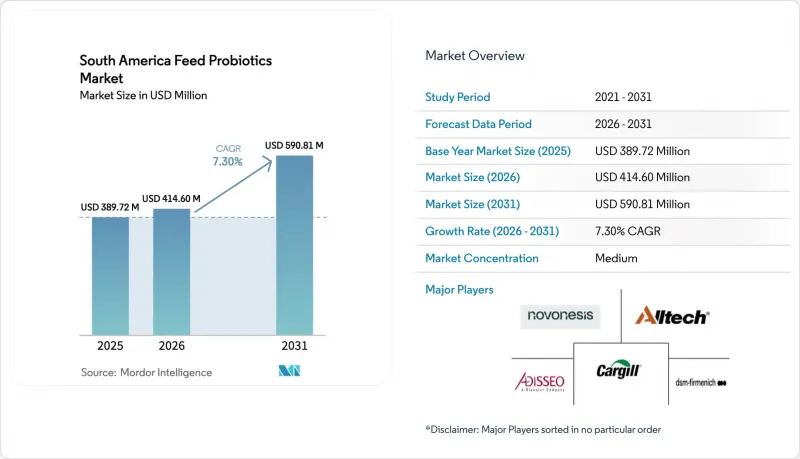
This report is Segmented by Product Type (Bifidobacteria, Enterococcus, Lactobacilli, and More), by Animal Type (Ruminant, Poultry, Swine, Aquaculture, and Other Animals), and by Country (Brazil, Argentina, Chile, Colombia, and Rest of South America). The Report Offers the Market Size and Forecasts in Terms of Value (USD) and Volume (Metric Tons).
South America Feed Probiotics Market Trends and Insights
Rising Meat Demand and Antibiotic-Free Protein Trend
Per-capita poultry consumption climbed to 44.6 kg in 2025, and Brazil's 15.3 million metric tons of chicken meat output positions exporters to meet Asia-Pacific and Middle-East orders that increasingly require antibiotic-free certifications. Supermarket audits show domestic consumers paying 15-20% premiums for chicken labeled "raised without antibiotics," prompting integrators to embed probiotics into every formulation tier. The 2024 Bio-inputs Law halved registration timelines, letting suppliers capture faster shelf entry and iterate strains more rapidly. Commercial broiler trials in Sao Paulo and Parana demonstrated 3% or better feed-conversion improvements with Lactobacillus blends, clearing the payback threshold even at a two-to-three-times additive cost premium. The pull effect extends to swine and beef channels where processors seek "no-antibiotic-ever" labels to enter premium retail and export segments. As retailers expand private-label antibiotic-free lines, probiotic volumes scale proportionally, boosting the South America feed probiotics market value in tandem.
Regulatory Bans on Antibiotic Growth Promoters
Chile's Servicio Agricola y Ganadero now prohibits every antibiotic growth promoter, forcing layer operations that produce 3.94 billion eggs to rely on probiotics and organic acids for performance enhancement. Brazil's 2020 ban on tylosin, lincomycin, and thiamulin erased roughly 40% of the antibiotic volume previously used in poultry and swine diets, costing producers USD 183 million in additive substitution but establishing probiotics as the de facto replacement. Argentina and Colombia restrict critically important antibiotics, compelling feed formulators to design multi-strain blends capable of cross-jurisdiction efficacy. Ministry of Agriculture, Livestock and Food Supply's (MAPA) 2024 guidelines require strain deposit, Colony Forming Unit (CFU) guarantees, and antimicrobial-resistance testing, increasing compliance costs but elevating market credibility. Rapid enforcement in Brazil and Chile accelerates demand within 24 months, while slower rule harmonization in Argentina extends the window for supplier education. The regulatory push adds 2.5% points to the forecast CAGR, underpinning the sustained expansion of the South America feed probiotics market.
Price Premium Versus Conventional Additives
Probiotics are priced at USD 5-15/kg compared with USD 2-5/kg for organic acids and enzymes, so feed formulators demand at least a 3% feed-conversion gain to justify the incremental spend. Argentine beef feedlots operating on slim margins of USD 0.05-0.10/kg live-weight prefer cheaper ionophores that deliver predictable weight gain. In smallholder swine systems across Paraguay and Bolivia, limited performance tracking tools make cost per bag the decisive factor, relegating probiotics to a discretionary purchase. Integrators mitigate sticker shock by bundling technical support and performance guarantees, but such programs only work above 10,000 heads annual throughput. High interest rates further raise working-capital costs, amplifying resistance to price premiums.
Other drivers and restraints analyzed in the detailed report include:
- Expansion of Industrial Livestock Operations
- Farmer Awareness of Gut-Health Benefits
- Probiotic Stability During Pelleting and Storage
For complete list of drivers and restraints, kindly check the Table Of Contents.
Segment Analysis
The South America feed probiotics market size for Lactobacilli accounted for 38% of the overall revenue in 2025. Despite this leadership, Pediococcus posted the highest trajectory with a 9.6% CAGR, reflecting superior heat tolerance that avoids costly encapsulation above 80 °C pelleting thresholds. In poultry and swine, Lactobacillus acidophilus, L. plantarum, and L. reuteri remain staples because of consistent feed-conversion gains. Pediococcus acidilactici is infiltrating aquaculture and high-temperature feed mills, trimming formulation costs by USD 2-3/kg and widening profit margins in Ecuadorian shrimp ponds. Bifidobacteria currently hold a minimal share, but new micro-encapsulation patents promise shelf-life extensions that could unlock ruminant opportunities. Enterococcus faecium demonstrated a moderate reduction in post-weaning diarrhea during Brazilian trials at a dose of 1 X 10⁹ CFU/kg and is gaining recognition among swine veterinarians. Regulatory strain-deposit mandates now favor suppliers with large libraries, pushing Chr. Hansen and DSM-Firmenich to localize fermentation for faster approvals and bespoke blends tuned to cassava-rich diets.
Non-lactic acid categories are emerging as wild cards. Bacillus spores, classified within 'Other Probiotics,' logged strong growth as their pelleting resilience addresses stability gaps affecting Lactobacilli. Yeast-based postbiotics such as Levucell SB attract dairy and beef producers who want rumen pH control without antibiotics. Spray-drying and lipid-matrix encapsulation lines now installed in Brazil shorten supply chains, lowering lead times from 90 days import to 30 days domestic. As Pediococcus captures pelleted-feed niches and Bacillus gains share in aquaculture, the product-type landscape remains fluid, giving nimble formulators room to chip away at incumbent dominance while propelling the broader South America feed probiotics market.
Complete Report Scope:
- By Product Type
- Bifidobacteria
- Enterococcus
- Lactobacilli
- Pediococcus
- Streptococcus
- Other Probiotics
- By Animal Type
- Poultry
- Broiler
- Layer
- Other Poultry Birds
- Swine
- Ruminants
- Beef Cattle
- Dairy Cattle
- Other Ruminants
- Aquaculture
- Fish
- Shrimp
- Other Aquaculture Species
- Other Animals
- Poultry
- By Country
- Brazil
- Argentina
- Chile
- Colombia
- Rest of South America
List of Companies Covered in this Report:
- Cargill, Incorporated
- Novonesis Group
- DSM-Firmenich AG
- Adisseo (Bluestar Adisseo Company)
- Alltech Inc.
- Lallemand Animal Nutrition (Lallemand Inc.)
- Kemin Industries, Inc
- Evonik Industries AG
- Nutreco N.V. (SHV Holdings)
- Novus International, Inc
- Calpis Co., Ltd. (Asahi Group Holdings)
- Pancosma (ADM)
- Biorigin (Zilor)
- Orffa (Marubeni Corporation)
- Unique Biotech Limited
Additional Benefits:
- The market estimate (ME) sheet in Excel format
- 3 months of analyst support
TABLE OF CONTENTS
1 Introduction
- 1.1 Study Assumptions and Market Definition
- 1.2 Scope of the Study
2 Research Methodology
3 Executive Summary
4 Market Landscape
- 4.1 Market Overview
- 4.2 Market Drivers
- 4.2.1 Rising meat demand and antibiotic-free protein trend
- 4.2.2 Regulatory bans on antibiotic growth promoters
- 4.2.3 Expansion of industrial livestock operations
- 4.2.4 Farmer awareness of gut-health benefits
- 4.2.5 Shrimp farming boom in Ecuador driving aquatic use
- 4.2.6 Indigenous Bacillus strains for tropical diets
- 4.3 Market Restraints
- 4.3.1 Price premium versus conventional additives
- 4.3.2 Probiotic stability during pelleting and storage
- 4.3.3 Rural distribution gaps in Paraguay and Bolivia
- 4.3.4 Variable strain efficacy with local feed ingredients
- 4.4 Regulatory Landscape
- 4.5 Technological Outlook
- 4.6 Porter's Five Forces Analysis
- 4.6.1 Threat of New Entrants
- 4.6.2 Bargaining Power of Suppliers
- 4.6.3 Bargaining Power of Buyers
- 4.6.4 Threat of Substitutes
- 4.6.5 Intensity of Competitive Rivalry
5 Market Size and Growth Forecasts (Value and Volume)
- 5.1 By Product Type
- 5.1.1 Bifidobacteria
- 5.1.2 Enterococcus
- 5.1.3 Lactobacilli
- 5.1.4 Pediococcus
- 5.1.5 Streptococcus
- 5.1.6 Other Probiotics
- 5.2 By Animal Type
- 5.2.1 Poultry
- 5.2.1.1 Broiler
- 5.2.1.2 Layer
- 5.2.1.3 Other Poultry Birds
- 5.2.2 Swine
- 5.2.3 Ruminants
- 5.2.3.1 Beef Cattle
- 5.2.3.2 Dairy Cattle
- 5.2.3.3 Other Ruminants
- 5.2.4 Aquaculture
- 5.2.4.1 Fish
- 5.2.4.2 Shrimp
- 5.2.4.3 Other Aquaculture Species
- 5.2.5 Other Animals
- 5.2.1 Poultry
- 5.3 By Country
- 5.3.1 Brazil
- 5.3.2 Argentina
- 5.3.3 Chile
- 5.3.4 Colombia
- 5.3.5 Rest of South America
6 Competitive Landscape
- 6.1 Market Concentration
- 6.2 Strategic Moves
- 6.3 Market Share Analysis
- 6.4 Company Profiles (includes Global Level Overview, Market Level Overview, Core Segments, Financials as Available, Strategic Information, Market Rank/Share for Key Companies, Products and Services, and Recent Developments)
- 6.4.1 Cargill, Incorporated
- 6.4.2 Novonesis Group
- 6.4.3 DSM-Firmenich AG
- 6.4.4 Adisseo (Bluestar Adisseo Company)
- 6.4.5 Alltech Inc.
- 6.4.6 Lallemand Animal Nutrition (Lallemand Inc.)
- 6.4.7 Kemin Industries, Inc
- 6.4.8 Evonik Industries AG
- 6.4.9 Nutreco N.V. (SHV Holdings)
- 6.4.10 Novus International, Inc
- 6.4.11 Calpis Co., Ltd. (Asahi Group Holdings)
- 6.4.12 Pancosma (ADM)
- 6.4.13 Biorigin (Zilor)
- 6.4.14 Orffa (Marubeni Corporation)
- 6.4.15 Unique Biotech Limited
7 Market Opportunities and Future Outlook

