PUBLISHER: Mordor Intelligence | PRODUCT CODE: 2113680

PUBLISHER: Mordor Intelligence | PRODUCT CODE: 2113680
Asia-Pacific Olive - Market Share Analysis, Industry Trends & Statistics, Growth Forecasts (2026 - 2031)
According to Mordor Intelligence, the Asia-Pacific olive market size in 2026 is estimated at USD 2.29 billion, growing from 2025 value of USD 2.10 billion with 2031 projections showing USD 3.53 billion, growing at 9.05% CAGR over 2026-2031.
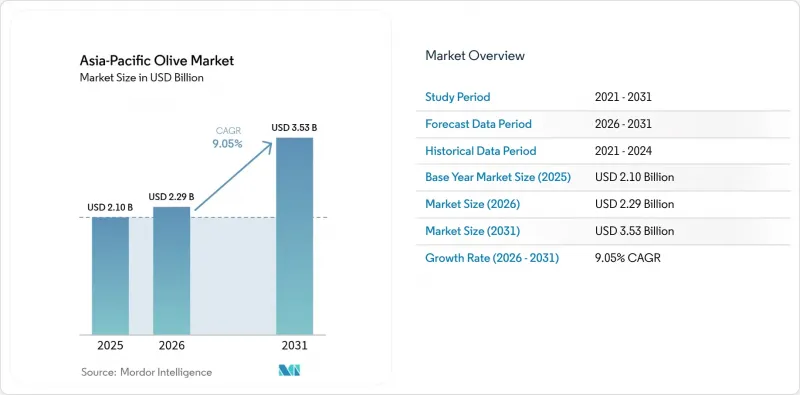
This report is Segmented by Geography (China, Japan, India, and More). The Study Includes Production Analysis (Volume), Consumption Analysis (Value and Volume), Export Analysis (Value and Volume), Import Analysis (Value and Volume), and Price Trend Analysis. The Market Forecasts are Provided in Terms of Value (USD) and Volume (Metric Tons).
Asia-Pacific Olive Market Trends and Insights
Rising Olive Output in China and Australia
China's Gansu Province cultivates over 40,000 hectares of olive groves, primarily centered in Longnan City, producing 30,000 metric tons of olive oil annually. Meanwhile, Yunnan, Sichuan, and Shaanxi provinces are expanding experimental plots, supported by poverty-alleviation subsidies and agricultural modernization programs. Australia's super-high-density plantings span approximately 7,000 hectares across multiple states, leveraging mechanical harvesting and precision irrigation to achieve yields that represent 36% of the global extra-virgin olive oil output, despite occupying only 3% of the planted area. The International Olive Council's September 2024 engagement with Chinese officials aims to harmonize quality standards and expand technical training, potentially accelerating China's transition from net importer to self-sufficient producer within the forecast period.
Dietary Shift Toward Mediterranean Foods
In 2023, Japan imported 58,000 metric tons of olive oil, valued at USD 250 million. The primary suppliers were Spain, Italy, and Greece, driven by health-conscious consumers who associate olive oil with cardiovascular benefits and longevity. In China, urban middle-class households are increasingly purchasing olive oil through platforms like Tmall and JD.com. Premium Spanish and Italian brands on these platforms command price premiums of 30% to 50% over domestic rapeseed and soybean oils, reflecting consumer willingness to pay for perceived quality and authenticity. In India, the online grocery market, supported by quick-commerce platforms such as Blinkit, Zepto, and Swiggy Instamart, facilitates trial purchases of specialty items, including olives, by delivering fresh produce within 10 to 15 minutes in metropolitan areas. Meanwhile, Japan's aging population, with 29% of residents projected to be over 65 years old in 2024, is driving demand for nutrient-dense foods. Platforms like Rakuten, Amazon Fresh, and Oisix are focusing on offering premium fresh produce to cater to this demographic.
Extreme Climatic Anomalies (Heatwaves, Typhoons)
The Asia-Pacific region incurs annual disaster-related economic losses, with extreme heatwaves, typhoons, and floods disrupting agricultural production cycles and degrading fruit quality . Olive lace bug infestations in Victoria, South Australia, and Western Australia have resulted in multi-seasonal losses, with some growers reporting yield declines of 20 to 30%. This has prompted the Australian Olive Association to issue integrated pest management guidelines that emphasize biological controls and canopy monitoring. India's Rajasthan belt experiences summer temperatures exceeding 45 degrees Celsius, which trigger flower abortion and reduce fruit set. Meanwhile, erratic monsoon patterns between 2023 and 2024 resulted in either waterlogging or prolonged dry spells, stressing trees and lowering oil content below the 19% threshold required for commercial viability.
Other drivers and restraints analyzed in the detailed report include:
- Growth of Hotel, Restaurant, and Cafes/Catering (HoReCa) and Food-Service Channels
- Government Reforestation and Agri-Diversification Grants
- High Cost of Cultivation Inputs and Labor
For complete list of drivers and restraints, kindly check the Table Of Contents.
Complete Report Scope:
- By Country
- China
- Production Analysis (Volume)
- Consumption Analysis (Volume and Value)
- Import Analysis (Volume and Value)
- Export Analysis (Volume and Value)
- Price Trend Analysis
- Japan
- Production Analysis (Volume)
- Consumption Analysis (Volume and Value)
- Import Analysis (Volume and Value)
- Export Analysis (Volume and Value)
- Price Trend Analysis
- India
- Production Analysis (Volume)
- Consumption Analysis (Volume and Value)
- Import Analysis (Volume and Value)
- Export Analysis (Volume and Value)
- Price Trend Analysis
- Australia
- Production Analysis (Volume)
- Consumption Analysis (Volume and Value)
- Import Analysis (Volume and Value)
- Export Analysis (Volume and Value)
- Price Trend Analysis
- China
Additional Benefits:
- The market estimate (ME) sheet in Excel format
- 3 months of analyst support
TABLE OF CONTENTS
1 INTRODUCTION
- 1.1 Study Assumptions and Market Definition
- 1.2 Scope of the Study
2 RESEARCH METHODOLOGY
3 EXECUTIVE SUMMARY
4 MARKET LANDSCAPE
- 4.1 Market Overview
- 4.2 Market Drivers
- 4.2.1 Rising olive output in China and Australia
- 4.2.2 Dietary shift toward Mediterranean foods
- 4.2.3 Growth of Hotel, Restaurant, and Cafes/Catering (HoReCa) and food-service channels
- 4.2.4 Government reforestation and diversification grants
- 4.2.5 Precision irrigation in drought-prone groves
- 4.2.6 E-commerce penetration for fresh produce
- 4.3 Market Restraints
- 4.3.1 Extreme climatic anomalies (heatwaves, typhoons)
- 4.3.2 High cost of cultivation inputs and labor
- 4.3.3 Smallholder fragmentation is limiting economies of scale
- 4.3.4 Limited cold-chain nodes outside Tier-1 cities
- 4.4 Regulatory Landscape
- 4.5 Technological Outlook
- 4.6 Value / Supply Chain Analysis
- 4.7 PESTLE Analysis
5 MARKET SIZE AND GROWTH FORECASTS (VALUE AND VOLUME)
- 5.1 By Country
- 5.1.1 China
- 5.1.1.1 Production Analysis (Volume)
- 5.1.1.2 Consumption Analysis (Volume and Value)
- 5.1.1.3 Import Analysis (Volume and Value)
- 5.1.1.4 Export Analysis (Volume and Value)
- 5.1.1.5 Price Trend Analysis
- 5.1.2 Japan
- 5.1.2.1 Production Analysis (Volume)
- 5.1.2.2 Consumption Analysis (Volume and Value)
- 5.1.2.3 Import Analysis (Volume and Value)
- 5.1.2.4 Export Analysis (Volume and Value)
- 5.1.2.5 Price Trend Analysis
- 5.1.3 India
- 5.1.3.1 Production Analysis (Volume)
- 5.1.3.2 Consumption Analysis (Volume and Value)
- 5.1.3.3 Import Analysis (Volume and Value)
- 5.1.3.4 Export Analysis (Volume and Value)
- 5.1.3.5 Price Trend Analysis
- 5.1.4 Australia
- 5.1.4.1 Production Analysis (Volume)
- 5.1.4.2 Consumption Analysis (Volume and Value)
- 5.1.4.3 Import Analysis (Volume and Value)
- 5.1.4.4 Export Analysis (Volume and Value)
- 5.1.4.5 Price Trend Analysis
- 5.1.1 China
6 COMPETITIVE LANDSCAPE
- 6.1 List of Stakeholders
- 6.1.1 Boundary Bend Fresh Produce
- 6.1.2 Cobram Estate Olives
- 6.1.3 COFCO Import-Export
- 6.1.4 Yunnan Yun-Sha Agriculture
- 6.1.5 Borges India Trading
- 6.1.6 Deoleo Japan K.K.
- 6.1.7 Kangaroo Island Olives
- 6.1.8 Nisshin OilliO Group
- 6.1.9 Ruchi Soya Olive Division
- 6.1.10 Mt. Zero Olives
- 6.1.11 Sovena Asia
- 6.1.12 Aceites Sandua Asia
7 MARKET OPPORTUNITIES AND FUTURE OUTLOOK

