PUBLISHER: Mordor Intelligence | PRODUCT CODE: 2113762

PUBLISHER: Mordor Intelligence | PRODUCT CODE: 2113762
HVDC Converter Station - Market Share Analysis, Industry Trends & Statistics, Growth Forecasts (2026 - 2031)
According to Mordor Intelligence, the hVDC converter station market size is projected to expand from USD 7.16 billion in 2025 and USD 7.73 billion in 2026 to USD 10.85 billion by 2031, registering a CAGR of 7.01% between 2026 to 2031.
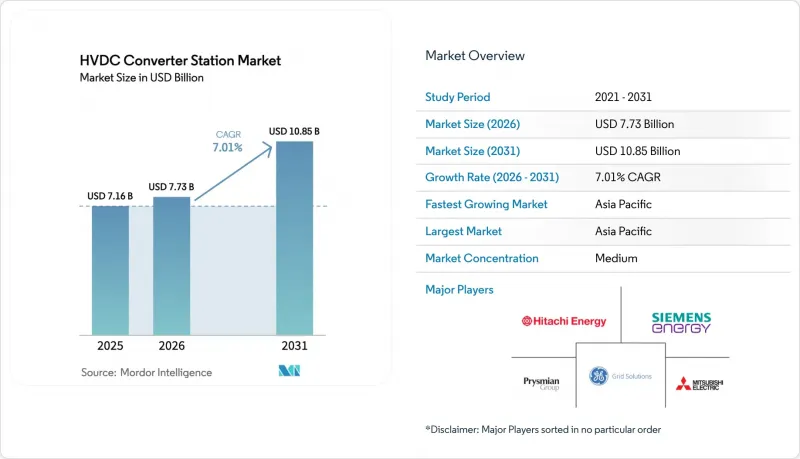
This report is Segmented by Technology (Voltage Source Converter and Line-Commutated Converter), Component (Valves, Converters Transformers, Harmonic Filter, Reactor, and Others), Voltage Rating (Up To 320 KV, 320-500 KV, 500-800 KV, and Above 800 KV), and Geography (North America, Europe, Asia-Pacific, South America, and Middle East and Africa).
Global HVDC Converter Station Market Trends and Insights
Surge in offshore-wind HVDC links
Deep-water projects beyond 100 km now rely on HVDC as AC cables face prohibitive reactive losses. Dogger Bank's first 1.2 GW phase, energized in 2024 with HVDC Light valves, posted 98.5% round-trip efficiency over a 200 km subsea span. Germany's 2 GW Ostwind 4, awarded in 2024, uses modular multilevel converters to funnel Baltic wind southward. Taiwan's 5.6 GW offshore roadmap has already triggered three HVDC awards split between Siemens Energy and Hitachi Energy. Japan entered the subsea arena when Tokyo Electric Power ordered a 1 GW link for Choshi in 2025. The North Sea Wind Power Hub aims for a 10 GW meshed platform by 2035, a scale that requires DC breakers now in early commercial rollout.
Cross-border renewable interconnections
The 1.4 GW Viking Link, energized in 2024, enables the UK to import Danish wind during gales and export nuclear baseload during calms, monetizing average 2024 spreads of EUR 45 per MWh. Europe's TEN-E rule mandating 15% interconnection by 2030 is prompting projects such as NordLink and LionLink. ASEAN targets 17 GW of HVDC corridors by 2035 to arbitrage Laos hydropower and Thai solar, although financing gaps persist. South America's 1 GW Brazil-Argentina line set for 2028 balances hydropower variability with Patagonian wind. The GCC is evaluating a 3 GW overlay to knit Saudi renewables into UAE load pockets.
High CAPEX & Permitting Cycle
A 2 GW, 1,000 km bipolar link costs USD 2 billion-USD 2.5 billion, half of which is converter stations, deterring utilities with constrained balance sheets. The U.S. Plains & Eastern line secured federal approval in 2016, yet remains unbuilt due to state-level opposition. Europe's LionLink spent four years in environmental review before its 2025 consent. Brazil-Argentina negotiations over wheeling charges pushed in-service targets from 2027 to 2028. Multilateral banks often become anchor financiers because merchant developers struggle to secure investment-grade ratings without regulated returns.
Other drivers and restraints analyzed in the detailed report include:
- Ultra-high-voltage (+-800 kV) roll-out in Asia
- Replacement of aging HVAC lines
- Converter-component supply bottlenecks
For complete list of drivers and restraints, kindly check the Table Of Contents.
Segment Analysis
Voltage-source converters are forecast to grow at an 8.1% CAGR, faster than the overall HVDC converter stations market, as offshore wind developers and grid planners seek black-start, fast-fault-clearing, and multi-terminal features. Line-commutated converters held 59.1% of the HVDC converter stations market share in 2025 because China's bulk-transfer corridors rely on +-800 kV thyristor stacks that minimize losses over 2,000 km routes.
Dogger Bank's 3.6 GW link uses 401-level MMC valves that meet a total harmonic distortion benchmark below 1.5% without filters. Siemens Energy's East Anglia THREE implementation demonstrates the same grid-forming agility within 200 milliseconds of a blackout. Hitachi Energy's Gansu-Zhejiang +-800 kV VSC project will test whether voltage-source converters can match UHV power density and erode LCC's historical cost edge. GE Vernova is exploring hybrid topologies that merge LCC efficiency with VSC controllability, though commercial rollout remains at least three years away.
Complete Report Scope:
- By Technology
- Voltage Source Converter (VSC)
- Line-Commutated Converter (LCC)
- By Component
- Valves
- Converters Transformers
- Harmonic Filter
- Reactor
- Others
- By Voltage Rating
- Up to 320 kV
- 320 to 500 kV
- 500 to 800 kV
- Above 800 kV (UHVDC)
- By Geography
- North America
- United States
- Canada
- Mexico
- Europe
- Germany
- United Kingdom
- France
- Spain
- Italy
- NORDIC Countries
- Russia
- Rest of Europe
- Asia-Pacific
- China
- India
- Japan
- South Korea
- ASEAN Countries
- Australia and New Zealand
- Rest of Asia-Pacific
- South America
- Brazil
- Argentina
- Chile
- Rest of South America
- Middle East and Africa
- Saudi Arabia
- United Arab Emirates
- South Africa
- Egypt
- Rest of Middle East and Africa
- North America
Geography Analysis
Asia-Pacific accounted for 66.8% of the HVDC converter stations market value in 2025 and is tracking a 7.6% CAGR to 2031. China aims to transmit 1,000 TWh of west-wind and hydro to coastal loads by 2030, implying 30 more +-800 kV corridors and USD 50 billion investment. India's Green Energy Corridor Phase II adds a +-800 kV, 6 GW Rajasthan-Tamil Nadu link plus a +-500 kV Lakshadweep VSC interconnector. Japan's 1 GW Choshi subsea line entered service in 2025, signaling a wider 10 GW offshore wind target. South Korea and ASEAN members are moving more slowly as financing and sovereignty issues delay final investment decisions.
Europe represented around 20% of the 2025 converter spend, but leads VSC innovation. The UK's Dogger Bank, East Anglia THREE, and Sea Link total 7 GW of capacity under HVDC Light or Plus platforms. Denmark's Bornholm hub will anchor a 3 GW meshed grid in the Baltic by 2030. GE Vernova's Ostwind 4 contract marks re-entry into offshore HVDC. Nordic interconnectors such as Viking Link and NordLink let countries arbitrage renewables across weather patterns.
North America is accelerating planning but still faces seven-to-ten-year permitting cycles. Grain Belt Express secured all approvals in 2024 for a 4 GW Kansas-Indiana line scheduled for 2028 using HVDC Light. Canada's 300 MW Montana link and Mexico's proposed 2 GW Baja-Mexico City corridor illustrate region-wide interest. South America's Brazil-Argentina interconnector heads toward 2028 while Chile tenders a 500 MW northern solar link. Middle East projects remain nascent, although Saudi Arabia's 58.7 GW renewable pipeline will likely need a 3 GW HVDC overlay by 2032.
- Hitachi Energy Ltd
- Siemens Energy AG
- GE Grid Solutions LLC
- Mitsubishi Electric Corp.
- Toshiba Corp.
- Bharat Heavy Electricals Ltd
- NR Electric Co. Ltd
- C-EPRI Electric Power Eng. Co. Ltd
- Crompton Greaves Ltd (CG Power)
- Prysmian Group
- Nexans SA
- NKT A/S
- State Grid Corp. of China
- TDK Corporation
- LS Electric Co. Ltd
- Hyosung Heavy Industries
- Trench Group (Siemens)
- KAPES (Korea-ABB JV)
- Xian XD Transformer Co.
- TransGrid Solutions
Additional Benefits:
- The market estimate (ME) sheet in Excel format
- 3 months of analyst support
TABLE OF CONTENTS
1 Introduction
- 1.1 Study Assumptions & Market Definition
- 1.2 Scope of the Study
2 Research Methodology
3 Executive Summary
4 Market Landscape
- 4.1 Market Overview
- 4.2 Market Drivers
- 4.2.1 Surge in offshore-wind HVDC links
- 4.2.2 Cross-border renewable interconnections
- 4.2.3 Ultra-high-voltage (800 kV) roll-out in Asia
- 4.2.4 Replacement of aging HVAC lines
- 4.2.5 Rise of multi-terminal/mesh DC grids
- 4.2.6 Grid-forming black-start capability demand
- 4.3 Market Restraints
- 4.3.1 High CAPEX & permitting cycle
- 4.3.2 Converter-component supply bottlenecks
- 4.3.3 Multi-vendor interoperability risk
- 4.3.4 Cyber-security of digital HVDC controls
- 4.4 Supply-Chain Analysis
- 4.5 Regulatory Landscape
- 4.6 Technological Outlook
- 4.7 Porter's Five Forces
- 4.7.1 Bargaining Power of Suppliers
- 4.7.2 Bargaining Power of Buyers
- 4.7.3 Threat of New Entrants
- 4.7.4 Threat of Substitutes
- 4.7.5 Competitive Rivalry
5 Market Size & Growth Forecasts
- 5.1 By Technology
- 5.1.1 Voltage Source Converter (VSC)
- 5.1.2 Line-Commutated Converter (LCC)
- 5.2 By Component
- 5.2.1 Valves
- 5.2.2 Converters Transformers
- 5.2.3 Harmonic Filter
- 5.2.4 Reactor
- 5.2.5 Others
- 5.3 By Voltage Rating
- 5.3.1 Up to 320 kV
- 5.3.2 320 to 500 kV
- 5.3.3 500 to 800 kV
- 5.3.4 Above 800 kV (UHVDC)
- 5.4 By Geography
- 5.4.1 North America
- 5.4.1.1 United States
- 5.4.1.2 Canada
- 5.4.1.3 Mexico
- 5.4.2 Europe
- 5.4.2.1 Germany
- 5.4.2.2 United Kingdom
- 5.4.2.3 France
- 5.4.2.4 Spain
- 5.4.2.5 Italy
- 5.4.2.6 NORDIC Countries
- 5.4.2.7 Russia
- 5.4.2.8 Rest of Europe
- 5.4.3 Asia-Pacific
- 5.4.3.1 China
- 5.4.3.2 India
- 5.4.3.3 Japan
- 5.4.3.4 South Korea
- 5.4.3.5 ASEAN Countries
- 5.4.3.6 Australia and New Zealand
- 5.4.3.7 Rest of Asia-Pacific
- 5.4.4 South America
- 5.4.4.1 Brazil
- 5.4.4.2 Argentina
- 5.4.4.3 Chile
- 5.4.4.4 Rest of South America
- 5.4.5 Middle East and Africa
- 5.4.5.1 Saudi Arabia
- 5.4.5.2 United Arab Emirates
- 5.4.5.3 South Africa
- 5.4.5.4 Egypt
- 5.4.5.5 Rest of Middle East and Africa
- 5.4.1 North America
6 Competitive Landscape
- 6.1 Market Concentration
- 6.2 Strategic Moves (M&A, Partnerships, PPAs)
- 6.3 Market Share Analysis (Market Rank/Share for key companies)
- 6.4 Company Profiles (includes Global level Overview, Market level overview, Core Segments, Financials as available, Strategic Information, Products & Services, and Recent Developments)
- 6.4.1 Hitachi Energy Ltd
- 6.4.2 Siemens Energy AG
- 6.4.3 GE Grid Solutions LLC
- 6.4.4 Mitsubishi Electric Corp.
- 6.4.5 Toshiba Corp.
- 6.4.6 Bharat Heavy Electricals Ltd
- 6.4.7 NR Electric Co. Ltd
- 6.4.8 C-EPRI Electric Power Eng. Co. Ltd
- 6.4.9 Crompton Greaves Ltd (CG Power)
- 6.4.10 Prysmian Group
- 6.4.11 Nexans SA
- 6.4.12 NKT A/S
- 6.4.13 State Grid Corp. of China
- 6.4.14 TDK Corporation
- 6.4.15 LS Electric Co. Ltd
- 6.4.16 Hyosung Heavy Industries
- 6.4.17 Trench Group (Siemens)
- 6.4.18 KAPES (Korea-ABB JV)
- 6.4.19 Xian XD Transformer Co.
- 6.4.20 TransGrid Solutions
7 Market Opportunities & Future Outlook
- 7.1 White-Space & Unmet-Need Assessment

