PUBLISHER: Mordor Intelligence | PRODUCT CODE: 2186080

PUBLISHER: Mordor Intelligence | PRODUCT CODE: 2186080
United States HVDC Converter Station - Market Share Analysis, Industry Trends & Statistics, Growth Forecasts (2027 - 2032)
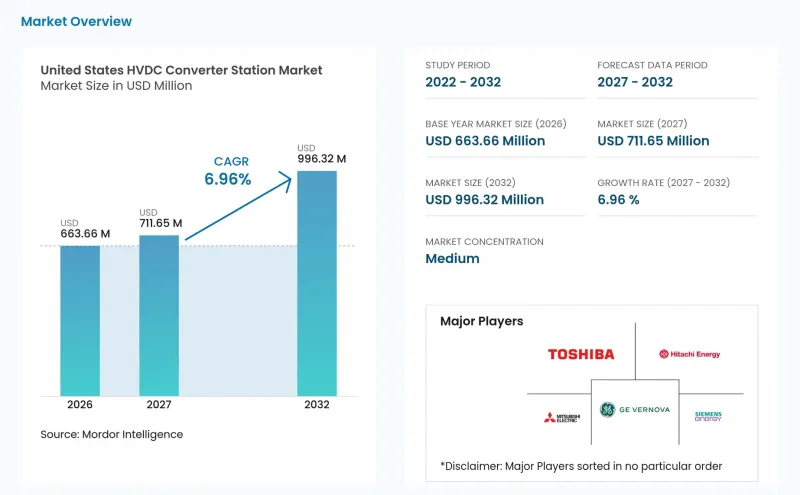
According to Mordor Intelligence, the United States HVDC converter station market size is projected to expand from USD 663.66 million in 2026 and USD 711.65 million in 2027 to USD 996.32 million by 2032, registering a CAGR of 6.96% between 2027 and 2032.
United States HVDC Converter Station Market Trends and Insights
Long-Distance Renewable Power Transfer
The United States HVDC converter station market benefits when renewable resources are far from the cities that use the electricity. HVDC can become economic on long routes because it limits transmission losses and provides direct control over power transfer. Wind and solar resources in the Great Plains are located far from large eastern demand centers, which makes long-distance transmission planning important. The SunZia project uses a 3,000 MW, +-525 kV Voltage Source Converter (VSC) link across 552 miles from New Mexico to Arizona and entered commissioning in late 2025. Converter stations at each end can provide frequency support, reactive power control, and black-start capability that conventional AC substations cannot provide in the same way. State clean-energy targets strengthen the long-term project pipeline because new renewable capacity needs reliable access to distant demand areas.
Rising Electricity Demand from Data Centers and Industrial Electrification
Data centers need large volumes of reliable electricity within short development periods, creating a different transmission requirement from more dispersed load growth. Lawrence Berkeley National Laboratory estimated that data centers could account for 11.8% of United States electricity demand by 2030, compared with nearly 4% in an earlier period. The United States HVDC converter station market can benefit when developers use long-distance links to connect renewable and hydropower resources with major computing centers. Virginia, Texas, Arizona, and Georgia are important locations because they combine large, planned loads with a need for dependable power delivery. Large data center buyers can support transmission project financing when they contract for access to capacity on planned corridors. This arrangement gives project developers a more visible demand base before a line enters service.
Permitting and Multi-Jurisdictional Siting Delays
Permitting is a persistent constraint on the United States HVDC converter station market because lines and stations often cross several states. The SunZia project required 17 years for route approval and 6 years for construction, showing how development schedules can exceed physical construction schedules. States apply separate approval processes, while merchant HVDC projects do not operate under a single national sitting framework. The Congressional Research Service (CRS) has documented continuing policy discussion on federal transmission permitting authority and the relationship between federal and state roles. Long approval periods force manufacturers and developers to perform early engineering before all regulatory milestones are complete. This raises financing risk because equipment reservations and development expenses may be incurred before a project has a final construction path.
Other drivers and restraints analyzed in the detailed report include:
- Expansion of Offshore Wind and Coastal Transmission
- Interregional Grid Congestion and Reliability Needs
- Converter Transformer and Power-Electronics Supply Bottlenecks
For complete list of drivers and restraints, kindly check the Table Of Contents.
Segment Analysis
Line-Commutated Converter (LCC) held 58.6% of United States HVDC converter station market share in 2026, supported by established long-distance point-to-point projects. It remains suitable for bulk power routes where the grid is strong and reactive power support can be provided by nearby substations. Grain Belt Express illustrates the continuing relevance of this approach because it is planned as a large transmission project with 5,000 MW capacity. The installed base of long-haul systems also supports ongoing demand for LCC expertise and modernization work. LCC remains a practical choice where the objective is efficient transfer of large volumes of electricity between clearly defined terminals.
VSC is forecast to grow at a 7.9% CAGR through 2032, faster than the overall United States HVDC converter station market. It is used where offshore wind, weak grids, asynchronous connections, or multi-terminal designs require greater operating flexibility. A 2025 technical report by Oak Ridge National Laboratory, Pacific Northwest National Laboratory, and National Renewable Energy Laboratory (NREL) considered scalable hybrid DC-AC grid analysis methods for large inter-area power transfers. Peer-reviewed research also reported improved control performance for VSC-based multi-terminal systems. The United States HVDC converter station industry is therefore moving toward a two-technology market, with LCC used for established bulk corridors and VSC used for more complex connections.
Complete Report Scope:
- By Type
- Line Commuatated Converters (LCC)
- Voltage Source Converters (VSC)
- By Component
- Valves
- Converters Transformers
- Harmonic Filter
- Reactor
- Others
List of Companies Covered in this Report:
- Hitachi Energy Ltd
- Siemens Energy AG
- GE Vernova Inc.
- Mitsubishi Electric Corporation
- Toshiba Energy Systems and Solutions Corporation
- General Electric Company
- ABB Ltd
- Prysmian S.p.A.
- Nexans S.A.
- NKT A/S
- LS Electric Co., Ltd.
- Bharat Heavy Electricals Limited
- NR Electric Co., Ltd.
- China Electric Power Research Institute Co., Ltd.
- CG Power and Industrial Solutions Limited
- Schneider Electric SE
- Doble Engineering Company
- Mitsubishi Electric Power Products, Inc.
- Quanta Services, Inc.
- Pattern Energy Group LP
Additional Benefits:
- The market estimate (ME) sheet in Excel format
- 3 months of analyst support
TABLE OF CONTENTS
1 INTRODUCTION
- 1.1 Study Assumptions and Market Definition
- 1.2 Scope of the Study
2 RESEARCH METHODOLOGY
3 EXECUTIVE SUMMARY
4 MARKET LANDSCAPE
- 4.1 Market Overview
- 4.2 Market Drivers
- 4.2.1 Long-Distance Renewable Power Transfer
- 4.2.2 Interregional Grid Congestion and Reliability Needs
- 4.2.3 Expansion of Offshore Wind and Coastal Transmission
- 4.2.4 Rising Electricity Demand From Data Centers and Industrial Electrification
- 4.2.5 Asynchronous Interconnection Between U.S. Power Grids
- 4.2.6 Lower-Cost Modular Converter Designs and HVDC R&D
- 4.3 Market Restraints
- 4.3.1 Permitting and Multi-Jurisdictional Siting Delays
- 4.3.2 High Upfront Capital Requirements and Conditional Financing
- 4.3.3 Converter Transformer and Power-Electronics Supply Bottlenecks
- 4.3.4 Limited Domestic HVDC Engineering and Commissioning Capacity
- 4.4 Supply-Chain Analysis
- 4.5 Porter's Five Forces Analysis
- 4.5.1 Bargaining Power of Suppliers
- 4.5.2 Bargaining Power of Buyers
- 4.5.3 Threat of New Entrants
- 4.5.4 Threat of Substitutes
- 4.5.5 Competitive Rivalry
- 4.6 Technology Outlook
- 4.7 Regulatory Landscape
- 4.8 Investment Analysis
- 4.9 PESTLE Analysis
5 MARKET SIZE AND GROWTH FORECASTS
- 5.1 By Type
- 5.1.1 Line Commuatated Converters (LCC)
- 5.1.2 Voltage Source Converters (VSC)
- 5.2 By Component
- 5.2.1 Valves
- 5.2.2 Converters Transformers
- 5.2.3 Harmonic Filter
- 5.2.4 Reactor
- 5.2.5 Others
6 COMPETITIVE LANDSCAPE
- 6.1 Market Concentration
- 6.2 Strategic Moves
- 6.3 Market Share Analysis
- 6.4 Company Profiles (includes Global Level Overview, Market Level Overview, Core Segments, Financials as available, Strategic Information, Market Rank/Share, Products and Services, Recent Developments)
- 6.4.1 Hitachi Energy Ltd
- 6.4.2 Siemens Energy AG
- 6.4.3 GE Vernova Inc.
- 6.4.4 Mitsubishi Electric Corporation
- 6.4.5 Toshiba Energy Systems and Solutions Corporation
- 6.4.6 General Electric Company
- 6.4.7 ABB Ltd
- 6.4.8 Prysmian S.p.A.
- 6.4.9 Nexans S.A.
- 6.4.10 NKT A/S
- 6.4.11 LS Electric Co., Ltd.
- 6.4.12 Bharat Heavy Electricals Limited
- 6.4.13 NR Electric Co., Ltd.
- 6.4.14 China Electric Power Research Institute Co., Ltd.
- 6.4.15 CG Power and Industrial Solutions Limited
- 6.4.16 Schneider Electric SE
- 6.4.17 Doble Engineering Company
- 6.4.18 Mitsubishi Electric Power Products, Inc.
- 6.4.19 Quanta Services, Inc.
- 6.4.20 Pattern Energy Group LP
7 MARKET OPPORTUNITIES AND FUTURE OUTLOOK
- 7.1 White-Space and Unmet-Need Assessment

