PUBLISHER: Mordor Intelligence | PRODUCT CODE: 2113779

PUBLISHER: Mordor Intelligence | PRODUCT CODE: 2113779
Hot-melt Adhesives - Market Share Analysis, Industry Trends & Statistics, Growth Forecasts (2026 - 2031)
According to Mordor Intelligence, the hot-melt adhesives market size was valued at USD 9.60 billion in 2025 and estimated to grow from USD 10.15 billion in 2026 to reach USD 13.42 billion by 2031, at a CAGR of 5.74% during the forecast period (2026-2031).
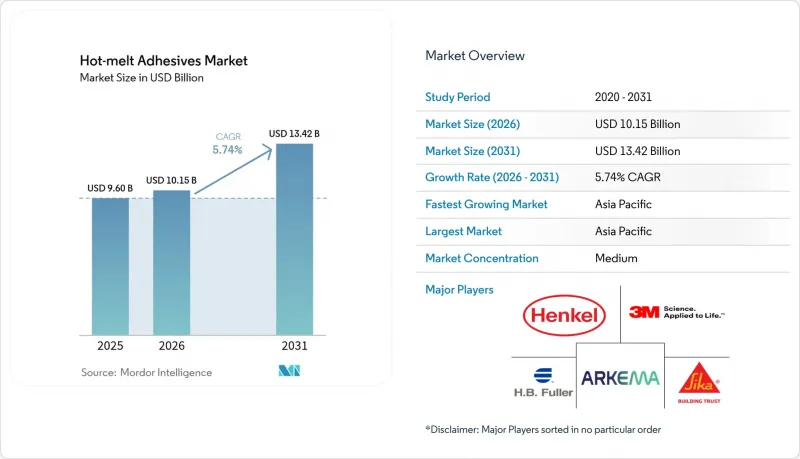
This report is Segmented by Resin Type (Ethylene-Vinyl Acetate, Styrenic Block Copolymers, and Other Resin Types), End-User Industry (Paper Board and Packaging, Building and Construction, Electrical and Electronic Appliances, Other End-User Industries), and Geography (Asia-Pacific, North America, Europe, South America, and Middle East and Africa). The Market Forecasts are Provided in Terms of Value (USD).
Global Hot-melt Adhesives Market Trends and Insights
Shift from Solvent-Borne to Hot-Melt Systems in Fast-Moving Packaging Lines
Production lines have cut cycle times by 40-60% by eliminating solvent flash-off and adopting melt-on-demand units that keep viscosity stable for entire shifts. Robatech's Volta platform trims energy draw by 30% while meeting REACH and FDA food-contact rules, making it a template for upgrades across beverage multipack and snack pouch plants.
Explosive Growth of Asian E-Commerce Fulfilment Hubs Demanding Eco-Friendly Case-Sealing Adhesives
China processed more than 130 billion parcels in 2024, and fulfilment centers specify starch-based hot melts that compost within 180 days, curbing landfill loads. India and ASEAN follow, pushing corrugators to install high-speed gluers compatible with low-temperature bio-formulations that prevent board warping in humid climates.
Crude-Oil-Linked Price Volatility of Tackifier Resins
C5 and C9 hydrocarbon tackifiers make up 15-25% of conventional formulations and saw 30-40% price swings during 2024 energy shocks. Large buyers secure multi-year supply contracts; smaller converters absorb margin squeeze or reduce adhesive load rates, risking bond failure in humid transit environments.
Other drivers and restraints analyzed in the detailed report include:
- Surge in Bio-Based Resin Capacity (Soy, Tall-Oil, Starch) Unlocking New Premium Niches
- Automation of Furniture and Mattress Production Driving PUR and MPO Hot-Melts
- Limited Heat-Resistance Window Versus Structural Epoxies
For complete list of drivers and restraints, kindly check the Table Of Contents.
Segment Analysis
EVA accounted for 59.10% of the hot melt adhesives market size in 2025 and is forecast to compound at 6.25% annually to 2031. Its balance of flexibility, adhesion, and cost keeps converters loyal, and decades of installed slot-die and spray equipment dampen switching incentives. The segment also benefits from a deep feedstock base in Asia and North America that cushions against isolated supply shocks.
Heightened sustainability goals push buyers toward metallocene polyolefins with 65% renewable content, such as Dow's AFFINITY RE, which cuts carbon footprint by 40-50% while matching bond strength. Thermoplastic polyurethane captures share in footwear, offering abrasion resistance that withstands 100,000 flex cycles. Specialty polyamides and polyimides cater to electronics potting, leveraging high-temperature stability that EVA and SBC cannot match, but volumes remain niche due to price premiums.
Complete Report Scope:
- By Resin Type
- Ethylene-Vinyl Acetate (EVA)
- Styrenic Block Copolymers (SBC)
- Thermoplastic Polyurethane (TPU)
- Other Resin Types
- By End-user Industry
- Paper, Board, and Packaging
- Building and Construction
- Woodworking and Joinery
- Automotive and Transportation
- Footwear and Leather
- Healthcare
- Electrical and Electronic Appliances
- Other End-User Industries
- By Geography
- Asia-Pacific
- China
- India
- Japan
- South Korea
- ASEAN Countries
- Rest of Asia-Pacific
- North America
- United States
- Canada
- Mexico
- Europe
- Germany
- United Kingdom
- France
- Italy
- Russia
- NORDIC Countries
- Rest of Europe
- South America
- Brazil
- Argentina
- Rest of South America
- Middle East and Africa
- Saudi Arabia
- South Africa
- Rest of Middle East and Africa
- Asia-Pacific
Geography Analysis
Asia-Pacific's 48.20% dominance in 2025 stems from integrated supply corridors linking polymer crackers, tackifier reactors, and high-volume corrugators. Chinese converters sit adjacent to cell phone and appliance plants, ensuring just-in-time adhesive deliveries that minimize heated-tank idle time. India's consumer-goods boom lifts demand for all-temperature carton sealing, and Southeast Asia benefits from printed-circuit board migration that needs precision jetting.
North American buyers prioritize premium performance and sustainability. U.S. automakers specify reactive polyolefins that permit end-of-life dismantling, while Canadian forestry residuals feed tall-oil tackifier streams that lower fossil intensity. Mexico's maquiladoras amplify regional volumes with appliance assembly lines that require thermal-shock-resistant bonds.
Europe's stringent VOC caps accelerate substitution of solvented laminating adhesives with melt-based grades. German vehicle makers co-develop lightweight cockpit modules using PUR that passes crash pulse tests. The United Kingdom focuses on compostable bag seals to meet municipal waste targets, and Nordic players leverage bio-refineries to supply renewable waxes that trim CO2 footprints. South America and MEA trail but invest in infrastructure insulation and consumer goods packaging, though currency volatility periodically tempers import demand.
- 3M
- Arkema
- Ashland
- Avery Dennison Corporation
- Daubert Chemical Company
- Dow
- Franklin International
- H.B. Fuller Company
- Henkel AG & Co. KGaA
- Hexcel Corporation
- Huntsman
- Jowat Corporation
- KLEIBERIT SE & Co. KG
- NANPAO RESINS CHEMICAL GROUP
- Paramelt B.V.
- Pidilite Industries Limited
- Power Adhesives Ltd.
- Sika AG
Additional Benefits:
- The market estimate (ME) sheet in Excel format
- 3 months of analyst support
TABLE OF CONTENTS
1 Introduction
- 1.1 Study Assumptions and Market Definition
- 1.2 Scope of the Study
2 Research Methodology
3 Executive Summary
4 Market Landscape
- 4.1 Market Overview
- 4.2 Market Drivers
- 4.2.1 Shift From Solvent-Borne to Hot-Melt Systems in Fast-Moving Packaging Lines
- 4.2.2 Explosive Growth of Asian E-Commerce Fulfilment Hubs Demanding Eco-Friendly Case-Sealing Adhesives
- 4.2.3 Surge in Bio-Based Resin Capacity (Soy, Tall-Oil, Starch) Unlocking New Premium Niches
- 4.2.4 Automation of Furniture and Mattress Production Driving PUR And MPO Hot-Melts
- 4.2.5 EV Lightweighting and Battery Module Bonding Requirements
- 4.3 Market Restraints
- 4.3.1 Crude-Oil-Linked Price Volatility of Tackifier Resins
- 4.3.2 Limited Heat-Resistance Window Versus Structural Epoxies
- 4.3.3 Growing VOC Scrutiny on Traditional SBC Tackifiers In EU
- 4.4 Value Chain Analysis
- 4.5 Porter's Five Forces
- 4.5.1 Bargaining Power of Suppliers
- 4.5.2 Bargaining Power of Buyers
- 4.5.3 Threat of New Entrants
- 4.5.4 Threat of Substitutes
- 4.5.5 Competitive Rivalry
5 Market Size and Growth Forecasts (Value)
- 5.1 By Resin Type
- 5.1.1 Ethylene-Vinyl Acetate (EVA)
- 5.1.2 Styrenic Block Copolymers (SBC)
- 5.1.3 Thermoplastic Polyurethane (TPU)
- 5.1.4 Other Resin Types
- 5.2 By End-user Industry
- 5.2.1 Paper, Board, and Packaging
- 5.2.2 Building and Construction
- 5.2.3 Woodworking and Joinery
- 5.2.4 Automotive and Transportation
- 5.2.5 Footwear and Leather
- 5.2.6 Healthcare
- 5.2.7 Electrical and Electronic Appliances
- 5.2.8 Other End-User Industries
- 5.3 By Geography
- 5.3.1 Asia-Pacific
- 5.3.1.1 China
- 5.3.1.2 India
- 5.3.1.3 Japan
- 5.3.1.4 South Korea
- 5.3.1.5 ASEAN Countries
- 5.3.1.6 Rest of Asia-Pacific
- 5.3.2 North America
- 5.3.2.1 United States
- 5.3.2.2 Canada
- 5.3.2.3 Mexico
- 5.3.3 Europe
- 5.3.3.1 Germany
- 5.3.3.2 United Kingdom
- 5.3.3.3 France
- 5.3.3.4 Italy
- 5.3.3.5 Russia
- 5.3.3.6 NORDIC Countries
- 5.3.3.7 Rest of Europe
- 5.3.4 South America
- 5.3.4.1 Brazil
- 5.3.4.2 Argentina
- 5.3.4.3 Rest of South America
- 5.3.5 Middle East and Africa
- 5.3.5.1 Saudi Arabia
- 5.3.5.2 South Africa
- 5.3.5.3 Rest of Middle East and Africa
- 5.3.1 Asia-Pacific
6 Competitive Landscape
- 6.1 Market Concentration
- 6.2 Strategic Moves
- 6.3 Market Share (%)/Ranking Analysis
- 6.4 Company Profiles (includes Global level Overview, Market level overview, Core Segments, Financials as available, Strategic Information, Market Rank/Share, Products and Services, Recent Developments)
- 6.4.1 3M
- 6.4.2 Arkema
- 6.4.3 Ashland
- 6.4.4 Avery Dennison Corporation
- 6.4.5 Daubert Chemical Company
- 6.4.6 Dow
- 6.4.7 Franklin International
- 6.4.8 H.B. Fuller Company
- 6.4.9 Henkel AG & Co. KGaA
- 6.4.10 Hexcel Corporation
- 6.4.11 Huntsman
- 6.4.12 Jowat Corporation
- 6.4.13 KLEIBERIT SE & Co. KG
- 6.4.14 NANPAO RESINS CHEMICAL GROUP
- 6.4.15 Paramelt B.V.
- 6.4.16 Pidilite Industries Limited
- 6.4.17 Power Adhesives Ltd.
- 6.4.18 Sika AG
7 Market Opportunities and Future Outlook
- 7.1 White-space and Unmet-need Assessment

