PUBLISHER: Mordor Intelligence | PRODUCT CODE: 2115881

PUBLISHER: Mordor Intelligence | PRODUCT CODE: 2115881
Polyester Hot Melt Adhesives - Market Share Analysis, Industry Trends & Statistics, Growth Forecasts (2026 - 2031)
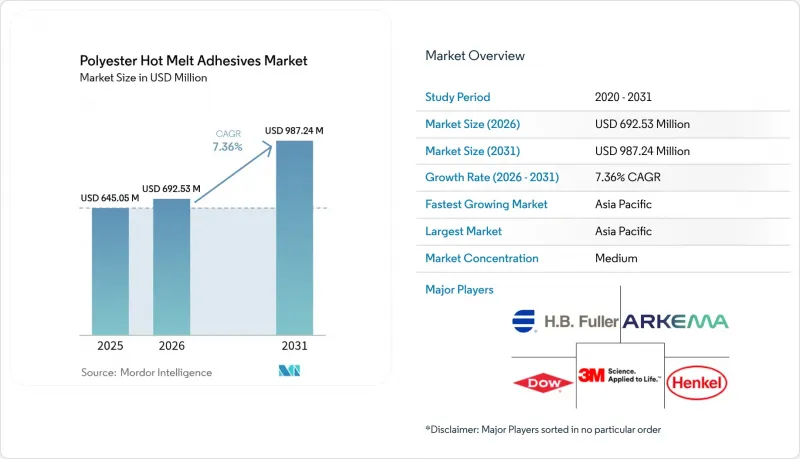
According to Mordor Intelligence, the polyester hot melt adhesives market size is expected to grow from USD 645.05 million in 2025 to USD 692.53 million in 2026 and is forecast to reach USD 987.24 million by 2031 at 7.36% CAGR over 2026-2031.
This report is Segmented by Application (Industrial Assembly, Food & Medical Packaging, and More), Resin Chemistry (Aromatic Polyester, Aliphatic Polyester, and More), Form (Pellets/Granules, Blocks/Slabs, and More), End-Use Industry (Packaging, Automotive & Transportation, and More), and Geography (Asia-Pacific, North America, Europe, South America, Middle East and Africa).
Global Polyester Hot Melt Adhesives Market Trends and Insights
Rising Demand for Solvent-Free Packaging Adhesives
Packaging producers are eliminating solvent emissions and cutting energy use by shifting from solvent-borne laminating products to 100% solids polyester hot melts. Henkel, Dow, and Kraton recently cut the carbon footprint of the TECHNOMELT range by 25% by introducing bio-based tackifiers without sacrificing food-contact safety. Tightening EU VOC limits further accelerates this switch, while converters benefit from quicker line speeds and the elimination of costly solvent-recovery equipment. Polyester formulations also improve adhesion to metallised films and enhance moisture resistance, making them attractive for premium barrier packaging.
Lightweight Automotive Bonding Requirements
Vehicle makers pursuing weight reduction and electrification rely on polyester hot melts to join aluminium, carbon fibre, and advanced steels that cannot be riveted or welded cost-effectively. These thermoplastic adhesives withstand wide temperature swings, damp vibration, and allow easier component disassembly for end-of-life recycling. Increasing power-electronics density in electric vehicles heightens under-hood thermal stress; polyester chemistries tailored for 150 °C service safely insulate battery modules while maintaining mechanical integrity.
Availability of Substitutes
Lignin-based hot melts, reactive polyurethane systems, and advanced cyanoacrylates match or exceed polyester performance in certain uses and attract buyers seeking lower cost or higher green content. As these alternatives scale, they cap pricing power for polyester suppliers and can divert new projects when technical differences are minimal.
Other drivers and restraints analyzed in the detailed report include:
- Growth in Miniaturised Electronic Components
- Wearable Smart-Textile Bonding Emergence
- Volatile Petrochemical Diacid & Glycol Prices
For complete list of drivers and restraints, kindly check the Table Of Contents.
Segment Analysis
Industrial assembly remains the largest slice of the polyester hot melt adhesives market, holding 35.20% share in 2025 and topping the USD polyester hot melt adhesives market size rankings. Automotive bonding dominates this segment, where the adhesive's ability to unite multi-material structures and survive life-cycle temperature extremes is critical. Vehicle electrification raises peak under-hood temperatures, further reinforcing the need for thermally resilient polyester hot melts. Other industrial uses include appliance, furniture, and filter assembly, each benefiting from fast set times and clean processing.
Food and medical packaging is the fastest-growing application, advancing at an 8.24% CAGR through 2031. Brand owners favour solvent-free, low-odour adhesives that meet stringent migration limits while reducing line energy demand. Peelable heat-seal coatings for retort pouches and lidding films illustrate the crossover between industrial assembly and packaging functions. Electronics packaging and heat-seal coatings add diversity, while textile laminates offer an emerging arena where flexible adhesion, breathability, and wash resistance converge.
Aromatic polyester commands 46.00% of 2025 revenues, prized for high glass-transition temperature, cohesive strength, and resistance to automotive and electronic operating conditions. The polyester hot melt adhesives market share advantage stems from decades of optimisation, ready availability of raw materials, and broad formulation know-how.
Bio-based and partially bio-based polyester, however, is the fastest-growing chemistry at 8.22% CAGR. Suppliers leverage plant-derived diacids, recycled PET, and CO2-based intermediates to cut carbon footprint without losing mechanical performance. Customers in consumer goods and medical devices value the sustainability story, and legislative pressure on petrochemical dependence will narrow legacy cost advantages. Aliphatic polyester serves niche biodegradable or compostable end-uses, while copolyester chemistries fine-tune crystallinity and melt viscosity for tailored substrate wet-out or reworkability. Continuous R&D keeps the polyester hot melt adhesives market dynamic as performance and sustainability benchmarks rise in tandem.
Complete Report Scope:
- By Application
- Industrial Assembly
- Automotive
- Others
- Food and Medical Packaging
- Electrical and Electronics Components
- Heat-Seal Coatings
- Textile Laminates
- Others
- Industrial Assembly
- By Resin Chemistry
- Aromatic Polyester
- Aliphatic Polyester
- Copolyester
- Bio-based/Partially Bio-based Polyester
- By Form
- Pellets/Granules
- Blocks/Slabs
- Sticks
- Film/Web
- Powder/Microspheres
- By End-use Industry
- Packaging (Food, Medical, Industrial)
- Automotive and Transportation
- Electronics and Electrical
- Textile and Footwear
- Furniture and Woodworking
- Others
- By Geography
- Asia-Pacific
- China
- India
- Japan
- South Korea
- Rest of Asia-Pacific
- North America
- United States
- Canada
- Mexico
- Europe
- Germany
- United Kingdom
- Italy
- France
- Rest of Europe
- South America
- Brazil
- Argentina
- Rest of South America
- Middle East and Africa
- Saudi Arabia
- South Africa
- Rest of Middle East and Africa
- Asia-Pacific
Geography Analysis
Asia Pacific held 39.60% of global sales in 2025 and is on track for an 8.12% CAGR to 2031. China's electric-vehicle buildout, India's smartphone assembly hubs, and Japan's high-precision electronics plants all consume large volumes of polyester hot melts. Regional authorities promote investment in advanced materials, encouraging Henkel and Sika to add local capacity, which shortens delivery cycles and integrates technical support into customers' product-development workflows. Consolidated net sales at Pidilite Industries reached INR 12,337 crore (USD 1.48 billion) in 2025, underscoring the region's maturing demand base.
North America remains an innovation powerhouse, driving stringent automotive lightweighting targets and pioneering bio-based chemistries. EU regulations steer materials away from diisocyanates and high-VOCs, making polyester hot melts a go-to solution. Both regions collaborate with academia and start-ups to scale CO2-derived monomers, showcasing leadership in circular-economy adhesives.
South America, the Middle East, and Africa register smaller volumes but represent untapped potential. Infrastructure expansion and growing packaged-food sectors support wider adoption. As regional converters modernise equipment and embrace solvent-free lines, polyester hot melt suppliers win green-field projects that lock in multi-year contract volumes and strengthen global network resilience.
- 3M
- Arkema (Bostik)
- Avery Dennison Corporation
- Beardow Adams Ltd.
- Buhnen GmbH & Co. KG
- Cattie Adhesives
- Dow
- Dymax Corporation
- Evonik Industries AG
- H.B. Fuller Company
- HellermannTyton
- Henkel AG & Co. KGaA
- Jowat SE
- Nihon Matai Co., Ltd.
- Sika AG
- Spiderbond Adhesives Co., Ltd.
- Toagosei Co., Ltd.
Additional Benefits:
- The market estimate (ME) sheet in Excel format
- 3 months of analyst support
TABLE OF CONTENTS
1 Introduction
- 1.1 Study Assumptions and Market Definition
- 1.2 Scope of the Study
2 Research Methodology
3 Executive Summary
4 Market Landscape
- 4.1 Market Overview
- 4.2 Market Drivers
- 4.2.1 Rising demand for solvent-free packaging adhesives
- 4.2.2 Lightweight automotive bonding requirements
- 4.2.3 Growth in miniaturised electronic components
- 4.2.4 Wearable smart-textile bonding emergence
- 4.2.5 Medical-grade low-temperature film adhesives
- 4.3 Market Restraints
- 4.3.1 Availiablity Of subsitutes
- 4.3.2 Volatile petrochemical diacid and glycol prices
- 4.3.3 High Raw Material and Production Costs
- 4.4 Value Chain Analysis
- 4.5 Porter's Five Forces
- 4.5.1 Bargaining Power of Suppliers
- 4.5.2 Bargaining Power of Buyers
- 4.5.3 Threat of New Entrants
- 4.5.4 Threat of Substitutes
- 4.5.5 Degree of Competition
5 Market Size and Growth Forecasts (Value)
- 5.1 By Application
- 5.1.1 Industrial Assembly
- 5.1.1.1 Automotive
- 5.1.1.2 Others
- 5.1.2 Food and Medical Packaging
- 5.1.3 Electrical and Electronics Components
- 5.1.4 Heat-Seal Coatings
- 5.1.5 Textile Laminates
- 5.1.6 Others
- 5.1.1 Industrial Assembly
- 5.2 By Resin Chemistry
- 5.2.1 Aromatic Polyester
- 5.2.2 Aliphatic Polyester
- 5.2.3 Copolyester
- 5.2.4 Bio-based/Partially Bio-based Polyester
- 5.3 By Form
- 5.3.1 Pellets/Granules
- 5.3.2 Blocks/Slabs
- 5.3.3 Sticks
- 5.3.4 Film/Web
- 5.3.5 Powder/Microspheres
- 5.4 By End-use Industry
- 5.4.1 Packaging (Food, Medical, Industrial)
- 5.4.2 Automotive and Transportation
- 5.4.3 Electronics and Electrical
- 5.4.4 Textile and Footwear
- 5.4.5 Furniture and Woodworking
- 5.4.6 Others
- 5.5 By Geography
- 5.5.1 Asia-Pacific
- 5.5.1.1 China
- 5.5.1.2 India
- 5.5.1.3 Japan
- 5.5.1.4 South Korea
- 5.5.1.5 Rest of Asia-Pacific
- 5.5.2 North America
- 5.5.2.1 United States
- 5.5.2.2 Canada
- 5.5.2.3 Mexico
- 5.5.3 Europe
- 5.5.3.1 Germany
- 5.5.3.2 United Kingdom
- 5.5.3.3 Italy
- 5.5.3.4 France
- 5.5.3.5 Rest of Europe
- 5.5.4 South America
- 5.5.4.1 Brazil
- 5.5.4.2 Argentina
- 5.5.4.3 Rest of South America
- 5.5.5 Middle East and Africa
- 5.5.5.1 Saudi Arabia
- 5.5.5.2 South Africa
- 5.5.5.3 Rest of Middle East and Africa
- 5.5.1 Asia-Pacific
6 Competitive Landscape
- 6.1 Market Concentration
- 6.2 Strategic Moves
- 6.3 Market Share Analysis
- 6.4 Company Profiles (includes Global level Overview, Market level overview, Core Segments, Financials as available, Strategic Information, Market Rank/Share for key companies, Products and Services, and Recent Developments)
- 6.4.1 3M
- 6.4.2 Arkema (Bostik)
- 6.4.3 Avery Dennison Corporation
- 6.4.4 Beardow Adams Ltd.
- 6.4.5 Buhnen GmbH & Co. KG
- 6.4.6 Cattie Adhesives
- 6.4.7 Dow
- 6.4.8 Dymax Corporation
- 6.4.9 Evonik Industries AG
- 6.4.10 H.B. Fuller Company
- 6.4.11 HellermannTyton
- 6.4.12 Henkel AG & Co. KGaA
- 6.4.13 Jowat SE
- 6.4.14 Nihon Matai Co., Ltd.
- 6.4.15 Sika AG
- 6.4.16 Spiderbond Adhesives Co., Ltd.
- 6.4.17 Toagosei Co., Ltd.
7 Market Opportunities and Future Outlook
- 7.1 White-space and Unmet-Need Assessment
- 7.2 Sustainability and Bio-Based Innovations

