PUBLISHER: Mordor Intelligence | PRODUCT CODE: 2113783

PUBLISHER: Mordor Intelligence | PRODUCT CODE: 2113783
Africa Algae Omega-3 Ingredients - Market Share Analysis, Industry Trends & Statistics, Growth Forecasts (2026 - 2031)
According to Mordor Intelligence, Africa algae omega-3 ingredients market size in 2026 is estimated at USD 22.85 million, growing from 2025 value of USD 21.36 million with 2031 projections showing USD 32.02 million, growing at 6.98% CAGR over 2026-2031.
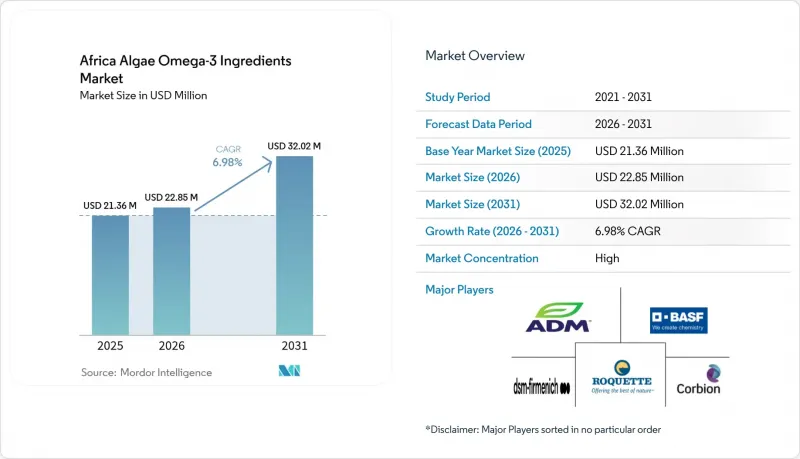
This report is Segmented by Type (Eicosapentaenoic Acid (EPA), Docosahexanoic Acid (DHA), and EPA/DHA Blends), by Application (Food and Beverages, Infant Formula and Baby Food, Dietary Supplements, and Other Applications), and by Geography (South Africa, Egypt, Nigeria, and Rest of Africa). The Market Forecasts are Provided in Terms of Value (USD).
Africa Algae Omega-3 Ingredients Market Trends and Insights
Infant-formula DHA fortification rules widening to Africa
East African governments are aligning infant formula nutrient standards with Codex Alimentarius guidelines, creating favorable regulatory conditions for algal DHA suppliers. Tanzania's 2024 Food Fortification Regulations, introduced in March 2025, require fortificant traceability and establish a legal framework for incorporating micronutrients, including omega-3 fatty acids, into edible oils and complementary foods, although DHA is not yet a mandatory fortificant. Kenya's draft infant formula regulations, released for stakeholder feedback in late 2024, propose a minimum DHA content of 20 milligrams per 100 kilocalories, consistent with European Union Regulation 2016/127 . These regulations also mandate that DHA sources must be free from marine contaminants, a requirement that benefits algae-based DHA over fish oil. Similarly, Uganda's National Bureau of Standards is developing comparable specifications, with implementation anticipated by 2026. This regulatory alignment is significant as infant formula represents a high-margin, low-volume market where manufacturers are willing to pay a premium for clean-label, allergen-free DHA, mitigating the cost disadvantage of algae-based sources.
Demand for functional food and beverage products
Urban consumers in South Africa and Nigeria are increasingly opting for functional beverages fortified with omega-3 as a convenient alternative to capsule supplements. Food manufacturers are capitalizing on this trend by implementing premium pricing strategies. In South Africa, new food-additive regulations set to take effect in January 2025 aim to streamline the approval process for novel omega-3 carriers, thereby reducing the time-to-market for fortified products such as juice, yogurt, and ready-to-drink smoothies. Meanwhile, in Nigeria, the urban middle class, primarily located in Lagos and Abuja, is driving demand for imported functional beverages. Local manufacturers are also beginning to co-pack fortified products using algal-oil concentrates supplied by companies such as Corbion and DSM-Firmenich, elaborating on the growing collaboration between global suppliers and local producers.
High algal DHA production costs vs fish oil
The high production cost of algal DHA compared to conventional fish oil remains a significant restraint on the growth of the algae-omega-3 ingredients market in Africa. The cultivation of microalgae, oil extraction, and maintaining consistent purity and stability require advanced technology, controlled environments, and energy-intensive processes. These factors increase per-unit costs, making algal DHA considerably more expensive than fish-derived omega-3, which benefits from established, large-scale extraction methods and supply chains. This cost disparity impacts affordability and adoption, particularly in price-sensitive African markets. Functional foods, supplements, and fortified products must compete with lower-cost alternatives, such as fish oil. Consequently, manufacturers may be reluctant to adopt algal DHA at scale unless factors such as increased consumer awareness, regulatory incentives, or sustainability-driven premium positioning help offset the higher costs. This creates a significant barrier to achieving widespread market penetration.
Other drivers and restraints analyzed in the detailed report include:
- Rising adoption of DHA-rich algae ingredients for heart health and healthy aging formulations
- Increasing government support for blue economy initiatives
- Import dependency on algal oil concentrates
For complete list of drivers and restraints, kindly check the Table Of Contents.
Segment Analysis
Docosahexaenoic acid (DHA) accounted for 61.42% of total revenue in 2025, highlighting its dominance in infant formula fortification and cognitive health supplements, particularly as regulatory monographs specifically reference DHA but not eicosapentaenoic acid (EPA). DHA's prominence is driven by its critical role in early brain development and its inclusion in regulatory guidelines for infant nutrition, making it a preferred choice for manufacturers. The Africa algae omega-3 market size for DHA-only formulations remains significantly larger than that for pure EPA oils, a disparity expected to continue until cardiovascular-specific guidelines referencing EPA gain broader clinical acceptance. The EPA/DHA Blends are projected to grow at a 7.12% CAGR through 2031. EPA, while recognized for its cardiovascular benefits, has yet to achieve the same level of regulatory and clinical endorsement as DHA, limiting its market penetration.
However, fragmented African regulations classify blends as novel ingredients, requiring each dossier to undergo an independent review process, which delays product launches by an additional 12-18 months. This regulatory complexity creates significant barriers for new product introductions, slowing the pace of innovation in the market. Consequently, the Africa algae omega-3 market is expected to continue favoring DHA-focused products through at least 2028, although the adoption of blends is anticipated to gradually increase as aquafeed usage expands. The gradual shift toward blends will likely be influenced by advancements in regulatory harmonization and increased awareness of EPA's benefits in aquaculture and human health applications.
Complete Report Scope:
- By Type
- Eicosapentaenoic Acid (EPA)
- Docosahexaenoic Acid (DHA)
- EPA/DHA Blends
- By Application
- Food and Beverages
- Dietary Supplements
- Infant Formula and Baby Food
- Other Applications
- By Geography
- South Africa
- Egypt
- Nigeria
- Rest of Africa
List of Companies Covered in this Report:
- dsm-firmenich
- Corbion N.V.
- Archer-Daniels-Midland Company (ADM)
- BASF SE
- Roquette Freres
- Polaris
- Lonza
- Algarithm
- Cellana
- JC Biotech
- FEMICO
- Cabio Biotech
- Xiamen Huison Biotech
- Guangdong Runke
- Fermentalg
- Qualitas Health
- BioProcess Algae
- Simris Alg
- Mara Renewables
- Kingdomway
- Nuseed
Additional Benefits:
- The market estimate (ME) sheet in Excel format
- 3 months of analyst support
TABLE OF CONTENTS
1 INTRODUCTION
- 1.1 Study Assumptions and Market Definition
- 1.2 Scope of the Study
2 RESEARCH METHODOLOGY
3 EXECUTIVE SUMMARY
4 MARKET LANDSCAPE
- 4.1 Market Overview
- 4.2 Market Drivers
- 4.2.1 Infant-formula DHA fortification rules widening to Africa
- 4.2.2 Demand for functional food and beverage products
- 4.2.3 Rising adoption of DHA-rich algae ingredients for heart health and healthy aging formulations
- 4.2.4 Increasing government support for blue economy initiatives
- 4.2.5 Surging vegan/halal supplement demand in urban hubs
- 4.2.6 Increased application of algae omega-3 in aquafeed to replace fishmeal
- 4.3 Market Restraints
- 4.3.1 High algal DHA production costs vs fish oil
- 4.3.2 Import dependency on algal oil concentrates
- 4.3.3 Regulatory delays for novel algae strains
- 4.3.4 Exchange-rate volatility affecting import pricing
- 4.4 Supply Chain Analysis
- 4.5 Regulatory and Technological Outlook
- 4.6 Porter's Five Forces Analysis
- 4.6.1 Threat of New Entrants
- 4.6.2 Bargaining Power of Buyers
- 4.6.3 Bargaining Power of Suppliers
- 4.6.4 Threat of Substitutes
- 4.6.5 Intensity of Competitive Rivalry
5 MARKET SIZE AND GROWTH FORECATS (VALUE)
- 5.1 By Type
- 5.1.1 Eicosapentaenoic Acid (EPA)
- 5.1.2 Docosahexaenoic Acid (DHA)
- 5.1.3 EPA/DHA Blends
- 5.2 By Application
- 5.2.1 Food and Beverages
- 5.2.2 Dietary Supplements
- 5.2.3 Infant Formula and Baby Food
- 5.2.4 Other Applications
- 5.3 By Geography
- 5.3.1 South Africa
- 5.3.2 Egypt
- 5.3.3 Nigeria
- 5.3.4 Rest of Africa
6 COMPETITIVE LANDSCAPE
- 6.1 Market Concentration
- 6.2 Strategic Moves
- 6.3 Market Ranking Analysis
- 6.4 Company Profiles {(includes Global level Overview, Market level overview, Core Segments, Financials as available, Strategic Information, Market Rank/Share for key companies, Products and Services, and Recent Developments)}
- 6.4.1 dsm-firmenich
- 6.4.2 Corbion N.V.
- 6.4.3 Archer-Daniels-Midland Company (ADM)
- 6.4.4 BASF SE
- 6.4.5 Roquette Freres
- 6.4.6 Polaris
- 6.4.7 Lonza
- 6.4.8 Algarithm
- 6.4.9 Cellana
- 6.4.10 JC Biotech
- 6.4.11 FEMICO
- 6.4.12 Cabio Biotech
- 6.4.13 Xiamen Huison Biotech
- 6.4.14 Guangdong Runke
- 6.4.15 Fermentalg
- 6.4.16 Qualitas Health
- 6.4.17 BioProcess Algae
- 6.4.18 Simris Alg
- 6.4.19 Mara Renewables
- 6.4.20 Kingdomway
- 6.4.21 Nuseed
7 MARKET OPPORTUNITIES AND FUTURE OUTLOOK

