PUBLISHER: Mordor Intelligence | PRODUCT CODE: 2113923

PUBLISHER: Mordor Intelligence | PRODUCT CODE: 2113923
Tuna And Algae Omega-3 Ingredients - Market Share Analysis, Industry Trends & Statistics, Growth Forecasts (2026 - 2031)
According to Mordor Intelligence, the tuna and algae omega-3 ingredient market size is expected to grow from USD 2.35 billion in 2025 to USD 2.58 billion in 2026 and is forecast to reach USD 4.14 billion by 2031 at 9.92% CAGR over 2026-2031.
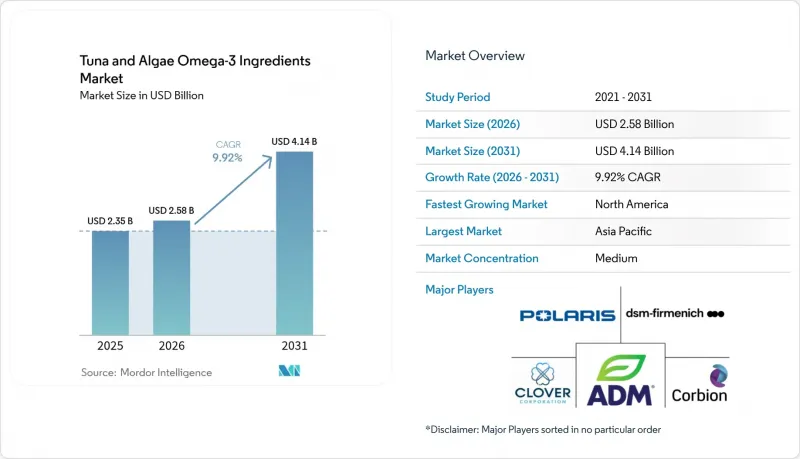
This report is Segmented by Type (Tuna Omega-3 Ingredient, Algae Omega-3 Ingredient), Application (Food and Beverage [Infant Formula, Fortified Food and Beverages], Dietary Supplements, Pharmaceutical, Animal Nutrition), and Geography (North America, Europe, Asia-Pacific, South America, Middle East and Africa). The Market Forecasts are Provided in Terms of Value (USD).
Global Tuna And Algae Omega-3 Ingredients Market Trends and Insights
Rising Consumer Awareness of Omega-3 Health Benefits for Cardiovascular, Brain, and Anti-Inflammatory Effects
Cardiovascular disease remains the leading global cause of mortality. Clinical evidence highlights EPA and DHA for lowering triglyceride levels and reducing major cardiac events, elevating omega-3s to therapeutic targets. The REDUCE-IT trial, with over 8,000 high-risk participants, showed high-dose icosapent ethyl (a purified EPA ethyl ester) reduced cardiovascular risks by 25% versus placebo. This led the U.S. Food and Drug Administration to approve its adjunctive use with statins. Following this, supplement brands emphasized EPA-to-DHA ratios and third-party testing for oxidative markers like peroxide and anisidine values to differentiate premium products. Cognitive health claims are also rising, with studies linking over 500 milligrams of daily DHA intake to better executive function and memory, though the European Food Safety Authority notes challenges in proving causation outside infant and maternal contexts. Specialized pro-resolving mediators from EPA and DHA are under study for anti-inflammatory effects in chronic conditions like rheumatoid arthritis and inflammatory bowel disease, with Phase II trials showing modest but significant reductions in C-reactive protein and interleukin-6 levels. Regulatory bodies also play a role.
Surge in Use for Infant Formula Fortification, Leveraging DHA Benefits Without Off-Odors
China's GB 14880 standard requires all domestically sold infant formulas to meet a minimum DHA content, while the European Union's Delegated Regulation (EU) 2016/127 mandates DHA levels between 20 to 50 milligrams per 100 kilocalories. Algae-derived DHA, obtained from Schizochytrium and Crypthecodinium oils, has replaced fish oil in infant formulas. These algae oils offer high DHA concentrations without the fishy odor or allergenic risks that often discourage caregivers. In January 2025, the European Food Safety Authority (EFSA) approved Schizochytrium sp. oil for use in infant and follow-on formulas, citing safety data from post-market surveillance and toxicological studies in neonatal animal models. The U.S. Food and Drug Administration (FDA) has issued several Generally Recognized As Safe (GRAS) notices for algal DHA oils, including GRN 1236 for Schizochytrium sp. oil, allowing levels up to 60 milligrams per 100 kilocalories, consistent with Codex Alimentarius's upper limit. Leading formula manufacturers such as Abbott, Nestle, and Danone have reformulated flagship products to include algae-derived DHA. They market the ingredient as vegetarian-friendly and sustainably sourced, appealing to millennial and Gen-Z parents who value plant-based nutrition. Clinical trials continue to examine dose-response relationships.
Climate Shifts and Stricter Sustainability Audits Disrupting Tuna Supply Chains
Ocean warming and acidification are altering tuna migration patterns, reducing catch predictability and increasing the operational costs of fishing fleets that must travel farther to locate schools. The Inter-American Tropical Tuna Commission documented in 2024 that El Nino conditions shifted yellowfin tuna eastward, lowering catch rates in traditional fishing zones off Ecuador and Peru by approximately 20 percent and forcing vessels to extend trip durations, which raised fuel costs and reduced profitability. Some tuna fisheries have lost or are at risk of losing MSC certification due to overfishing or bycatch concerns, which excludes their oil from supply chains serving eco-conscious brands and retailers. Regulatory frameworks such as the European Union's Illegal, Unreported and Unregulated Fishing Regulation require catch certificates and port-state inspections, and non-compliance can result in import bans that disrupt ingredient availability. These supply-chain frictions elevate the cost and volatility of tuna-derived omega-3, accelerating the shift toward algae sources that offer stable, year-round production independent of climate variability and fishery politics.
Other drivers and restraints analyzed in the detailed report include:
- Functional Foods and Beverage Fortification Expansion
- Demand for Sustainable, Plant-Based Alternatives to Fish Oil Amid Overfishing and Environmental Concerns
- High Cultivation and Extraction Costs for Algae
For complete list of drivers and restraints, kindly check the Table Of Contents.
Segment Analysis
Tuna-derived omega-3 ingredients held 60.45% of the market value in 2025, reflecting decades of infrastructure investment in fishing fleets, refining facilities, and regulatory approvals that have made tuna oil the default source for dietary supplements, pharmaceutical formulations, and fortified foods. Tuna oil offers a balanced EPA-to-DHA ratio that aligns with cardiovascular health claims, and molecular distillation processes can concentrate omega-3 content to 90 percent or higher, meeting the purity thresholds required for prescription drugs such as icosapent ethyl and omega-3-acid ethyl esters approved by the U.S. Food and Drug Administration.
Algae-derived omega-3 ingredients are forecast to expand at 11.12% CAGR from 2026 to 2031, outpacing the overall market as infant-formula manufacturers and pharmaceutical developers prioritize allergen-free, vegetarian-compliant sources that avoid the supply-chain risks associated with wild fisheries. In January 2025, the European Food Safety Authority extended its positive opinion on Schizochytrium sp. oil to cover infant and follow-on formula, and China's GB 14880 standard mandates DHA in all infant formulas, creating a structural demand floor for algae DHA that is insulated from consumer discretion.
Complete Report Scope:
- Type
- Tuna Omega-3 Ingredient
- Algae Omega-3 Ingredient
- Application
- Food and Beverage
- Infant Formula
- Fortified Food and Beverages
- Dietary Supplements
- Pharmaceutical
- Animal Nutrition
- Food and Beverage
- Geography
- North America
- United States
- Canada
- Mexico
- Rest of North America
- Europe
- Germany
- United Kingdom
- Italy
- France
- Spain
- Netherlands
- Poland
- Belgium
- Sweden
- Rest of Europe
- Asia-Pacific
- China
- India
- Japan
- Australia
- Indonesia
- South Korea
- Thailand
- Singapore
- Rest of Asia-Pacific
- South America
- Brazil
- Argentina
- Colombia
- Chile
- Peru
- Rest of South America
- Middle East and Africa
- South Africa
- Saudi Arabia
- United Arab Emirates
- Nigeria
- Egypt
- Morocco
- Turkey
- Rest of Middle East and Africa
- North America
Geography Analysis
Europe led with 31.15% of the 2025 global value, underpinned by stringent novel-food approvals that confer consumer confidence and by the wide uptake of MSC-certified ingredients. Germany and France dominate prescription volumes, aided by reimbursement under statutory insurance, whereas Scandinavia pioneers functional-food rollouts such as DHA-fortified dairy and bakery lines. The region's Green Deal accelerates corporate commitments to cut supply-chain carbon emissions, a tailwind for algae DHA adoption. Retailer coalitions in the United Kingdom and the Netherlands now require verifiable sustainability labels, cementing long-term demand certainty for certified supply.
Asia-Pacific is set to deliver the fastest expansion at 12.2% CAGR. China's infant-formula rules mandate DHA inclusion, locking in fermentation capacity utilization, while Japan's Foods with Function Claims system paves the way for on-pack omega-3 messaging across beverages and snacks. India's middle-class consumers are adopting supplements as chronic disease awareness rises, and FSSAI fortification guidelines integrate DHA into edible-oil and dairy standards. Concurrent aquaculture growth fuels incremental algae-oil demand as feed formulators scramble to reduce fish-oil inclusion ratios and secure export-market eco-labels.
North America remains a mature but sizeable hub. The U.S. qualified health claim for omega-3 and coronary heart disease, coupled with Medicare reimbursement for EPA ethyl ester therapies, keeps baseline demand resilient. Retail chains stock omega-3-enriched eggs, almond milk, and yogurts, normalizing DHA intake beyond pill form. Sustainability agendas are intensifying: by 2025, several leading grocers have pledged 100% certified seafood sourcing, indirectly pressuring tuna-oil suppliers to align with MSC or shift toward cultivated alternatives.
- Archer Daniels Midland (ADM)
- Koninklijke DSM-Firmenich
- BASF SE
- Corbion NV
- Lonza Group
- Bioprocess Algae LLC
- Neptune Wellness Solutions
- Polaris SA
- Source-Omega LLC
- AlgaeCytes
- GC Rieber VivoMega
- Golden Omega SA
- Epax Norway AS
- Aker BioMarine
- TASA
- KD Pharma Group
- MiAlgae
- Cellana Inc.
- Solutex GC
- Nippon Suisan Kaisha, Ltd. (Nissui)
Additional Benefits:
- The market estimate (ME) sheet in Excel format
- 3 months of analyst support
TABLE OF CONTENTS
1 INTRODUCTION
- 1.1 Study Assumptions and Market Definition
- 1.2 Scope of the Study
2 RESEARCH METHODOLOGY
3 EXECUTIVE SUMMARY
4 MARKET LANDSCAPE
- 4.1 Market Overview
- 4.2 Market Drivers
- 4.2.1 Rising consumer awareness of omega-3 health benefits for cardiovascular, brain, and anti-inflammatory effects.
- 4.2.2 Surge in use for infant formula fortification, leveraging DHA benefits without off-odors.
- 4.2.3 Functional Foods and Beverage Fortification Expansion
- 4.2.4 Demand for sustainable, plant-based alternatives to fish oil amid overfishing and environmental concerns.
- 4.2.5 Integration into animal nutrition and feed for healthier animal products.
- 4.2.6 Technological advancements in algae cultivation, extraction, and bioreactor efficiency.
- 4.3 Market Restraints
- 4.3.1 Regulatory complexities, such as varying GRAS notices, novel food approvals
- 4.3.2 Climate shifts and stricter sustainability audits are disrupting tuna supply chains.
- 4.3.3 High cultivation and extraction costs for algae
- 4.3.4 Consumer skepticism over efficacy, stability, and limited research on algae omega-3
- 4.4 Supply Chain Analysis
- 4.5 Regulatory Landscape
- 4.6 Technological Outlook
- 4.7 Porter's Five Forces Analysis
- 4.7.1 Threat of New Entrants
- 4.7.2 Bargaining Power of Buyers
- 4.7.3 Bargaining Power of Suppliers
- 4.7.4 Threat of Substitutes
- 4.7.5 Intensity of Competitive Rivalry
5 MARKET SIZE AND GROWTH FORECASTS (VALUE)
- 5.1 Type
- 5.1.1 Tuna Omega-3 Ingredient
- 5.1.2 Algae Omega-3 Ingredient
- 5.2 Application
- 5.2.1 Food and Beverage
- 5.2.1.1 Infant Formula
- 5.2.1.2 Fortified Food and Beverages
- 5.2.2 Dietary Supplements
- 5.2.3 Pharmaceutical
- 5.2.4 Animal Nutrition
- 5.2.1 Food and Beverage
- 5.3 Geography
- 5.3.1 North America
- 5.3.1.1 United States
- 5.3.1.2 Canada
- 5.3.1.3 Mexico
- 5.3.1.4 Rest of North America
- 5.3.2 Europe
- 5.3.2.1 Germany
- 5.3.2.2 United Kingdom
- 5.3.2.3 Italy
- 5.3.2.4 France
- 5.3.2.5 Spain
- 5.3.2.6 Netherlands
- 5.3.2.7 Poland
- 5.3.2.8 Belgium
- 5.3.2.9 Sweden
- 5.3.2.10 Rest of Europe
- 5.3.3 Asia-Pacific
- 5.3.3.1 China
- 5.3.3.2 India
- 5.3.3.3 Japan
- 5.3.3.4 Australia
- 5.3.3.5 Indonesia
- 5.3.3.6 South Korea
- 5.3.3.7 Thailand
- 5.3.3.8 Singapore
- 5.3.3.9 Rest of Asia-Pacific
- 5.3.4 South America
- 5.3.4.1 Brazil
- 5.3.4.2 Argentina
- 5.3.4.3 Colombia
- 5.3.4.4 Chile
- 5.3.4.5 Peru
- 5.3.4.6 Rest of South America
- 5.3.5 Middle East and Africa
- 5.3.5.1 South Africa
- 5.3.5.2 Saudi Arabia
- 5.3.5.3 United Arab Emirates
- 5.3.5.4 Nigeria
- 5.3.5.5 Egypt
- 5.3.5.6 Morocco
- 5.3.5.7 Turkey
- 5.3.5.8 Rest of Middle East and Africa
- 5.3.1 North America
6 COMPETITIVE LANDSCAPE
- 6.1 Market Concentration
- 6.2 Strategic Moves
- 6.3 Market Share Analysis
- 6.4 Company Profiles (includes Global level Overview, Market level overview, Core Segments, Financials as available, Strategic Information, Market Rank/Share for key companies, Products and Services, and Recent Developments)
- 6.4.1 Archer Daniels Midland (ADM)
- 6.4.2 Koninklijke DSM-Firmenich
- 6.4.3 BASF SE
- 6.4.4 Corbion NV
- 6.4.5 Lonza Group
- 6.4.6 Bioprocess Algae LLC
- 6.4.7 Neptune Wellness Solutions
- 6.4.8 Polaris SA
- 6.4.9 Source-Omega LLC
- 6.4.10 AlgaeCytes
- 6.4.11 GC Rieber VivoMega
- 6.4.12 Golden Omega SA
- 6.4.13 Epax Norway AS
- 6.4.14 Aker BioMarine
- 6.4.15 TASA
- 6.4.16 KD Pharma Group
- 6.4.17 MiAlgae
- 6.4.18 Cellana Inc.
- 6.4.19 Solutex GC
- 6.4.20 Nippon Suisan Kaisha, Ltd. (Nissui)
7 MARKET OPPORTUNITIES AND FUTURE OUTLOOK

