PUBLISHER: Mordor Intelligence | PRODUCT CODE: 2113819

PUBLISHER: Mordor Intelligence | PRODUCT CODE: 2113819
India Food Colorants - Market Share Analysis, Industry Trends & Statistics, Growth Forecasts (2026 - 2031)
According to Mordor Intelligence, the India food colorants market size is expected to grow from USD 195.14 million in 2025 to USD 210.98 million in 2026 and is forecast to reach USD 311.69 million by 2031 at 8.12% CAGR over 2026-2031.
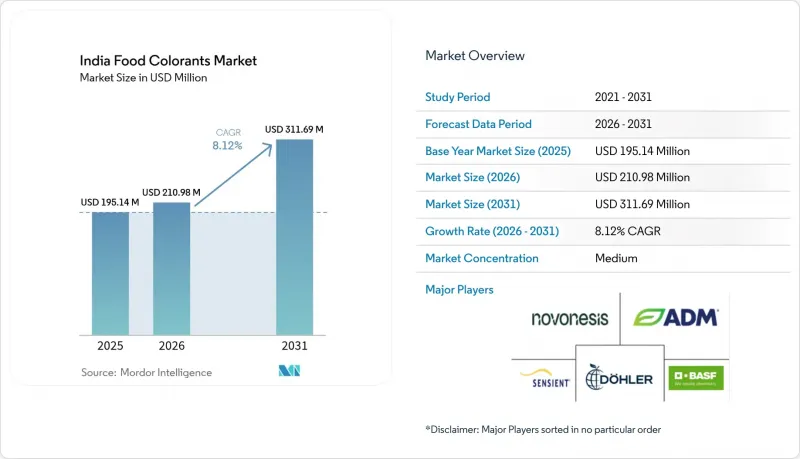
This report is Segmented by Product Type (Natural Colorants and Synthetic Colorants), by Color Type (Blue, Green, Red and More), by Application (Beverages, Dairy and Frozen Products, Bakery and Cereals, and More), and by Geography (North India, West India, South India, and East India). The Market Forecasts are Provided in Terms of Value (USD).
India Food Colorants Market Trends and Insights
Clean-label demand propelling natural color adoption
Indian shoppers are increasingly rejecting synthetic E-numbers in mithai, confectionery, and dairy products. A 2024 peer-reviewed survey found widespread overuse of Tartrazine and Brilliant Blue in namkeens, prompting urgent reformulations that swap chemical dyes for botanical extracts. Since 2018, Nestle India has launched over 70 products, now contributing to more than 6% of the company's turnover. This underscores the commercial significance of cleaner formulations, which are resilient to freeze-thaw cycles and feature reduced sugar content. Premium mithai artisans are now infusing petals, berries, and vegetable concentrates, along with edible metals, to craft vibrant treats that are ready for social media. As India's food processing sector flourishes, there's a noticeable shift from synthetic to natural colorants, driven by a growing demand for clean-label products. Urban millennials and Gen Z, with their wellness focus and label scrutiny, play a pivotal role in this trend, bolstered by increasing disposable incomes and the rise of e-commerce. Consequently, the natural segment has transitioned from a niche preference to a mainstream choice across snacks, beverages, and dairy products.
Expansion of India's processed food and beverage manufacturing base
Urban incomes are rising, and online grocery platforms are booming, leading to a surge in demand for packaged foods. The states of Andhra Pradesh, Tamil Nadu, and Telangana are home to most registered processing units, meeting the consistent pigment demands of snacks, ready-to-eat curries, and seafood. In a move signaling regulatory backing for the expansion of India's food colorants market, Karnataka has introduced policies offering grants for cold storage and offsets for green energy. The Indian market's appetite for food colorants is further fueled by the rise of mega plants and high-speed production lines. Take, for instance, Varun Beverages' new lines in Uttar Pradesh and Madhya Pradesh, operating at speeds of 600-1,200 bpm. These lines, demanding highly stable colors like caramel Class IV and encapsulated carotenoids, underscore the growing need for colorants. Consequently, manufacturers adept at providing heat-stable, cost-efficient natural colors and potent synthetic lakes stand poised to dominate this burgeoning market.
Volatile crop-based raw-material supply
Every time a major crop fails or an export ban is imposed, raw material prices surge. FMCG companies dread budgeting uncertainties even more than they do high prices. Following each market shock, a significant number of buyers make a permanent shift from synthetic dyes to natural colors. Importers bear the brunt of these price shocks, facing harsher penalties than domestic processors who have secured contracts with farmers. Paprika yields, too, face unpredictability due to erratic rainfall patterns in Karnataka. To navigate these challenges, smaller pigment houses either maintain a larger safety inventory or enter into long-term contracts with growers, both of which put a strain on their working capital. While global suppliers have diversified their sources, mixing domestic and imported batches to counter shade variations, they still face limitations. Escalation clauses linked to GI-tagged turmeric and Kashmir saffron restrict the extent to which inflated costs can be passed on in the Indian food colorants market.
Other drivers and restraints analyzed in the detailed report include:
- Regulatory nods for novel botanicals
- Domestic backward-integration in spice-derived pigments
- Stringent FSSAI limits on synthetic dyes
For complete list of drivers and restraints, kindly check the Table Of Contents.
Segment Analysis
Synthetic dyes still account for 56.92% of India's food colorants market revenue, thanks to their low cost and uniform coloring strength. Tartrazine, Sunset Yellow, Allura Red, and Brilliant Blue FCF remain ubiquitous in beverages, candies, and baked goods. The natural segment, however, is forecast to advance at a 10.86% CAGR, reflecting stringent export rules and premiumization among metro consumers. Oterra's Kochi expansion demonstrates that indigenous spice chains can now scale color-value-optimized extracts competitively. Micro-encapsulated curcumin and carotenoids, sold under ChromaFine and Natracol lines, deliver stability in acidic drinks and transparent gummies without oversupply risk, though dosage reduction can trim absolute tonnage growth. Price-sensitive namkeens and low-priced candies are expected to sustain core synthetic volumes, ensuring balanced coexistence across the India food colorants market.
Synthetic colors primarily due to their low cost, high tint strength, and wide shade range, which suit price-sensitive mass packaged foods and traditional confectionery. FSSAI permits several synthetic colors (e.g., tartrazine, sunset yellow, quinoline yellow, indigo carmine, amaranth), so manufacturers still have clear regulatory pathways to use these in many product categories. However, rising health awareness and concern about the potential adverse effects of synthetic dyes (e.g., hyperactivity concerns, allergy risks) are central to the shift toward botanical and fermentation-derived pigments. Parallel growth in India's organic and "better-for-you" segments, which saw strong post-COVID momentum, reinforces consumer expectations that color, flavor, and preservative systems should also be "natural" or minimally processed.
Complete Report Scope:
- By Product Type
- Natural Colorants
- Anthocyanins
- Carotenoids (includes Beta-Carotenes)
- Curcumin
- Carmine
- Spirulina
- Other Types
- Synthetic Colorants
- Natural Colorants
- By Color Type
- Blue
- Green
- Red
- Yellow
- Others
- By Application
- Beverages
- Dairy and Frozen Desserts
- Bakery and Cereals
- Confectionery
- Meat, Poultry and Seafood
- Sauces, Dressings and Condiments
- Snacks and RTE Meals
- Other Applications
- By Geography
- North India
- West India
- South India
- East India
List of Companies Covered in this Report:
- Novozymes A/S
- Sensient Technologies Corp.
- GNT Group (Exberry)
- DDW The Color House (Givaudan)
- Dohler Group
- Roha Dyechem
- Kancor Ingredients (Mane)
- Synthite Industries
- Naturex SA (Givaudan)
- ADM (Wild Flavors & Colors)
- Kalsec Inc.
- BASF SE
- Omniactive Health Technologies
- Aarkay Food Products
- San-Ei Gen F.F.I. India
- Ajanta Food Products
- Vinayak Ingredients
- Lycored
- Secna Natural Ingredients Group
- Camlin Fine Sciences
- Akay Natural Ingredients
Additional Benefits:
- The market estimate (ME) sheet in Excel format
- 3 months of analyst support
TABLE OF CONTENTS
1 INTRODUCTION
- 1.1 Study Assumptions and Market Definition
- 1.2 Scope of the Study
2 RESEARCH METHODOLOGY
3 EXECUTIVE SUMMARY
4 MARKET LANDSCAPE
- 4.1 Market Overview
- 4.2 Market Drivers
- 4.2.1 Clean-label demand propelling natural color adoption
- 4.2.2 Expansion of India's processed food and beverage manufacturing base
- 4.2.3 Regulatory nods for novel botanicals
- 4.2.4 Domestic backward-integration in spice-derived pigments
- 4.2.5 Color solutions for plant-based meat analogues
- 4.2.6 Rising demand for functional and health-focused beverages driving adoption of natural food colorants
- 4.3 Market Restraints
- 4.3.1 Volatile crop-based raw-material supply
- 4.3.2 Stringent FSSAI limits on synthetic dyes
- 4.3.3 Cost premium of natural versus synthetic pigments
- 4.3.4 Emerging micro-encapsulation technologies lowering dosage
- 4.4 Supply-Chain Analysis
- 4.5 Regulatory Landscape
- 4.6 Technological Outlook
- 4.7 Porter's Five Forces Analysis
- 4.7.1 Bargaining Power of Suppliers
- 4.7.2 Bargaining Power of Buyers/Consumers
- 4.7.3 Threat of New Entrants
- 4.7.4 Threat of Substitute Products
- 4.7.5 Intensity of Competitive Rivalry
5 MARKET SIZE AND GROWTH FORECASTS (VALUE)
- 5.1 By Product Type
- 5.1.1 Natural Colorants
- 5.1.1.1 Anthocyanins
- 5.1.1.2 Carotenoids (includes Beta-Carotenes)
- 5.1.1.3 Curcumin
- 5.1.1.4 Carmine
- 5.1.1.5 Spirulina
- 5.1.1.6 Other Types
- 5.1.2 Synthetic Colorants
- 5.1.1 Natural Colorants
- 5.2 By Color Type
- 5.2.1 Blue
- 5.2.2 Green
- 5.2.3 Red
- 5.2.4 Yellow
- 5.2.5 Others
- 5.3 By Application
- 5.3.1 Beverages
- 5.3.2 Dairy and Frozen Desserts
- 5.3.3 Bakery and Cereals
- 5.3.4 Confectionery
- 5.3.5 Meat, Poultry and Seafood
- 5.3.6 Sauces, Dressings and Condiments
- 5.3.7 Snacks and RTE Meals
- 5.3.8 Other Applications
- 5.4 By Geography
- 5.4.1 North India
- 5.4.2 West India
- 5.4.3 South India
- 5.4.4 East India
6 COMPETITIVE LANDSCAPE
- 6.1 Market Concentration
- 6.2 Strategic Moves
- 6.3 Market Positioning Analysis
- 6.4 Company Profiles (includes Global level Overview, Market level overview, Core Segments, Financials as available, Strategic Information, Market Rank/Share for key companies, Products and Services, and Recent Developments)
- 6.4.1 Novozymes A/S
- 6.4.2 Sensient Technologies Corp.
- 6.4.3 GNT Group (Exberry)
- 6.4.4 DDW The Color House (Givaudan)
- 6.4.5 Dohler Group
- 6.4.6 Roha Dyechem
- 6.4.7 Kancor Ingredients (Mane)
- 6.4.8 Synthite Industries
- 6.4.9 Naturex SA (Givaudan)
- 6.4.10 ADM (Wild Flavors & Colors)
- 6.4.11 Kalsec Inc.
- 6.4.12 BASF SE
- 6.4.13 Omniactive Health Technologies
- 6.4.14 Aarkay Food Products
- 6.4.15 San-Ei Gen F.F.I. India
- 6.4.16 Ajanta Food Products
- 6.4.17 Vinayak Ingredients
- 6.4.18 Lycored
- 6.4.19 Secna Natural Ingredients Group
- 6.4.20 Camlin Fine Sciences
- 6.4.21 Akay Natural Ingredients
7 MARKET OPPORTUNITIES AND FUTURE OUTLOOK

