PUBLISHER: Mordor Intelligence | PRODUCT CODE: 2113840

PUBLISHER: Mordor Intelligence | PRODUCT CODE: 2113840
China Food Colorants - Market Share Analysis, Industry Trends & Statistics, Growth Forecasts (2026 - 2031)
According to Mordor Intelligence, China food colorants market size in 2026 is estimated at USD 345.02 million, growing from 2025 value of USD 325.12 million with 2031 projections showing USD 463.99 million, growing at 6.12% CAGR over 2026-2031.
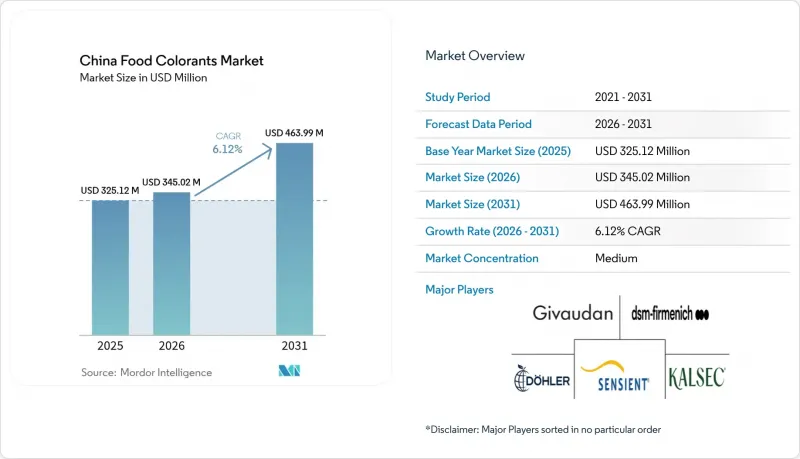
This report is Segmented by Product Type (Natural Color and Synthetic Color), by Color (Blue, Green, Red, Yellow, and More), and by Application (Bakery and Confectionery, Dairy Products, Snacks and Cereals, Beverages, and Others ). The Market Forecasts are Provided in Terms of Value (USD).
China Food Colorants Market Trends and Insights
Growing demand for processed, convenience and ready-to-eat foods
The increasing consumption of processed, convenience, and ready-to-eat foods in China is a significant driver of the food colorants market. As urban lifestyles grow busier and dual-income households become more common, consumers are turning to packaged snacks, instant meals, chilled ready dishes, and ready-to-drink beverages. These products rely on colorants for flavor signaling and enhancing shelf appeal. Food manufacturers use colorants to standardize product appearance across large-scale production, mask natural ingredient variability, and ensure products appear fresh and appealing even after extended storage and distribution. The expansion of modern retail formats, convenience stores, and online grocery platforms further emphasizes the importance of visually appealing packaging and product colors, as many purchases are made quickly and impulsively. In this context, both synthetic and natural colorants are experiencing increased demand, while premium convenience products, such as better-for-you snacks and functional ready meals, are driving opportunities for clean-label, plant-based color solutions.
Increasing demand for organic and clean-label ingredients
The growing demand for organic and clean-label ingredients is a key driver of the China Food Colorants Market, as consumers increasingly focus on ingredient transparency and naturalness. Clean-label expectations are encouraging brands to replace synthetic dyes with colorants derived from fruits, vegetables, plants, and algae, which can be described in simple and recognizable terms. This trend is further supported by regulatory developments, such as China's new standard for plant-based coloring foods. This regulation classifies many natural colorants as food ingredients rather than additives, promoting transparent labeling practices. The broader green food movement highlights the scale of this preference. According to the China Green Food Development Center, sales of certified green food in China reached approximately CNY 609.78 billion in 2024, demonstrating consumers' willingness to invest in safer and more sustainable products . As food and beverage manufacturers adapt to these trends, the demand for natural and organic color solutions continues to rise, benefiting suppliers of clean-label food colorants.
High cost of natural colorants
The high cost of natural colorants serves as a significant restraint on the China Food Colorants Market. Plant-based pigments, such as anthocyanins, carotenoids, and spirulina extracts, require more complex cultivation, extraction, and purification processes compared to synthetic dyes, leading to higher production costs. Additionally, natural colorants often exhibit lower tinting strength and narrower stability ranges, necessitating higher dosages or advanced formulation technologies to achieve comparable visual effects. These factors result in natural colorants being more expensive per functional unit in many applications, particularly in cost-sensitive mass-market products. Consequently, some food and beverage manufacturers in China are hesitant to fully transition from synthetic to natural alternatives, which slows the adoption of clean-label products despite strong consumer demand and regulatory support.
Other drivers and restraints analyzed in the detailed report include:
- Growth in dairy, and meat/seafood applications for aesthetic appeal.
- Regulatory tailwinds expanding natural color approvals
- Limited color palette / shade range with natural colorants
For complete list of drivers and restraints, kindly check the Table Of Contents.
Segment Analysis
Synthetic colorants hold the largest share of the China Food Colorants Market, driven by their long-standing use, cost-effectiveness, and technical stability across diverse applications. In 2025, these products accounted for 56.03% of the market, reflecting their significant presence in high-volume segments such as beverages, snacks, and confectionery. Their strong tinting strength and lower dosage requirements remain attractive to manufacturers aiming to optimize formulation costs. Additionally, established production infrastructure and robust supply chains further support their dominant position. However, this leadership is increasingly under pressure due to heightened regulatory scrutiny and growing concerns about consumer health. Consequently, while synthetic colors are expected to remain important in the short term, their market share is anticipated to decline as natural alternatives gradually gain traction.
Natural colors represent the fastest-growing segment in the China Food Colorants Market, with a projected CAGR of approximately 8.52% between 2026 and 2031. This growth is fueled by rising demand for clean-label, plant-based, and minimally processed ingredients, particularly in beverages, dairy, and confectionery. Regulatory initiatives, such as China's emphasis on plant-based coloring foods, are accelerating adoption by clarifying standards and encouraging reformulation away from synthetic options. Simultaneously, advancements in extraction and stabilization technologies are enhancing the performance and shelf life of natural pigments, making them more viable for challenging applications. As these solutions become increasingly competitive in terms of cost and functionality, they are progressively eroding the market share of synthetic colorants.
Complete Report Scope:
- By Product Type
- Natural Color
- Anthocyanins
- Carotenoids
- Curcumin
- Carmine
- Spirulina
- Other Types
- Synthetic Color
- Natural Color
- By Color
- Blue
- Green
- Red
- Yellow
- Purple
- Orange
- Pink
- Others
- By Application
- Bakery and Confectionery
- Dairy Products
- Snacks and Cereals
- Beverages
- Others
List of Companies Covered in this Report:
- Givaudan S.A.
- DSM-Firmenich AG
- Sensient Technologies Corporation
- Dohler GmbH
- Kalsec Inc.
- Chr. Hansen Holding A/S
- International Flavors & Fragrances Inc
- Zhejiang Weile Biotechnology Co., Ltd.
- Yunnan Rainbow Biotech Co., Ltd.
- Chenguang Biotech Group Co., Ltd.
- Zhejiang Binmei Biotechnology Co., Ltd.
- Dongzhixing Biotech Co., Ltd.
- Zhongda Hengyuan Biotechnology
- Archer Daniels Midland Co.
- BASF SE
- San-Ei Gen F.F.I., Inc.
- GNT Group B.V.
- King Dnarmsa Spirulina Co., Ltd.
- Jeco Group
- Cathay Industries
Additional Benefits:
- The market estimate (ME) sheet in Excel format
- 3 months of analyst support
TABLE OF CONTENTS
1 INTRODUCTION
- 1.1 Study Assumptions and Market Definition
- 1.2 Scope of the Study
2 RESEARCH METHODOLOGY
3 EXECUTIVE SUMMARY
4 MARKET LANDSCAPE
- 4.1 Market Overview
- 4.2 Market Drivers
- 4.2.1 Growing demand for processed, convenience and ready-to-eat foods
- 4.2.2 Increasing demand for organic and clean-label ingredients
- 4.2.3 Growth in dairy, and meat/seafood applications for aesthetic appeal.
- 4.2.4 Regulatory tailwinds expanding natural color approvals
- 4.2.5 Rising popularity of vegan and plant-based products
- 4.2.6 Technological advancements in colorant extraction
- 4.3 Market Restraints
- 4.3.1 High cost of natural colorants
- 4.3.2 Limited color palette / shade range with natural colorants
- 4.3.3 Climate-driven crop supply volatility
- 4.3.4 Limited innovation pace in synthetic colorants
- 4.4 Supply Chain Analysis
- 4.5 Regulatory Landscape
- 4.6 Technological Outlook
- 4.7 Porter's Five Forces Analysis
- 4.7.1 Threat of New Entrants
- 4.7.2 Bargaining Power of Buyers
- 4.7.3 Bargaining Power of Suppliers
- 4.7.4 Threat of Substitutes
- 4.7.5 Intensity of Competitive Rivalry
5 MARKET SIZE AND GROWTH FORECASTS (VALUE)
- 5.1 By Product Type
- 5.1.1 Natural Color
- 5.1.1.1 Anthocyanins
- 5.1.1.2 Carotenoids
- 5.1.1.3 Curcumin
- 5.1.1.4 Carmine
- 5.1.1.5 Spirulina
- 5.1.1.6 Other Types
- 5.1.2 Synthetic Color
- 5.1.1 Natural Color
- 5.2 By Color
- 5.2.1 Blue
- 5.2.2 Green
- 5.2.3 Red
- 5.2.4 Yellow
- 5.2.5 Purple
- 5.2.6 Orange
- 5.2.7 Pink
- 5.2.8 Others
- 5.3 By Application
- 5.3.1 Bakery and Confectionery
- 5.3.2 Dairy Products
- 5.3.3 Snacks and Cereals
- 5.3.4 Beverages
- 5.3.5 Others
6 COMPETITIVE LANDSCAPE
- 6.1 Market Concentration
- 6.2 Strategic Moves
- 6.3 Market Positioning Analysis
- 6.4 Company Profiles (includes Global level Overview, Market level overview, Core Segments, Financials as available, Strategic Information, Market Rank/Share for key companies, Products and Services, and Recent Developments)
- 6.4.1 Givaudan S.A.
- 6.4.2 DSM-Firmenich AG
- 6.4.3 Sensient Technologies Corporation
- 6.4.4 Dohler GmbH
- 6.4.5 Kalsec Inc.
- 6.4.6 Chr. Hansen Holding A/S
- 6.4.7 International Flavors & Fragrances Inc
- 6.4.8 Zhejiang Weile Biotechnology Co., Ltd.
- 6.4.9 Yunnan Rainbow Biotech Co., Ltd.
- 6.4.10 Chenguang Biotech Group Co., Ltd.
- 6.4.11 Zhejiang Binmei Biotechnology Co., Ltd.
- 6.4.12 Dongzhixing Biotech Co., Ltd.
- 6.4.13 Zhongda Hengyuan Biotechnology
- 6.4.14 Archer Daniels Midland Co.
- 6.4.15 BASF SE
- 6.4.16 San-Ei Gen F.F.I., Inc.
- 6.4.17 GNT Group B.V.
- 6.4.18 King Dnarmsa Spirulina Co., Ltd.
- 6.4.19 Jeco Group
- 6.4.20 Cathay Industries
7 MARKET OPPORTUNITIES AND FUTURE OUTLOOK

