PUBLISHER: Mordor Intelligence | PRODUCT CODE: 2122017

PUBLISHER: Mordor Intelligence | PRODUCT CODE: 2122017
United States Food Colorants - Market Share Analysis, Industry Trends & Statistics, Growth Forecasts (2026 - 2031)
According to Mordor Intelligence, the United States food colorants market size is projected to be USD 1.82 billion in 2025, USD 1.9 billion in 2026, and reach USD 2.45 billion by 2031, growing at a CAGR of 5.22% from 2026 to 2031.Strong retail demand for clean-label products, retailer reformulation requirements, and regulatory clarity regarding plant-derived pigments are driving growth in the United States food colorant market.
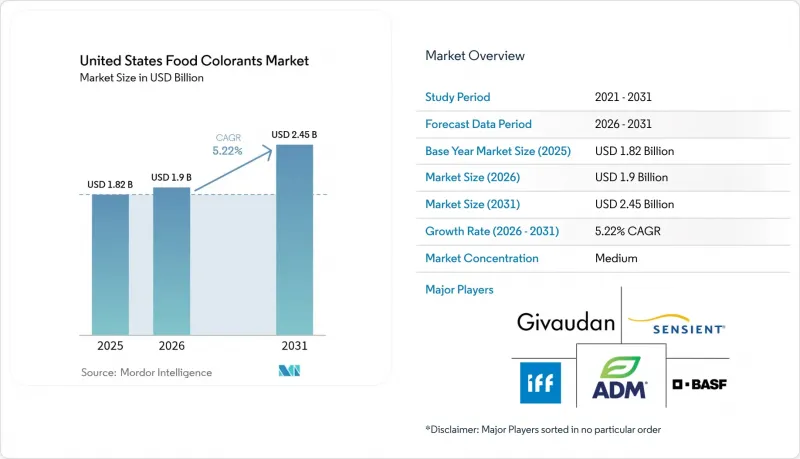
This report is Segmented by Product Type (Natural Color, and Synthetic Color), Form (Powder and Liquid), Color (Blue, Red, Green, Yellow, and Others), and Application (Bakery and Confectionery, Dairy-Based Products, Beverages, Nutraceuticals, Snacks and Cereals, and Others). The Market Forecasts are Provided in Terms of Value (USD) and Volume (Tons).
United States Food Colorants Market Trends and Insights
Rising preference for clean-label and "no artificial colors" claims
Consumer demand for transparency has significantly impacted product offerings in grocery aisles. A recent survey revealed that many shoppers in the United States actively avoid artificial colorants when choosing packaged foods. This trend is particularly prominent among millennial and Generation Z households, who carefully review ingredient labels and favor brands utilizing plant-based sources such as beet juice, turmeric, and spirulina. In response, retailers have allocated more shelf space to clean-label stock-keeping units (SKUs), and major private-label programs now mandate natural colorants for new product development. As a result, synthetic alternatives have been largely excluded from high-demand categories like yogurt, granola bars, and refrigerated dips. Economically, this shift demonstrates a willingness to accept higher ingredient costs to achieve premium positioning and address reformulation risks as regulatory standards tighten. Smaller brands are leveraging this trend by using "no artificial colors" claims to compete with established players, securing distribution in natural-channel retailers and e-commerce platforms where such claims enhance click-through rates and drive repeat purchases. According to the International Food Information Council, in 2024, 26% of respondents in the United States identified "Natural" as the best definition of healthy food, while "NON-GMO" accounted for 14% .
Loosening or clarification of "no artificial color" labeling rules for naturally derived colorants
The United States Food and Drug Administration (FDA) issued updated guidance clarifying that colorants derived from fermentation processes using genetically modified microorganisms may qualify as "natural," provided the final product contains no recombinant DNA and the production method resembles traditional fermentation . This regulatory clarification has encouraged investment in precision-fermentation platforms, with several major suppliers announcing pilot-scale production of beta-carotene, lycopene, and anthocyanins. The guidance resolves a long-standing ambiguity that had deterred food manufacturers from adopting fermentation-derived pigments due to concerns over consumer backlash or regulatory challenges. It also creates a level playing field for suppliers who had invested in fermentation technology but lacked the regulatory certainty to commercialize at scale. The framework established by the Food and Drug Administration for evaluating "naturalness" now prioritizes source material and processing methods over molecular structure. This allows botanical extracts processed with enzymes or supercritical carbon dioxide to carry "no artificial color" claims, even when the extraction yield or purity exceeds that of traditional solvent methods. This change is speeding up reformulation timelines, as brands that were previously hesitant to move away from synthetic options now have access to a wider range of compliant, high-performance natural alternatives.
Stringent FDA regulations and evolving guidance
The United States Food and Drug Administration's Color Additive Petition process requires manufacturers to provide detailed safety data, stability studies, and manufacturing protocols before approving a new natural colorant for food use. This process can take several years and involves significant costs per petition. Such regulatory requirements place a heavier burden on smaller suppliers and novel pigment sources, such as algae-derived astaxanthin or fruit-derived betalains, which lack the long history of safe use that simplifies approval for established colorants like annatto or carotene. The 2025 guidance from the United States Food and Drug Administration on fermentation-derived colorants, while clarifying certain approval pathways, introduced new labeling requirements. These include the disclosure of the microbial host organism and fermentation substrate, raising transparency concerns among brands cautious of consumer skepticism toward biotechnology. Additionally, evolving state-level regulations add further complexity. For example, California's Proposition 65 requires warning labels for colorants containing trace levels of heavy metals or other compounds, even when these levels are far below the safety thresholds set by the United States Food and Drug Administration. This creates a fragmented compliance landscape, increasing formulation and documentation costs. These regulatory challenges slow innovation cycles and discourage investment in novel colorant platforms, particularly for applications with narrow profit margins or uncertain market acceptance.
Other drivers and restraints analyzed in the detailed report include:
- Growth of plant-based, vegan, and allergen-free food formats
- Strong growth of highly processed and convenience-food categories
- Technical challenges in matching brand-iconic synthetic hues
For complete list of drivers and restraints, kindly check the Table Of Contents.
Segment Analysis
Natural colorants accounted for 77.50% of the market share in 2025 and are projected to grow at a compound annual growth rate (CAGR) of 5.81% through 2031. This growth is driven by retailer requirements and consumer concerns regarding synthetic additives. Synthetic colorants, while still utilized in cost-sensitive applications such as hard candy and powdered drink mixes, are experiencing a decline in market share as brands reformulate products in anticipation of potential regulatory restrictions. The United States Food and Drug Administration's 2025 clarification that certain fermentation-derived pigments qualify as "natural" has blurred traditional distinctions, allowing suppliers to develop high-intensity, stable colorants that meet clean-label requirements without compromising performance. This regulatory change has spurred increased investment in precision-fermentation platforms, with at least two major suppliers initiating pilot-scale production of beta-carotene and lycopene in 2025.
Synthetic colorants continue to offer advantages in applications requiring extreme pH stability, high-temperature processing, or vivid neon hues that cannot be achieved with plant-based extracts, such as specific sports drinks and novelty confections. However, their use is increasingly limited to export-oriented products or private-label stock-keeping units (SKUs) targeting cost-conscious consumers. The cost disparity between natural and synthetic colorants has decreased from 300% in 2020 to approximately 150% in 2025, driven by advancements in extraction efficiency and economies of scale in botanical sourcing.
Liquid colorants accounted for 55.01% of the market share in 2025, primarily due to their ease of dispersion in aqueous systems such as beverages, sauces, and dairy products, where uniformity and rapid solubility are essential. Beverage manufacturers, in particular, favor liquid formats as they integrate efficiently into continuous-flow production lines and eliminate the dust-handling challenges associated with powders. However, powder colorants are projected to grow at a Compound Annual Growth Rate (CAGR) of 7.92% through 2031, driven by their longer shelf life, lower transportation costs, and suitability for dry-mix applications, including baking mixes, seasoning blends, and instant beverage powders. A kilogram of powder colorant can replace 3 to 5 kilograms of liquid concentrate, reducing packaging waste and logistics costs, which is an important factor for sustainability-focused procurement teams.
Encapsulation technologies are improving the performance of powder colorants by protecting pigments from oxidation and moisture absorption, thereby extending shelf life from 12 months to 24 months under ambient conditions. Spray-drying and freeze-drying are the predominant encapsulation methods, with freeze-drying preserving more of the original pigment intensity but incurring costs that are 40% to 60% higher.
Complete Report Scope:
- By Product Type
- Natural Color
- Synthetic Color
- By Form
- Powder
- Liquid
- By Color
- Blue
- Red
- Green
- Yellow
- Others
- By Application
- Bakery
- Confectionary
- Dairy-based Products
- Meat and Seafood
- Beverage
- Alcoholic Beverages
- Non-Alcoholic Beverages
- Dietary Supplement
- Snacks and Cereals
- Others
List of Companies Covered in this Report:
- Sensient Technologies Corporation
- BASF SE
- International Flavors & Fragrances Inc.
- Archer Daniels Midland Company
- Givaudan S.A.
- Dohler Group SE
- Oterra A/S
- DSM-Firmenich AG
- Kalsec Inc.
- GNT Group B.V.
- San-Ei Gen F.F.I., Inc.
- IFC Solutions Inc.
- Flavorchem Corporation
- Proquimac Color, S.L.
- Syngenta Group Co., Ltd.
- Biocon Colors
- Nactarome S.P.A.
- ROHA Dyechem Pvt. Ltd.
- Mane Kancor Ingredients
- ColorKitchen, Inc.
Additional Benefits:
- The market estimate (ME) sheet in Excel format
- 3 months of analyst support
TABLE OF CONTENTS
1 INTRODUCTION
- 1.1 Study Assumptions and Market Definition
- 1.2 Scope of the Study
2 RESEARCH METHODOLOGY
3 EXECUTIVE SUMMARY
4 MARKET LANDSCAPE
- 4.1 Market Overview
- 4.2 Market Drivers
- 4.2.1 Rising preference for clean-label and "no artificial colors" claims
- 4.2.2 Loosening / clarification of "no artificial color" labeling rules for naturally derived colorants
- 4.2.3 Growth of plant-based, vegan, and allergen-free food formats
- 4.2.4 Strong growth of highly processed and convenience-food categories
- 4.2.5 Demand from the beverage industry for stable, vivid hues
- 4.2.6 Advancements in extraction and formulation technologies improving yield and color intensity
- 4.3 Market Restraints
- 4.3.1 Stringent FDA regulations and evolving guidance
- 4.3.2 Technical challenges in matching brand-iconic synthetic hues
- 4.3.3 Sourcing-related sustainability and biodiversity concerns
- 4.3.4 Supply-chain fragmentation and multi-tier sourcing for some niche botanicals
- 4.4 Value Chain Analysis
- 4.5 Regulatory Outlook
- 4.6 Porter's Five Forces
- 4.6.1 Threat of New Entrants
- 4.6.2 Bargaining Power of Buyers
- 4.6.3 Bargaining Power of Suppliers
- 4.6.4 Threat of Substitute Products
- 4.6.5 Intensity of Competitive Rivalry
5 MARKET SIZE AND GROWTH FORECASTS (VALUE AND VOLUME)
- 5.1 By Product Type
- 5.1.1 Natural Color
- 5.1.2 Synthetic Color
- 5.2 By Form
- 5.2.1 Powder
- 5.2.2 Liquid
- 5.3 By Color
- 5.3.1 Blue
- 5.3.2 Red
- 5.3.3 Green
- 5.3.4 Yellow
- 5.3.5 Others
- 5.4 By Application
- 5.4.1 Bakery
- 5.4.2 Confectionary
- 5.4.3 Dairy-based Products
- 5.4.4 Meat and Seafood
- 5.4.5 Beverage
- 5.4.5.1 Alcoholic Beverages
- 5.4.5.2 Non-Alcoholic Beverages
- 5.4.6 Dietary Supplement
- 5.4.7 Snacks and Cereals
- 5.4.8 Others
6 COMPETITIVE LANDSCAPE
- 6.1 Market Concentration
- 6.2 Strategic Moves
- 6.3 Market Ranking Analysis
- 6.4 Company Profiles (includes Global-level Overview, Market-level Overview, Core Segments, Financials (if available), Strategic Information, Market Rank/Share, Products and Services, Recent Developments)
- 6.4.1 Sensient Technologies Corporation
- 6.4.2 BASF SE
- 6.4.3 International Flavors & Fragrances Inc.
- 6.4.4 Archer Daniels Midland Company
- 6.4.5 Givaudan S.A.
- 6.4.6 Dohler Group SE
- 6.4.7 Oterra A/S
- 6.4.8 DSM-Firmenich AG
- 6.4.9 Kalsec Inc.
- 6.4.10 GNT Group B.V.
- 6.4.11 San-Ei Gen F.F.I., Inc.
- 6.4.12 IFC Solutions Inc.
- 6.4.13 Flavorchem Corporation
- 6.4.14 Proquimac Color, S.L.
- 6.4.15 Syngenta Group Co., Ltd.
- 6.4.16 Biocon Colors
- 6.4.17 Nactarome S.P.A.
- 6.4.18 ROHA Dyechem Pvt. Ltd.
- 6.4.19 Mane Kancor Ingredients
- 6.4.20 ColorKitchen, Inc.
7 MARKET OPPORTUNITIES AND FUTURE OUTLOOK

