PUBLISHER: Mordor Intelligence | PRODUCT CODE: 2113908

PUBLISHER: Mordor Intelligence | PRODUCT CODE: 2113908
Vacuum Pump - Market Share Analysis, Industry Trends & Statistics, Growth Forecasts (2026 - 2031)
According to Mordor Intelligence, the vacuum pump market size is expected to grow from USD 7.49 billion in 2025 to USD 8.07 billion in 2026 and is forecast to reach USD 11.23 billion by 2031 at 6.83% CAGR over 2026-2031.
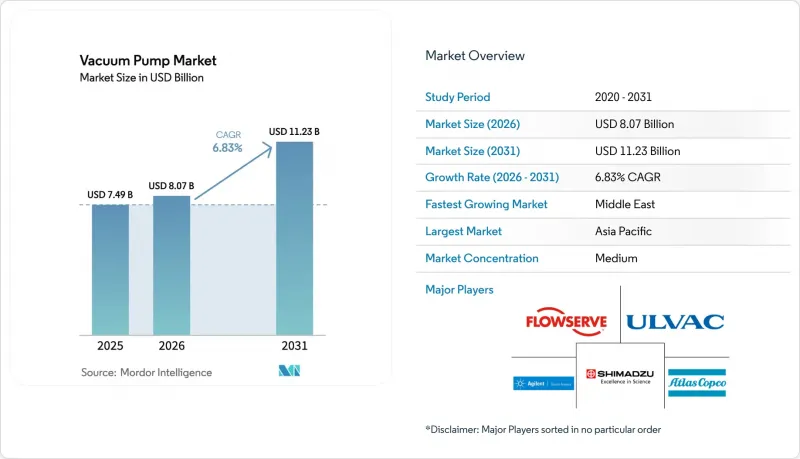
This report is Segmented by Pump Principle (Mechanical, and Entrapment), Lubrication (Dry Vacuum Pumps, and Oil-Sealed / Wet Vacuum Pumps), Vacuum Level (Rough and Low, Medium, High, Ultra-High / Extreme), End-User Industry (Chemical Processing, Food and Beverage, Power Generation, Battery Manufacturing, Wood Paper and Pulp, and More), and Geography. The Market Forecasts are Provided in Terms of Value (USD).
Global Vacuum Pump Market Trends and Insights
Semiconductor-Grade Vacuum in EUV Lithography
EUV scanners run below 10-6 pascal to prevent 13.5-nanometer photons from scattering, driving a step change in turbomolecular and cryogenic specifications. ASML's Twinscan NXE platforms integrate multistage turbomolecular arrays that evacuate 1 m3 chambers in under 30 minutes. Fab expansion in Arizona, Texas, and Ohio collectively exceeds USD 200 billion, each site requiring 40-60 pumps per EUV tool and 200-300 pumps elsewhere in the fab. Transition from 7-nm to 3-nm nodes increases the etch and deposition steps by almost 30%, boosting pump content per wafer start. Refurbishment contracts for the installed base present an attractive aftermarket annuity as operators demand sub-10-nm particulate control.
Accelerated LNG Capacity Additions Post-2025
Global LNG liquefaction capacity is poised to climb 45% between 2024 and 2030, adding nearly 250 million tonnes per annum in Qatar, the U.S. Gulf Coast, and Australia. Each train employs 10-15 large rotary vane or liquid-ring pumps rated at 500-2,000 kW for dehydration, mercury removal, and refrigerant seal gas. Qatar Energy's North Field projects alone represent vacuum equipment contracts over USD 100 million. Stricter International Maritime Organization carbon-intensity rules are accelerating the deployment of floating storage and regasification units, each of which adds 6-8 ballast and cargo containment pumps.
Volatile Rare-Earth Prices (NdFeB Motors)
Neodymium-iron-boron magnets power about three-quarters of turbomolecular pumps, yet neodymium oxide climbed from USD 68 kg-1 in January 2024 to USD 94 kg-1 by December 2025 after China tightened export quotas. Resulting material cost inflation added USD 800-1,200 per high-end pump, eroding gross margins where multi-year OEM supply deals cap price pass-through. Alternatives such as ferrite or switched-reluctance drives sacrifice 15-20% energy efficiency and enlarge motor housings by up to 40%, complicating installation in compact semiconductor tools.
Other drivers and restraints analyzed in the detailed report include:
- Rapid Uptake of Industry 4.0 Smart Pumps
- Growth of Global Biologics Fill-Finish Lines
- Stricter PFAS Lubricant Regulations
For complete list of drivers and restraints, kindly check the Table Of Contents.
Segment Analysis
Mechanical pumps generated 55.74% of the vacuum pump market in 2025, dominated by rotary vane, screw, claw, and roots designs used in food, wood, and LNG processing. Entrapment solutions, cryogenic, getter, and ion pumps account for a smaller base but are forecast to grow at a 7.29% CAGR. The shift stems from quantum-computing dilution refrigerators and fusion-energy tokamaks that demand vibration-free operation below 10-8 pascal. ULVAC's LS Series integrates cryogenic stages into screw housings, eliminating electromagnetic interference while delivering base pressures an order of magnitude lower than those of mechanical peers. Meanwhile, the United Kingdom's Industrial Fusion Solutions awarded a GBP 225,000 contract for a compound cryogenic prototype in 2025, highlighting nascent demand in the fusion sector.
Entrapment adoption is tempered by higher acquisition costs and specialized maintenance skills, yet total ownership savings accrue through oil-free operation, zero backstreaming, and extended mean time between service intervals. As extreme ultraviolet lithography migrates toward gate-all-around transistors, getter pumping arrays increasingly supplement turbomolecular forelines to achieve hydrocarbon-free vacuums. Mechanical suppliers respond with hybrid screw-plus-cryopanel offerings, but the complexity of component integration inflates procurement lead times.
Dry pumps accounted for 64.89% of revenue in 2025 and are projected to maintain a 7.23% CAGR through 2031. The transition is propelled by PFAS restrictions and cleanroom mandates that cap hydrocarbon backstreaming at 10-9 torr-liters s-1 under SEMI S2 guidelines. Edwards Vacuum's CHIPS-Act-funded New York plant aims to deliver domestically semiconductor-grade dry screw units within 4 weeks, compared with 12-16 weeks for Asian imports. Agilent's IDP-45 and Ebara's EV-X launches further underscore the suppliers' focus on oil-free technologies tuned for corrosive etch chemistries and low-noise laboratory settings.
Oil-sealed variants retain footholds in chemical distillation, power, and legacy pharma lines where capital budgets or corrosive gas loads complicate the adoption of dry systems. Yet even conservative operators are reevaluating lifecycle economics as waste-oil disposal fees, lubricant compliance audits, and unexpected maintenance stoppages surface in total cost models. The vacuum pump market size for dry architectures is therefore set to expand faster than that of oil-sealed peers, despite a 40-60% upfront premium.
Complete Report Scope:
- By Pump Principle
- Mechanical
- Rotary
- Reciprocating
- Kinetic
- Dynamic
- Entrapment
- Cryogenic
- Getter
- Ion
- Mechanical
- By Lubrication
- Dry Vacuum Pumps
- Oil-Sealed / Wet Vacuum Pumps
- By Vacuum Level
- Rough / Low
- Medium
- High
- Ultra-High / Extreme
- By End-User Industry
- Oil and Gas
- Semiconductor and Electronics
- Pharmaceutical and Biotechnology
- Chemical Processing
- Food and Beverage
- Power Generation
- Battery Manufacturing
- Wood, Paper and Pulp
- Other End-User Industries
- By Geography
- North America
- United States
- Canada
- Mexico
- Europe
- Germany
- United Kingdom
- France
- Russia
- Rest of Europe
- Asia-Pacific
- China
- Japan
- India
- South Korea
- Australia
- Rest of Asia-Pacific
- Middle East and Africa
- Middle East
- Saudi Arabia
- United Arab Emirates
- Rest of Middle East
- Africa
- South Africa
- Egypt
- Rest of Africa
- Middle East
- South America
- Brazil
- Argentina
- Rest of South America
- North America
Geography Analysis
Asia Pacific accounted for 39.72% of global revenue in 2025, making it the region with the largest vacuum pump market share. This leadership reflects China's drive to localize equipment, South Korea's expansion of memory chip production, and Japan's entrenched supplier base. Domestic makers such as Wintek and Kashiyama are winning orders in mature-node semiconductor and photovoltaic lines as United States export controls restrict the import of advanced tools. Samsung and SK Hynix together accounted for one-fifth of regional demand by adding pumps for high-bandwidth memory and 3D NAND stacks with more than 200 layers. Ebara's second overhaul plant in South Korea further strengthens local service capacity.
The Middle East is the fastest-growing region, with a forecast CAGR of 7.89% through 2031. Qatar Energy's North Field East and South projects each deploy up to 15 large rotary vane or liquid-ring units, driving contracts worth more than USD 100 million. Saudi Arabia's Vision 2030 petrochemical build-out and the United Arab Emirates' hydrogen programs add demand for hydrogen-compatible turbomolecular pumps. Announced LNG, petrochemical, and desalination investments across the region exceed USD 300 billion, a pipeline expected to double the vacuum pump market size there over the forecast window. Rising adoption of predictive-maintenance platforms should also broaden aftermarket revenue streams.
North America generated about 11% of 2025 global sales, and this share will climb as Edwards Vacuum's Genesee County plant and Intel's USD 100 billion Ohio complex reach volume, cutting lead times to four weeks and meeting CHIPS Act domestic content rules. Europe, holding roughly 3%, should see incremental gains from battery gigafactories and REPowerEU electrolyzer lines that need high-vacuum drying and leak-testing systems. South America and Africa together account for a mid-single-digit share, with Brazil's pulp sector and South Africa's petrochemical plants anchoring orders while mining and infrastructure projects create additional opportunities.
- Atlas Copco AB
- Ingersoll Rand
- Busch Vacuum Solutions
- Pfeiffer Vacuum
- ULVAC Inc.
- Flowserve Corporation
- Agilent Technologies
- Leybold GmbH
- Ebara Corporation
- Shimadzu Corporation
- Gardner Denver Holdings, Inc.
- Osaka Vacuum, Ltd.
- Kashiyama Industries
- Becker Pumps
- Graham Corporation
- Wintek Corporation
- Tsurumi Mfg.
- Shinko Seiki Co., Ltd.
- Leyco Vacuum
Additional Benefits:
- The market estimate (ME) sheet in Excel format
- 3 months of analyst support
TABLE OF CONTENTS
1 INTRODUCTION
- 1.1 Study Assumptions and Market Definition
- 1.2 Scope of the Study
2 RESEARCH METHODOLOGY
3 EXECUTIVE SUMMARY
4 MARKET LANDSCAPE
- 4.1 Market Overview
- 4.2 Market Drivers
- 4.2.1 Semiconductor-Grade Vacuum in EUV Lithography
- 4.2.2 Accelerated LNG Capacity Additions Post-2025
- 4.2.3 Rapid Uptake of Industry 4.0 Smart Pumps
- 4.2.4 Growth of Global Biologics Fill-Finish Lines
- 4.2.5 Battery-Grade Graphite Anode Production Boom
- 4.2.6 Green-Hydrogen Electrolyzer Build-Out
- 4.3 Market Restraints
- 4.3.1 Volatile Rare-Earth Prices (NdFeB Motors)
- 4.3.2 Stricter PFAS Lubricant Regulations
- 4.3.3 High TCO in Ultra-High-Vacuum Ranges
- 4.3.4 Skilled-Labor Shortage for Pump Servicing
- 4.4 Industry Value Chain Analysis
- 4.5 Regulatory Landscape
- 4.6 Technological Outlook
- 4.7 Impact of Macroeconomic Factors on the Market
- 4.8 Porter's Five Forces Analysis
- 4.8.1 Bargaining Power of Suppliers
- 4.8.2 Bargaining Power of Buyers
- 4.8.3 Threat of New Entrants
- 4.8.4 Threat of Substitutes
- 4.8.5 Intensity of Competitive Rivalry
5 MARKET SIZE AND GROWTH FORECASTS (VALUE)
- 5.1 By Pump Principle
- 5.1.1 Mechanical
- 5.1.1.1 Rotary
- 5.1.1.2 Reciprocating
- 5.1.1.3 Kinetic
- 5.1.1.4 Dynamic
- 5.1.2 Entrapment
- 5.1.2.1 Cryogenic
- 5.1.2.2 Getter
- 5.1.2.3 Ion
- 5.1.1 Mechanical
- 5.2 By Lubrication
- 5.2.1 Dry Vacuum Pumps
- 5.2.2 Oil-Sealed / Wet Vacuum Pumps
- 5.3 By Vacuum Level
- 5.3.1 Rough / Low
- 5.3.2 Medium
- 5.3.3 High
- 5.3.4 Ultra-High / Extreme
- 5.4 By End-User Industry
- 5.4.1 Oil and Gas
- 5.4.2 Semiconductor and Electronics
- 5.4.3 Pharmaceutical and Biotechnology
- 5.4.4 Chemical Processing
- 5.4.5 Food and Beverage
- 5.4.6 Power Generation
- 5.4.7 Battery Manufacturing
- 5.4.8 Wood, Paper and Pulp
- 5.4.9 Other End-User Industries
- 5.5 By Geography
- 5.5.1 North America
- 5.5.1.1 United States
- 5.5.1.2 Canada
- 5.5.1.3 Mexico
- 5.5.2 Europe
- 5.5.2.1 Germany
- 5.5.2.2 United Kingdom
- 5.5.2.3 France
- 5.5.2.4 Russia
- 5.5.2.5 Rest of Europe
- 5.5.3 Asia-Pacific
- 5.5.3.1 China
- 5.5.3.2 Japan
- 5.5.3.3 India
- 5.5.3.4 South Korea
- 5.5.3.5 Australia
- 5.5.3.6 Rest of Asia-Pacific
- 5.5.4 Middle East and Africa
- 5.5.4.1 Middle East
- 5.5.4.1.1 Saudi Arabia
- 5.5.4.1.2 United Arab Emirates
- 5.5.4.1.3 Rest of Middle East
- 5.5.4.2 Africa
- 5.5.4.2.1 South Africa
- 5.5.4.2.2 Egypt
- 5.5.4.2.3 Rest of Africa
- 5.5.4.1 Middle East
- 5.5.5 South America
- 5.5.5.1 Brazil
- 5.5.5.2 Argentina
- 5.5.5.3 Rest of South America
- 5.5.1 North America
6 COMPETITIVE LANDSCAPE
- 6.1 Market Concentration
- 6.2 Strategic Moves
- 6.3 Market Share Analysis
- 6.4 Company Profiles (includes Global Level Overview, Market Level Overview, Core Segments, Financials as Available, Strategic Information, Market Rank/Share for Key Companies, Products and Services, and Recent Developments)
- 6.4.1 Atlas Copco AB
- 6.4.2 Ingersoll Rand
- 6.4.3 Busch Vacuum Solutions
- 6.4.4 Pfeiffer Vacuum
- 6.4.5 ULVAC Inc.
- 6.4.6 Flowserve Corporation
- 6.4.7 Agilent Technologies
- 6.4.8 Leybold GmbH
- 6.4.9 Ebara Corporation
- 6.4.10 Shimadzu Corporation
- 6.4.11 Gardner Denver Holdings, Inc.
- 6.4.12 Osaka Vacuum, Ltd.
- 6.4.13 Kashiyama Industries
- 6.4.14 Becker Pumps
- 6.4.15 Graham Corporation
- 6.4.16 Wintek Corporation
- 6.4.17 Tsurumi Mfg.
- 6.4.18 Shinko Seiki Co., Ltd.
- 6.4.19 Leyco Vacuum
7 MARKET OPPORTUNITIES AND FUTURE OUTLOOK
- 7.1 White-Space and Unmet-Need Assessment

