PUBLISHER: Mordor Intelligence | PRODUCT CODE: 2116914

PUBLISHER: Mordor Intelligence | PRODUCT CODE: 2116914
Europe Vacuum Pump - Market Share Analysis, Industry Trends & Statistics, Growth Forecasts (2026 - 2031)
According to Mordor Intelligence, the europe vacuum pump market size was valued at USD 2.26 billion in 2025 and estimated to grow from USD 2.4 billion in 2026 to reach USD 3.22 billion by 2031, at a CAGR of 6.05% during the forecast period (2026-2031).
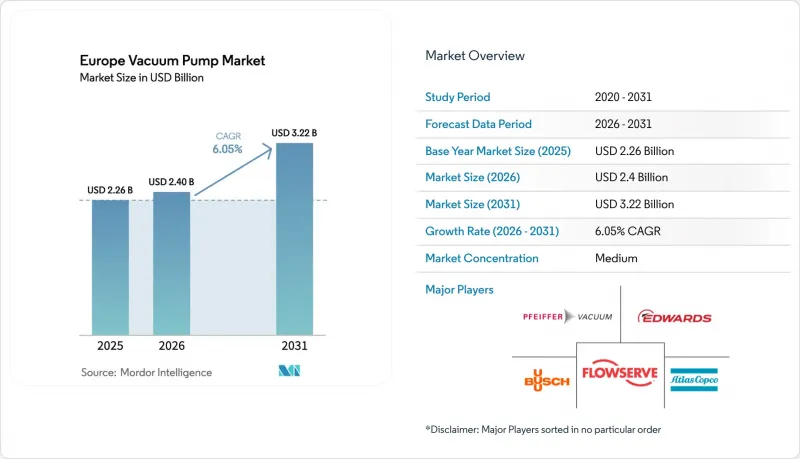
This report is Segmented by Pump Type (Rotary Vacuum Pumps, Reciprocating Vacuum Pumps, and More), Vacuum Level (Rough Vacuum (>=10-3 Mbar), Medium Vacuum (10-3 - 10-7 Mbar), High and Ultra-High Vacuum (<10-7 Mbar)), End-User Industry (Semiconductor and Electronics, Oil and Gas / Energy, and More), Drive/Lubrication (Oil-Sealed Pumps, Dry Pumps), and Country. The Market Forecasts are Provided in Terms of Value (USD).
Europe Vacuum Pump Market Trends and Insights
Surge in Semiconductor and MEMS Fab Expansions
Europe's push to secure 20% of global chip output drives unprecedented vacuum demand. GlobalFoundries is investing EUR 1.1 billion (USD 1.2 billion) to raise Dresden capacity to 1.5 million wafers annually, while Infineon's EUR 5 billion (USD 5.4 billion) Smart Power Fab comes online in 2026, each specifying 10-7 mbar base pressures for advanced nodes. New wide-band-gap lines such as Nexperia's SiC/GaN facility tighten particulate-control tolerances, lifting turbomolecular pump penetration. The Europe vacuum pump market therefore realigns around high-flow, contamination-free systems that bundle pumps with abatement and condition-monitoring modules.
Shift Toward Dry, Oil-Free Pumps in Clean Processes
EU Regulation 2024/573 phases out long-chain PFAS lubricants and imposes recovery mandates, accelerating the migration from oil-sealed to dry pumps. Dry screw, claw, and scroll technologies mitigate vapor contamination and lower disposal costs, a key selling point for pharmaceutical and food processors facing stricter hazard-analysis audits. OEMs such as Pfeiffer Vacuum respond with DuoVane oil-free rotary designs that retain familiar maintenance intervals while eliminating PFAS exposure risks. As compliance windows close, Europe vacuum pump market participants monetize retrofit services and predictive-maintenance subscriptions.
High CAPEX of Advanced Dry/Turbo Pumps
Turbomolecular pumps cost 3-5 times more than oil-sealed rotary units, reflecting magnetic-bearing and position-control complexity. PFAS-free seals add 15-25% to bill-of-materials, slowing adoption in SMEs with stretched payback horizons. Although semiconductors absorb these premiums, cost-sensitive packaging, plastics, and woodworking lines defer upgrades, limiting near-term penetration for high-end models in the Europe vacuum pump market.
Other drivers and restraints analyzed in the detailed report include:
- Pharma and Biotech Freeze-Drying Capacity Build-Out
- Hydrogen-Electrolyser Gigafactories Need High Vacuum
- Asian Import Price Pressure Squeezing Margins
For complete list of drivers and restraints, kindly check the Table Of Contents.
Segment Analysis
Rotary vane designs held 31.45% revenue in 2025, underpinning the largest slice of the Europe vacuum pump market. The familiar architecture serves packaging, material handling, and general industrial tasks where 10-1 to 10-3 mbar suffices. Yet turbomolecular units post a 7.42% CAGR through 2031 as fabs, quantum-computing labs, and surface-science tools impose ultra-high vacuum thresholds. Hybrid rotary-screw designs such as Pfeiffer's DuoVane promise oil-free operation while preserving port-to-port interchangeability, easing migration costs.
Within kinetic pumping, turbo, diffusion, and ejector technologies fill the <10-7 mbar niche, justifying premium price-points. Entrapment pumps-getter and cryo-extend the spectrum to 10-1° mbar for gravitational-wave observatories and cold-atom systems. As specialist requirements proliferate, the Europe vacuum pump market size for kinetic and entrapment categories is projected to outgrow rotary sales by value after 2030, even though volumetric shipments remain lower.
Rough-vacuum duties represented 45.30% revenue in 2025, anchored by food packaging and thermoforming lines. Medium vacuum applications-coatings, analytical instruments, legacy semiconductor steps-span 10-3 to 10-7 mbar and integrate roots-blowers or multistage dry screws as backing pumps. High and ultra-high segments, however, are growing at an 8.35% CAGR as advanced logic nodes, EUV lithography, and MBE systems scale.
Quantum-computing prototypes now specify continuous 10-1° mbar environments, necessitating bakeable chambers and low-outgassing pump materials. The Europe vacuum pump market size for ultra-high vacuum services thus expands alongside European Research Council programs, while high-vacuum growth parallels AI chip volumes at 12 nm and below. Process toolmakers respond by offering modular pump racks that cascade from fore-vacuum to turbo stages, compressing footprint and simplifying service.
Complete Report Scope:
- By Pump Type
- Rotary Vacuum Pumps
- Rotary Vane Pumps
- Screw and Claw Pumps
- Roots Pumps
- Reciprocating Vacuum Pumps
- Diaphragm Pumps
- Piston Pumps
- Kinetic Vacuum Pumps
- Ejector Pumps
- Turbomolecular Pumps
- Diffusion Pumps
- Dynamic Pumps
- Liquid Ring Pumps
- Side Channel Pumps
- Specialised / Entrapment Pumps
- Getter Pumps
- Cryogenic Pumps
- Rotary Vacuum Pumps
- By Vacuum Level
- Rough Vacuum (>=10-3 mbar)
- Medium Vacuum (10-3 - 10-7 mbar)
- High and Ultra-High Vacuum (<10-7 mbar)
- By End-user Industry
- Semiconductor and Electronics
- Oil and Gas / Energy
- Chemical and Petrochemical
- Pharmaceutical and Biotechnology
- Food and Beverage Packaging
- Power Generation
- Wood, Paper and Pulp
- Other Manufacturing (Automotive, Aerospace, etc.)
- By Drive / Lubrication
- Oil-Sealed Pumps
- Dry (Oil-free) Pumps
- Dry Scroll Pumps
- Dry Screw Pumps
- Dry Claw Pumps
- By Country
- Germany
- United Kingdom
- France
- Italy
- Spain
- Netherlands
- Russia
- Rest of Europe
List of Companies Covered in this Report:
- Atlas Copco AB
- Edwards Vacuum
- Flowserve Corporation
- Busch Group
- Pfeiffer Vacuum GmbH
- ULVAC Inc.
- Becker Pumps
- Tsurumi Manufacturing Co. Ltd
- Ingersoll Rand
- Gardner Denver
- Leybold GmbH
- Elmo Rietschle
- Ebara Corporation
- Kinney Vacuum
- Italvacuum
- Chart Industries (Cryogenic)
- Demaco (Cryogenic)
- Becker Pumps
- Oerlikon Leybold Vacuum
- Edwards Vacuum
Additional Benefits:
- The market estimate (ME) sheet in Excel format
- 3 months of analyst support
TABLE OF CONTENTS
1 INTRODUCTION
- 1.1 Study Assumptions and Market Definition
- 1.2 Scope of the Study
2 RESEARCH METHODOLOGY
3 EXECUTIVE SUMMARY
4 MARKET LANDSCAPE
- 4.1 Market Overview
- 4.2 Market Drivers
- 4.2.1 Surge in semiconductor and MEMS fab expansions
- 4.2.2 Shift toward dry, oil-free pumps in clean processes
- 4.2.3 Pharma and biotech freeze-drying capacity build-out
- 4.2.4 Hydrogen-electrolyser gigafactories need high vacuum
- 4.2.5 EU battery gigafactory scale-up ("Fit-for-55")
- 4.2.6 Quantum-computing labs requiring UHV chambers
- 4.3 Market Restraints
- 4.3.1 High CAPEX of advanced dry/turbo pumps
- 4.3.2 Asian import price pressure squeezing margins
- 4.3.3 Shortage of certified vacuum-systems technicians
- 4.3.4 PFAS lubricant regulations raising compliance cost
- 4.4 Value / Supply-Chain Analysis
- 4.5 Regulatory Landscape
- 4.6 Technological Outlook
- 4.7 Porter's Five Forces Analysis
- 4.7.1 Bargaining Power of Suppliers
- 4.7.2 Bargaining Power of Buyers
- 4.7.3 Threat of New Entrants
- 4.7.4 Threat of Substitutes
- 4.7.5 Intensity of Competitive Rivalry
5 MARKET SIZE AND GROWTH FORECASTS (VALUE)
- 5.1 By Pump Type
- 5.1.1 Rotary Vacuum Pumps
- 5.1.1.1 Rotary Vane Pumps
- 5.1.1.2 Screw and Claw Pumps
- 5.1.1.3 Roots Pumps
- 5.1.2 Reciprocating Vacuum Pumps
- 5.1.2.1 Diaphragm Pumps
- 5.1.2.2 Piston Pumps
- 5.1.3 Kinetic Vacuum Pumps
- 5.1.3.1 Ejector Pumps
- 5.1.3.2 Turbomolecular Pumps
- 5.1.3.3 Diffusion Pumps
- 5.1.4 Dynamic Pumps
- 5.1.4.1 Liquid Ring Pumps
- 5.1.4.2 Side Channel Pumps
- 5.1.5 Specialised / Entrapment Pumps
- 5.1.5.1 Getter Pumps
- 5.1.5.2 Cryogenic Pumps
- 5.1.1 Rotary Vacuum Pumps
- 5.2 By Vacuum Level
- 5.2.1 Rough Vacuum (>=10-3 mbar)
- 5.2.2 Medium Vacuum (10-3 - 10-7 mbar)
- 5.2.3 High and Ultra-High Vacuum (<10-7 mbar)
- 5.3 By End-user Industry
- 5.3.1 Semiconductor and Electronics
- 5.3.2 Oil and Gas / Energy
- 5.3.3 Chemical and Petrochemical
- 5.3.4 Pharmaceutical and Biotechnology
- 5.3.5 Food and Beverage Packaging
- 5.3.6 Power Generation
- 5.3.7 Wood, Paper and Pulp
- 5.3.8 Other Manufacturing (Automotive, Aerospace, etc.)
- 5.4 By Drive / Lubrication
- 5.4.1 Oil-Sealed Pumps
- 5.4.2 Dry (Oil-free) Pumps
- 5.4.2.1 Dry Scroll Pumps
- 5.4.2.2 Dry Screw Pumps
- 5.4.2.3 Dry Claw Pumps
- 5.5 By Country
- 5.5.1 Germany
- 5.5.2 United Kingdom
- 5.5.3 France
- 5.5.4 Italy
- 5.5.5 Spain
- 5.5.6 Netherlands
- 5.5.7 Russia
- 5.5.8 Rest of Europe
6 COMPETITIVE LANDSCAPE
- 6.1 Market Concentration
- 6.2 Strategic Moves
- 6.3 Market Share Analysis
- 6.4 Company Profiles (includes Global level Overview, Market level overview, Core Segments, Financials as available, Strategic Information, Market Rank/Share, Products and Services, Recent Developments)
- 6.4.1 Atlas Copco AB
- 6.4.2 Edwards Vacuum
- 6.4.3 Flowserve Corporation
- 6.4.4 Busch Group
- 6.4.5 Pfeiffer Vacuum GmbH
- 6.4.6 ULVAC Inc.
- 6.4.7 Becker Pumps
- 6.4.8 Tsurumi Manufacturing Co. Ltd
- 6.4.9 Ingersoll Rand
- 6.4.10 Gardner Denver
- 6.4.11 Leybold GmbH
- 6.4.12 Elmo Rietschle
- 6.4.13 Ebara Corporation
- 6.4.14 Kinney Vacuum
- 6.4.15 Italvacuum
- 6.4.16 Chart Industries (Cryogenic)
- 6.4.17 Demaco (Cryogenic)
- 6.4.18 Becker Pumps
- 6.4.19 Oerlikon Leybold Vacuum
- 6.4.20 Edwards Vacuum
7 MARKET OPPORTUNITIES AND FUTURE OUTLOOK
- 7.1 White-space and Unmet-need Assessment

